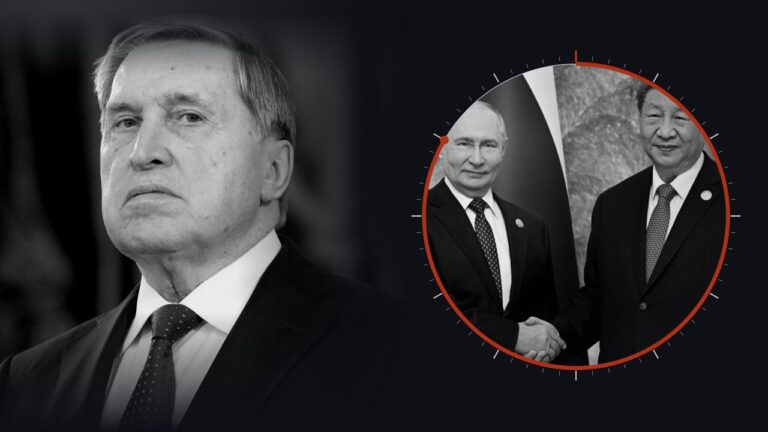

Yuri Ushakov, the Russian president’s foreign policy aide, declared on 12 November 2026 in Moscow, after Vladimir Putin’s talks with Donald Trump’s envoys, that one of the pillars of Europe’s new security architecture should be the return of NATO forces to their 1997 configuration. The Kremlin also announced further demands and wants to agree them “in tandem” with the Americans, while offering Europe the role of the party that will “support” this work.
In brief
- Ushakov named Russia’s three “key principles”: no NATO enlargement, no deployment near Russia’s borders of weapons Moscow considers threatening, and the return of Alliance forces to their state as of 27 May 1997.
- Sixteen states have joined NATO since that date, including Poland (1999). Russia’s 2021 draft agreement prohibited the deployment of other allies’ forces on their territory without Russia’s consent.
- The Kremlin made clear that the list is “not limited” to these points and declared its readiness for immediate talks on Europe’s security “in tandem” with US representatives.
- According to Ushakov, the Americans “actively supported” Russia’s proposal for a humanitarian operation in Kostiantynivka, a city still being fought over. For now this is only the Kremlin’s version.
- Putin and Trump are to discuss Ukraine at the APEC summit in Shenzhen on 18–19 November, where their first trilateral meeting with Xi Jinping is also planned.
Who Yuri Ushakov is and why his briefing carries the weight of an official statement
In the Polish media, Yuri Ushakov is usually described as Putin’s adviser. That is inaccurate. Since May 2012 he has been the aide to the President of the Russian Federation for foreign policy, and in the Kremlin hierarchy an aide (pomoshchnik) ranks above an adviser (sovetnik). He holds the highest diplomatic rank of ambassador extraordinary and plenipotentiary. For almost ten years from January 1999 he was Russia’s ambassador in Washington. Analysts quoted by The Moscow Times believe he has overtaken Sergei Lavrov in influence over foreign policy.
It is he who, after every important conversation of Putin’s, goes out to the journalists and announces what, in the Kremlin’s view, was agreed. This is the same Ushakov whom Steve Witkoff, according to a recording of a conversation published by Bloomberg, coached on how Putin should talk to Trump. On the evening of 12 November, after a meeting that lasted about two and a half hours, he gave an eight-and-a-half-minute statement to the press. Below are his most important remarks, transcribed verbatim from the recording and checked against the Reuters report, the piece by St Petersburg’s Fontanka and the Interfax report, together with my notes on them.
“Constructive and useful”. As always
“The conversation and exchange of views were very substantive, constructive, frank and useful. As, incidentally, were all the previous conversations.”
– Yuri Ushakov, aide to the Russian president, statement to the press, Moscow, 12 November 2026, from the recording and Fontanka’s report
Note the ending: all the previous conversations were useful too. 12 November was the 1,723rd day of the full-scale war, so the usefulness must lie in something other than ending it. The talks in Abu Dhabi, where peace in 24 hours was extended until further notice, were just as useful. Summing up the two and a half hours in the Kremlin, Ushakov listed three agreements: continuing the trilateral talks, a prisoner exchange and “concrete contacts” on Kostiantynivka. The rest of the statement was taken up by conditions.
“Our and the American assessments of these talks, these contacts, as constructive and productive coincide.”
– Yuri Ushakov on the Abu Dhabi talks, 12 November 2026, transcript of the recording
So on Abu Dhabi the Kremlin and the Americans are unanimous: it was productive. Let us recall what this productivity looked like. According to RBC-Ukraine’s sources, the Russian delegation there refused to discuss a ceasefire, territory, energy and security in the Black Sea. A few hours after Ushakov’s statement, Jared Kushner used the same adjective in Dublin.
What the Kremlin demanded: NATO in its 1997 configuration
“Key principles: no enlargement of the NATO bloc, no deployment near Russian borders of weapons systems that pose a threat to us, and the return of Alliance forces to the configuration that existed when the Russia–NATO Founding Act was signed.”
– Yuri Ushakov, 12 November 2026, from the recording and the Reuters report
Ushakov did not name the year. He did not need to. The NATO–Russia Founding Act was signed in Paris on 27 May 1997. Poland, the Czech Republic and Hungary joined the Alliance on 12 March 1999, followed by thirteen more states, from Estonia to Finland and Sweden. Sixteen in all.
What “the 1997 force configuration” means we know from the document Ushakov referred to when he spoke of the 2021 draft agreements with the US and NATO. The Russian Foreign Ministry published them on 17 December 2021. Article 4 of the draft agreement with NATO provides that states that were members of the Alliance on 27 May 1997 shall not deploy forces or weapons on the territory of any other state in Europe beyond those deployed there on that date. An exception requires the consent of all parties, including Russia. Steven Pifer of the Brookings Institution, a former US ambassador in Kyiv, noted at the time that the content of the drafts and the way they were published gave no grounds to regard them as a serious negotiating proposal.
Let us translate this into plain terms. On 27 May 1997 not a single NATO soldier was stationed in Poland. Today there is a multinational battlegroup under US command here, one of nine on the eastern flank, from Estonia and Finland to Bulgaria. In the Kremlin’s “configuration” they all disappear, and every further allied battalion on the Vistula would need Moscow’s consent. The Telegraph warned back in October that Putin would demand a return to the 1997 state and that this would mean withdrawing NATO troops from Poland, Estonia, Latvia, Lithuania and Finland.
Since the Kremlin refers to the Founding Act, let us do as it asks and read it. In it, Russia undertook to refrain from the threat or use of force against any state, to respect the sovereignty, independence and territorial integrity of all states, and their inherent right to choose the means of ensuring their own security. Of the whole document, Moscow remembered the date.
Ushakov also twice used the formula “architecture of indivisible security”. It is a favourite term of Russian diplomacy, borrowed from OSCE documents. Let us check the source. The Charter for European Security, which Russia signed in Istanbul in November 1999, does indeed provide in paragraph 8 that states will not strengthen their security at the expense of the security of others. But the same paragraph affirms the inherent right of every state to freely choose or change its alliances, and ends with the sentence that no state can consider any part of the OSCE area as its sphere of influence. The Kremlin quotes one sentence from this paragraph. The other two describe exactly what it demands.
Here I have to soften my own thesis. The demand itself is not new. It is almost five years old. The United States and NATO responded to it in writing on 26 January 2022, rejecting the key points, and a month later Russia launched its invasion. What is new are the circumstances. According to Axios, it was the Americans who now asked Russia to provide a draft agreement on Europe’s security, with the caveat that the world has changed since 2021. Ushakov confirmed this in his own way: Putin, he said, “once again supported the American side’s idea” of resolving security issues by building a future European security system. A headline has already appeared in the Russian media: “Putin agreed to the US plan for a new European security”. The Kremlin answered the American order the next day: the same list, and it will be longer. At last it has been said plainly what we have been saying for years. This is not only about Donbas. It is about returning NATO to its 1997 state.
“Fresh considerations”: the list of demands remains open
“Of course, to this list, which is not limited to the points I have named, we also want to add some fresh considerations of our own arising from the lessons we simply cannot fail to learn in the current situation, when the collective West has come out against us, making no secret that, in saving the Kyiv regime, it is interested in Russia’s strategic defeat.”
– Yuri Ushakov, 12 November 2026, from the recording and the Reuters report
Note the aside: the list is “not limited” to the three points named. In trade, this is called raising the price after the handshake. The starting point is an ultimatum issued before the invasion, and the war Russia itself started is supposed to entitle it to a surcharge. Ushakov did not reveal what these “considerations” would be. We know what was not on the list in 2021: Finland and Sweden in NATO. That the “lessons” will begin there is my hypothesis, not an established fact.
The second part of this quotation is even more interesting. The “collective West” seeks Russia’s strategic defeat. Ushakov said this right after bidding farewell to the envoys of that West’s leader, and in the same statement in which he announced joint work with them.
“It is clear that the current system does not work. This is obvious to everyone. And we hope that representatives of European states will also support the work on agreeing the parameters of a new long-term architecture of indivisible security and peace – work that we are ready to begin immediately in tandem with the American representatives.”
– Yuri Ushakov, 12 November 2026, from the recording and the Reuters report
The system really does not work. It was broken by one of its signatories: in 2014 in Crimea and Donbas, and in 2022 across the whole of Ukraine. Now the same signatory offers to fix it, on condition that it does so “in tandem” with the Americans while the Europeans “support” it. A tandem is a bicycle for two. Europe has been assigned the role of the luggage rack.
Europe has to choose between peace and war. The Kremlin already knows the answer
“For our part, we gave an exhaustive description of the Europeans’ position. They are trying in every way to get involved in the talks, but, as our president said, they have to decide what they want: peace or further war. So far all their practical actions point to the latter.”
– Yuri Ushakov, 12 November 2026, from the recording and the Reuters report
After the statement, journalists asked whether Putin had supported Europe’s participation in the talks. Ushakov replied: “I have already said in what context the Europeans’ role was discussed.” He gave no direct answer. Let us remember this sentence, because a few hours later in Dublin Jared Kushner would be talking about how important it was to convince Putin that Europe must be at the negotiating table.
“In particular, attention was drawn to the persistent push to deploy foreign contingents of the coalition of the willing on Ukrainian territory after the end of the conflict. And that is precisely a recipe for endless war.”
– Yuri Ushakov, 12 November 2026, from the recording and the Reuters report
Let us check the ingredients of this recipe. The war has lasted more than 1,700 days, and in all that time not a single soldier of the coalition of the willing has set foot on Ukrainian soil. They are to arrive, as Ushakov himself admits, “after the end of the conflict”. So they could cause an endless war in only one way: if Russia attacks again. Putin said so openly on the same day: foreign troops in Ukraine will be a “legitimate target”. Ushakov added a recipe to this threat.
“Vladimir Putin, by the way, described the Europeans’ current line very aptly and vividly in his remarks. As you know, he told an old joke about money in the bedside table. This joke illustrates how Europe is trying to send the question of peace or further war round in a closed circle.”
– Yuri Ushakov, 12 November 2026, transcript of the recording
This is how the joke went: investigators ask a fraudster where his money comes from. From the bedside table. And who puts it there? My wife. And where does your wife get it? From me. And where do you get it? From the bedside table. Let us check the logic. Europe’s position is linear: first stop shooting, then we will talk about architecture. The circular motion is started by someone else. There will be no peace without a new security architecture, the architecture cannot include guarantees for Ukraine, and guarantees are a “recipe for war”. Putin puts the money in this bedside table, and Putin takes it out. A joke that the president’s aide has to explain in an official statement, by the way, says more about its author than about its addressees.
Kostiantynivka is not Oleshky: why the Kremlin needs a humanitarian operation
“The president specifically drew attention to the fact that the Ukrainian side is raising the question of so-called grey zones. And the humanitarian operation we have proposed will allow everyone to see under whose control this city really is – not on Ukrainian maps, not on the maps of the Armed Forces of Ukraine.”
– Yuri Ushakov, 12 November 2026, from the recording and Fontanka’s report
Of all the issues the Kremlin presents as secondary, this is the most insidious. According to Ushakov, the Americans “actively supported” Putin’s proposal to extend the practice of the “successfully conducted humanitarian operation in Oleshky” to another city beyond the front line, “namely Kostiantynivka”. “Concrete contacts” on this were agreed. Russia is ready to begin demining “immediately” and will then invite journalists from Ukraine, European states and the United States to “observe all this”. A caveat: we know of the Americans’ support only from Ushakov’s words.
The problem is that Kostiantynivka is not Oleshky. Oleshky has been under Russian occupation since 24 February 2022. Kostiantynivka is still being fought over. The Russian army announced its capture in July, the Ukrainian General Staff denied it, and according to the DeepState map the city is still not under Russian control. Ushakov gave away the purpose himself by combining both issues in one sentence: Ukraine talks about grey zones, so the humanitarian operation is to show who “really” holds the city. Whoever controls it does not need foreign witnesses.
We know how it went last time. During the humanitarian pause in Oleshky, from 27 October to 1 November, the Russians, according to the command of Ukraine’s 34th Marine Brigade, brought more than a thousand troops into the occupied part of Kherson region, and Sky News showed footage of rotations and heavy equipment. Dmytro Lytvyn, the Ukrainian president’s communications adviser, put it briefly: since equipment was brought into Oleshky and troops rotated under cover of a humanitarian operation, “it is clear what they want in Kostiantynivka”. My assessment: Russia may try to use the humanitarian operation to move troops into the city and strengthen its positions. The choice of this particular town can hardly be accidental.
Who is afraid of losing power: “the head of the Kyiv regime” and elections
“Today’s talks also discussed the behaviour of the head of the Kyiv regime and the ‘friendly greetings’, in quotation marks, that he publicly addresses to the US president. It was also noted that Kyiv does not want to end the war, because general elections would have to be called immediately. Nobody wants to lose power.”
– Yuri Ushakov, 12 November 2026, from the recording and the Interfax report
Let us pause on this scene. The master of the Kremlin and two envoys of the US president discuss the “behaviour” of the president of the country that has been attacked, like a form teacher with parents at a school meeting. Ushakov did not explain which of Volodymyr Zelensky’s statements were meant. A few hours later the same envoys thanked Zelensky in Dublin for a “very good conversation”.
Now the elections. The sentence “nobody wants to lose power” is delivered by the aide of a man who has ruled Russia since 1999 and who in April 2021 signed a law resetting his own previous presidential terms, allowing him to remain in the Kremlin until 2036. Ukraine is not holding elections because the martial law act prohibits them. Martial law is in force because Russia attacked Ukraine. The reason there are no elections in Ukraine is easy to name. It sits in the Kremlin.
Shenzhen: a “new Yalta” gets an address and a date
“Of course, during the planned meeting with him [Donald Trump] at the APEC summit in Shenzhen, the discussion of the whole range of issues related to the settlement will continue.”
– Yuri Ushakov, 12 November 2026, from the recording and the Reuters report
“Active work is under way on the substance of the meeting. We hope that this first meeting in this format will have a healing effect on the entire international situation.”
– Yuri Ushakov on the planned trilateral meeting at the Shenzhen summit, from the recording and the Reuters report
The APEC summit takes place in Shenzhen on 18–19 November. There Putin is to discuss “the whole range” of Ukrainian issues with Trump, and then both are to sit down at the table with Xi Jinping. As Ushakov noted, the meeting is being organised by the Chinese hosts of the summit, and he himself is to discuss the state of play with Witkoff and Kushner beforehand. The day before this statement, Vladimir Medinsky announced that the goal of the talks is a new “Yalta” and a new “Potsdam”. Ushakov added the address and the date. In Yalta in February 1945 three leaders defined the post-war order over the heads of those it concerned, and Poland’s fate was decided without Poland. In Shenzhen there will also be three chairs. None of them European.
Meanwhile in Dublin: “signals from Moscow” delivered
“After such a thorough conversation in the Kremlin, the American negotiators, as is known, flew to Dublin, where they will meet Zelensky and representatives of European capitals. We hope that the signals from Moscow will be conscientiously passed on to them.”
– Yuri Ushakov, 12 November 2026, from the recording and Fontanka’s report
Witkoff and Kushner spoke with Volodymyr Zelensky at Casement Aerodrome in Baldonnel near Dublin for just under an hour. They had devoted two and a half to Putin. Then all three stood in front of the cameras.
Kushner called the meeting with Putin and his team – “Ushakov, Dmitriev and Medinsky” – “very detailed and productive”. He assured that no agreement can be reached without Europeans at the negotiating table and that Putin had been told so. Witkoff spoke of “positive results”, and The Irish Times noted that he gave no details. Zelensky said that in the next round Europe would be part of the negotiating team and “will have a voice”, because “the war is taking place in Europe”.
That leaves convincing Europe itself. EU leaders only gathered in Dublin on 13 November to decide who should speak on their behalf. Luxembourg’s Prime Minister Luc Frieden points to European Council President António Costa, Italian Prime Minister Giorgia Meloni asks about the mandate, and Estonian Prime Minister Kristen Michal warns that dragging broader security issues into talks on ending the war is a “trap”. Prime Minister Donald Tusk, quoted by Euronews, does not think Poland suffers from not taking part in the talks. The day before, the Kremlin had demanded that NATO forces return to the configuration that existed before Poland joined the Alliance.
About the three points of 2021, the “fresh considerations” and Kostiantynivka I found not a word in the reports on the Dublin briefing. If the “signals from Moscow” were conscientiously passed on, it was behind closed doors. Zelensky did, however, manage to tell the Europeans what is at stake: it is about, as he put it, rather “some new security framework between Europe and Russia”. The 43 states of the European Political Community signed a declaration in Dublin stating that Europe’s security is decided by Europeans. There is a declaration. There is not yet a negotiator’s name.
What actually worked: the largest prisoner exchange
“In particular, the initiative discussed in Abu Dhabi to carry out another, apparently the largest, exchange of prisoners of war was supported. The parameters of this exchange are now being agreed. Let me remind you that since 2025 there have been 35 prisoner exchanges. That is about 5,000 people on each side. We hope that the Ukrainian side will take the implementation of the new agreement, reached in principle in Abu Dhabi, seriously.”
– Yuri Ushakov, 12 November 2026, from the recording, the Reuters report and Fontanka’s report
Here again I have to soften my own thesis, because one result of these three days is real and measurable. Zelensky said in Dublin that Russia had “agreed” to the exchange and called it a “real result”. He is right. As I wrote after Abu Dhabi: the prisoners come home, the war goes on. But note the last sentence of the quotation. The agreement is so far only “in principle”, and the Kremlin has named the culprit of a possible failure in advance. A prisoner exchange does not require returning NATO to its 1997 state either.
And a second caveat. This text is based on one side’s version. Ushakov says what the Kremlin wants to be heard. In the available reports I found neither confirmation nor denial from the US regarding support for the Kostiantynivka operation. Nor did I find an American response to the three points of 2021. That silence is information too.
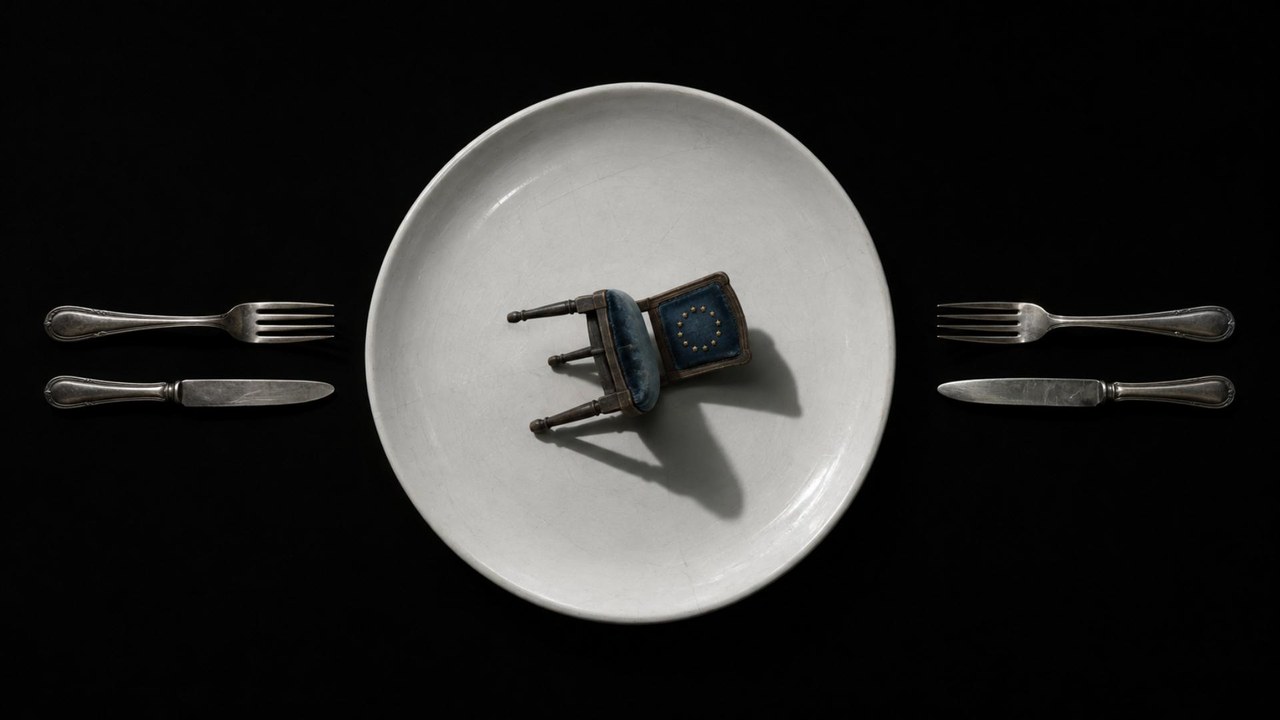
Whoever is not at the table is on the plate
Before our eyes, an attempt is under way to divide Europe anew into spheres of influence, contrary to the Charter that Russia itself signed in Istanbul. The Kremlin has set out its terms: NATO forces in their 1997 configuration, an open-ended list of demands, guarantees for Ukraine as a “recipe for endless war” – all to be agreed “in tandem” with Washington and discussed in Shenzhen. The Kremlin is in no hurry, because for this regime war is fuel, not a cost.
Whoever is not at the table is on the plate. Europe has just landed on the menu, and Poland is on its first page, together with the fifteen other states that joined NATO after 1997. Ushakov has honestly warned that this is only the starter.
Author: Artur Żak
Official Russian and Belarusian sources cited in this text are for informational purposes only. Content from these sources may constitute disinformation or propaganda.