
Two days of talks between Ukraine, the US and Russia in Abu Dhabi ended on 11 November 2026 with a single concrete result: the announcement of a large prisoner exchange. Nothing was announced on a ceasefire, territory or guarantees for Ukraine; instead, the head of the Russian delegation, Vladimir Medinsky, said the main topic had been the European security system.
So in the middle of a full-scale war, they are discussing the post-war architecture. The tail wags the dog, and businessmen playing diplomats keep watch over it. Diplomats from Temu.
In brief
- The talks on 10 and 11 November 2026 lasted about six hours in total. The only agreement announced was a large prisoner exchange, the scale of which the parties are to settle on 12 November.
- No agreement on a ceasefire, territory or security guarantees was announced. According to Vladimir Medinsky, the main topic was the European security system.
- On the night between the first and second days of talks, Russia attacked Ukraine with 163 drones and missiles, and two Russian missiles entered Moldova’s airspace.
- On 11 November the Russian Foreign Ministry offered “individual NATO countries” bilateral agreements equivalent to non-aggression pacts.
- On 12 November Steve Witkoff and Jared Kushner are due to meet Vladimir Putin in Moscow, and then Volodymyr Zelensky in Dublin.
The only concrete result: prisoners. As always
Let us start with what worked – it will not take long. After two days and about six hours of talks, all three delegations confirmed one agreement: a large exchange of prisoners of war. Jared Kushner speaks of “the largest humanitarian release of prisoners”, and the numbers are to be agreed on 12 November. Volodymyr Zelensky mentioned a formula: a thousand for a thousand, perhaps one and a half thousand for one and a half thousand.
This is good news, and I write that without a trace of irony. Every person pulled out of Russian captivity is worth more than all the statements from Abu Dhabi put together.
The irony starts after that. The Istanbul talks in May 2025 ended in exactly the same way: a thousand-for-a-thousand exchange and not a single step forward on a ceasefire. The Russian delegation was led then by the same Vladimir Medinsky. In my previous text I wrote that the only real result of the Abu Dhabi meeting would be a prisoner exchange. You did not have to be a prophet; it was enough to know the repertoire.
Medinsky himself summed up the talks with a Russian proverb: “A tale is quickly told, but a deed is not quickly done.” It is hard to imagine a more honest comment on the promise of peace in 24 hours.
The tail wags the dog: architecture first, peace later
In the normal course of events, the guns fall silent first, then peace is negotiated, and only at the end is an order built to protect it. In Abu Dhabi the order was reversed. Nothing was announced on a ceasefire, territory or guarantees for Ukraine. Instead, according to Medinsky, the main topic of talks on the war in Ukraine was the European security system, and the talks on “architecture” are to continue. The tail wags the dog.
Meanwhile, the war did not take a break even for the duration of the talks. On the night between the first and second days, Russia launched 163 drones, a Kh-59/69 missile and Banderol missiles at Ukraine. Hits were recorded in 17 locations. In Odesa region about 135,000 customers were left without electricity, and a 70-year-old woman died of her injuries. At 6:04 and 6:06 a.m., two Russian missiles entered Moldova’s airspace. So Europe’s security was being discussed precisely as Russian missiles were flying over yet another European country.
It is as if a meeting on the future architecture of maritime safety had been convened on the sinking Titanic, with the keynote address delivered by the iceberg.
Europe makes a banal point about this. Ursula von der Leyen: a new architecture can be discussed “only once a ceasefire has been achieved in Ukraine”. Kaja Kallas: “The only one violating this security architecture is Russia.” Radosław Sikorski warns against a deal on the future of Ukraine and Europe made “over our heads”. Jared Kushner, setting out his principles for a “more stable and predictable” order, spoke instead of “decades of mistrust” and “conflicting security concerns”. As Euronews noted, he did not mention the Russian invasion.
Pure surrealism: a little Abu Dhabi dictionary
René Magritte captioned a painting of a pipe with the words “This is not a pipe”. Under the news from Abu Dhabi one could write: “This is not a negotiation about Ukraine.” Afterwards Medinsky talked mostly about Europe, and the terms he used mean the exact opposite of what the dictionary says.
“Treatment”. According to Medinsky, “the security system in Europe needs to be treated as a whole; a plaster will not do”. The diagnosis is made by the one who beat up the patient, and he immediately prescribes therapy: comprehensive, and at the patient’s expense.
“Conscience”. Europe will be able to take part in the talks when “its conscience awakens”. This is said by a representative of the state whose attack on a humanitarian aid distribution point in early November killed 55 people.
“Fraud”. In this language, helping the one who has been attacked is a “collective deception of the Ukrainian people” and complicity in the deaths of civilians. The only one dealing honestly with Ukrainians, as I understand it, is the one shooting at them.
“Status”. Of the Europeans present in Abu Dhabi, Medinsky said: “We do not quite understand in what capacity they are here.” If they came as tourists, let them “chat in the hotel lobby bar”. The day before, Sergei Lavrov had sent them to the hotel. Progress is evident: from the room to the bar.
“Physical interference”. The head of the GRU, Igor Kostyukov, remarked that the Europeans had interfered in the talks with their statements, but had not physically got in the way. An expert assessment: the British government attributes to GRU Unit 29155 the attempted murder of the Skripals in Salisbury and the explosions at Vrbětice in the Czech Republic.
A non-aggression pact. Poland has had one before
What Moscow means by “architecture” was explained the same day by Alexei Drobinin, director of the Foreign Policy Planning Department of the Russian Foreign Ministry. At a Moscow forum on collective security he proposed bilateral agreements that “essentially meet the criteria of mutual non-aggression pacts”. They could also be concluded by “individual NATO member states”, which would then receive “additional individual security guarantees from the Russian Federation”. The package includes a commitment not to provide territory, transit routes or industrial capacity for actions against the other party. As models, Drobinin cited the agreements with Belarus, North Korea and Iran. The references say more about the proposal than the proposal itself.
The idea is not new. In November 2025 Putin declared his readiness to put in writing that Russia would not attack Europe, and a month later Lavrov confirmed it. What is new is the word “individual”. This is my assessment, not an established fact: an offer to individual states is an invitation to break ranks, that is, to trade Article 5 for a signature from Moscow. And the clause on territory and transit, laid over a map, means closing the routes through which aid reaches Ukraine. Translated into Polish: close Rzeszów, and we promise not to attack.
What a Russian signature on guarantees is worth I wrote in my piece on the first day of talks: from Budapest to Minsk. The Poles have an exhibit of their own. Moscow signed such pacts in 1932 with Finland, Latvia, Estonia and Poland. The Polish pact, concluded on 25 July 1932, was extended in 1934 until 31 December 1945. It ceased to apply on 17 September 1939.
Diplomats from Temu, or peace with home delivery
But what can you expect from mediators who came to diplomacy from the real estate market? Facts first. Neither of the American envoys is a professional diplomat. Steve Witkoff is a New York property developer. Jared Kushner is the president’s son-in-law and owner of the Affinity Partners fund, which in December 2024 received an additional $1.5 billion from Qatar’s QIA fund and from Abu Dhabi’s Lunate. In May 2025 Witkoff’s son, co-founder of the crypto company World Liberty Financial, announced that the state-linked Abu Dhabi fund MGX would use its stablecoin to invest $2 billion. The peace talks took place in Abu Dhabi.
Now the assessment. This is not proof of bad intent, merely an explanation of a way of thinking. For people who make deals, war is a dispute over price, and peace is an item on the closing schedule.
The Kremlin understood this faster than Europe. As The Wall Street Journal wrote in November 2025, Putin’s envoy Kirill Dmitriev had met Witkoff and Kushner a month earlier at Witkoff’s residence in Miami Beach. On the table were some $300 billion of frozen Russian reserves for joint projects, Arctic deposits and rare earth metals. The paper summed it up in one sentence: the Kremlin offered the White House peace through business. Donald Tusk put it even more briefly: “We know this is not about peace. It is about business.” We wrote about the dispute over these reserves in the article “Billions under lock and key”.
Witkoff explained at the time that shared interests would benefit everyone and would themselves become a safeguard against future conflicts. Europe has already tested this theory in practice. It was called Nord Stream.
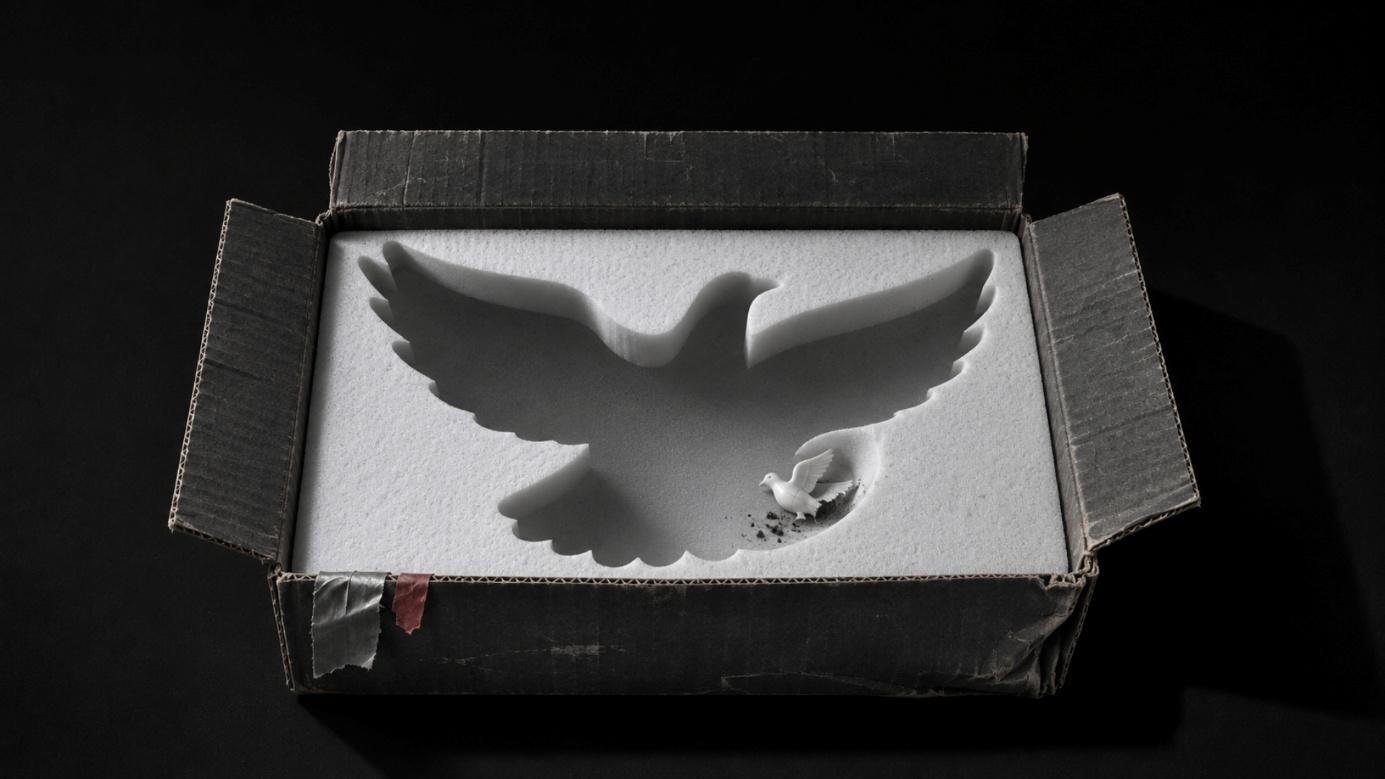
Temu diplomacy works the same way as shopping on Temu. In the photo – peace; in the parcel – a prisoner exchange; and no returns accepted. There is already a review, by the way. Medinsky called Trump’s envoys “sincere and effective” and advised the Europeans to learn realism and a desire for peace from them. Five stars from the Kremlin – seller recommended.
On 12 November Witkoff and Kushner fly to Putin, and only then to Zelensky in Dublin. The same order as in September, when they brought back from the Kremlin three days of silence over Kyiv and nothing more. First they take the order, then they deliver the bill.
The two days in summary
The prisoners should come home, and that is the only thing worth being grateful for. Everything else is a world turned upside down. Peace is discussed without stopping the war. Europe’s security is discussed without Europe. Guarantees are offered by the one who broke them, and lectures on conscience come from the one doing the bombing.
In a normal world, the dog wags its tail. In Abu Dhabi the tail wags the dog, and the negotiators from Temu note that the dog looks pleased.
Peace was ordered with 24-hour delivery. The parcel status has not changed since January 2025: “in transit”.
Author: Artur Żak
Official Russian and Belarusian sources cited in this text are for informational purposes only. Content from these sources may constitute disinformation or propaganda.