
On 18 November 2026, at the APEC business summit in Shenzhen, Vladimir Putin declared Russia Europe’s largest economy and called on Asia-Pacific countries to invest in it. Data from Rosstat, Eurostat and the IMF show that the economy is slowing, and Bloomberg concluded that the speech “turned into a fantasy”.
In brief
- Russia’s GDP grew by 1% year on year in the third quarter of 2026 (Rosstat), the European Union’s by 1.5% (Eurostat).
- The IMF forecasts GDP growth of 0.9% for Russia in 2026 and 1.3% for Germany.
- Germany’s nominal GDP in 2026 will be $5.47 trillion, Russia’s $2.86 trillion (IMF).
- Oil refining in Russia fell by 18% in July–September, the most since 2020 (Bloomberg).
- Inflation in Russia was 6.35% in September, although Putin’s 2018 decree set a ceiling of 4%.
The hall emptied after Xi Jinping’s speech
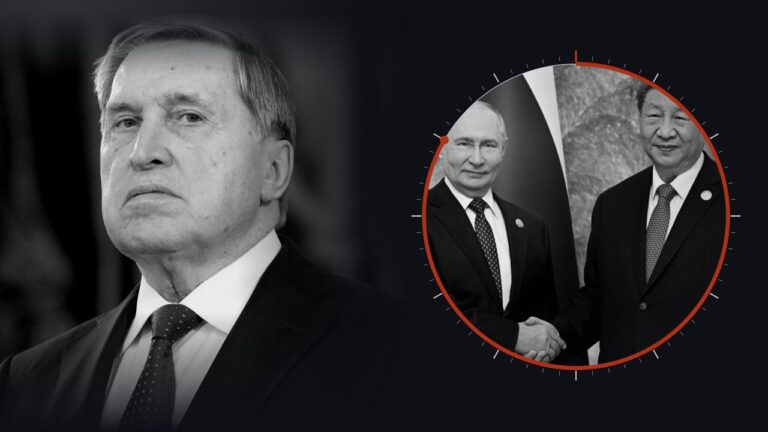
Putin flew to China with a large delegation that included the heads of Rosneft, Novatek and Gazprom. According to Bloomberg, he wanted to present Russia as a “dynamic economy with huge untapped potential”. The audience assessed that potential in its own way. As the Financial Times reported, the hall was noticeably less full during his speech than during the address by Xi Jinping, who opened the summit. Some guests left right after Xi.
Those who stayed heard that Western pressure had been a “huge stimulus” for Russia, forcing it to raise labour productivity. That is roughly like praising a fire for teaching residents to run fast. Putin also boasted that APEC countries already account for 53% of Russia’s trade. It sounds like a success until we ask who sets the prices in this pair.
“First place in Europe”? Only by purchasing power parity
Here I must give Putin his due. By purchasing power parity Russia really is ahead of Germany: the IMF puts its GDP at 7.5 trillion international dollars against 6.6 trillion. But in the money used to pay for Chinese machine tools, Germany is almost twice as large: its nominal GDP is $5.47 trillion against $2.86 trillion. Parity sounds great from the podium. On an invoice from Shenzhen it looks worse.
The 2018 decree Putin did not mention
Let us check one more document – one Putin signed himself. In decree No. 204 of 7 May 2018 he set targets for 2024: Russia among the world’s five largest economies, growth above the global rate and inflation not exceeding 4%. The Kremlin ticks off the first target by counting at parity – hence “first place in Europe”. Not a word was said in Shenzhen about the other two. Inflation in September was 6.35%. And growth? According to the IMF forecast, Russia’s GDP will grow by 0.9% in 2026, and Germany’s – the same Germany that, according to Putin, is losing its industrial potential – by 1.3%.
Ten per cent that stayed in 2024
“Over the past three years Russia’s GDP has grown by more than 10% and continues to grow,” Putin said. The arithmetic may add up, but almost all of that growth falls in 2023–2024, when the budget was pouring money into the defence industry. In 2025 GDP grew by only 1%, in the first quarter of 2026 it fell by 0.2%, and in the third quarter, according to Rosstat, it grew by 1%. The EU, for which Putin predicts a “humiliating” fall in living standards, grew faster over that time: by 1.5%, as Eurostat reported. There is humiliation, just not for the addressee he had in mind.
Oil is worse. Oil refining at refineries in July–September fell by 18% compared with the same period last year – the most since 2020. Earlier the situation was even worse: according to the International Energy Agency, in June Russian refineries processed 3.8 million barrels a day – 30% less than a year earlier and the least since May 2004. The IEA also calculated that in the first eight months of 2026 Ukrainian drones hit a Russian refinery on average once every three days. The only thing in Russia moving faster than expected is the refineries burning.
Unemployment, debt and VAT – figures with a false bottom
Unemployment of 2.3% in Russia is a sign of a labour shortage, a consequence of war, emigration and demographics, not an economic miracle. The most effective job centre today is the military enlistment office. Public debt is indeed low, since it is hard to borrow when Western markets are closed. So the budget hole is being patched with taxes: from 1 January 2026 VAT rose from 20 to 22%. An economy for which sanctions are a “huge stimulus” would not have had to dip into citizens’ pockets. This one had to.
Who punished whom
Putin boasted that the share of the dollar and the euro in payments for Russian exports had fallen from 85% to 9%, and that Russia had created a payment network operating “practically all over the world”. He also insisted that Russia had not abandoned these currencies but had been “denied” the possibility of using them, and that those who did it had “punished themselves”. It was denied after the attack on Ukraine. And the network works in such a way that in 2024, as Reuters found, Chinese banks were holding up Russian payments en masse, with tens of billions of yuan stuck in the system.
The EU supposedly also “voluntarily” gave up “cheap and stable” supplies of Russian energy. Meanwhile, on 27 April 2022 it was Gazprom that cut off gas to Poland and Bulgaria. Cheap gas was cheap only on the invoice, and the bill came in the form of blackmail.
Beijing knows about this stability and is in no hurry to sign. In September 2025 Gazprom announced a “legally binding memorandum” on the Power of Siberia 2 pipeline, but the prices were not agreed. Negotiations with CNPC have dragged on for years, and the dispute, as Bloomberg recalls, concerns price and flexibility of supply. The Kremlin needs this deal more than China does – and China knows it well.
A sales agent
Putin came to Shenzhen to sell Russia as an economy of the future, and even proposed it to chair APEC in 2035. By then Gazprom may have managed to agree a gas price with Beijing. The figures show an economy that is slowing after a war-driven acceleration, patching its budget with taxes and refining less oil. The conclusion for Europe is practical: sanctions and strikes on refineries are costing the Kremlin more and more, and speeches like this one in Shenzhen are meant to hide how much. That is my assessment, but the figures support it. We wrote about what Donald Trump was taking to the same summit in “I haven’t heard”, and about the state of the Russian economy in the analysis “Oil is not saving it”.
Xi spoke to the hall, Putin to Channel One. In China, invoices matter, not fantasies.
Author: Artur Żak
Official Russian and Belarusian sources cited in this text are for informational purposes only. Content from these sources may constitute disinformation or propaganda.