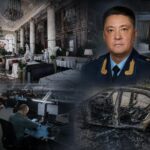

Vladimir Putin received Donald Trump’s son-in-law and his business partner in the Kremlin. In front of the cameras he declared that foreign troops in Ukraine would be a “legitimate target” for Russia, that the only line of demarcation is the “state border”, and that he would like an eternal peace. Two and a half hours later the Americans left without any statement. Let us look at what exactly they heard.
In brief
- On 12 November Putin spoke with Steve Witkoff and Jared Kushner in the Kremlin for about two and a half hours. At the time of finishing this text, neither side had announced any agreements.
- Putin declared that foreign troops in Ukraine would be a “legitimate target”, and that for Russia the only line of demarcation is “the line of the state border”.
- He proposed a humanitarian mission in Kostiantynivka and claimed that Russia controls the city. The DeepState map and the Ukrainian military deny this.
- According to the Ukrainian side, the Russians used the previous such mission, in Oleshky, to rotate troops and bring in equipment.
- The only countable result of the week is the announcement of a prisoner exchange: more than a thousand people on each side.
Three hours’ delay, two and a half hours of talks
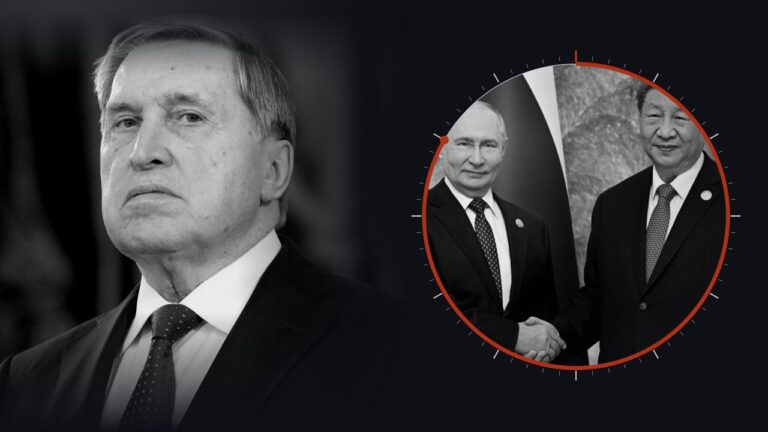
I introduce the American envoys in terms of their mandate. Jared Kushner is the son-in-law of the President of the United States. Steve Witkoff is a property developer, Trump’s long-time friend and business partner. Neither of them is a professional diplomat. Across the table sits a man who has ruled Russia since 1999, advised by Yuri Ushakov, Russia’s former ambassador in Washington.
The talks were announced for 12:00 Moscow time. The American motorcade drove into the Kremlin after 13:00. The meeting began a few minutes after 15:00 and lasted about two and a half hours. What the US president’s envoys did for almost two hours within the Kremlin walls, the agencies did not report. On the Russian side, Ushakov, the head of the Russian Direct Investment Fund Kirill Dmitriev and Vladimir Medinsky sat at the table.
That same morning a Russian drone hit a nine-storey apartment block in Kyiv’s Solomianskyi district. A woman was killed and seven people were injured. A few hours later the master of the Kremlin was talking to his guests about eternal peace.
Not everyone in Washington is applauding. The day before, Congressmen Gregory Meeks and Adam Smith and Senator Jack Reed accused the envoys of weakening Ukraine’s negotiating position and pressing it to give up the “fortress belt” in Donbas. They called on Trump to end the policy of concessions to the Kremlin.
Foreign troops as a target, or a war announced before the peace
“We believe this poses a threat to Russia’s security. The Europeans know this. And what do we hear from them? That after peace is concluded they will immediately send troops into Ukraine? What does that mean? War will immediately flare up again.”
– Vladimir Putin to Steve Witkoff and Jared Kushner, the Kremlin, 12 November 2026
According to a TASS report, Putin added that Russia had been saying this “from the very beginning”, and that foreign troops in Ukraine would be a “legitimate target” for the Russian armed forces. And indeed, he has been consistent. He used the same words on 5 September 2025 in Vladivostok, the day after 26 states declared in Paris that they would contribute to Ukraine’s post-war security.
Let us read that again, slowly. Peace is to be concluded, and immediately afterwards war is to flare up again if Ukraine receives what peace is concluded for: a guarantee that no one will attack it again. Putin is announcing in advance the condition under which he will break an agreement that does not yet exist. The only foreign troops standing on Ukrainian soil today are Russian. They, of course, threaten no one’s security.
Here I have to soften my own thesis. This position is not new, and no one in Washington can pretend to be surprised. What is new is the audience. Putin repeated the threat to people who had come to persuade him to hold talks with European participation, and in the public part of the meeting no one contradicted him. Whether anyone did behind closed doors is unknown.
“Here you, here us”. Which border does Putin mean?
“We know that the Ukrainian side is raising the issue of so-called grey zones. As I have already said, that will always be a bone of contention. For us there is only one line of demarcation: the line of the state border. Then everything will be clear: here you, here us, and that is the line of demarcation.”
– Vladimir Putin, the Kremlin, 12 November 2026, via TASS and RBC-Ukraine
It sounded like a reasonable rule. Let us check. Putin knows the state border with Ukraine very well, because he signed it himself: on 28 January 2003 in Kyiv, together with Leonid Kuchma. The treaty entered into force on 23 April 2004 and leaves Donetsk, Luhansk and Crimea on the Ukrainian side.
But he means a different border. Sergei Lavrov recalled these days that Russia is pursuing the goals Putin set out in June 2024. At the time he demanded the withdrawal of Ukrainian troops from the entire territory of the Donetsk, Luhansk, Zaporizhzhia and Kherson regions within their administrative borders – that is, also from Zaporizhzhia and Kherson, which the Russian army has not captured. The “state border” in the Kremlin’s dictionary is the line added to the Russian constitution in the autumn of 2022. This is my assessment, not an established fact: in the Kremlin, Putin did not specify.
Against this background, it is worth recalling the idea that, according to The Telegraph, Trump’s envoys floated even before the Abu Dhabi talks. Since Russia demands all of Donbas but cannot capture it, the administrative borders of the Donetsk and Luhansk regions should be redrawn to coincide with the front line. Moscow would announce that it has “all of Donbas”, and the Ukrainian fortress towns would end up outside the redrawn region. This concerns about 5,000 km² that Russia has failed to capture in almost five years. Kyiv rejected the idea, and Ukrainian sources deny that it was ever put forward in that form.
This is Temu diplomacy in its purest form: if the map does not match the front line, fix the map. And that is exactly what Putin answered in front of the cameras: there will be no grey zones, because with them there will be “no lasting peace”. He was being offered a victory on paper. He replied that he prefers a real one.
Let us add two details from Abu Dhabi. Volodymyr Zelensky said that the Russians there inflated the area of Donbas they control, and NATO’s Supreme Allied Commander Europe, General Alexus Grynkewich, confirmed that the Ukrainian version of the front line is closer to the truth. According to RBC-Ukraine’s sources, on the second day the Russian delegation refused to discuss a ceasefire, territory, energy and security in the Black Sea.
Kostiantynivka: a humanitarian mission as material evidence
Putin devoted the most cunning part of his statement to humanitarian matters. He thanked Melania Trump for her involvement in the Oleshky case and proposed repeating the mission in Kostiantynivka in Donetsk region. He claimed that Russia controls the city, that it needs five days to demine the outskirts and that it will guarantee the mission’s security. If Kyiv believes it controls Kostiantynivka, let it provide security from its side. According to him, 400–500 civilians remain in the city. The ombudsmen of both countries would organise it, and foreign journalists, including American ones, should be invited.
He explained the purpose of this stage set himself. The mission, according to Putin as quoted by state television, “will show who really controls the city”.
So let us check who controls it. The Russian army announced the capture of Kostiantynivka back in July. The General Staff of the Armed Forces of Ukraine replied at the time that this was untrue. According to the DeepState map, the city is still not under Russian control, although last week the Russians advanced from the direction of Illinivka and the zone of fighting among the buildings widened. Kyiv Post’s sources confirm that Ukrainian troops remain in the city. Before the invasion Kostiantynivka had 70,000 inhabitants. In June, according to the 19th Army Corps, fewer than 1,500 civilians remained.
The “Oleshky experience” Putin refers to can also be checked. The ceasefire there lasted from 27 October to 1 November. Melania Trump announced success: aid was delivered and almost 800 people evacuated. She did not say how many of them went to Ukrainian-controlled territory and how many to Russia. What is known, however, is what the Russian army was doing in the meantime. The command of the 34th Marine Brigade reported that the Russians brought more than a thousand troops into the occupied part of Kherson region. Sky News showed footage of rotations and heavy equipment being deployed. The Kremlin replied that this was normal practice.
Zelensky’s adviser Dmytro Lytvyn commented briefly on the proposal: in Oleshky, under the banner of a humanitarian mission, equipment was brought in and units were rotated, so it is clear what Russia wants in Kostiantynivka, although the details still need to be clarified.
My assessment is this: five days of “demining” on the hottest section of the front in Donbas means five days of respite for the attacker, while American journalists are to certify whose city it is that the Russians have been unable to capture since July. In this plan, civilians are props. But here I have to soften my own thesis. Several hundred people really did leave Oleshky, and if living people can be brought out of Kostiantynivka, that must be talked about. Only the terms of the corridor should be set by someone other than the army that has been destroying this city for months.
“People matter more”, or eternal peace Kremlin-style
As for territory, Putin assured, for Russia “the people who live there matter more”. This is said by a politician against whom the International Criminal Court issued an arrest warrant on 17 March 2023 for the unlawful deportation of Ukrainian children. He says it on the day his drone killed a woman in a Kyiv apartment block.
Then came the sentence for which it was worth switching on the cameras: Putin would like peace in Ukraine “to be eternal”. Russia has already signed one such peace. On 12 May 1997 in the Kremlin, Boris Yeltsin and Aslan Maskhadov concluded a peace treaty in which Moscow renounced the use of force against Chechnya. Eternity lasted just over two years. In August 1999 Vladimir Putin became prime minister, and in the autumn Russian troops entered Chechnya for the second time.
There is also a document bearing Putin’s own signature, already mentioned: the 2003 border treaty. A Kremlin peace is eternal exactly for as long as the Kremlin needs it.
The bedside-table joke and thanks to Medinsky
Putin devoted an anecdote to Europe. Detectives from Ukraine’s National Anti-Corruption Bureau (NABU) ask a fraudster who has built villas outside Kyiv where his money comes from. From the bedside table. And who puts it there? My wife. And where does your wife get it? From me. And where do you get it? From the bedside table. That, Putin argued, is how the Europeans behave: Trump offers them an agreement on a security system, but they want to talk about that system only after the war and are also planning to send troops to Ukraine.
The logic of this joke is worth checking. Europe’s position is linear: first stop shooting, then we will talk about architecture. The circle is closed by someone else. There will be no peace without a new security architecture, the architecture cannot include guarantees for Ukraine, and guarantees mean war. It is Putin who puts the money in this bedside table, and Putin who takes it out. A joke about family finances told to the president’s son-in-law and business partner is a category of humour of its own. I leave it to the readers.
There was also the claim that Russia “never curtailed” dialogue with Europe, because it was the Europeans who broke it off. Let us check. On 18 October 2021, four months before the invasion, Sergei Lavrov announced the suspension of Russia’s mission to NATO and the closure of the Alliance’s offices in Moscow. Two months later Russia issued an ultimatum demanding that NATO return to its 1997 borders. Finally, Putin asked the Americans to “work” with Europe, because it must decide whether it wants peace or war. Such a choice is put to a side that has attacked no one by a politician who started the war and can end it with a single order.
And the Americans? Steve Witkoff thanked Vladimir Medinsky for his involvement in the settlement “from the very beginning” and for his work in Abu Dhabi. This is the same Medinsky who the day before said on Russian television: “I will be satisfied only when we win and sign a peace agreement on our terms.” Witkoff also confirmed that the Europeans did not sit at the table in Abu Dhabi, but “they were briefed”. The Speaker of the Federation Council, Valentina Matviyenko, described this role bluntly: humiliating.
What we do not know and what was actually achieved
The closed part of the talks lasted more than two hours, and at the time of finishing this text neither the Kremlin nor the Americans had announced any agreements. Putin only said that he would raise territorial issues. Witkoff hoped that after the meeting he would be able to announce the next round of talks, this time with European participation. So far he has not done so. From Moscow the envoys were to fly to Dublin to brief Zelensky on the meeting. The next day EU leaders are to discuss there who should represent Europe.
“The Americans flew to Putin with specifics. I would very much like them to fly to Dublin with specifics too. I don’t really believe it, but there is hope.”
– Volodymyr Zelensky, 11 November 2026, via Ukrainska Pravda
Here again I have to soften my own thesis, because one result of this week can be counted. General Alexander Zorin of the Russian delegation announced the largest prisoner exchange of this war: more than a thousand people on each side. If the exchange takes place, that will be more than a thousand reasons why it was worth sitting down at the negotiating table. Then again, prisoners were exchanged even when no one was talking about any “security architecture”.
The rest falls into the chain I described after the first day of talks in Abu Dhabi. According to Axios, the Americans asked Russia itself to draft a new agreement on Europe’s security. In the Kremlin, the author of the future draft showed what it will contain: no guarantors, no buffer zones, the border wherever Moscow says. A Levada Center poll shows that 65% of Russians want peace talks. So does their president – provided they are about the other side’s capitulation.
Return luggage: zero peace, one joke and two down jackets
The Americans brought proposals to the Kremlin. They took away thanks to the First Lady, the bedside-table joke, two down jackets and a list of targets that includes the troops of their own allies. In front of the cameras Putin told them everything there is to know about his peace: guarantees for Ukraine mean war, the front line is not a border, and humanitarian aid serves to establish whose city it is.
I am not saying that one should not talk to the Kremlin. I am saying that one must listen to what it says. War is fuel for this regime, and talk of peace is a way of making sure it does not run out. Putin wants eternal peace. Previous peace agreements signed by Russia lasted exactly until the moment they stopped being useful to the Kremlin.
Author: Artur Żak
Official Russian and Belarusian sources cited in this text are for informational purposes only. Content from these sources may constitute disinformation or propaganda.