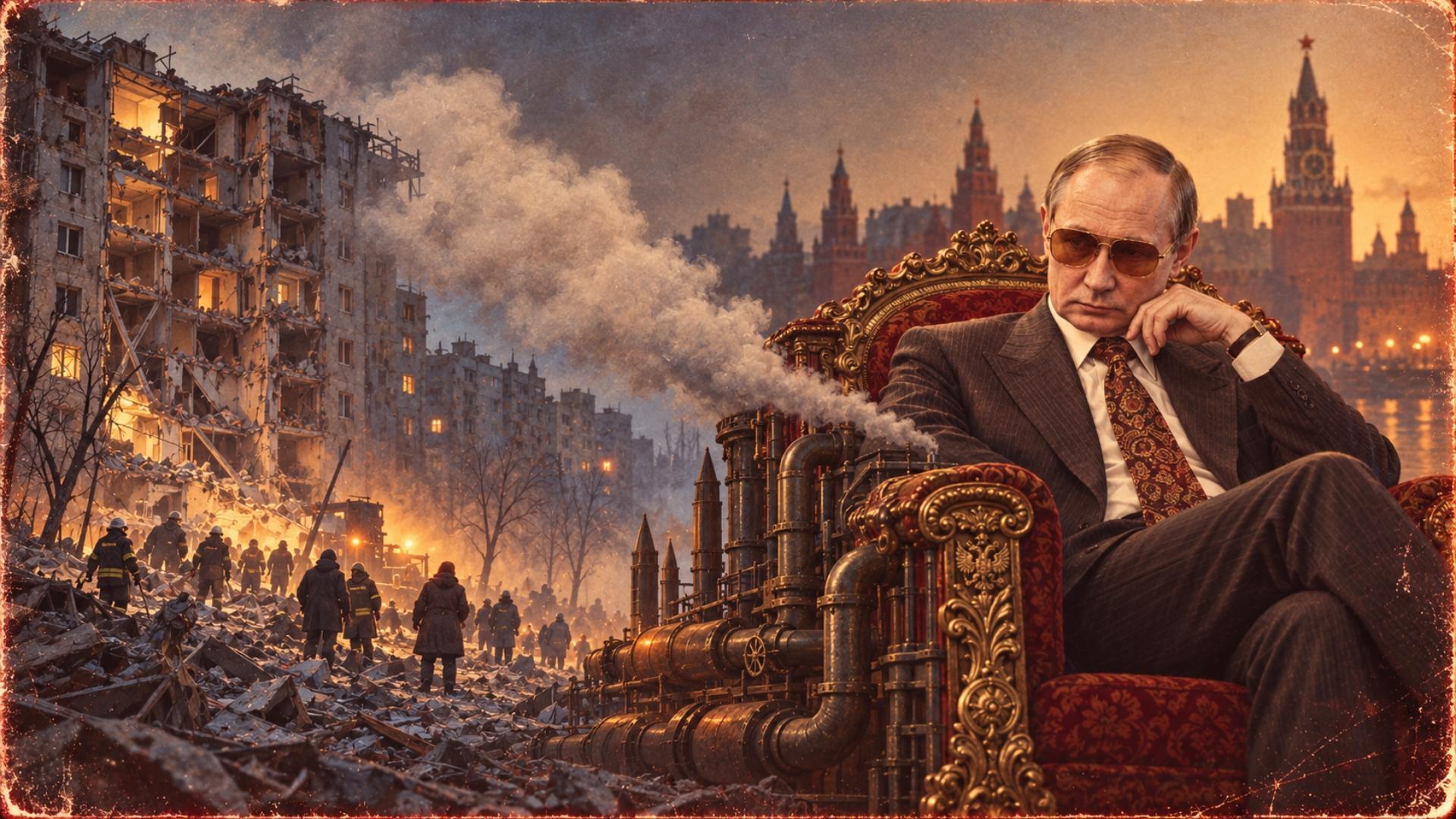

On the night of 6 to 7 October 2026, on Vladimir Putin’s 74th birthday, Russia sent 70 missiles and 130 drones against Ukraine and killed at least 19 people, including four children in Pryluky. Whether the date was chosen with the birthday in mind cannot be proved today. What can be shown is why a system in which such a gesture is legible has no reason to end the war.
In brief:
- At least 19 killed and 74 wounded. The heaviest losses were in Pryluky: 13 dead, four of them children. One of the main targets was the energy system.
- Anna Politkovskaya was killed on Putin’s birthday, Boris Nemtsov on the day the Special Operations Forces holiday was marked for the first time, and the 2022 invasion began the day after Russia’s army holiday.
- The date of the attack is a symbolic “gift” for Putin.
- War gives the regime enemies, a justification for repression and legitimacy. Appeals for compromise will not end it. Only the loss of resources will.
Two hundred targets, 18 hits, 19 dead
The attack lasted from the evening of 6 October until morning. Ukraine’s Air Force recorded 130 unmanned aerial vehicles (Shaheds, Gerans, Gerberas and Parodiya-type decoys), including 46 jet-powered ones. On top of that came Kh-101, Kalibr and Iskander-K cruise missiles launched from the directions of the Vologda and Kursk regions and the Caspian Sea, Iskander-M and KN-23 ballistic missiles, and the high-speed Zircon and Onyx. The overall figure of 70 missiles was given by President Volodymyr Zelensky. The Air Force has not published a full breakdown by type, so I treat that figure as an official statement rather than a verified tally.
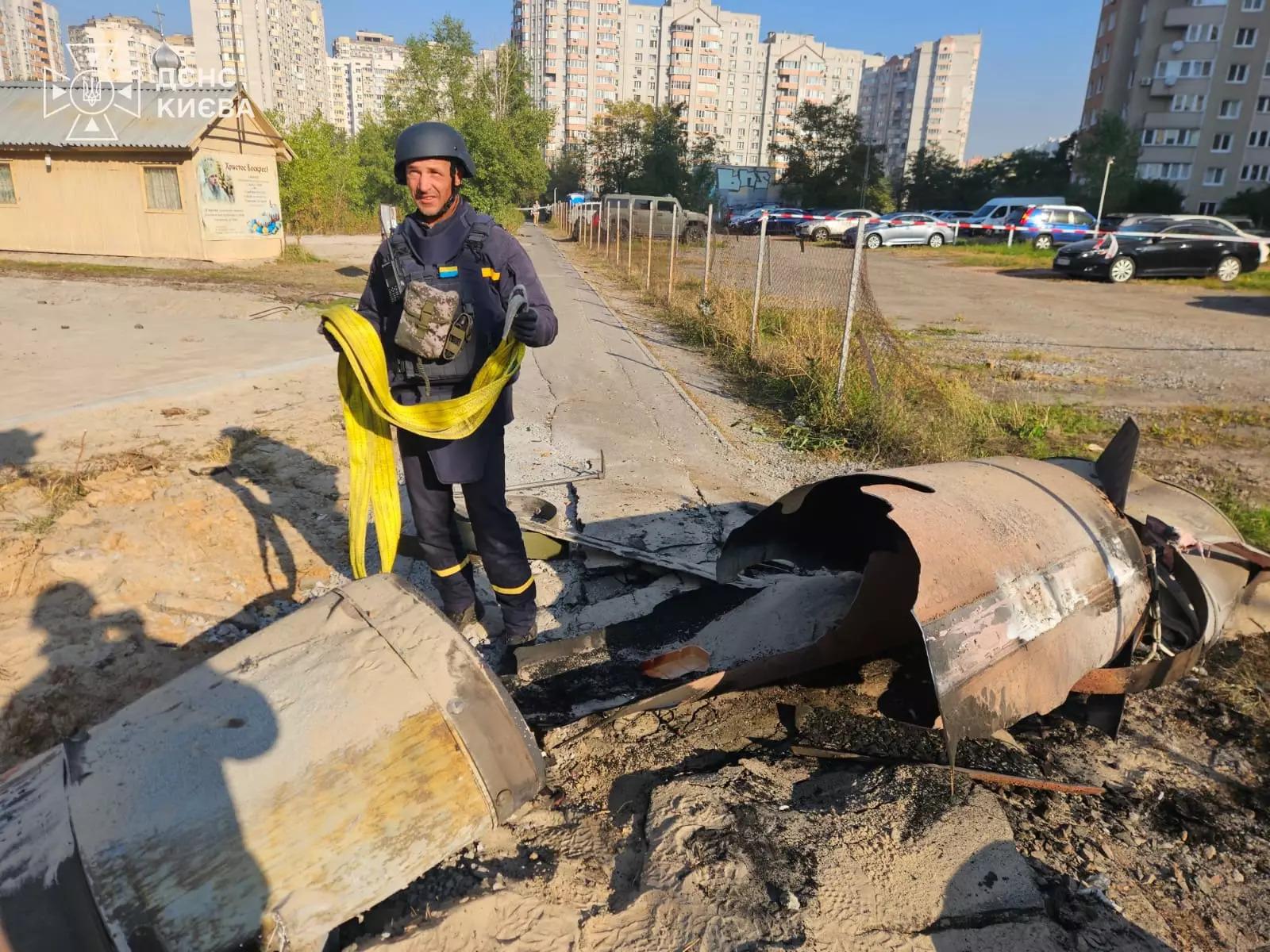
Air defences shot down or neutralised 161 targets: 117 drones and 44 missiles (Air Force, data as of 9:00). Hits were confirmed at 18 locations. The largest number of people died in Pryluky in the Chernihiv region, where a missile struck a five-storey residential block. According to the regional prosecutor’s office, 13 people were killed there, four of them children, while 50 were wounded, including seven children. In Kyiv, attacked with ballistic missiles among other weapons, the bodies of two people were found in Darnytskyi district after a fire in a garage complex. Two deaths each were recorded in Kremenchuk and Oleksandriia. As of 13:25 the toll was at least 19 killed and 74 wounded. This is the sum of confirmed regional figures, not a full national total, and the numbers may yet rise.
The second line of attack was the energy system. Ukrenergo reported new power cuts in the Poltava, Chernihiv, Kharkiv, Vinnytsia and Kherson regions. One side’s claim: the Russian Ministry of Defence maintains that it struck the defence industry as well as port and repair facilities. The residential block hit in Pryluky and around 430 damaged flats in Kremenchuk are a different description of the same night.
Let us check the calendar
Before every Ukrainian holiday we ask how Russia will “mark” it. I propose turning that question around: not which Ukrainian date Moscow wants to spoil, but which of its own it wants to glorify. Let us check a few.
On 7 October 2006 Anna Politkovskaya, a journalist with Novaya Gazeta who had spent years documenting the crimes of the second Chechen war, was shot dead in the lift of her Moscow block. That day Putin turned 54. In 2014 a court convicted her killer, three other Chechens and a former Moscow policeman. Whoever ordered the murder has never been identified.
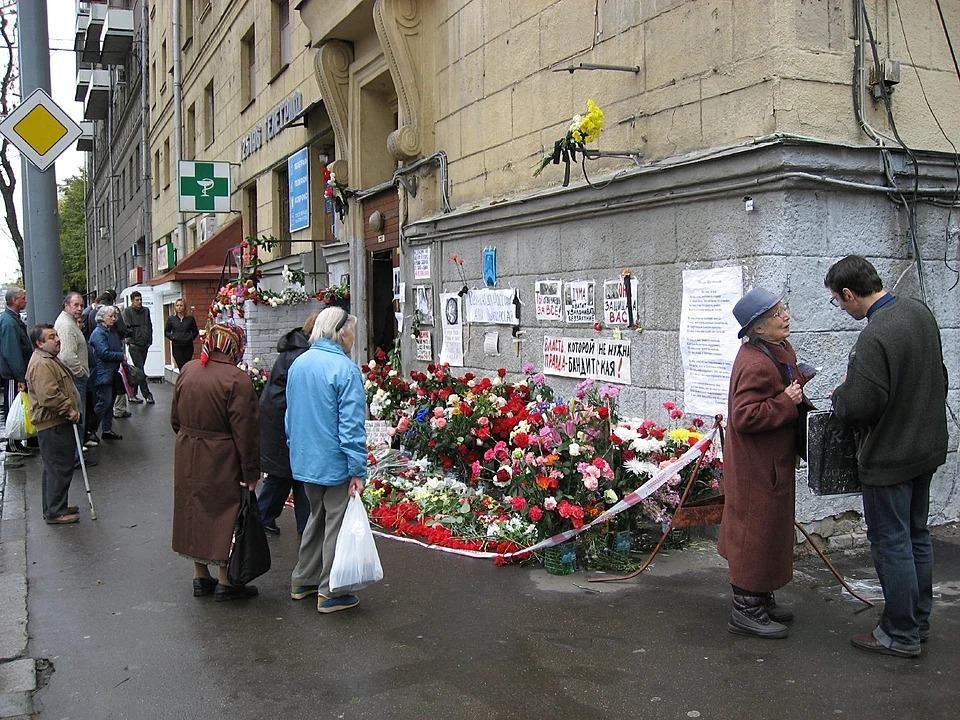
On 27 February 2015 Boris Nemtsov was shot dead on the Bolshoy Moskvoretsky Bridge, a few hundred metres from the Kremlin. The day before, Putin had signed decree No. 103, which declared 27 February the Day of the Special Operations Forces. From the very first day Russian media linked it with the “polite people”, that is the soldiers without insignia who seized Crimea. In time the unofficial name “day of the polite people” stuck to it. Nemtsov therefore died on the day the holiday was marked for the first time. In 2017 a court convicted five Chechens, including the man who fired the shots. Who ordered the killing, Russian justice did not establish.
Early in the morning of 24 February 2022 the full-scale invasion began. It came the day after 23 February, the former Day of the Soviet Army, marked in Russia today as Defender of the Fatherland Day.
And finally 7 October 2026: 70 missiles on Putin’s 74th birthday, on the exact twentieth anniversary of Politkovskaya’s death.
A coincidence of dates is not yet proof of intent
Here, however, I must weaken my own thesis. The Russian calendar is densely packed with military holidays and days of “military glory”. Almost every date in it commemorates something, and fitting events to the calendar after the fact comes easily. I know of no document or credible leak that would confirm that the strike on the night of 6 to 7 October was planned for Putin’s birthday. Air Force data point to a considerable concentration of missile assets. Such a concentration, however, precedes every massed strike, and the date is also determined by purely military factors, from the state of stockpiles to target reconnaissance.
The working hypothesis therefore sounds more cautious. Russia does not have arsenals that would allow it to launch dozens of missiles every day, so it accumulates them for large strikes. And since the stockpile will have to be fired at some point anyway, a date that matters to those in power is a natural choice for the planners. That is my hypothesis, not an established fact.
Something else matters more. Even if nobody on the general staff circled 7 October in red, everyone in Russia understands what such a gesture would mean. Symbolism needs no order; it is enough that it is legible. By this logic, violence serves not only to destroy Ukraine. It also works as an internal ritual of the system: it confirms that those in power can still kill whomever they want, whenever they want, and that an opponent’s death can pass for a “gift” to the leader. This is an assessment, but it rests on a recurring pattern rather than on a single incident.
This regime was born of war
Fact: Putin took charge of the government in August 1999, on 1 October federal troops entered Chechnya, and in March 2000 he won the presidential election. Assessment: for men who had come out of the security services, the second Chechen war was what the war against Ukraine is today, that is an instrument for building a dictatorship. It allowed them to strengthen the security apparatus and to silence those who disagreed. Politkovskaya described precisely this mechanism before she was killed.
That is why the question Western politicians have been asking for years, namely what would have to happen for Putin to end the war, is put upside down. The right one runs: why would he end it?
War gives the regime a state of permanent threat in which every act of repression has a ready justification. It gives it an internal enemy, because a political opponent easily becomes a “traitor” or a “foreign agent”. It strengthens the position and the resources of the security apparatus from which Putin himself came. It keeps society in mobilisation mode, in which violence becomes an everyday matter. Finally, it allows the rule of one man to be presented as a historical necessity, because you do not change the commander during a war.
Peace would give the Kremlin none of this. It would instead raise questions about the point of the losses, about the costs and about who is responsible for the ruin. That is why, in this logic, ending the war is a risk for the regime rather than a reward. War is not the cost of holding on to power, it is its fuel.
The same applies to personnel. For more than a quarter of a century the system has promoted people for whom violence is an ordinary working tool. I do not need to go into the psychology of the Russian elites to state something simpler: in that milieu, killing does not damage a reputation. It is the currency of loyalty.
Society: not seeing, or rejoicing
The regime rests not only on the apparatus of violence but also on silent consent. I see two forms of it. The first is selective blindness: many Russians do not want to see the violence, because seeing it could prove costly. Indifference here is the price of relative quiet. The second form is more dangerous. Part of society accepts aggression against Ukraine as compensation for its own subjugation. Life is bad, those in power ask nobody’s opinion, but at least the people who “disagreed” with the leader are dying. And on his birthday, no less.
This is a generalised diagnosis and that is exactly how it should be read. It does not cover those who ended up in penal colonies for their resistance, nor those who left the country. I do not back it with opinion polls, because surveys in a state under wartime censorship say little about real attitudes. It describes a mechanism, not every individual citizen. Without that mechanism, that is without passive consent, a war on this scale could not have been waged for more than four and a half years.
Talks are not a readiness for peace
If war is the source of the regime’s strength, then a strategy built on appeals for compromise assumes something that does not exist: that the Kremlin wants out of this war. The mere possibility of talks does not mean a readiness to end it. For Moscow, talks can be just as much an instrument as missiles, a way of buying time and easing the pressure.
What remains is the harder road: depriving Russia of the resources with which it wages this war. One element is Ukrainian long-range strikes against the Russian economy. The more effective they are, the sooner the Russian state will start sinking into an economic, political and social crisis. The second element is defence. The night of 6 to 7 October showed this without any retouching. The ballistic component remains the biggest problem, and President Zelensky again pressed for further systems and Patriot missiles. Every missile that is not intercepted is potentially another Pryluky.
This cannot be the task of Ukraine’s Armed Forces alone. Allies who today help by halves will draw their conclusions anyway. The only question is whether from somebody else’s experience or from a shock of their own. Ukraine has already been through this lesson: whoever counts on an agreement with an aggressor in the face of a growing threat first takes the blow and only then learns how to act. Better not to repeat it on one’s own territory.
The lesson of 7 October
Whether anyone on the Russian general staff was thinking about Putin’s birthday we may never find out. To understand how this system works, however, we do not need to. The calendar of the past twenty years and the toll in Pryluky are enough. A regime that draws its strength from war will not abandon it merely because somebody asks it to.
A war like this is ended by a lack of resources, not by goodwill.
Author: Artur Żak
Official Russian and Belarusian sources cited in this text are for informational purposes only. Content from these sources may constitute disinformation or propaganda.