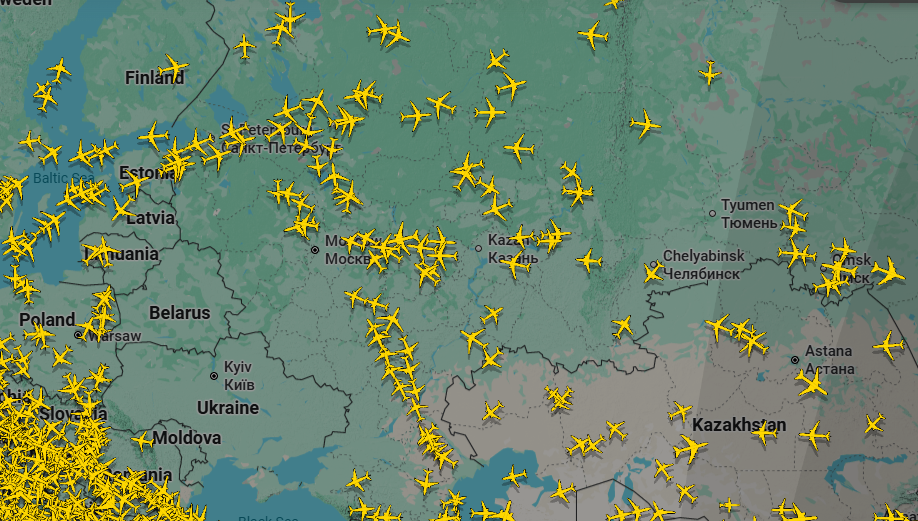

In early September Zelensky addressed international airlines with a warning about flights over Russia, drawing carriers’ attention to the constant presence of Ukrainian drones in Russian airspace. In Russia such statements were called state terrorism. Even so, a number of airlines cancelled flights in order to reassess the risks.
In brief:
- Zelensky called on international airlines to take account of the drone threat in the skies over Russia.
- A number of international airlines cancelled flights to Russia after Zelensky’s statements.
- Flights resumed once the risks had been assessed, but passengers are still facing delays and diversions.
- The problem in Russian airspace has been building since August. Airports in Russia have been systematically imposing restrictions because of the drone threat.
- Putin called Zelensky’s statement an act of state terrorism.
Why the skies over Russia are becoming dangerous
Since the second half of 2023 Ukraine has been using drones to strike targets on Russian territory, but in 2025–2026 these attacks became large-scale and reached record distances of more than 3,000 km. In August 2026, for example, Ukraine launched 800 drones towards Russia in a single night.
On 1 September the president of Ukraine used his evening video address to warn international airlines about the presence of Ukrainian drones in Russian airspace. He stressed that Ukrainian skies have been closed since the start of Russia’s full-scale invasion in 2022, whereas Russia has not closed its own – but Ukrainian drones may do it for them.
By 2 September Ukraine’s foreign minister said that Ukraine had formally notified ICAO that Russian airspace is dangerous for civil aviation because of increased military activity:
“This is our responsible decision to notify ICAO and all airlines, and governments to take caution — even if Russia refuses to fulfill its responsibility to inform them. We want to prevent unintended incidents.
The war is returning home to Russia. Ukraine exercises its inherent right to self-defense under Article 51 of the UN Charter,” Andrii Sybiha wrote on X.
How international airlines responded to the warning
International flights over Russia are restricted by European sanctions. There are currently no direct flights from European countries, and aircraft belonging to Russian airlines are not accepted at European airports. Russia nevertheless retains air links with a number of countries, including Turkey, Egypt, Armenia, Georgia, Belarus, the UAE, India and countries in Africa.
Turkish carriers responded most actively to the warning. On 2 September Pegasus Airlines cancelled 12 flights at once (six to Moscow and six from Moscow) at Moscow’s Vnukovo airport. The cancellations came against the background of restrictions on airport operations that Russia imposes while there is a threat in its airspace. The company itself cited technical and operational reasons for the cancellations.
Another of the airline’s aircraft, on flight PC1576 (Antalya–Moscow), was turned back to Istanbul.
Other Turkish airlines were also affected by the situation:
- Turkish Airlines: four cancelled flights (two Istanbul–Moscow and two Moscow–Istanbul). AJet, Turkish Airlines’ budget subsidiary, continued to operate its flights according to available data.
- Flydubai: cancelled Dubai–Moscow flights to Vnukovo airport on 2 September. The airline stated officially that it was monitoring the situation closely and would adjust its schedule and routes accordingly.
Besides Turkey, airlines from other countries also cancelled flights to Russia – the Egyptian carrier Nesma Airlines, for instance, cancelled Sharm el-Sheikh–Moscow flights (to Vnukovo airport) amid the security restrictions.
Armenia’s Shirak Avia cancelled four scheduled flights between Yerevan and Moscow. Kuwait Airways cancelled Kuwait–Moscow flights (to Domodedovo airport). Tajikistan’s Somon Air cancelled at least one Moscow–Dushanbe flight (from Domodedovo).
According to Flightradar24, on 2 September 21 flights were cancelled and 235 delayed at Sheremetyevo airport. Vnukovo saw 22 cancellations and 94 delays.
Have the airports recovered after the temporary cancellations?
Most of the cancelled flights resumed once the security situation had been checked, but Russian airports are still operating with disruptions.
Using Flightradar24 data, we analysed the international segment at Moscow’s Sheremetyevo airport over the first week of September in order to reconstruct the full picture of the situation in the airspace.
The most delays on international flights occurred on 2 and 3 September: 69 and 86 flights respectively were delayed by varying amounts of time. On 2 September a further 16 flights (international and domestic) were diverted to other airports in Russia.

Under international aviation rules, airlines are obliged to provide meals for passengers on flights delayed by two hours or more, and on flights delayed by more than four hours they must provide passengers with overnight accommodation and meals so that they can wait in reasonable comfort. Where flights are diverted, airlines must make it possible for passengers to reach their destination by transferring to other flights or by ground transport.
International airlines are incurring significant losses because of regular delays, which raises the question: if air services do not return to normal, how long will the carriers be able to ignore the constant disruption?
Did Zelensky’s address trigger the collapse?
The Ukrainian president’s address was a reaction to events rather than the cause of the destabilisation of air links with Russia.
Mass disruption at Russian airports began back in August, when the number of Ukrainian drone attacks increased. During periods of heightened danger the Russian authorities imposed temporary restrictions on airport operations.
In August 2026 Russian airports were temporarily closed 993 times – an average of about 32 times a day. The restrictions affected 32 airports, including the Moscow air hub and St Petersburg. Across the whole summer 2,182 closures were recorded, Euronews reports.
On the night of 18 August, after a large-scale drone attack on the Moscow region, operations at Moscow’s airports were substantially restricted and more than 200 flights there were delayed or cancelled. Similar disruptions continued until the end of August.
After Zelensky’s address, by contrast, international airlines that had already been experiencing delays took note of the problem and carried out a reassessment of the risks.
Does Russia deny that flying is dangerous?
Russia reacted sharply to Zelensky’s statement. Vladimir Putin himself, speaking on 1 September at the SCO summit in Bishkek, called the Ukrainian president’s words “a declaration of state terrorism”, adding that Russia would find a way to respond.
Rosaviatsia, Russia’s Federal Air Transport Agency, also described Zelensky’s rhetoric as terrorist in a statement published on the evening of 1 September, saying that Russian air transport would continue to operate as normal.
The latest delay figures, however, suggest otherwise. On 7 September alone more than six flights were diverted away from Sheremetyevo.
For Russia, air links are an important part of its logistical connectivity. Given the size of the country, reaching some regions by road takes several days. The airports of Moscow and St Petersburg are the main logistical hubs of Russia’s domestic air network.
Yulia Derdyuk
Official Russian and Belarusian sources cited in this text are for informational purposes only. Content from these sources may constitute disinformation or propaganda.