On the night of 12–13 September a Russian air raid on Ukraine set fire to a petrol station and several lorries at the Yahodyn–Dorohusk border crossing, some 800 metres from the border with Poland. Poland scrambled aircraft, placed ground-based air defences on alert and set off sirens and an RCB alert across the Lublin region. No violation of Polish airspace was recorded, and the crossing returned to normal operation at 10 a.m.
In brief
- The Ukrainian customs service confirmed that after debris from a Russian drone came down, the premises of a petrol station and several lorries parked beside it caught fire at the Yahodyn–Dorohusk crossing.
- The State Border Guard Service of Ukraine stressed that the checkpoint itself was not hit. No casualties had been confirmed by the time this article was prepared.
- Polish fighter jets were operating from 4 a.m., sirens sounded across the Lublin region at around 4:15, the RCB alert covered six areas, and the immediate threat was called off at about 5 a.m.
- This is the sixth Ukrainian checkpoint, or facility directly connected with one, hit by Russian drones since 20 August – and the first on the border with Poland.
- The day before, Russian drones struck the railway junctions in Lutsk and Kovel, which lie on the same transport axis as Yahodyn.
The station burned, but the checkpoint was unharmed
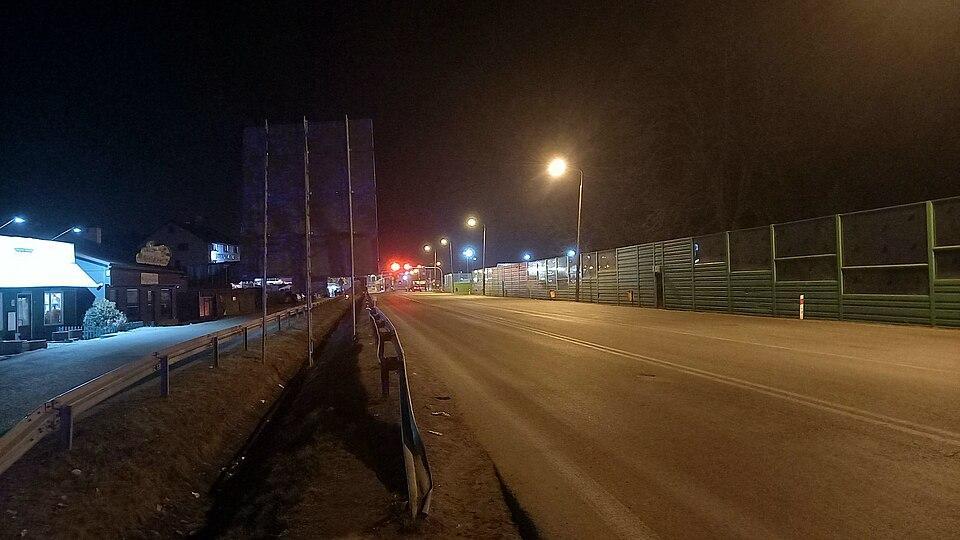
The first footage of the fire was circulating on local channels before dawn. Confirmation came after nine in the morning. Valentyna Chernysh, spokeswoman for the Volyn Customs Service, told Suspilne that “falling debris set fire to the premises of the petrol station and several lorries parked next to it”.
Andrii Demchenko, spokesman for the State Border Guard Service of Ukraine, clarified a point that was being lost in the headlines: “there were no hits on the Yahodyn checkpoint on the border with Poland as a result of the enemy’s night-time air attack”. The infrastructure beside the crossing was damaged, not the crossing itself.
The Polish Border Guard described it differently that morning. Major Dariusz Sienicki of the Nadbużański Border Guard Unit spoke of a drone that hit a lorry – “about 800 metres from the Polish border” – and noted that, contrary to earlier reports, the Border Guard had no information about the petrol station being hit. The Ukrainian confirmation came later and was more detailed, but the discrepancy over the mechanism remains open: a drone striking a vehicle is not the same as a fire caused by falling debris. Neither side has so far confirmed any casualties; the Ministry of the Interior and Administration said only that no one had been hurt on the Polish side.
No one attributed a type to the drone. In the night’s wave the Air Force counted 453 drones – Shaheds, including jet-powered versions, Gerberas, Parodiya decoys and S8000 Banderol missiles – of which 409 targets were shot down or jammed. With a raid of that composition, calling this particular machine a Shahed would be guesswork.
Clearances were suspended for the duration of the alert and people went down to the shelters. By 10 a.m. the crossing was working normally again.
The night’s second target: the locomotive of the Kyiv–Warsaw train
The petrol station was not the only facility hit near the border that night. Oleksandr Shevchenko, deputy director of Ukrzaliznytsia for passenger transport, told Suspilne that a Russian drone had struck the locomotive of the international passenger train on the Kyiv–Warsaw route directly. The hit occurred in Volyn region, less than two kilometres from the Ukrainian-Polish border. No deaths or injuries were recorded among the passengers – the crew had received advance warning from an air-threat monitoring group and managed to react.
The strike on the locomotive was another episode in the intensified Russian attacks on Volyn’s transport infrastructure and communication routes, including those leading towards the border with Poland and forming one of Ukraine’s key transport links with Polish territory. In the course of a single night, within a two-kilometre belt along the border, two elements of the same corridor to Poland were damaged – road and rail.
Fighters after four, sirens at 4:15, all clear at five
The Operational Command of the Armed Forces announced after 4 a.m. that military aviation had begun operating in Polish airspace, that ground-based air defence systems had been placed on alert and that radar reconnaissance had been reinforced. The communiqué contained the word that is decisive in this case: the measures “are preventive in nature”.
At around 4:15 sirens sounded across the Lublin region. A quarter of an hour later the RCB sent out text messages warning of an air attack threat to six units: the Włodawa, Łęczna, Świdnik, Krasnystaw and Chełm districts and the city of Chełm. The alert was called off at about 5 a.m.
The military then stated that “no violation of the airspace of the Republic of Poland was recorded”. That distinction is worth maintaining, because in the first hours the opposite claim was circulating online. Polish aircraft were not scrambled after a drone was detected over Poland – they were scrambled because the Russian raid was taking place a few hundred metres from the border.
Since 20 August: six crossings and facilities directly connected with them
Yahodyn did not happen in a vacuum: on 9 September the spokesman for Ukraine’s Border Guard spoke of five checkpoints attacked in recent times – four on the border with Moldova and one with Romania.
On 20 August drones hit a facility near the Reni–Giurgiulești crossing; two trailers carrying food burned out and there were no casualties. Then on 21 August they struck Tabaky, and on 25 August the Vynohradivka–Vulcănești crossing, damaging infrastructure and halting customs clearance. On the night of 31 August to 1 September Shaheds hit buildings and the grounds of the Orlivka ferry crossing on the border with Romania. And on 9 September two people were killed and three injured at Starokozache–Tudora – all civilians waiting near the crossing.
Yahodyn is the sixth point in this series and the first on the border with Poland. Nor do all the cases have the same character – in one a terminal was hit, in another a facility beside it, in another a lorry park.
The series itself is not a debut. Orlivka was also a target in 2023 and 2024, which Ukrainian analysts record in a separate chronology of strikes on border infrastructure. What is new is the density of the strikes.
Volyn’s busiest crossing and a building site
Yahodyn–Dorohusk, known on the Polish side as Dorohusk–Yahodyn, operates around the clock and, since 27 June 2022, handles lorries and coaches only; cars travel by other routes. A strike in this place therefore affects heavy transport above all, not tourist traffic.
In the summer of 2026 around 1.2 million people and 237,000 vehicles passed through the Volyn crossings. Ustyluh cleared the most passengers – Yahodyn the most vehicles.
It is also a building site. In May the construction of a parking zone for 600 lorries on 13 hectares beside the crossing was announced, half financed by the European Union under the Connecting Europe Facility and the EU–Ukraine solidarity lanes, with a deadline of the end of 2026. Russian drones burned lorries at exactly the spot where Brussels and Kyiv are preparing room for the next six hundred.
The day before: the railway in Lutsk and Kovel
On the afternoon of 12 September Russian drones struck Volyn’s railway junctions. An explosion took place in Lutsk at 15:11, and at around 15:51 in Kovel. According to the acting head of the regional military administration, Roman Romaniuk, some 20 drones were recorded over the region: one attacked the Kyiv–Kovel passenger train in Lutsk, the rest were directed at railway infrastructure in the Kovel municipality. Five people were injured.
Kovel and Yahodyn lie on the same axis – the M-07 Kyiv–Kovel–Yahodyn road and the railway that ends at the Polish border. Two strikes in two days on the same corridor are a strong indication. They are not yet proof of a single jointly planned package of targets.
What Russia achieves without destroying the crossing itself
None of the six crossings has been put out of action permanently. Yahodyn returned to work after a few hours, Starokozache after a few days. The effect is different and cheaper: each strike closes a checkpoint for several hours, pushes traffic onto neighbouring ones, lengthens routes and queues, raises cargo insurance costs, forces hauliers to recalculate risk and compels the dispersal of lorry parks, which by their nature are concentrations of flammable targets.
Ukraine’s Border Guard speaks openly of an intention to disrupt logistics routes. In an August analysis the ISW attributed to Russia a two-track strategy: strikes on overland export routes and political intimidation of Moldova and Romania. These are assessments – the first from a service fighting a war, the second from a think tank – not Russian documents. The Russian defence ministry itself used a general formula during this period about “transport and logistics infrastructure used by the AFU”, which establishes nothing. A declaration by the attacking side is not an independent description of the character of a target.
It is tempting to ascribe a military function to the petrol station. There is no public evidence for it. A civilian station at a civilian crossing serving civilian lorries remains a civilian station until someone shows something more.
Eight hundred metres. What changed after Yahodyn
Proximity to the border is not the same as an attack on Poland. Four things need to be separated: a strike on a target on the Ukrainian side near the border, an unestablished or accidental violation of NATO airspace, a deliberate violation, and a deliberate attack on allied territory. Yahodyn belongs – on all the material available today – to the first category. Poland did not find any violation of its airspace.
That does not change the fact that such strikes set real procedures in motion: fighters in the air, radars, sirens, text messages to several hundred thousand people. One effect is that Russia can observe how those procedures work. There is no public evidence that testing the Polish response was an aim of the planning rather than a by-product of geography.
Three days earlier, on 10 September in Bratislava, Donald Tusk said that cooperation between the Polish and Ukrainian services had made it possible “to avoid a direct threat to one of the border crossings”, and added: “Russia has recently opted for provocative attacks on crossings, including in Moldova. We expect this in other countries as well, including Poland.” He did not reveal which crossing he meant, and there is nothing to suggest he was speaking about Yahodyn.
This is the answer to the question about the last night. Not the beginning of a new war and not a test of Article 5, but a geographical extension of a pattern that has been running in the south-west for three weeks. Russia has been attacking Ukrainian logistics for years; what is new is that it is doing so at formal border crossings, one after another – and that it has now reached Dorohusk. Ukraine’s foreign minister, Andrii Sybiha, called it “Putin’s terror knocking directly on the door of the EU and NATO”. Eight hundred metres really is very little.
Author: Artur Żak