
From 1 September, a law comes into force in Russia prohibiting the use of the term ‘diamond’ to describe laboratory-grown diamonds. From now on, these gemstones will be labelled as ‘cut synthetic diamonds’. However, the law does not apply to other laboratory-grown precious and semi-precious stones.
In brief:
- On 30 May, the Russian Federation adopted a resolution amending the rules for labelling lab-grown diamonds. In addition to the ban on using the term ‘diamond’ to refer to lab-grown stones, the unit of measurement will also change.
- The proliferation of lab-grown diamonds poses a threat to the market for naturally mined gemstones.
- Until 2022, Russia held the leading position in the world for diamond mining. Due to sanctions, ALROSA’s profits have fallen by more than 80 per cent.
- Russia has begun buying up its own stocks of precious stones from ALROSA. It is also encouraging buyers to invest in diamonds.
- One of Russia’s diamond mines is being closed down.
- This new measure is a desperate attempt to save the market for natural gemstones, which has been virtually shut down due to the export ban.
What the new Russian Federation decree entails
On 30 May 2026, the Government of the Russian Federation adopted Decree No. 657 ‘On the Approval of the Rules for the Sale of Goods under a Retail Sale and Purchase Agreement, the List of Durable Goods to Which the Consumer’s Right to Receive, free of charge, goods possessing the same essential consumer properties, for the duration of the repair or replacement of such goods, and the list of non-food goods of satisfactory quality’.
The provisions of the resolution will come into force on 1 September. The new regulations prohibit the use of the term ‘diamond’ in relation to stones produced in a laboratory. It will be replaced by the term ‘cut laboratory-grown diamond’. It is also prohibited to use other descriptors that may imply the natural origin of the stones, such as ‘precious’ or ‘eco-friendly’. Furthermore, such precious stones will be measured in grams rather than carats.
The Russian Ministry of Finance explains that the new rules are an attempt to make jewellery displays more transparent for buyers and to protect consumers from unscrupulous sellers who may fail to disclose the laboratory origin of diamonds at the point of sale. However, the new rules apply exclusively to diamonds and do not extend to other precious and semi-precious stones, which also have lab-grown equivalents on the market.
What is the difference between natural and lab-grown diamonds?
Dmytro Vydolob, president of the Ukrainian Jewellers’ Union, explains that in terms of chemical composition and physical properties, both types are diamonds. The main difference between natural and lab-grown stones is their cost. On the market, the price difference can be more than tenfold.
Crysdiam, a company specialising in the production of lab-grown diamonds, reports that the price difference between lab-grown and natural gemstones is as much as 50 per cent, and in some cases even 80 per cent.
‘Be that as it may, in both cases they are diamonds. Lab-grown diamonds and natural diamonds are, in fact, one and the same. The only difference is how they are produced. Natural diamonds take millions of years to form, so to speak, whilst lab-grown diamonds are essentially the result of a technological process. The main difference lies in the cost”, says Dmytro Vydolob.
According to data from BRITECO, by 2025 over 45 per cent of all engagement rings purchased in the US will feature a lab-grown diamond. The market is undergoing a period of transformation, and lab-grown diamonds are set to become the dominant force.
Why Russia is trying to distinguish between the two concepts
In 2021, the diamond mining industry generated around $4 billion in revenue for Russia.
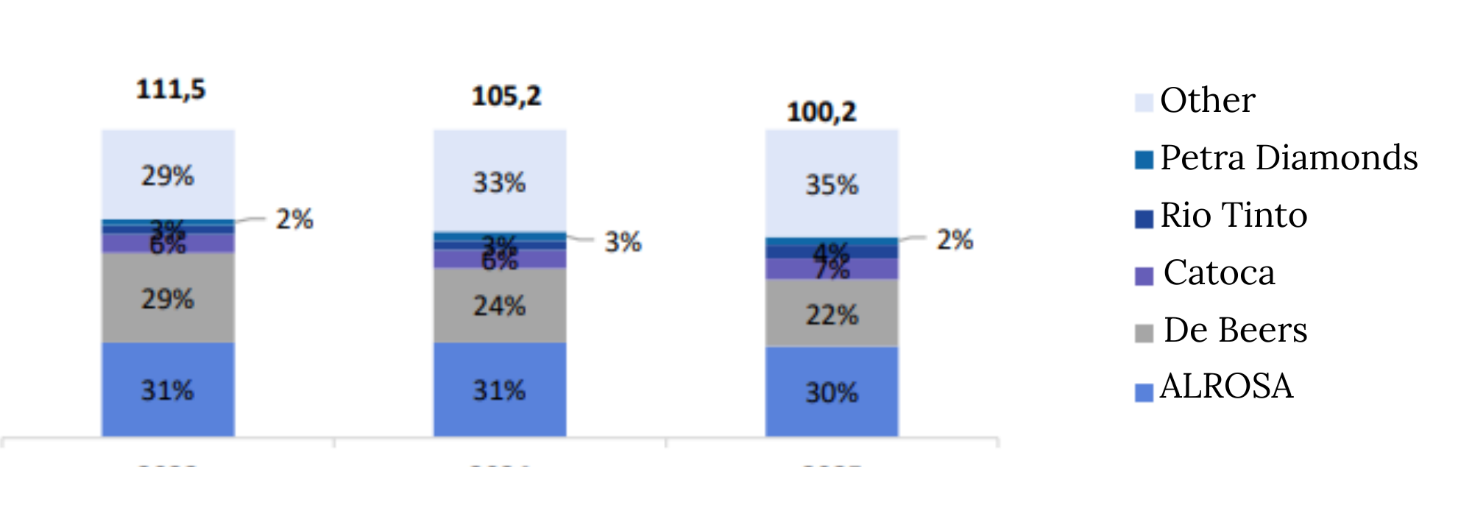
Russia accounts for around 30 per cent of global diamond production, occupying a leading position in the industry. The mining industry in the Russian Federation is monopolised by ALROSA, which accounts for around 90 per cent of all diamonds mined in Russia.
In 2025, ALROSA’s gemstone production totalled 29.8 million carats, whilst global production stood at approximately 100.2 million carats.
ALROSA JSC is state-controlled. The company’s shares are held by the Ministry of State Finance of the Russian Federation, the Republic of Sakha and the municipal districts of Yakutia.
Russia possesses the world’s richest diamond resource base – around 50 per cent of global reserves. As at 1 January 2026, the reserves of deposits on the ALROSA Group’s balance sheet, according to the company’s report for 2025, amounted to 1,027,057 thousand carats.
However, despite these substantial reserves, the company’s profits are falling and production is declining.
How ALROSA’s profits have changed
The twelfth package of sanctions against Russia included restrictions on the trade in precious stones; in particular, EU and G-7 countries refused to purchase Russian diamonds, and the same applies to precious stones processed in third countries.
Although some countries had stopped buying Russian diamonds as early as 2022, the sanctions were not introduced until 2024 due to delays in reaching a decision. In particular, diamonds accounted for 5 per cent of Belgium’s imports, so the country had long been calling on its partners to develop an appropriate diamond-tracking system to prevent the market from shifting to other countries.
Due to the delay in decision-making, Russia was able to prepare for the restrictions and devise ways to circumvent the sanctions.
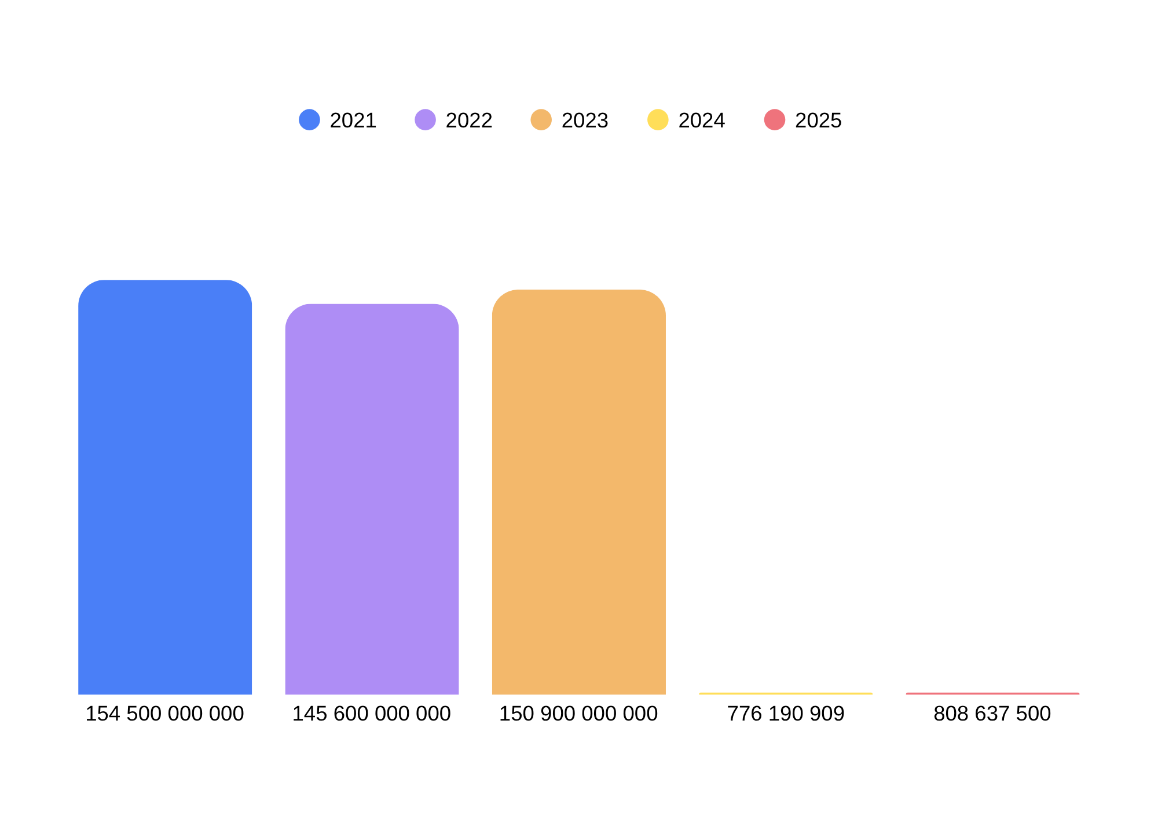
However, in 2024, the company’s earnings did fall. Whilst ALROSA’s gross profit stood at approximately $2.088 billion in 2021, by 2025 the figure had fallen to just $808.64 million. Over four years, ALROSA’s gross profit fell by 61%.
However, in 2024, this figure was even lower — $776.190 million. The company’s reports state that the 88 per cent increase in profit in 2025 was achieved mainly through proceeds from the sale of the Katoka and Hidroroshika S.A.R.L. joint ventures (the transaction was completed on 26 May 2025). Below are ALROSA’s gross profit figures in roubles.
How Russia is trying to support the diamond industry
In 2024, Russia began buying up its own diamonds for the State Reserve (State Fund for Precious Metals and Precious Stones). Among the purchases was even a rare 390-carat diamond mined in 2023. The exact purchase price was not disclosed, but the Rapaport Group estimated it at approximately $100 million. In 2025, the Russian Federation’s State Depository allocated a total of up to 154.5 billion roubles (US$1.97 billion) for the purchase of precious metals and gemstones for the period 2025–2027.
In addition to state support, the Russian Federation is seeking to encourage domestic buyers, in particular by opening up the diamond investment market. In 2019, ALROSA launched the ALROSA Diamond Exclusive programme, which specialises in the sale of the largest and most expensive diamonds as investments.
However, the real boost to this sales channel came after the abolition in Russia of the tax on the purchase of investment diamonds by private individuals in 2022. In the same year, the Moscow Exchange announced the launch of ‘diamond’ indices, whilst ALROSA introduced a system for buying back investment diamonds from its own customers. However, according to the company, prices for precious stones are calculated based on the ‘exchange rate’ at the time of buyback, rather than depending on the price paid by the investor.
According to data from the Moscow ‘Diamond’ Exchange, the index has fallen by 4.29 per cent since the start of 2026.
Dmytro Vydolob, president of the Ukrainian Jewellers’ Union, believes that diamonds are not the best choice for investment:
“When it comes to investment, lab-grown diamonds are certainly out of the question, but natural diamonds could be considered an option—though I don’t think so. The trend towards gold makes it, after all, a more attractive investment than diamonds. This is because, since the end of 2005, the global gold price has never been negative.”
Looking at the last few years as a whole, we are seeing a downward trend in diamond prices, according to the international diamond exchange IDEX.
Can domestic buyers save the market?
ALROSA’s investment diamonds consist solely of unique stones weighing 2 carats or more. Although the company has developed ‘diamond baskets’ – sets of smaller stones designed to create an attractive investment proposition – this still does not solve the problem of selling smaller diamonds to the mass market.
It was precisely for this reason that amendments were made to current Russian legislation, prohibiting the use of the actual name for laboratory-grown diamonds, in order to encourage the mass consumer to focus on ‘diamonds’ (of natural origin) rather than ‘cut laboratory-grown diamonds’.
Dmitry Vidolob attributes this new development to the decline of the diamond mining industry in Russia.
“How many Ukrainians could fit into Yakutia (the Republic of Sakha in the Russian Federation)? Now imagine that this entire vast territory sustains itself almost exclusively through the extraction of gold and precious stones…”, the expert points out.
From 1 July, mining operations at Severalmaz, part of ALROSA, will be suspended for a period of around three months. The company explains the decision as part of a strategy to maintain operational and financial stability and to ensure discipline in the effective management of rough diamond sales flows. However, will operations be able to resume at all, given that production was due to increase in 2025? ALROSA had even begun work to launch diamond mining at yet another pit — ‘Karpinsky-2’ — only to halt production entirely just a year later.
Last year, ALROSA temporarily suspended mining at some alluvial deposits in Yakutia and at the Verkhne-Munske deposit due to unprofitability. In total, these deposits accounted for up to 3 per cent of the company’s total diamond output, whilst Severalmaz accounted for up to 14 per cent of production.
Yulia Derdyuk
Official Russian and Belarusian sources cited in this text are for informational purposes only. Content from these sources may constitute disinformation or propaganda.