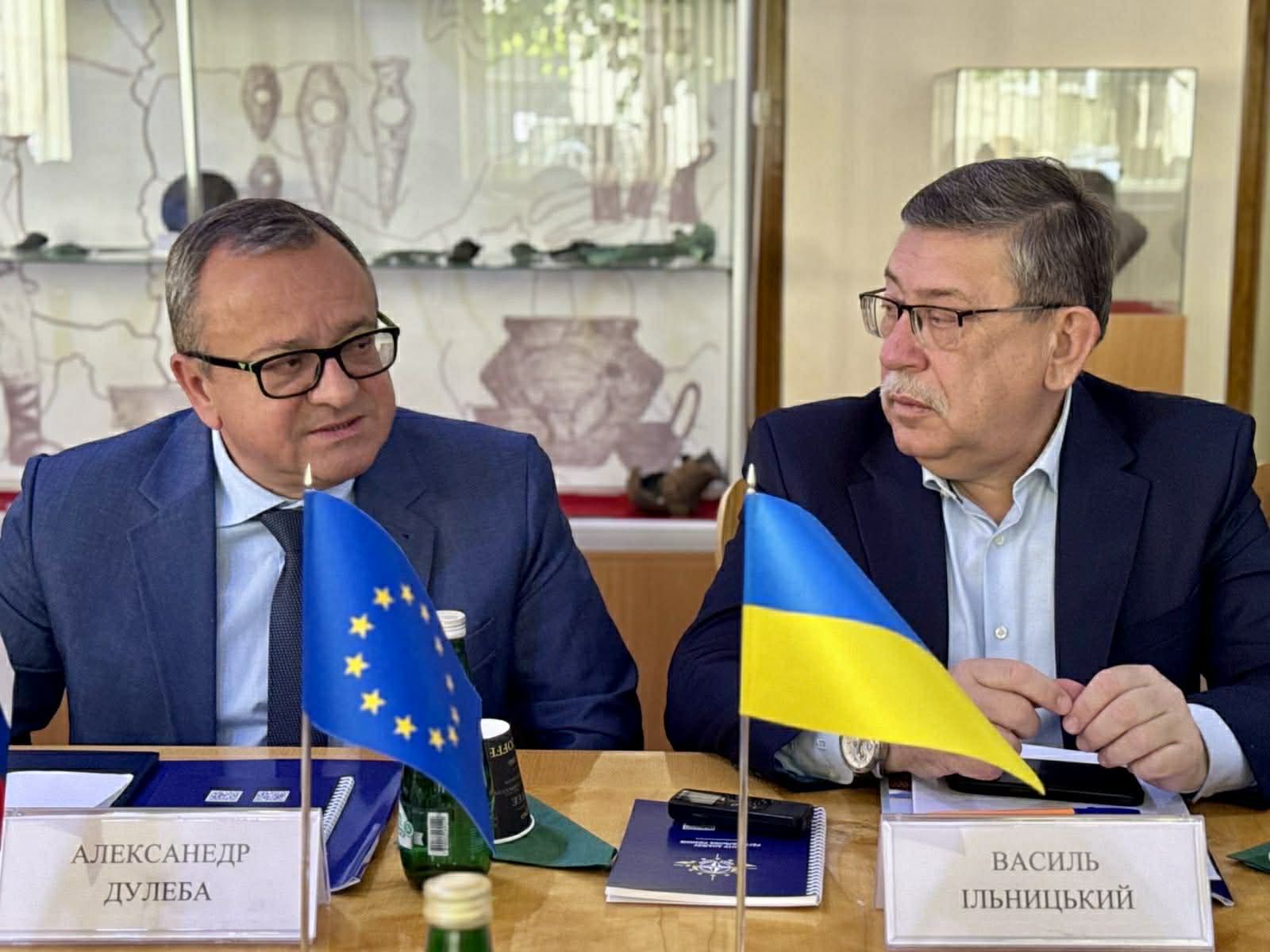

In March 2026, the Academic Council of UzhNU conferred the title of “Honorary Doctor of Uzhhorod National University” upon Alexander Duleba—a professor of political science at the University of Prešov, senior researcher at the Research Center of the Slovak Foreign Policy Association (RC SFPA), a leading analyst specializing in Eastern Europe, particularly Ukraine, Honorary Advisor to the President of the Slovak Republic on Foreign Policy (2003–2006), and Advisor to the Prime Minister of the Slovak Republic (2021–2023). A few days later, the renowned scholar visited Uzhhorod. We took this opportunity to have a candid conversation.
In Brief
- Behind the scenes of the negotiations at the start of the full-scale invasion
- Slovakia is in favour of Ukraine’s swift integration into the EU
- Orbán’s defeat foreshadows Fico’s defeat in the elections
In Kyiv in the 1980s, few people spoke Ukrainian
– You went on to pursue higher education at the Faculty of Philosophy of Kyiv National University. What motivated you to make such an unconventional decision?
In the upper grades of the Svidnytsia Gymnasium, where I received my secondary education, I had the opportunity to study the Ukrainian language and literature. It was at that time that I realized that to better understand the world, I needed to radically change my environment, go beyond the confines of my native village, my district, and my region, and get to know a different society. That is why I wanted to continue my studies abroad. I successfully passed the entrance exam for the Faculty of Philosophy at the University of Prešov, which was a prerequisite for continuing my studies abroad. I was interested in philosophy and the social sciences, and the only place to study them abroad was in the Soviet Union. I didn’t know exactly where I would be sent—they could have sent me to Moscow or Minsk, but they sent me to Kyiv, to Taras Shevchenko National University. It was fate—to end up studying in Kyiv.
– How did Kyiv welcome you?
Nowadays, in such cases, people say—I experienced culture shock. In Czechoslovakia, I had the opportunity to study the Ukrainian language, but in Ukraine, all classes were conducted in Russian! Kyiv in the late 1980s surprised me—few people in the city spoke Ukrainian. I spoke Ukrainian only in the dormitory and in my free time with students who had come to Kyiv from the western regions of Ukraine.
Overall, the studies were interesting and informative. Students had free access to high-quality translations of works by the classics of philosophy.
I was also lucky because my years of study coincided with Gorbachev’s “perestroika,” when the state opened the archives and encouraged public discussions on social issues.
In the archives of Kyiv University, I found Masaryk’s major works on the reconstruction of Central Europe after World War I purely by chance. This topic fascinated me immensely, and I chose it for my thesis. I was also intrigued by Masaryk’s personality. After the end of World War I, he came to Kyiv and reached an agreement with Milyukov (head of the Foreign Ministry of the Provisional Government of Russia. In May 1918, he negotiated in Kyiv with the German command regarding the formation of an anti-Bolshevik coalition—ed.) to form the first Czechoslovak battalion from among the Czech and Slovak prisoners of war held in the camp at Darnytsia. Incidentally, my great-grandfather Mikuláš was among them.
During that trip, deeply affected by the events in the Russian Empire, Masaryk came to the conclusion that the new Czechoslovakia would not be a monarchy but a republic. Setting off for the Far East, and from there to the United States for an audience with President Woodrow Wilson, he entrusted his library—which included his own works—to a Kyiv businessman, Dragomanov, for safekeeping; Dragomanov, in turn, entrusted it to St. Vladimir’s University. There they remained for several decades. I carefully reread them and made excerpts from them. The main theme of these works: to successfully resolve our national problems, we must help resolve the problems of our neighbors. This is relevant even today!
My analytical articles in the press on social issues were noticed by the Slovak Academy of Sciences, and they offered me a job
– In 1989, you returned to your homeland with a degree from a Kyiv university. What was your start into adult life like?
After being demobilized from the Czechoslovak People’s Army, I went to work at the Department of Social and Political Sciences at Pavol Jozef Šafárik University in Prešov. It was then that I wrote several analytical articles for newspapers on the collapse of the USSR and the political situation in Ukraine and Russia as new states. My work was noticed by the Slovak Academy of Sciences, and I was offered a position focusing on Slovak-Ukrainian relations. So, starting in 1993, I began working at the Institute of International Studies at the Ministry of Foreign Affairs of the Slovak Republic, and from 1995 onward, at the Research Center of the Slovak Foreign Policy Association.
– How did your collaboration with Slovakia’s top officials begin?
In 1998, when Prime Minister Mikuláš Dzurinda formed his first government, we received an invitation from the Ministry of Foreign Affairs to establish a department of political planning and analysis. I and several other colleagues declined the offer because we did not want to tie our fate to a government institution again.
We proposed that the Association and the Ministry of Foreign Affairs establish the Research Center of the Slovak Foreign Policy Association. The Ministry commissioned us to conduct expert studies on current topics to facilitate sound decision-making at the government level. This arrangement continued until 2023, when current Prime Minister Robert Fico suspended it.
Thanks to my years of study in Kyiv and my understanding of the Ukrainian mindset, I was fully aware that the occupiers would not be able to conquer Ukraine in ‘2–3 days’ or even years
– What specific issues did you work on as an advisor to the Prime Minister of the Slovak Republic? What specific advice did you give to Eduard Heger?
He took office in April 2021, and a phone call with Ukrainian President Zelenskyy was scheduled to take place a few days later. Heger was not very familiar with the Ukrainian political scene at the time, so I was invited to brief the prime minister on the situation. We had a substantive conversation lasting several hours, with which he was satisfied. A month later, I was included in the government delegation for a trip to Kyiv, and upon returning home, I was offered the position of advisor.
Heger was deeply concerned with foreign policy because, unlike many other leaders of Slovak governments, he understood well that Slovakia, as a small country, is highly dependent on external factors. In addition, Slovakia had virtually no hostile relations with any EU country, unlike, for example, the tensions between the Netherlands and Poland, the Czech Republic and Hungary, or Poland and Hungary. We maintained positive relations with everyone. Unfortunately, everything changed when Heger’s government lost its majority in parliament, and with it, the mandate to shape European policy.
Developing cooperation with Ukraine was the prime minister’s top priority, which is quite rare. Eduard Heger first asked me to develop a Strategy for the Development of Slovak-Ukrainian Relations. We met the rather tight deadlines set for us, and our strategy was successfully presented during the meeting of the Slovak and Ukrainian prime ministers in Uzhhorod in November 2021, but its successful implementation was hindered by the war.
On March 10–11, 2022, while Putin’s occupying forces were in Bucha, Hostomel, Vorzel, Irpin, and Borodianka and had Kyiv in their sights,
I had the opportunity, as an advisor to the Prime Minister, to attend an informal summit of European leaders in Versailles organized by French President Emmanuel Macron. It was there and then that the head of the Slovak government proposed to his EU colleagues a “rapid integration” plan for Ukraine, based on my many years of research in this field. Quite a few European leaders were shocked by this proposal, as they were unsure whether there would be anyone left to integrate or help, since Ukraine was on the verge of collapse. Thanks to five years of study in Kyiv and my understanding of the Ukrainian mindset, I was fully aware that the occupiers would not be able to defeat Ukraine in “2–3 days,” nor even over the course of years. That is why little Slovakia transferred one of our two available S-300 systems and MiG fighter jets to Ukraine right at the very beginning of the war, when the German chancellor’s government decided to provide the Ukrainian Armed Forces with nothing more than helmets… We needed to convey this conviction in Ukraine’s invincibility to our partners, and we succeeded! After that, European Commission President Ursula von der Leyen invited Heger to visit Kyiv with her in April 2022, after the Ukrainian Armed Forces had driven the Muscovites out of the Kyiv region.
Americans support far-right parties to dismantle the EU
– Can Ukraine’s hypothetical accession to NATO realistically provide us—and all of Europe—with firm security guarantees, or is it time to seek other, more effective and modern alliances?
On the third day after the start of the Russian invasion of Ukraine, German Chancellor Olaf Scholz said: a zeitenwende has arrived, which in Ukrainian means “a turning point.” And indeed, the war unleashed by Russia has shattered everything.
In my view, the most important issue for Ukraine today is accession to the EU, which must gradually take on the functions of a European NATO. The North Atlantic Alliance, to which the Trump administration also belongs, is ceasing to be a reliable project. It all began with the U.S. president’s statements regarding Greenland, followed by Canada, and now these actions in the Strait of Hormuz… If one reads the text of the current “U.S. National Strategy” carefully, it clearly follows that the Americans support far-right parties in order to dismantle the EU. This is exactly what Putin is striving for! Such actions run counter to the interests not only of Ukraine, but of all European countries. We must clearly understand that today a war is being waged on two fronts in Europe: a conventional one on Ukrainian territory, and a political one throughout the European community. Elections will take place in 14 EU countries over the course of this year and next. This is the immediate line of contact on the political front in the discourse regarding the war and in explaining to the citizens of these countries what is at stake in this war. It is precisely in these arenas that the fate of the war, the future of Ukraine, and the future of Europe as a whole are being decided today.
– What urgent steps, in your opinion, should be taken to successfully counter this threat?
Russia’s war against Ukraine is one of the key issues in the domestic politics of all European countries. Europeans need to counter the influence of Russian propaganda in their countries with something effective. The growing influence of pro-Russian forces in European countries is the result of disinformation about Ukraine. It is precisely this factor that should be given top priority at both the governmental and civic levels, to explain the nature and origin of Russian disinformation.
When most countries were still unsure of what to do, Slovakia proposed Ukraine’s integration as a response to the war. This war cannot end with just a bilateral agreement between Ukraine and Russia on some kind of ceasefire. It must end with the reconstruction of the overall security order. Together, we must have a clear understanding of where we see Russia and what its responsibilities are. Whether it wants that or not is its business, but we must have a clear position on what we are striving for! And Europe currently lacks such a position. And that is very dangerous! This concerns “hard power.”
Regarding “soft power.” As World War II was ending, British Prime Minister Winston Churchill proposed the integration of institutions. Not only a common economic market for goods, but also collective security. Everything that the concept of the “European way of life” encompasses—the rule of law, democracy, free elections, guarantees of human rights, and freedom of speech—is now in serious question. We are completely underestimating the foundations of the European integration project, which are now crucial to restore. We have returned to the relevance of Churchill’s ideas after 80 years of relative stability. Now is the time to acquire a new “umbrella” and build a new “curtain.”
It is of the utmost importance for us to restore the four pillars of the security order, for without this there will be no vision of the future. It is the EU itself that must assume the functions and guarantees of collective European security, regardless of the U.S. position.
If a decision on Ukraine’s accession to the EU cannot be reached within the legal framework of the EU’s functioning due to the blocking of one or two countries, then it is worth applying the formula of “differentiated integration,” authored by Finnish President Alexander Stubb. Why not? After all, not all EU member states are in the Schengen Area today, nor are all in the Eurozone. If there is no consensus, “coalitions of the willing” will form, modeled after the one that exists today providing military support to Ukraine. This coalition excludes neutral countries as well as Hungary and Slovakia, but includes the UK, Canada, and other non-EU nations. If the EU fails to reach a consensus, “coalitions of the willing” will form on issues such as energy and agriculture… If the EU cannot find a solution to the issue of Ukraine’s accession within the legal framework for decision-making, then we will lose the EU, Putin will win this war, and Europe will return to the 19th century.
We are heading toward conflict with the US. This is very sad and difficult. But this is a zeitenwende. Nothing will ever return to the way it was before the war. Putin started the zeitenwende; Trump finished it. We live in a new world, and we are slowly losing it because we don’t understand where we are now. The agenda is very complex. Either the EU will take on the role of NATO, the role of the armed forces, or it will disappear. My life experience has taught me to be an optimist.
Slovakia’s current government won the elections by banking on populism
– What prevented pro-European politicians from winning the recent parliamentary and presidential elections in Slovakia?
In my view, the main reason is that the previous parliament had a very broad coalition and the Matovič government’s anarchic style of work, which generated many conflicts among coalition partners and a sense of chaos in the government among the public. During the early parliamentary elections in 2023, Fico played this card well, guaranteeing stability and banking on populism. These ideas found support among the anti-establishment electorate, which accounts for nearly a third of voters.
– What is the phenomenon of the current Robert Fico?
He is a political strategist who has thoroughly studied the demands and sentiments of his electorate and says exactly what they want to hear, while instilling as much fear as possible in voters through various societal crises, such as the possibility of Slovakia being drawn into war or rising energy prices. In this sense, the presidential race was also revealing, when, at Fico’s instigation, the pro-European candidate Ivan Korčok was positioned as the “candidate of war,” and Peter Pellegrini as the candidate of peace. Plus the influence of the Hungarian media, which has systematically and for a long time worked with Slovakia’s Hungarian community.
– Observing the regular “Dost bolo Fico” (Enough is enough, Fico) protests, I conclude that if elections were held in Slovakia today, the results would be different. Am I wrong?
Based on our current research, “Progresívne Slovensko – Progressive Slovakia” currently has the most support (21–24%), followed by Fico’s SMER (17–20%), with the neo-fascist “Republic” (7–9%) in third place, “Voice” at 8%, and Heger’s “Democrats” at 5%. We must also mention the support for the “Freedom and Solidarity” (6–8%) and “Christian Democratic Movement” (6–8%) parties—these are opposition parties, just like Matovič’s “Slovakia” party (8–9%).
Currently, the biggest problem is that it will most likely be impossible to form a democratic parliamentary majority without Matovič’s party. And taking him on as a partner would be a deliberate recipe for new political scandals, since Matovič is a true Slovak Trump!
– Can Orbán’s party’s crushing defeat in the recent parliamentary elections in Hungary be considered the beginning of the end of populist politics?
Populism will never disappear from politics. I believe that the anti-establishment wave in Western democracies will reach its peak with Trump’s defeat in the U.S., which he and his team are working hard to achieve today. Orbán’s defeat in Hungary is a harbinger of this. I believe it is also a harbinger of Fico’s defeat in Slovakia in next year’s parliamentary elections. The crisis in Putin’s Russia and its failure in the war against Ukraine will also significantly contribute to this. Russia can only have prospects for development through cooperation with Europe. The alternative is its vassal dependence on China. Without Europe, Russia is doomed to defeat.
Vasyl Ilnytskyi