
A new wave of mobilisation following the State Duma elections is one of the most hotly debated topics in Russia. Ukrainian and Western sources claim that Vladimir Putin is preparing to announce an additional conscription drive, whilst Russian officials and military personnel dismiss such claims as ‘nonsense and rubbish’, and Russians of conscription age are looking for places to wait out these turbulent times.
In brief:
- Volodymyr Zelenskyy: Russia may step up mobilisation efforts following the State Duma elections
- Ukrainian Armed Forces officer: without an influx of new conscripts, the Russian Federation is unable to either increase or maintain the pace of its operations
- Russian officials and military personnel deny any reports of mobilisation
- Institutions and businesses are scrambling to find military registration specialists
- Meanwhile, Russians of conscription age are looking into how and where they can leave the country during mobilisation
Theories and denials
Ukrainian President Volodymyr Zelenskyy, citing intelligence reports, stated that the Russian authorities are planning to expand mobilisation in autumn 2026 — following the State Duma elections. According to him, the Kremlin hopes to use this to make up for the shortage of personnel needed to continue the war.
In early July, Czech President Petr Pavel made a similar statement. In his view, the Russian leadership is unlikely to take this step before the vote due to its unpopularity, but such a scenario is entirely possible after the elections.
According to reports in The Wall Street Journal, the Russian leadership intends to continue its offensive in Ukraine and seek full control over the Donbas; however, the current rate of recruitment of contract soldiers is no longer sufficient to make up for losses. As the publication reports, Russians with minimal training or those who have no desire to fight at all may be subject to the new mobilisation, whereas the first wave involved the conscription of reservists and men with military experience.
In Russia itself, both officials and the military deny any information regarding a possible mobilisation. Deputy Chairman of the Security Council Dmitry Medvedev described any reports on this subject as “nonsense” and “rubbish”, stating that the army continues to be replenished by contract soldiers and volunteers, and therefore no additional conscription is required.
Andrei Kartapolov, Chair of the State Duma’s Defence Committee, also dismissed such reports as a “flight of fancy” on the part of Volodymyr Zelenskyy and stated that there is no need for a new conscription drive. However, Kartapolov had made similar statements in September 2022 — just a few days before Vladimir Putin announced a “partial mobilisation” in Russia.
The contract army is stretched to the limit During the first wave of mobilisation, the Ministry of Defence planned to conscript 300,000 people. As early as October 2022, Sergei Shoigu, then Minister of Defence, reported to Vladimir Putin that the mobilisation target had been successfully met and that no further targets were planned as part of the partial mobilisation.
Since then, the Russian army has been replenished mainly through contract soldiers. The state has significantly increased the one-off payments for signing a contract, raised pay rates and expanded regional support measures. According to official figures, around 540,000 people enlisted for contract service in 2023, around 450,000 in 2024, and 422,000 in 2025.
At present, the Russian authorities are managing to recruit around 30,000 contract soldiers each month. This is comparable to the Russian army’s monthly losses, and in some periods is even lower than them. For instance, according to data from the General Staff of the Armed Forces of Ukraine, the Russian army’s losses in July 2026 reached 42,860 servicemen.
As an officer of the Armed Forces of Ukraine explained to BlackSky, “the ratio of losses to reinforcements among the Russians has remained negative for a long time. The Kremlin finds itself faced with a dilemma: to carry out a mobilisation with unpredictable domestic consequences in order to maintain a slow pace of the offensive, or to allow the offensive potential of its troops to be completely exhausted. Without an influx of new conscripts, the Russian Federation is unable to either increase or maintain the pace of its operations. At the same time, mobilisation alone, under the current conditions, does not guarantee an acceleration of the offensive.”
Learning from mistakes
In the four years since the first wave of mobilisation, Russia has significantly improved its military registration system. From 2025, the electronic summons register has been fully operational. A summons is now deemed to have been served not only upon personal receipt, but also from the moment it is entered into the state register.
At the same time, penalties for failing to report to the military registration and enlistment office have been expanded. Offenders may be barred from leaving the country, registering property or vehicles, or registering as self-employed.
In 2026, human rights activists began reporting on the practical application of these measures. According to their information, conscripts were prevented from travelling abroad via Vnukovo and Pulkovo airports, as well as via the land border crossing with Abkhazia. In April, the first case was recorded in which a Russian man who had ignored his conscription notice was prevented from flying via Belarus: border guards in Minsk removed him from flights first to Tbilisi and then to Yerevan.
Amid rumours of a possible mobilisation, Russians set a record in June for the number of search queries related to leaving the country. Searches for ‘where to go without a visa’, ‘how long does it take to get a passport’ and ‘permission to leave the country’ reached their highest levels since the start of the war, according to an analysis of data from Yandex and Google Trends carried out by the ‘We Can Explain’ project.
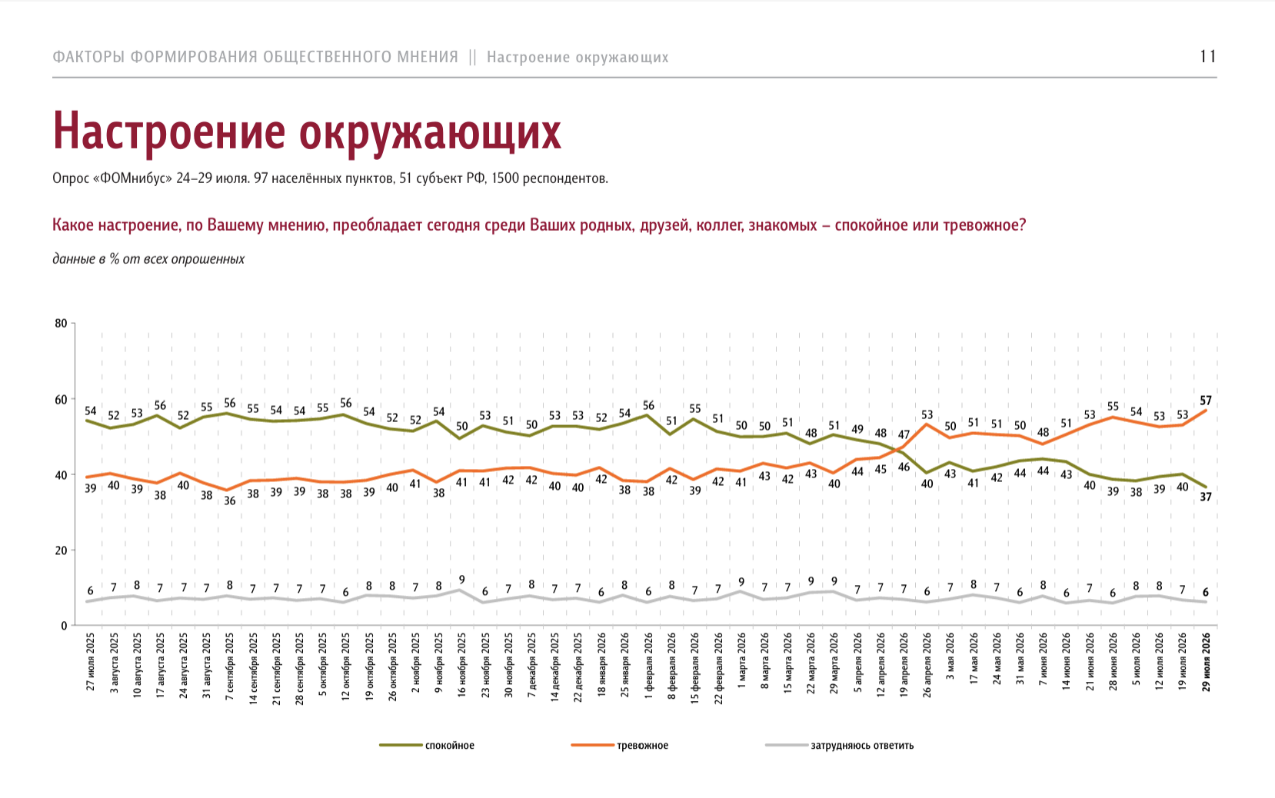
A survey by the Public Opinion Foundation also recorded a rise in anxiety among Russians. Over the week from 24 to 29 July, the proportion of respondents feeling anxious increased from 53 per cent to 57 per cent, reaching its highest level since the 2022 mobilisation. It was precisely at this time that the Russian authorities were actively denying preparations for a new mobilisation.
According to an officer in the Armed Forces of Ukraine, ‘the first wave of 2022 prompted around one million men to leave Russia. The main threat posed by a new mobilisation is the destabilisation of the socio-political situation. Mass conscription could trigger a rise in social discontent, a new wave of emigration, a loss of trust in the authorities and a further deepening of the labour shortage in the economy. Even in the absence of widespread panic, mass conscription will not resolve systemic problems with the training, command and logistical support of the troops. At best, the newly mobilised will be used to plug gaps on the front line as ‘cannon fodder’.
Signs of an impending mobilisation
According to an assessment by the US Institute for the Study of War (ISW), the Kremlin is already laying the legal groundwork for mobilisation: The State Duma has expanded the group of individuals with criminal records who are permitted to sign contracts with the Ministry of Defence, whilst the Russian Guard has updated its civil defence regulations to take into account periods of mobilisation and martial law.
Since June, managers, accountants and HR staff in Russian companies have been preparing employees for mobilisation. At the same time, the Federal Tax Service’s in-house journal, *Russian Tax Courier*, published a guide entitled ‘Priority Order of Conscription during Mobilisation’, which explains how to maintain military registration records correctly, how to respond to summonses and mobilisation orders for employees, and how to notify military registration and enlistment offices.
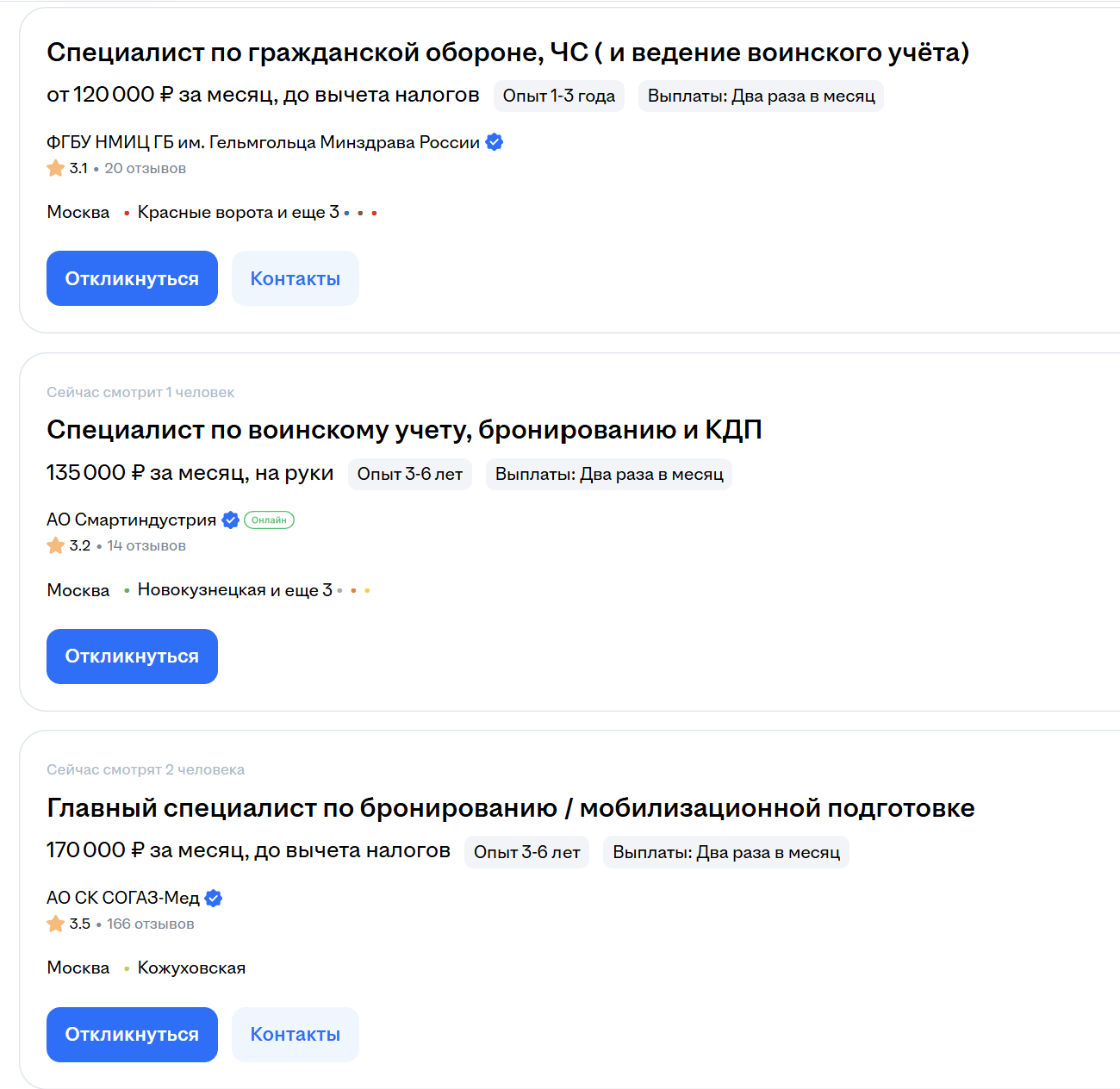
At the end of July, companies and government bodies across Russia began a mass search for specialists in military registration and mobilisation. Hundreds of such job advertisements have been posted on the HeadHunter job search platform: everyone from hospitals to Roscosmos is looking for specialists.
Authors: Olga Semashko, Artur Żak
Official Russian and Belarusian sources cited in this text are for informational purposes only. Content from these sources may constitute disinformation or propaganda.