
The Russian government has submitted to the State Duma its draft federal budget for 2027 and the planning period 2028–2029. The document is currently being examined by the relevant committee, and the first reading in the State Duma is scheduled for 29 October.
The Finance Ministry faces a difficult task – balancing public finances. The growth of military spending in 2026 noticeably widened the budget deficit, while oil and gas revenues, despite the higher price of oil, turned out lower than planned. All of this diverged from the initial forecasts and forced the government to adjust key budget parameters in the course of the year.
In the 2027 budget the authorities are trying to reduce this imbalance through growth in tax revenues, restraint on civilian spending and a further build-up of domestic debt. On military spending, however, there is no economising.
In brief:
- The budget rests on the baseline macroeconomic forecast for 2027: accelerating economic growth, inflation falling to 4%, a weaker rouble and cheaper oil. The experience of 2026 shows that these benchmarks may still change substantially.
- The deficit remains high, despite the Finance Ministry’s attempts to balance public finances.
- The deficit is financed mainly through growth in domestic debt, and servicing it is becoming more expensive.
- Oil and gas revenues are increasingly being replaced by domestic taxes.
- Defence remains the main spending priority.
The 2027 budget has been drawn up on the basis of the Economic Development Ministry’s baseline macroeconomic forecast of September 2026. The government expects that next year GDP growth will accelerate to 1.4%, inflation will fall to 4%, the average exchange rate will stand at around 87 roubles to the dollar, and Urals oil will cost about $53 a barrel. At the same time, the investment downturn is expected to end, real household incomes to rise and the economy to be supported by domestic demand.
How realistic these assumptions are is shown well by the experience of 2026. When the current budget was being drawn up, the government expected GDP growth of 1.3%, inflation of 4%, an exchange rate of 92.2 roubles to the dollar, a Urals price of about $59, a fall in investment of only 0.5% and growth in real disposable incomes of 2.1%.
By the autumn most of these forecasts had to be revised.
GDP. In the first half of the year the economy grew by only 0.6% year on year: after a decline of 0.2% in the first quarter, growth in the second came to 1.3%. The government now expects around 0.6% for the whole year – less than half the original forecast.
In other words, instead of the expected moderate growth, in 2026 the Russian economy was in fact balancing on the edge of stagnation.
Inflation. Instead of the expected return to the 4% target, annual inflation in August stood at 6.33%. For the year as a whole the government forecasts around 6.8%, and the Bank of Russia 6–7%. The return to the central bank’s target is being pushed back to next year.
Oil. Here, by contrast, the government’s forecast proved too cautious. Instead of the $59 a barrel for Urals assumed in the forecast, the Economic Development Ministry now expects around $61.2. Oil prices were supported, among other things, by geopolitical tension in the Middle East, which heightened the risks to supplies and to key export routes.
The rouble exchange rate. Instead of the 92.2 roubles to the dollar assumed in the forecast, the Economic Development Ministry now expects an average rate of around 79.5 roubles for 2026.
The higher price per barrel, however, did not offset the effect of a strong rouble, and as a result the budget’s oil and gas revenues came in 15% below plan.
Investment. This is one of the largest deviations from the forecast. Instead of the expected fall in fixed capital investment of just 0.5%, in the first half of the year it dropped by 9.9%. The government now expects a contraction of around 5.4% for the year as a whole.
Household incomes. Here the divergence from the forecast is slight. The government expected real disposable incomes to grow by 2.1%. In the second quarter they were around 1.5% higher than a year earlier, while real wages rose by around 4.4%. Growth in household incomes remains one of the factors supporting consumer demand against a background of weak investment activity.
Budget imbalance
In 2027 federal budget revenues are planned at 43.3 trillion roubles and spending at 48.8 trillion. The deficit will come to around 5.5 trillion roubles, or 2.2% of GDP. A year ago the gap between revenues and spending for 2027 was estimated at 3.2 trillion roubles, or 1.2% of GDP.
In a single budget cycle the planned deficit has grown by more than 2 trillion roubles.
But even this benchmark may prove too optimistic. The experience of 2026 shows that spending cannot be kept within the original limits. The budget for this year was drawn up with a deficit of 3.8 trillion roubles, or 1.6% of GDP, yet within eight months it had reached 5.8 trillion. The Finance Ministry now expects around 7.3 trillion roubles for the year as a whole, or 3.2% of GDP – almost twice as much as the original plan envisaged.
Revenues: less oil, more taxes
In 2027 the policy of reducing the budget’s dependence on oil and gas continues – the sector is now set to account for around 16% of all revenues, against more than 20% under the previous plan.
At the same time the government is tightening the budget rule. A year ago the cut-off price for Urals was to be lowered gradually – from $59 a barrel in 2026 to $55 by 2030. Now the bar is being brought down to $50 straight away, from 2027.
Revenues above the baseline level will be directed to the National Wealth Fund (NWF) rather than to the financing of current spending. In the Finance Ministry’s design, this should make the budget less dependent on the oil market.
The revenue side is coming to rest on non-oil-and-gas receipts – above all domestic taxes. The budget expects to collect more revenue thanks to the already raised rates of corporate profit tax and VAT.
Receipts from personal income tax on interest from bank deposits are planned to increase by more than one and a half times (to around 1.02 trillion roubles). The increase is linked not only to high interest rates and the large volume of funds held on deposit, but also to a change in the way the tax is collected. Banks will now withhold personal income tax directly when interest is paid out, while the amount of interest income exempt from tax is to be reduced.
At the same time the Finance Ministry proposes extending the progressive 13–22% personal income tax scale to passive income – including dividends, interest, income from securities transactions and from the sale of property.
The budget plans to save money at the expense of oil and gas companies: their payments under the fuel damper – the mechanism that compensates part of the difference between the export and the domestic price of fuel – will be reduced. The downward adjustment to the damper formula was due to be abolished from 2027, but it will now be kept for a further two years. As a result, around 423 billion roubles will remain in the budget in 2027.
Spending: everything for the front
While on the revenue side the state is looking for new sources of receipts, on the spending side it is defining ever more strictly who will receive them. Total federal budget spending in 2027 will come to around 48.8 trillion roubles. That is comparable with spending this year.
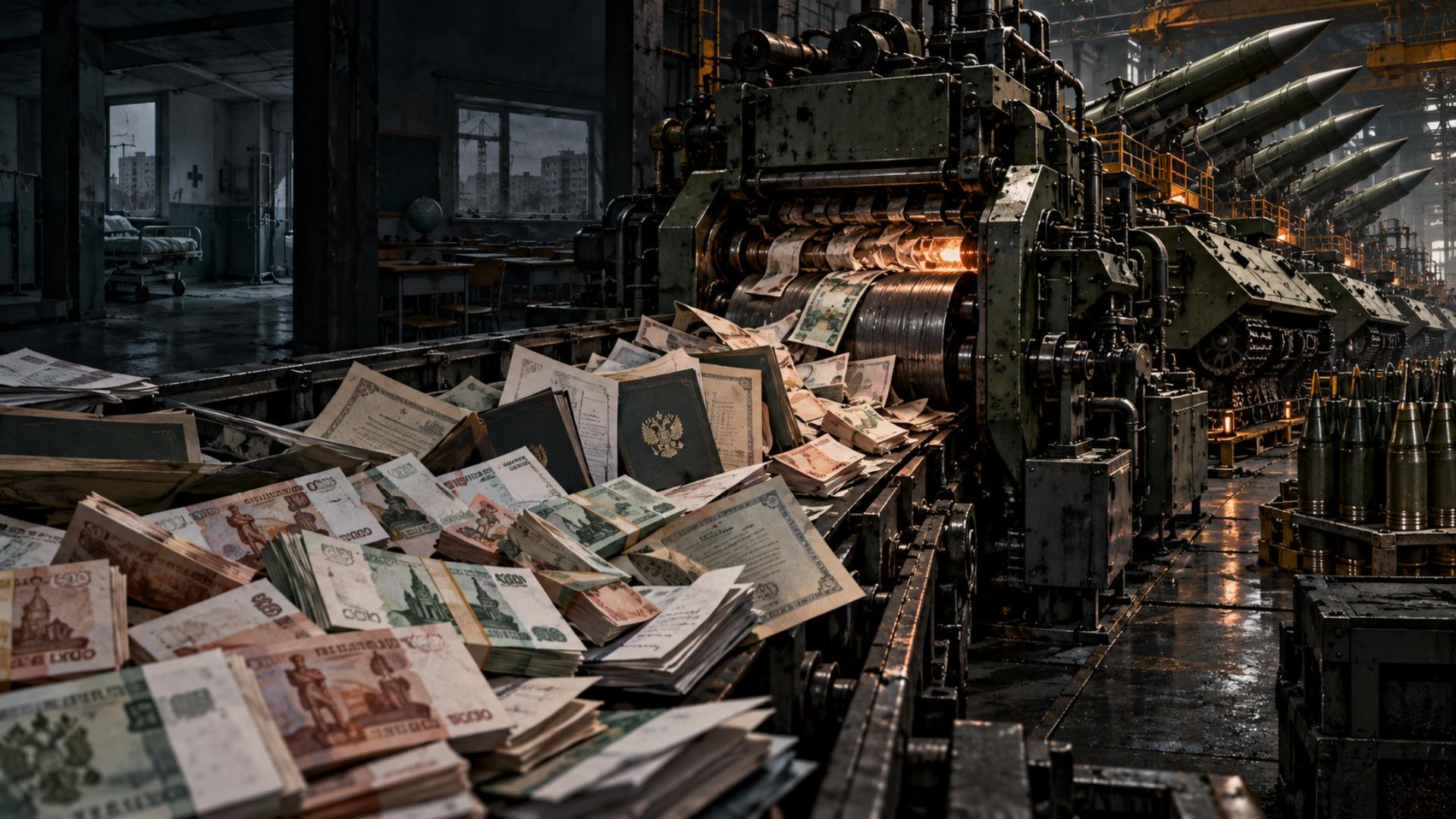
The state is not economising on defence – around 17.1 trillion roubles has been set aside for it in 2027. A year ago about 13.6 trillion was planned for that same year, 2027. In other words, in a single budget cycle military spending has risen by around 27%.
If spending on national security and law enforcement is added, the security bloc accounts for around 44% of federal budget spending.
Almost every second rouble of budget spending goes to defence and security.
One more rapidly growing item of budget spending is indirectly linked to the war – servicing the state debt. The point is that the current budget deficit is financed mainly through domestic borrowing: the Finance Ministry issues OFZ bonds, and because of high interest rates new borrowing is costing the state ever more. In 2027 interest payments alone will require around 4.6 trillion roubles – an increase of almost 18% in a year.
Against this background the government is being forced to squeeze civilian spending items: compared with the previous plan, spending on social policy, healthcare, education and the national economy is being cut by an average of 7%.
At the same time spending on payments to combat veterans will rise: around 228 billion roubles is provided for in 2027 – 12% more than in 2026. The increase is linked, among other things, to the number of recipients rising from 3.6 million to 3.9 million people.
The government: a budget resilient to different scenarios
Within the government the 2027 budget is described above all as an attempt to return public finances to a more stable structure after the sharp growth in spending of recent years.
Finance Minister Anton Siluanov calls the budget “balanced” and resilient to different scenarios. The Finance Ministry’s main argument is its more conservative assumptions about the price of oil: the baseline Urals price in the budget rule is being lowered to $50 a barrel. According to Siluanov, even at that price the state will be able to meet all the obligations provided for, while additional oil and gas revenues under a more favourable market will be directed to the NWF.
Prime Minister Mikhail Mishustin sets out the budget’s priorities more directly: meeting social obligations, defence and security, support for participants in the “special military operation” and their families, and technological development. These are the areas to which the government promises to direct the budget’s growing revenues.
The economist Alexandra Prokopenko notes that the figures in the 2027 budget should be treated as a plan rather than as a reliable forecast of actual spending. Wartime budgets have been revised repeatedly, and the 2026 parameters diverged from the original plan as early as the start of the year. In her formulation, real spending in 2027 will be determined largely by the situation with the war rather than by the three-year plan adopted now.
Author: Olga Siamashko
Official Russian and Belarusian sources cited in this text are for informational purposes only. Content from these sources may constitute disinformation or propaganda.