
The State Duma has backed bills that restrict the rights of political migrants from Russia. They will be denied most consular services, and their ability to access their money and property within the country will be blocked. State Duma Speaker Vyacheslav Volodin described this initiative as a law against “traitors” and “degenerates”.
In brief:
- The State Duma justifies the need for these bans by citing the impossibility of extraditing political migrants to Russia
- Russians who have left the country will be denied consular services abroad, whilst in Russia their right to manage their finances and property will be restricted
- The restrictions will apply to those who ‘discredit’ the army, call for sanctions or the violation of Russia’s territorial integrity, as well as ‘foreign agents’ and members of ‘undesirable organisations’
- The Speaker of the State Duma explicitly labelled such citizens “traitors and criminals”
- Lawyers have defined them as internally “disenfranchised citizens”
- International organisations have called on the governments of host countries to urgently develop practical mechanisms to counter the repressive actions of the Russian authorities
The draft federal law ‘On Temporary Restrictive Measures in Respect of Persons Outside the Russian Federation Who Are Evading the Execution of Their Sentences’ had been under consideration by the State Duma since December 2025. At that time, MPs passed it at first reading, after which the document was not mentioned for almost seven months.
On 22 July, literally on the eve of parliament’s summer recess, the State Duma passed this bill in both the second and third readings in one go, along with the omnibus bill ‘On Amendments to Certain Legislative Acts of the Russian Federation’, which establishes the mechanisms for applying restrictive measures.
The bill was drafted by the State Duma Commission for Investigating Foreign Interference in Russia’s Internal Affairs. In the explanatory note, the authors claim that many states refuse, on political grounds, to extradite individuals convicted by Russian courts. According to the General Prosecutor’s Office, there were 102 such refusals in 2024 and 109 in 2025. It was therefore necessary to improve the procedure for enforcing criminal and administrative penalties.
Under the new rules, restrictions may be imposed on any Russian citizen who is hiding abroad from Russian justice. In practice, the restrictions are likely to be applied to ‘foreign agents’ and representatives of ‘undesirable organisations’, as well as to citizens who ‘discredit’ the army, call for sanctions or advocate the violation of Russia’s territorial integrity.
The fact of evading punishment will be confirmed by a designated authorised body, whilst the decision to impose temporary restrictive measures will be taken by the Prosecutor General or his deputy. The Prosecutor General’s Office will also maintain a list of ‘evaders’ on its website.
What will be prohibited
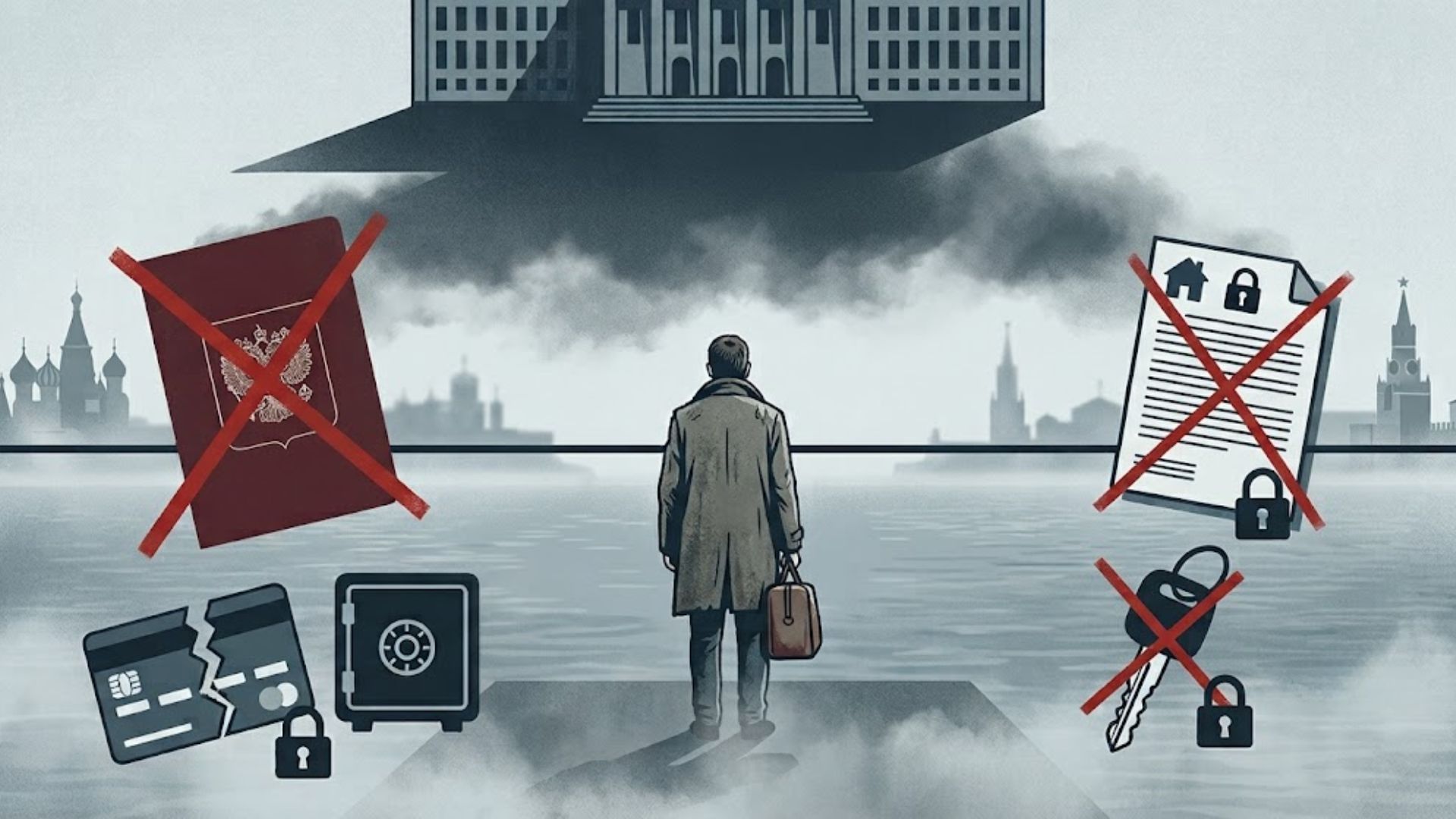
The draft law restricts consular services for Russians who have left the country. This means that, whilst abroad, those who have relocated will not be able to renew their foreign passport, obtain documents or certificates, get married or change their name, or renounce their Russian citizenship. It will still be possible to certify that a person is alive and to authenticate the handwritten signature of a visually impaired person.
Within Russia, any ability to manage bank accounts and property – even via a power of attorney issued to relatives – will be blocked, and it will be impossible to claim an inheritance. The validity of all licences, including driving licences, will be suspended.
All restrictions are described as ‘temporary’ measures, but no specific duration has been set.
‘One must not betray one’s homeland’
The State Duma unanimously backed the draft laws on restrictions; they were barely discussed – the entire procedure took around 20 minutes. Speaker Vyacheslav Volodin spoke for almost the entire time. He did not mince his words, describing the initiative as a law against ‘degenerates and traitors to the homeland’ .
According to him, citizens who have left the country cannot represent the political opposition, as opposition parties in Russia are represented in parliament.
“Those who have gone abroad and harm the country are not the opposition; they are traitors, they are criminals,” — Volodin concluded.
‘Disenfranchised’ citizens
Lawyers from the organisation ‘First Department’ described the deputies’ proposals as ‘de facto deprivation of citizenship’.
‘In other words, the state retains jurisdiction and control over the individual, continues to demand that they serve their sentence, but does not grant them a substantial part of the rights normally associated with citizenship.
A person who has left for political reasons and is deemed to be ‘evading’ is granted the status of an internally ‘disenfranchised citizen’.
Amnesty International’s Director for Eastern Europe and Central Asia, Marie Strazers, called for the development of support mechanisms for political migrants from Russia.
“The governments of host countries must urgently develop practical mechanisms to counter the repressive actions of the Russian authorities outside the country and ensure that people affected by these measures can access basic services, including banking services, and obtain vital documents such as passports.”
Politician Andrei Pivovarov believes that this bill is yet another attempt to intimidate Russians.
The law is aimed not so much at those who have left the country as it is at serving as yet another scare tactic for people within the country and for those abroad who have not yet actively expressed their views. It is a demonstration of what could happen to them if they start giving interviews to independent media, criticising the authorities or speaking the truth about the war. It is yet another attempt to silence people through financial pressure.
The draft law must be considered by the Federation Council within 14 days. The document will then be sent to Vladimir Putin for his signature. The law will come into force on the day of its official publication.
Official Russian and Belarusian sources cited in this text are for informational purposes only. Content from these sources may constitute disinformation or propaganda.