Russia’s full-scale war against Ukraine, now in its fifth year, was one of the key topics at the recent “Defence24 Days 2026” conference on defense and security in Central and Eastern Europe, held in Warsaw. One of the conference participants was Brigadier General Maciej Trelka, Head of the Aviation Directorate and Deputy Inspector of the Polish Air Force. In the interview, the general discussed changes in Russia’s war against Ukraine, contemporary challenges, the significance and value of Ukrainian experiences, and the conclusions shaping the security and defense policies of North Atlantic Treaty Organization member states.
IN BRIEF:
- Russia’s war against Ukraine is constantly evolving, which is why experiences from the Ukrainian front are now being closely analyzed by NATO military personnel and experts.
- Despite Russia’s air defense system, Ukraine has managed to maintain its combat aviation through a change in tactics, the dispersal of forces, and support from Western partners.
- Poland has already transferred MiG-29 fighter jets to Ukraine and does not rule out further military aid, though it is not disclosing details at this time.
- Establishing a joint NATO air defense zone over western Ukraine is currently impossible, as it could be interpreted as the Alliance’s direct involvement in the war.
- Russia regularly tests NATO’s readiness through provocations involving drones and airspace violations, which is why Alliance nations are developing anti-drone defense systems, drawing on Ukraine’s experience.
- General Trelka emphasizes: Ukraine is fighting not only for itself but also for the security of all of Europe. The resilience of the Ukrainians has thwarted the Kremlin’s plans for a swift takeover of the country and has set an example for the world.
General, how did this year’s Defence24 Days 2026 conference differ from previous ones? What key topics were discussed?
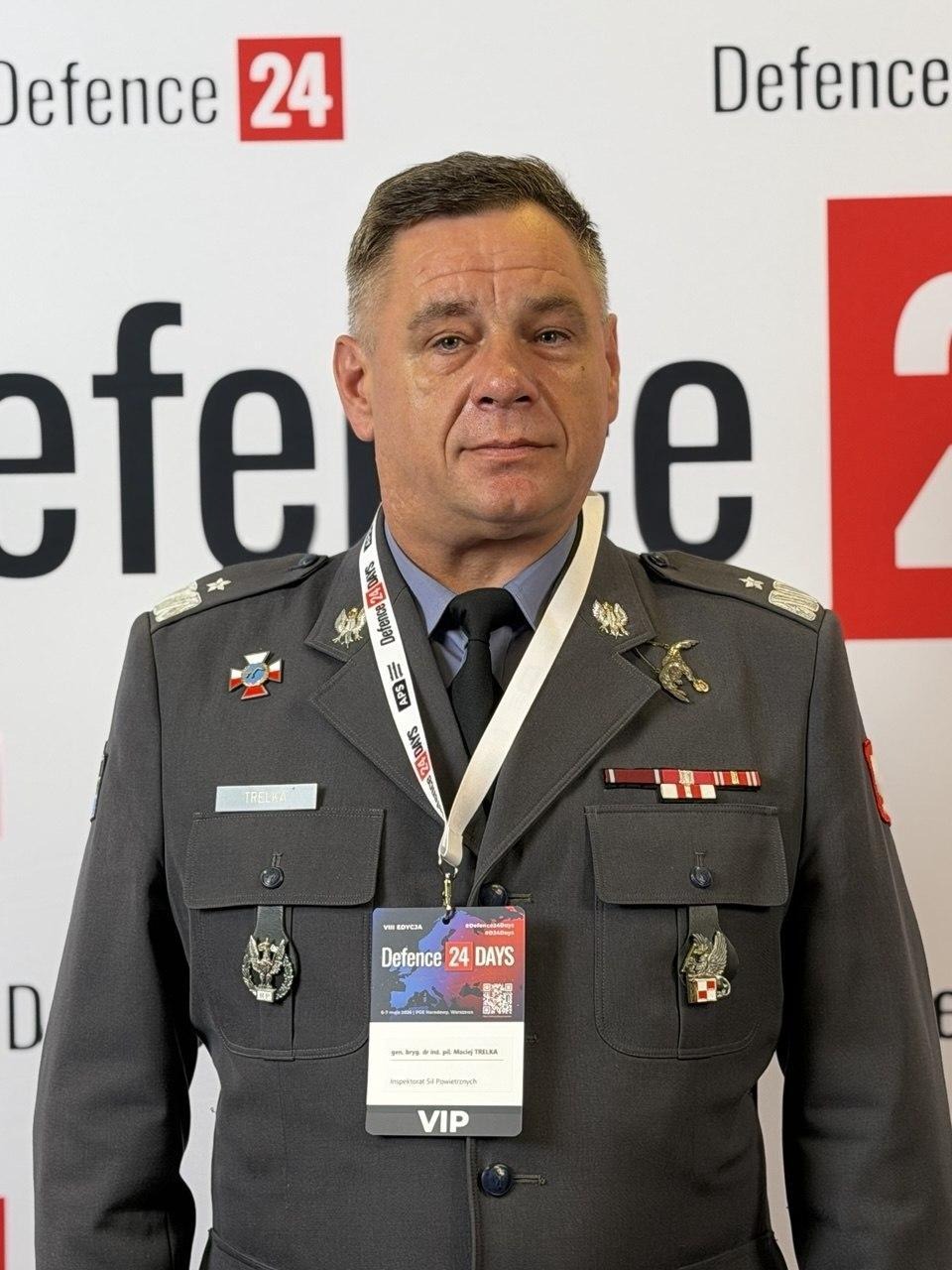
During this conference, we discussed various topics, particularly those based on the experiences of the Russian war in Ukraine. Since the beginning of the Russian Federation’s full-scale invasion of Ukraine, this conflict has been constantly evolving, taking on new forms and methods of warfare. Defence24 is precisely the place where we can share knowledge about what has changed and how we should respond to the dynamics emerging during hostilities. That is exactly why this forum exists.
Such events are also necessary so that we can enhance our knowledge in the areas we are currently engaged in. In my case, this involves the modernization of the Air Force: what this process looks like and what else can be done to make the improvement and strengthening of the Air Force’s combat capabilities more efficient and effective.
Air defense remains Ukraine’s weakest point. Both the survival of the civilian population and civilian infrastructure, as well as the lives of soldiers on the front lines, depend on it to a decisive extent. The sky has thus been Ukraine’s Achilles’ heel throughout the entire period of the full-scale Russian-Ukrainian war. How do you assess the current state of airspace protection over Ukraine, and can more be done to protect it? How do Polish military officials assess this situation?
Russia is one of the world’s major powers, possessing a highly complex and technologically advanced system for restricting and blocking access and maneuvering. It has a wide range of various missile-based air defense systems that, in practice, prevent access to specific zones. This is precisely why the Ukrainian Air Force has found itself in extremely difficult conditions.
The entire tactics of conducting military operations, especially at the beginning of the war, boiled down to the fact that Ukrainian aircraft were forced to fly at very low altitudes to avoid being shot down by Russian air defense systems or air-to-air missiles fired from Russian aircraft. We are talking about long-range missiles—over 200 kilometers.
Therefore, tactics had to be adapted: they involved flying at low altitudes and maximizing the dispersion of the air force to remove it from the line of fire right at the start of the war and prevent destruction at airfields. Ukraine succeeded in this. Such operations are also being effectively continued today.
The Ukrainian Air Force has already been reinforced with Western equipment: in particular, F-16 fighters, French Mirage 2000s, and, according to available information, Swedish Gripen aircraft are in service. For our part, we have provided a squadron of MiG-29 aircraft. In the near future, we will likely also continue efforts to transfer additional aircraft. For now, however, I cannot provide any details.
Over the past few years, as part of discussions among NATO member states, Ukraine has repeatedly raised the issue of establishing a joint system or zone of enhanced air defense along Ukraine’s western border. The idea is to significantly strengthen airspace protection in coordination with partners, particularly Poland, and to respond more effectively to Russian missile and drone attacks. To what extent is this idea still relevant today? How do military and political circles assess it?
Currently, from my perspective, establishing such a zone is impossible, because any launch of missiles from Polish territory toward Russian targets flying over Ukraine would be considered a direct NATO attack on the Russian Federation. Therefore, in this sense, we cannot discuss this today. Our actions consist of a different form of support—providing Ukraine with additional weapons so that it can more effectively defend its airspace on its own.
At this stage, NATO cannot directly intervene in this conflict, as this would be perceived as the Alliance shifting to aggressive actions against Russia, which creates the risk of further escalation and the war spreading westward. Therefore, the underlying logic remains unchanged: Ukraine is fighting this battle today for the security of us all as well.
In Europe, incidents involving drones, objects of unknown origin, or violations of NATO countries’ airspace are being reported with increasing frequency. This is no coincidence—in fact, such actions have allowed Russia for several years to test the reaction of NATO countries while avoiding direct military escalation. What is your opinion on this?
It is obvious that Russia is testing us. It is testing all of us: our air defense systems, our detection systems, and also whether we will react and to what extent we will allow it to play such games with us. The threat is constant. It is an ongoing process. We are all aware of this, and our response must be proportionate.
We cannot immediately provoke a conflict over the flight of a few drones, as this could lead to a disproportionate response. For example, we could strike Kaliningrad, but that is not the point at all.
We are trying by every possible means—both diplomatic and through the development of anti-drone defense systems based on Ukrainian experience—to ensure that these Russian drones do not pose a serious threat to us. Even if they cross the border, we must be able to neutralize them. That means either sending them back to where they were launched, shooting them down while still in the air, or directing them to the ground. Not necessarily onto Russian territory, since they won’t reach it anyway.
Ukraine has been resisting Russia’s full-scale aggression for five years now. And this despite Russia’s significant advantage in military resources, troop strength, and the quantity of weaponry. Despite prolonged Russian pressure and massive missile attacks, Ukraine has managed to preserve its statehood and retain most of its territory. What would you like to say to the Ukrainian defenders who continue to fight?
I think that at this stage of the war, Ukraine will continue to defend itself. I find it hard to imagine Ukrainians laying down their arms, effectively handing over to Russia the territories it has already occupied, accepting the loss of Crimea, and creating a situation where, by giving up the fight, they are effectively surrendering. This would mean giving Russia the opportunity to occupy Ukraine without any restrictions. Unless allied troops—that is, peacekeeping forces—were to enter the area first, but that does not solve the problem either.
After all, every country would prefer to rule its own territory independently, rather than depend on who ensures its security. Especially after so many years of full-scale war against an opponent that is many times stronger. I was convinced that after the events of 2014 in Crimea, something like that would never happen again. Putin thought the same. He believed that if he invaded Ukraine, he would capture Kyiv within three days and the war would be over. That did not happen. This only confirms the strength of spirit of the Ukrainian people and how determined Ukrainians are to defend their own land.
Author: Svitlana Myalyk