

The Ukrainian company HIMERA, in cooperation with Denmark’s GomSpace, has put into orbit the test satellite OBRIA NANO, the first spacecraft of the new Ukrainian satellite communications network OBRIA. The launch took place on 1 October, but HIMERA reported the first test results only at the end of October. HIMERA vice-president Dmytro Khmara told Black Sky what Ukraine’s space independence depends on.
In brief:
- On 1 October OBRIA NANO, the first spacecraft of the Ukrainian satellite communications network OBRIA, went into orbit.
- The OBRIA project is being implemented by the Ukrainian company HIMERA in cooperation with Denmark’s GomSpace and aims to create a Ukrainian network of low-orbit satellites to provide Ukraine with alternative, independent satellite communications.
- The project plans to deploy a network of about a hundred spacecraft to ensure continuous high-speed connectivity across the whole of Ukraine.
- OBRIA is not a replacement for Starlink but an independent alternative.
- The next stage of the programme involves building up the satellite network, the ground infrastructure and the technologies needed to scale it.
- Launching satellites into orbit is not enough for Ukraine to achieve space independence – the entire technological chain has to be developed.
What is OBRIA?
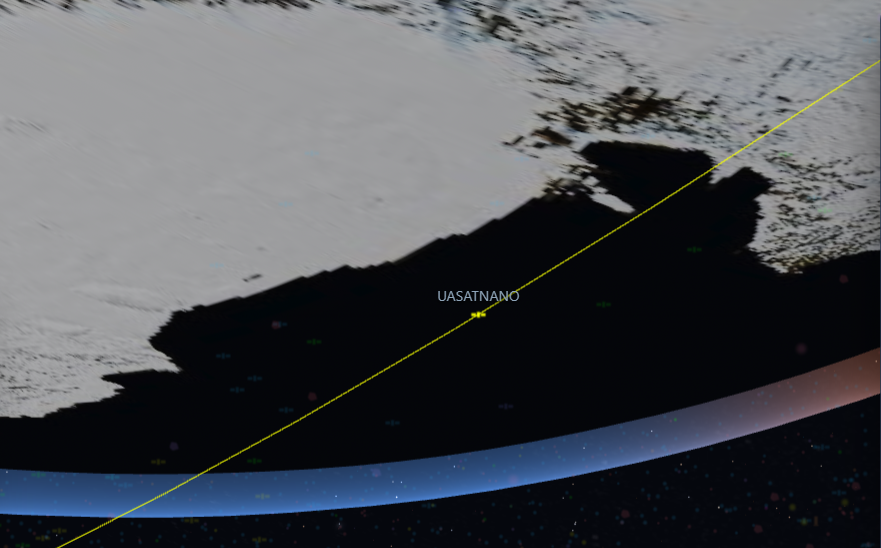
The OBRIA project envisages a Ukrainian network of low-orbit satellites providing high-speed satellite connectivity similar to that offered by the popular American Starlink network.
The programme is being implemented by the Ukrainian company HIMERA and the Danish company GomSpace, which specialises in the design, manufacture and operation of small satellites and nanosatellites. The satellite now being tested in orbit was built in Denmark, but both Ukrainian and Danish specialists worked on its design.
“OBRIA is a project to develop Ukraine’s sovereign dual-use satellite capabilities. Its aim is to create additional communications infrastructure that can meet the needs of the state and civilian sectors as well as Ukraine’s Defence Forces,” says HIMERA vice-president Dmytro Khmara.
The project plans to deploy a network of more than a hundred spacecraft to provide stable round-the-clock satellite internet connectivity over Ukraine.
How are the tests going?
The first test satellite, OBRIA NANO, a CubeSat 8U weighing just 10 kilograms, was put into orbit on 1 October 2026 during SpaceX’s Transporter-18 mission. The Falcon 9 rocket lifted off from Vandenberg in California carrying a total of 130 different satellites and other payloads.
Shortly after launch the satellite (also registered as UASAT-NANO) was assigned the NORAD identification number 100951.
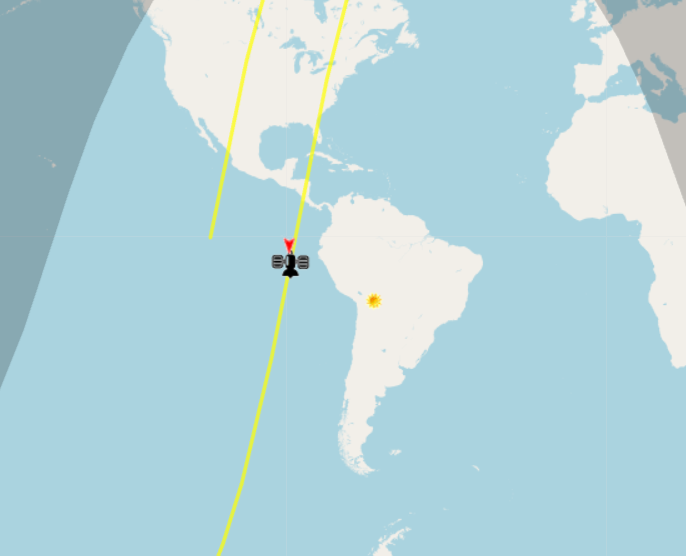
According to HIMERA, the first data from the satellite were received on 2 October, but company representatives announced the successful start only at the end of the month, on 27 October. The satellite is currently controlled by the Danish partners, but the whole process is to be transferred to Ukraine later.
“The plan is to go on developing the satellite network, the ground infrastructure and the technologies needed to scale it. But moving on to the next stage of development can only be discussed on the basis of the results of these tests,” notes Dmytro Khmara.
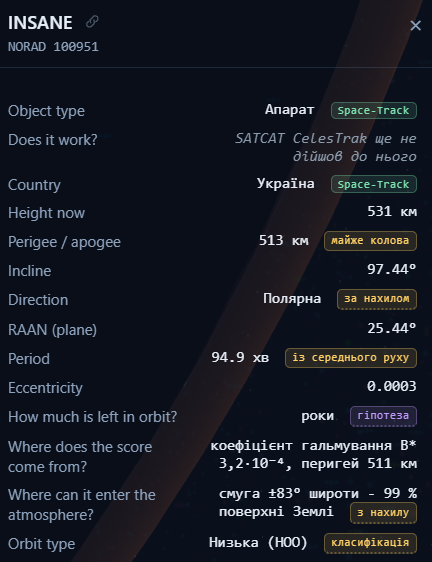
According to the latest data, OBRIA NANO is in orbit at an altitude of 531 km.
Why is Starlink not enough for Ukraine?
Starlink has become one of the important elements of Ukraine’s communications infrastructure. Since the start of the full-scale invasion, Starlink systems have been integrated in Ukraine for military needs, and extended access was agreed only at the end of 2024. But the system remains a foreign private network whose terms of use and access are set by its operator.
For example, on the night of 14 October 2026 Ukrainian terminals were significantly restricted, which was even seen as US pressure on the Ukrainian leadership. The connection dropped out at speeds of 60–70 km/h and disappeared completely at higher speeds, but the limits were adjusted that same evening.
Dependence on an external provider means that the state does not have full control over all the conditions of using the connection. In wartime this goes far beyond users’ comfort and directly concerns national security.
“The OBRIA project should not be seen as a replacement for Starlink or other existing satellite systems. It is about creating additional Ukrainian communications infrastructure. Our own satellite network will make it possible to diversify communication channels, reduce dependence on external providers and strengthen Ukraine’s strategic autonomy,” stresses Dmytro Khmara.
Building a full network will take years
The current spacecraft is only a technology demonstrator. Building a full satellite constellation providing stable round-the-clock connectivity is a long-term task that will take years. At least a hundred satellites must be deployed to provide basic continuous coverage of Ukraine’s territory. That is why over the next 12 months the focus will be on training the team, refining the technologies and forming a clear understanding of the technical tasks for the next stages of deployment, says Dmytro Khmara.
The company says the project will be implemented in several stages and is designed to take several years. Coverage of the whole of Ukraine is the project’s long-term goal. The exact timeline will depend on the results of the OBRIA NANO tests, the pace of deploying the satellite constellation and the development of the ground infrastructure.
Will space communications become truly Ukrainian?
Although the OBRIA satellite communications system is presented as purely Ukrainian, a lack of resources and technical base means Ukrainian developers have to rely on foreign partners for all stages of the technological chain. The most important is the cooperation with the Danish company GomSpace, whose specialists are involved in the design, manufacture and testing of the spacecraft at the current stage. No less important is the cooperation with the American SpaceX, which put the spacecraft into orbit.
“Developing our own satellite production is one of the desired outcomes of this initiative. Our goal is to gradually build manufacturing and technological competences in Ukraine, localise the production of satellites and ground terminals and reduce dependence on external suppliers. This requires not only production capacity but also a professional team, a technological base, investment and experience in implementing space projects,” says Dmytro Khmara.
Its own satellite communications infrastructure will allow Ukraine to diversify communication channels, reduce dependence on external suppliers and strengthen the resilience of critical communications. In the long run, a sovereign satellite constellation will let Ukraine make its own decisions on how to use it, without depending on permission or approval from external operators, HIMERA says.
“We understand that space independence is not only our own satellites in orbit. It means developing the whole technological chain in Ukraine: satellite production, ground infrastructure, terminals, software and components,” notes the HIMERA vice-president.
Julia Derdiuk