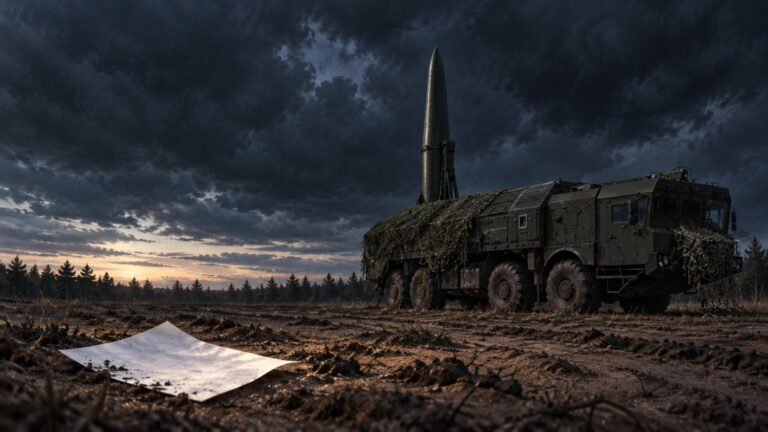
Encouraging a coup d’état, advising people to leave the country or abandon their combat posts without authorization, and calling for aggression against TCC staff and police officers—Russian propaganda is attempting to push Ukrainians toward self-destruction. StopFake project editor and fact-checker Olena Churanova told the publication “Black Sky” that the main goal of Russian propaganda remains undermining trust in the government and institutions, creating a mass of distrust and conflict groups to provoke a crisis in society.
In brief:
- Sanctioned former politician Spiridon Kilinkarov speaks to Russian media about the risks of a coup d’état in Ukraine.
- Russia is manipulating the topic of mobilization in Ukraine to destabilize society.
- Despite Ukrainian security services exposing a network of Telegram channels engaged in spreading propaganda and carrying out orders from Russian agents, these channels remain active.
- More than a third of the posts by propagandists on Telegram channels cover the topic of mobilization and the activities of the TCC in Ukraine.
Who started talking about a coup d’état
In late April, pro-Russian politician and former Member of Parliament of Ukraine (5th, 6th, and 7th convocations), Spiridon Kilinkarov, spoke to Russian media about the possibility of a coup d’état in Ukraine due to the actions of employees of the Territorial Recruitment and Social Support Centers in Ukraine. Spiridon himself is considered a traitor to Ukraine and has been on the National Security and Defense Council sanctions list since January 15, 2023.
Manipulating the topic of a coup d’état is not a new phenomenon in Kremlin propaganda. StopFake project editor and fact-checker Olena Churanova explains:
“On multiple occasions, pro-Russian actors have attempted to organize a so-called ‘Maidan’ or ‘protest against the TCS,’ which ended only with grandiose posts and a dozen people—obviously gathered for money—who could not explain why they had taken to the streets. So the main goal remains—to undermine trust in the government and institutions, to create a mass of distrust and conflict groups, in order to provoke a crisis in society.”
As the fact-checker notes, Russian propaganda methods since the start of the full-scale invasion show that they have a rather poor understanding of Ukrainian society, so their attempts to destabilize the situation continue, but so far they have not had much success.
Why the topic of the TCC became the basis for Russian propaganda
Mobilization in Ukraine was officially declared on February 24, 2022, by Decree of the President of Ukraine No. 69/2022, and is renewed every 90 days. Meanwhile, no official mobilization has been announced in the Russian Federation; instead, the RF is recruiting for military service through covert mobilization processes and enlisting soldiers for contract service.
Olena Churanova believes that the topic of mobilization is sensitive for a democratic society and is easily manipulated:
“The topic of mobilization in Ukraine, even without the influence of disinformation, is a very sensitive and triggering topic for society. All the more so for a democratic society that values freedom and rights above all else. While totalitarian dictatorships have no trouble recruiting people into the military, a democratic country resisting dictatorship faces a very difficult choice—how to mobilize its population to protect the country and its very existence”.
The Ukrainian Center for Countering Disinformation conducted an analysis of the information space to determine the extent of manipulation regarding mobilization in Ukraine. Over a three-month period (from October 1, 2025, to December 31, 2025), more than 85,400 posts containing destructive narratives about mobilization were recorded. In total, this amounts to over 419.7 million views.
How Russian propaganda creates a bubble of hopelessness
As early as the beginning of 2021, Ukrainian intelligence agencies reported on the exposure of agent networks engaged in destabilizing society through Telegram channels. The posts were aimed at creating panic, exacerbating tensions, and destabilizing the socio-political and socio-economic situation. Russian intelligence agents specifically recruited Ukrainians to administer these channels.
“Currently, the main thrust of disinformation is aimed at demoralizing Ukrainian society, as the full-scale war has been ongoing for five years now, and the Kremlin’s primary goal is to wear down the Ukrainian people. To this end, various disinformation campaigns and fake news are being used, primarily spread on social media, claiming that resistance is futile, that Ukraine must agree to any conditions set by Russia, that the prolonged war benefits the Ukrainian government, and that the opinions of ordinary people are ignored. There is also an increase in disinformation claiming that Ukraine as a country has no future, will never join the EU, and is gradually losing Western support. At the same time, disinformation continues to spread about problems within the Ukrainian army, epidemics, and dissent against the leadership, etc., notes the editor of the StopFake project, Olena Churanova.
Despite the exposure of the spy network back in 2021, the Telegram channels remain active and continue to operate. For instance, the “Spletnitsa” channel has over 145,500 subscribers. The administrators spare no effort in providing their audience with breaking news from Ukraine during the mobilization. In the first half of May 2026, the channel published 164 posts, 68 of which were dedicated to the topic of mobilization in Ukraine—that’s over 40% of the content.
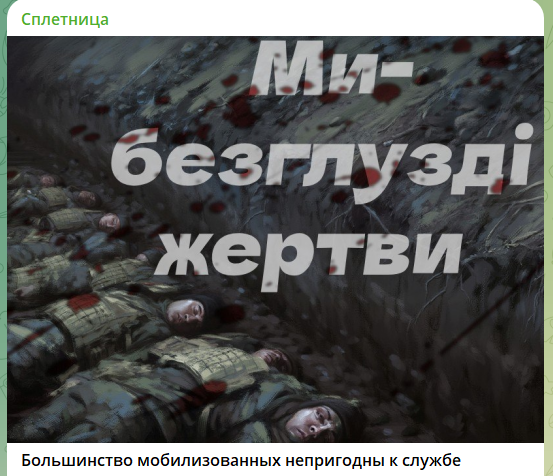
In particular, the texts are characterized by emotional manipulation (images of the dead created using AI), the use of concept substitution (bushification), and the application of labels (manhunters, TCC police).
StopFake project editor and fact-checker Olena Churanova explains:
“The Kremlin is actively working to ensure that the mobilization process in Ukraine fails—it is mass-distributing videos about human rights violations during mobilization (while most successful examples are absent from the information space—only the negative is preserved and disseminated), AI-generated videos and photos of such ‘violations’ are created and flooded into the information space. Specific terminology is used to create a certain emotional backdrop—‘manhunts,’ ‘roundups,’ ‘criminal TCCs,’ ‘TCCs are working according to a plan to round up bodies’».
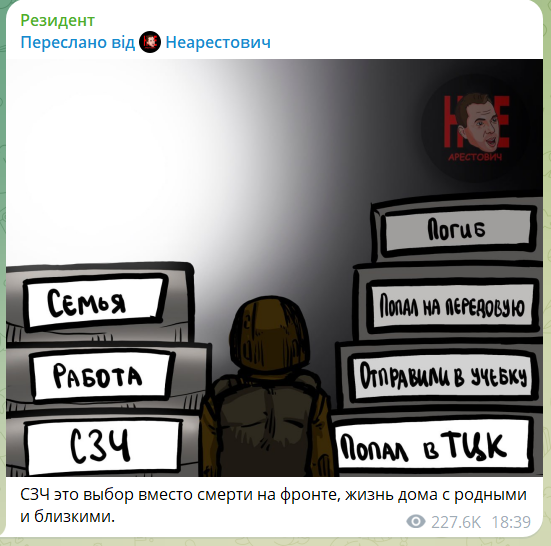
A similar situation exists on other Telegram channels linked to Russian intelligence agencies. The “Resident” channel has over 911,000 subscribers, and during the first two weeks of May, over 32% of its posts addressed the topic of mobilization in Ukraine. Meanwhile, the “Legitimny” channel, with an audience of 1,112,700 subscribers, shared over 39% of its content during the same period about the activities of TCC personnel in Ukraine. Some posts suggest a way out (if one has already joined the ranks of the Armed Forces of Ukraine)—deserting the unit.
Olena Churanova believes that even ineffective propaganda creates information noise in which it is harder for people to distinguish fact from manipulation; therefore, readers need to be extremely careful when processing information and avoid spreading questionable news:
“Research and monitoring show that Russian propaganda is not capable of completely changing the strategic course of Ukrainians, but it works well in terms of ‘side effects’: distrust, fatigue, aggression, and social conflicts.”
Yulia Derdyuk
Official Russian and Belarusian sources cited in this text are for informational purposes only. Content from these sources may constitute disinformation or propaganda.