
Vladimir Putin, Donald Trump and Xi Jinping met for the first time as a trio in Shenzhen on 19 November 2026 and adopted a “Declaration on Peace” that contains not a word about Russia’s war against Ukraine. Putin himself admitted that there was no agreement, and as for what happens next, “only God knows”.
In brief
- The meeting lasted less than an hour and a half, its open part just over 10 minutes.
- The declaration has four points: UN reform, more petroleum products, criticism of the ICC and nuclear risk. It says nothing about Ukraine or Iran.
- According to the Kremlin, the preceding Trump–Putin conversation lasted less than an hour and ended without statements.
- Putin: a new format – “not yet”; Ukraine must agree to compromises “from before Anchorage” and give up the remaining 10% of Donetsk region.
- On the night before the summit Ukraine struck the Crimean Bridge for the third time in a week; trains started running in the afternoon on a single track.
Historic, because it was the first
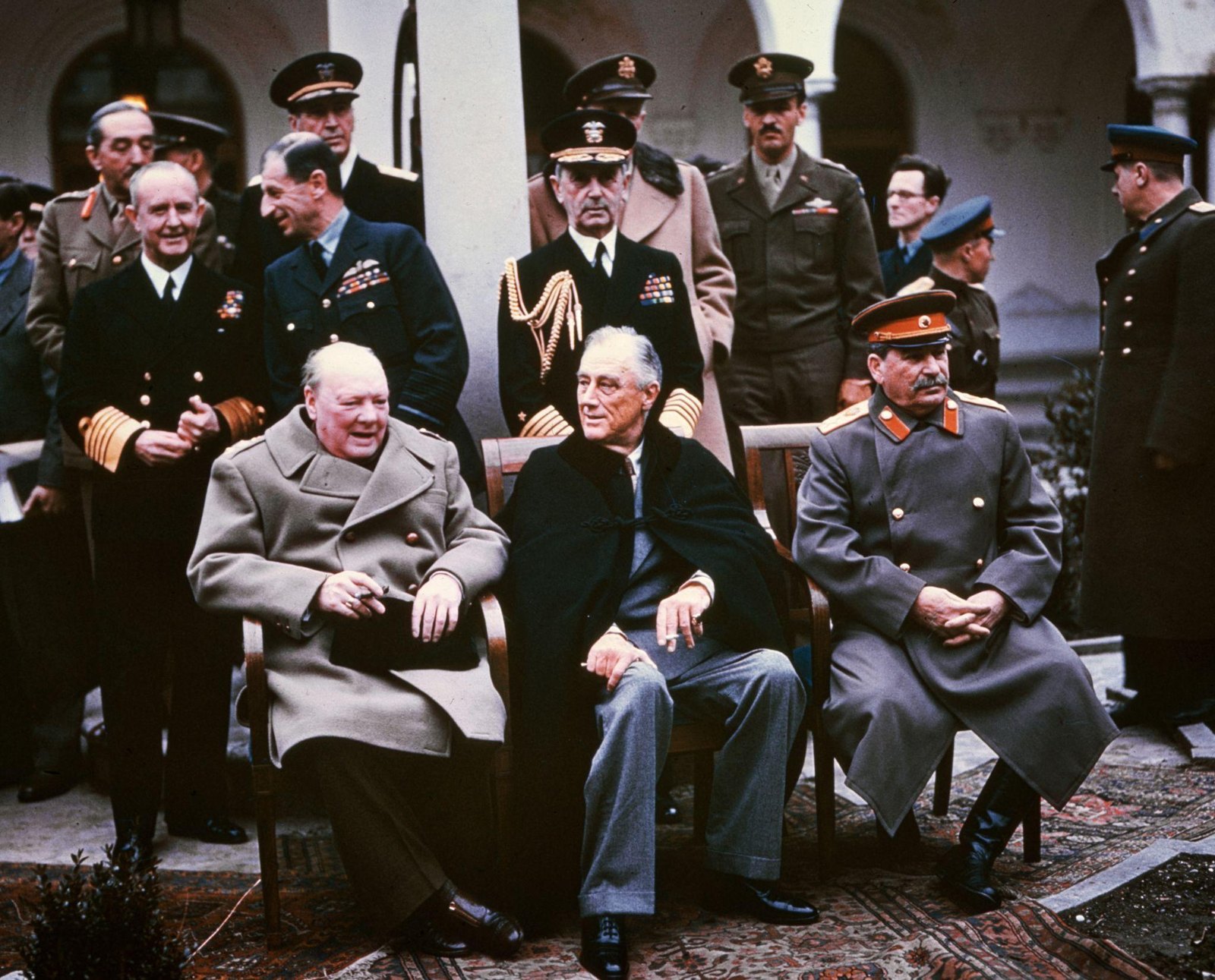
“We are making history,” Trump announced. History lasted less than an hour and a half, its open part just over 10 minutes. Only Andrei Kolesnikov of Kommersant managed to ask a question: is this a “new Yalta”? Putin nodded. After the summit he was more cautious: on key issues there is “if not agreement, then mutual understanding”. Steve Rosenberg of the BBC asked whether this was a new world order or “a nice picture of three leaders at a table”. A new format? “Not yet.” A picture? No again, because this is “serious work”. The only thing the three leaders really agreed on was that the meeting was historic. Because it was the first.
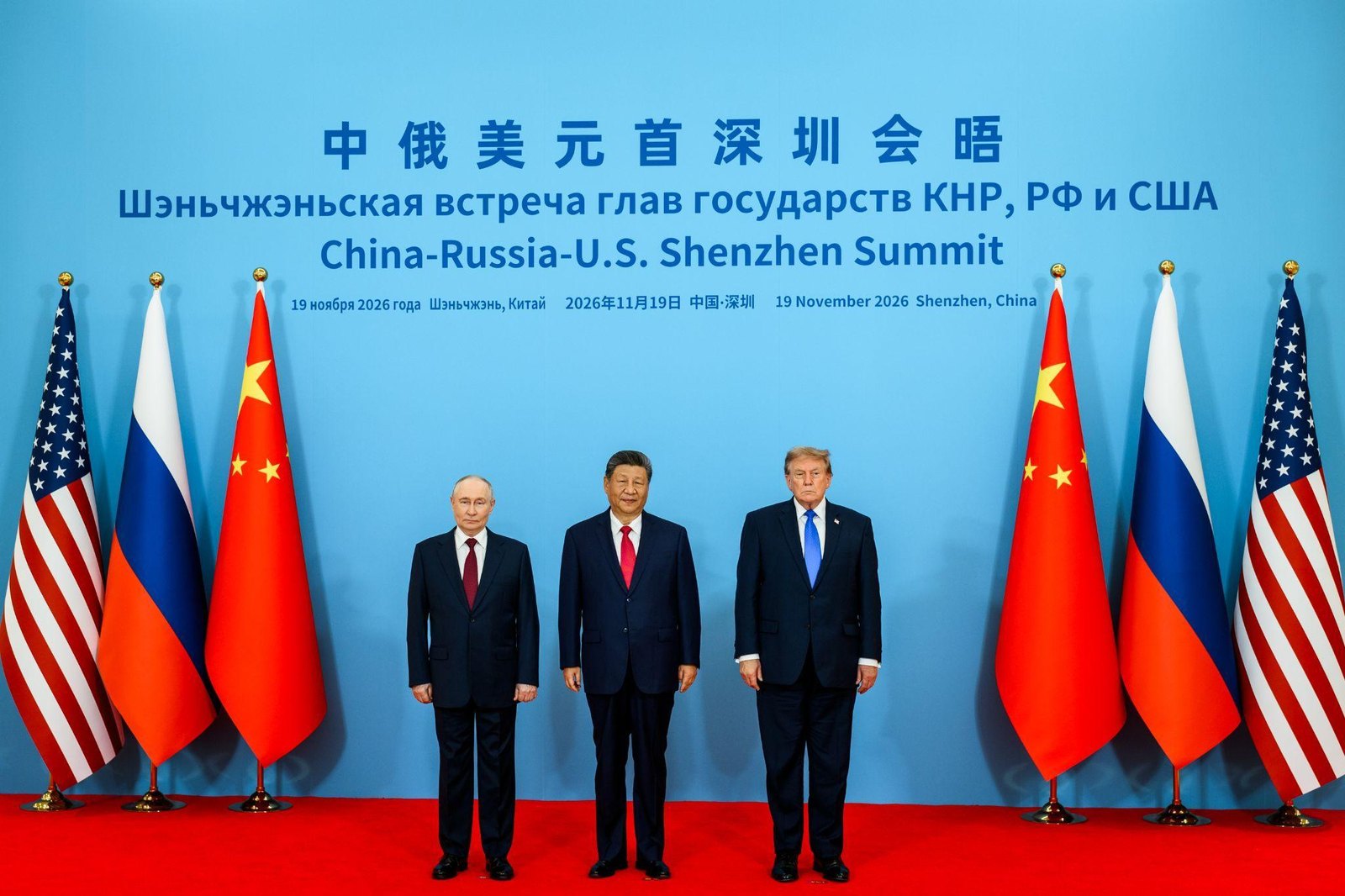
The host behaved like a host. Xi spoke about world peace and about how when great powers live in harmony the world is at peace, but did not say a word about Ukraine. For Beijing, it was valuable in itself that the “victors of the Second World War” sat at the table together with it. China was not at Yalta in 1945.
A peace declaration with no war in it
Four points, zero war. First: UN reform. It is wanted by three permanent members of the Security Council, including Russia, which by attacking Ukraine is violating the UN Charter and uses its veto to block resolutions on its own aggression. Second: more petroleum products “for the benefit of all countries”. Supplies depend on the Strait of Hormuz and on Iran, which is not mentioned in the declaration but which Russia and China support. In effect, this point could come in handy for Trump as a stick against Ukrainian strikes on Russian refineries.
Third: “the principle of state consent and respect for the immunities of officials”, and the ICC must not “abuse its powers”. At the table sat the only one of the trio against whom the Court has issued an arrest warrant – for the deportation of Ukrainian children. None of the three states is a party to the Rome Statute, so this is a manifesto, not law. At the press conference Putin was indignant that the West ignores the rulings of the sports tribunal in Lausanne. For the Kremlin an international court is sacred when it rules on Russian athletes, and “oversteps its competence” when it comes to Ukrainian children.
Fourth: “a nuclear war cannot be won”. The same sentence was proclaimed by the five great powers, including Russia, on 3 January 2022. Seven weeks later Russia attacked Ukraine and began threatening nuclear weapons. In Shenzhen Xi called for a complete ban on nuclear weapons while leading a state that, according to SIPRI, adds about 100 warheads a year – the fastest in the world. Trump wanted to talk about disarmament. He got a “dialogue on risks”.
Trump read from a sheet of paper, Putin nodded
This time Trump read from a sheet of paper. Instead of a stream of consciousness, a text in the MAGA spirit: a fight against “globalist organisations” and against the ICC, which has “gotten out of control”. Putin nodded approvingly. Their one-on-one conversation lasted, according to the Kremlin, less than an hour; subtract interpretation and perhaps half an hour is left. “There were no particularly important statements,” Yuri Ushakov admitted.
In my view, this is a signal. After losing the midterm elections, Trump needs concessions from Moscow to declare himself a peacemaker before the new Congress, more inclined to help Ukraine, convenes in January. Putin will not give them, because the only end to the war that interests him is the liquidation of the Ukrainian state. And Trump cannot sell that as a success. Hence the stalemate: they meet one on one and have nothing to talk about.
Putin: there was nothing bad about Yalta
Of the whole trio, only Putin came out to the journalists. We heard that “there was nothing bad about Yalta” and that “nobody divided the world there”. Thanks to it the world supposedly lived 80 years without global upheavals. Poland, Hungary in 1956 and Czechoslovakia in 1968 see it differently. Now Putin wants to “consolidate the victory over neo-Nazism” and advises “accepting realities”.
Realities, Kremlin-style: Ukraine must agree to compromises “from before Anchorage” and give up the remaining 10% of Donetsk region. Kyiv does not want peace because it would then have to hold elections – a line Moscow has been pushing since 2019. Peskov specified: Russia wants to achieve its goals and “stop immediately”. That same day Russian strikes hit two substations in Odesa region. There are no Russian peace terms. There is a plan to liquidate Ukraine, served up in instalments.
For dessert Peskov announced that the US had “in principle supported” a mission in Kostiantynivka, while “Kyiv is silent”. Russia has been claiming for months that it has captured the city, yet the fighting continues. A “humanitarian” pause on the Oleshky model would give Moscow what it has not taken by assault. This is my assessment.
A bridge instead of Yalta
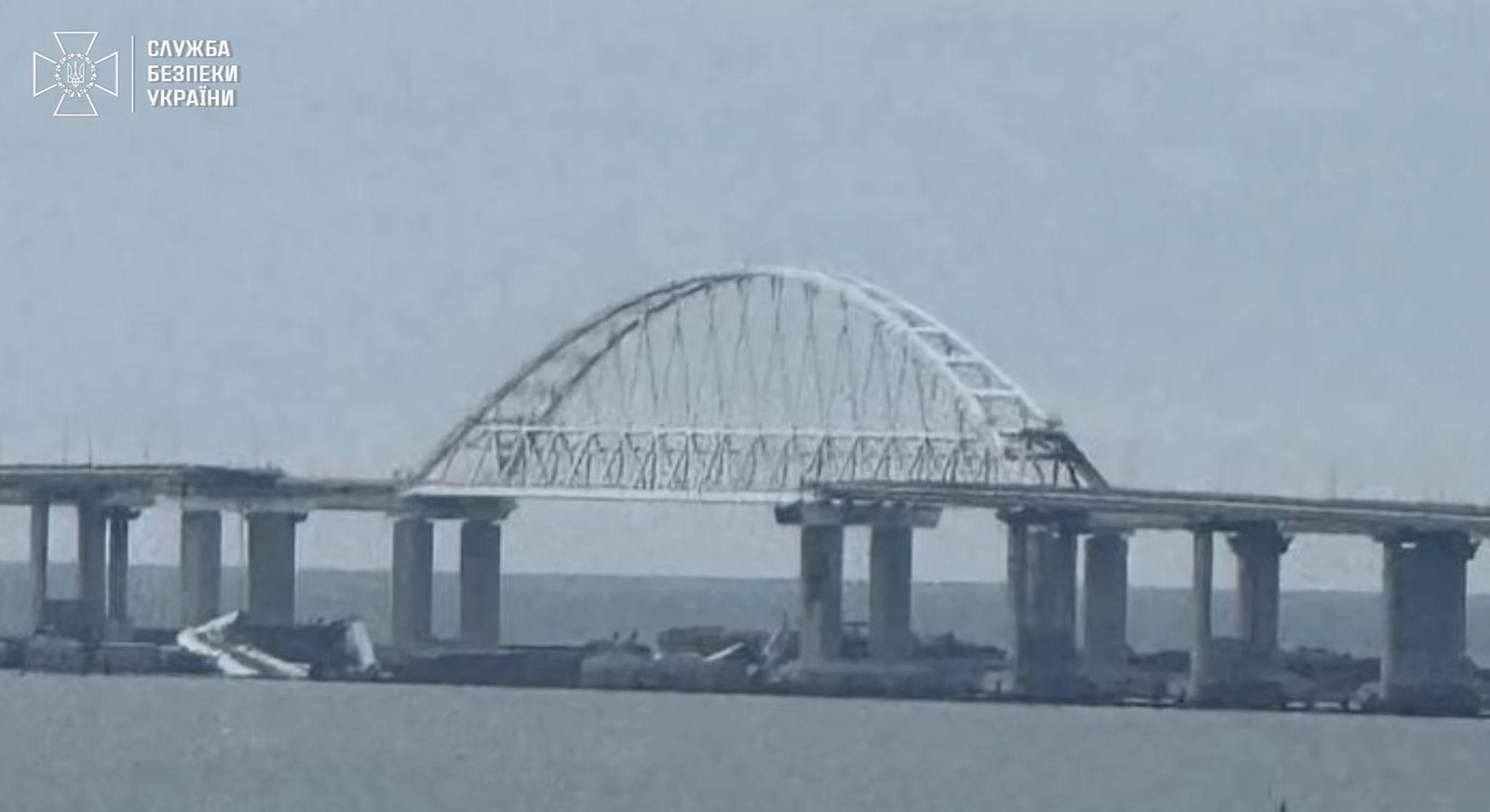
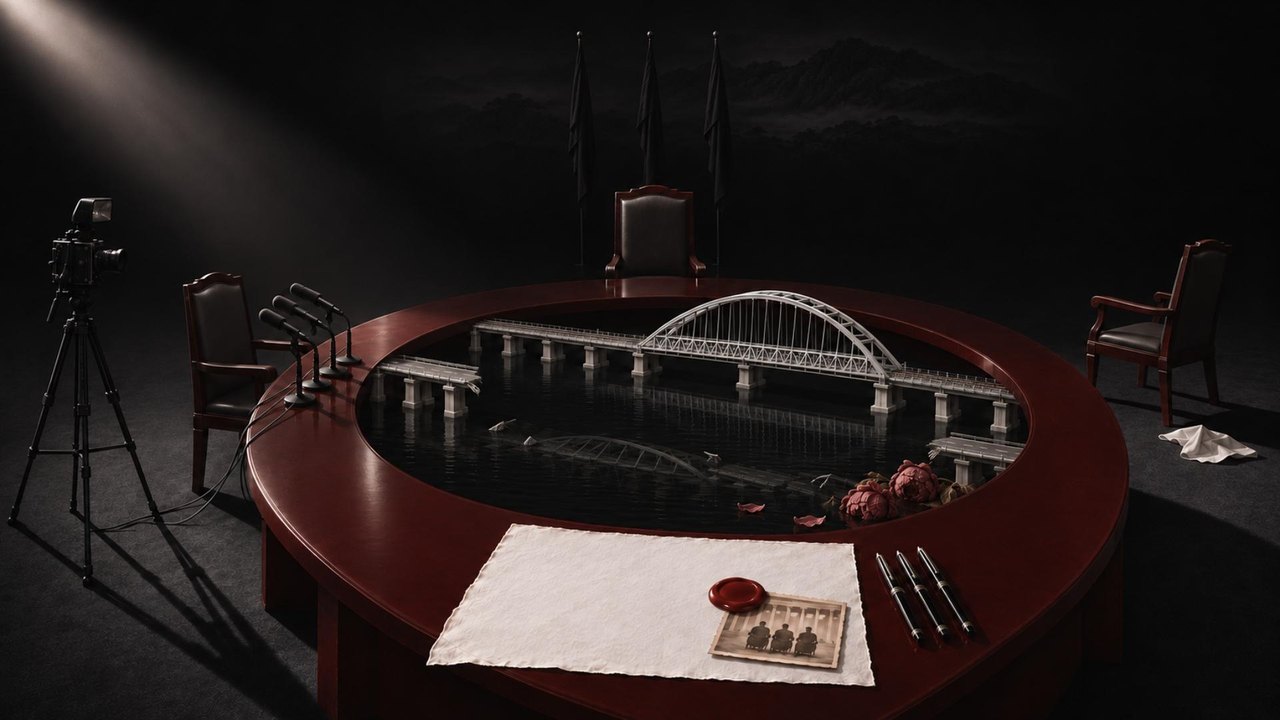
On the night before the summit Ukraine struck the Crimean Bridge for the third time in a week; after the attack on 17 November a span of the road section had already collapsed. Putin assured that the bridge is an “exclusively peaceful facility”, and then declared that after the attacks on it Russia “will not negotiate” a ceasefire and will respond “much more painfully”. Crimea can still be reached “via Novorossiya”, that is, through occupied southern Ukraine. Trains started running in the afternoon on a single track, the first from Taman station. As one Russian propagandist admitted, news of the train from Taman was awaited more impatiently than news from Shenzhen. This is a verdict on Putin’s twelve-year policy since the annexation of Crimea.
Yalta, demo version
Putin got what he came for: a photo next to Trump and Xi, a joint signature under criticism of the ICC and an invitation to the G20. He will most likely decline a trip to the US, because “frequent travel is not always comfortable” – especially where nobody will agree to be photographed with him. Trump got a sentence about history, Xi the role of a host who promised nothing. Ukraine got a warning of retaliation. We wrote about what Trump was taking to Shenzhen in “I haven’t heard”, and about Russia’s bill for peace in “The Kremlin’s bill for peace”.
At Yalta three leaders divided Europe. In Shenzhen they shared a photograph. The war remained undivided – in Putin’s hands.
Author: Artur Żak
Official Russian and Belarusian sources cited in this text are for informational purposes only. Content from these sources may constitute disinformation or propaganda.