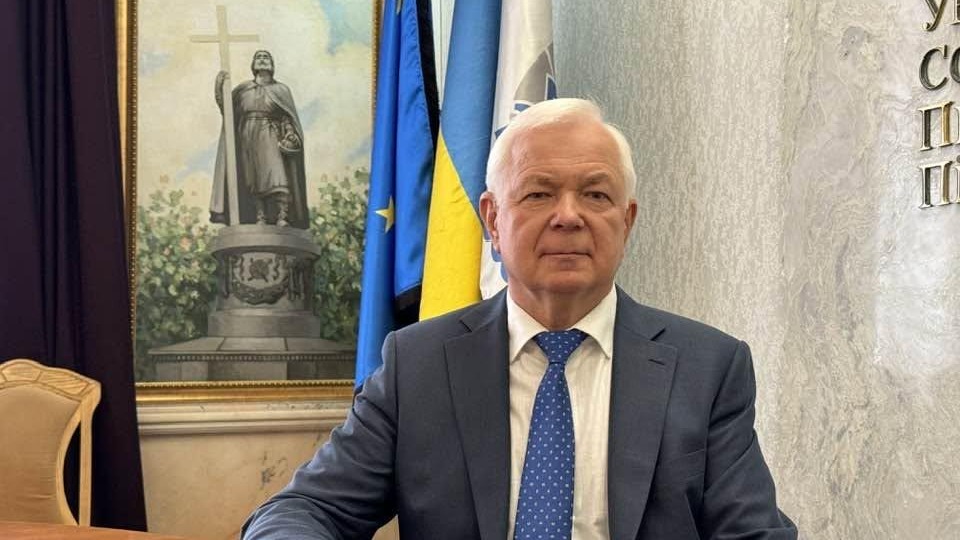

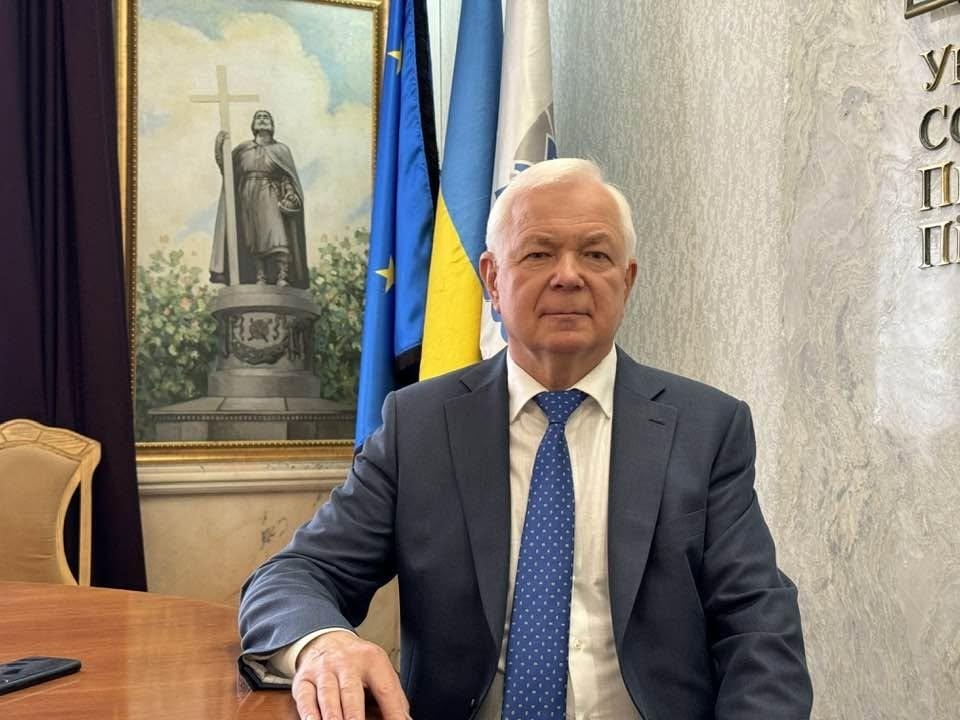
Russia continues to press at the front while launching massive missile and drone strikes on Ukrainian cities and critical infrastructure. To what extent does the situation on the battlefield match the Kremlin’s plans? Does the Russian army have the resources for large-scale offensive operations? How can cities – bridges included – be protected, and what role can Ukrainian long-range weapons play in countering the aggressor? Svitlana Mialyk spoke to Mykola Malomuzh, General of the Army of Ukraine and former head of Ukraine’s Foreign Intelligence Service, about the situation at the front, Belarus’s role in the Kremlin’s plans, the threats to Poland and the Baltic states, and possible scenarios for ending the war.
In brief
- According to Mykola Malomuzh, General of the Army of Ukraine and former head of Ukraine’s Foreign Intelligence Service, Russia lacks the reserves for a large-scale strategic offensive, while Ukrainian forces are holding the line and launching counter-attacks.
- By striking cities and the energy sector, the Kremlin is trying to break Ukrainians and force them to demand an end to the war on Russian terms.
- Protecting bridges and critical infrastructure requires multi-layered air defence – from intercepting aerial targets on the approaches to Ukraine to covering specific sites.
- Ukraine must speed up the production of its own long-range weapons by harnessing the potential of its domestic missile companies.
- Lukashenko, Malomuzh predicts, will help Russia while avoiding direct entry into the war, and Poland and the Baltic states should prepare for new provocations by the Kremlin.
- A combination of military, sanctions and diplomatic pressure could force Putin to stop the war; the interviewee describes the launch of a peace process in roughly three months as a possible positive scenario, one that would require extraordinary efforts from Ukraine and its partners.
– Mr Malomuzh, let us start with the main question: what is happening at the front right now? Who holds the strategic initiative? On which axes is Ukraine making gains, and where is the situation most difficult?
– First of all, I believe that Putin has no strategic prospects at the front today. He has tasked his General Staff and armed forces with capturing Donetsk region by the end of this autumn. That is yet another deadline. He set them in 2025 and at the beginning of 2026, too: by 9 May, by autumn, and now by the end of the warm season. But these plans are not being carried out. Claims that Kostiantynivka or Kupiansk have been captured are untrue.
On the contrary, we are holding our positions, and on the Kupiansk axis we have pushed the enemy back. On the Lyman axis, he claimed to have encircled up to five thousand of our troops. Instead, we carried out the successful operation “Vivaldi”, which wiped out the efforts of units of Russia’s 20th and 25th Armies. A drone centre was hit – not just the equipment, but also the command staff and personnel, who cannot be quickly replaced. In addition, we carried out an operation that liberated up to 180 square kilometres of territory.
This is a real success, the result of our soldiers’ asymmetric actions. Putin’s plans to seize territory are not coming true: we are holding the front and retaking territory.
At the same time, this strengthens our position internationally. Putin kept pressing Trump and other representatives, insisting that he would take Donbas anyway, and that Ukraine therefore supposedly had to be forced to give up these and other territories voluntarily, in particular in the Zaporizhzhia or Kharkiv regions. Now he has no such aces up his sleeve.
We are not giving up territory, and at the same time we are having some successes. This is the basis of our current military and military-political position. But the situation is very difficult. The front is very complex. Heavy fighting continues on the Pokrovsk axis: there are between 25 and 45–50 enemy attacks there every day.
The situation also remains difficult on the Dobropillia axis, where the enemy is trying to capture settlements and their outskirts. We are holding the line and destroying reserves, in particular those being brought up for assaults.
The Russians use infiltration tactics: they slip in twos and threes into individual houses, streets or basements, and then bring up other units. We have already studied this tactic and are trying to neutralise such groups before they concentrate for an attack.
We are actively striking the enemy’s drone networks, which cause major problems. We are applying new approaches to neutralising the enemy while he is still redeploying: when his units are only just arriving, undergoing training and not yet ready for combat. A separate line of effort is strikes on the airfields from which aircraft carrying guided aerial bombs take off. These KABs are a huge problem both for our soldiers and for front-line cities and villages, including Kharkiv, Sumy and Zaporizhzhia.
Hitting aircraft directly at airfields, along with flight control systems and fuel and ammunition stocks, deprives the enemy of the ability to get his aircraft airborne and carry out an operation.
It is precisely this comprehensive approach – destroying the enemy at the front, his reserves in the rear, and drones and aircraft deep inside Russia – that allows us to hold the line and prevents the enemy from advancing effectively.
A very important factor is intelligence, which tracks the enemy’s movements precisely. For example, when certain units were being moved to Lyman, we spotted them and attacked from the flanks and the rear. This allowed us to rout units of the aforementioned 20th and 25th Armies, force them to retreat and take up to 200 soldiers prisoner. That is a concrete result that shows our ability to conduct successful asymmetric operations.
Russian troops tried to seize territory in the Kharkiv region – near Vovchansk in the north and Kupiansk in the east. We worked out these plans, neutralised the reserves, carried out counter-attacks and advanced in some sectors.
The enemy’s plan was to create a so-called buffer zone by seizing up to 20 kilometres of our territory. We did not let this scenario play out, and the enemy was forced to retreat.
The situation is similar in the Sumy region. More than a week ago, particularly intense attacks were under way there: the enemy sought to push deeper into the region and half-encircle Sumy. That did not succeed. Although the Russians are attacking the city itself, as well as our units on its approaches, with KABs and drones, we are countering these efforts. Today Putin has no additional reserves he could send there.
Another difficult subject is the Zaporizhzhia axis. About two months ago the enemy had some partial success there and entered a number of settlements. We reinforced the sectors where the enemy was trying to bypass Huliaipole and move on towards Zaporizhzhia, and carried out counter-attacks. A number of settlements were liberated. The situation near Mala Tokmachka is particularly telling: the Russians repeatedly claimed to have captured it, but we kept destroying the forces they committed to the offensive.
On the Zaporizhzhia axis, we began actively destroying the enemy’s logistics: railways and roads, as well as hitting units that were moving up to reinforce the assault groups. That is how the offensive operation was thwarted.
This applies not only to Mala Tokmachka but also to other sectors, including near Orikhiv. In places the enemy has partially advanced, but we are driving him out with fire. He is failing to bypass Zaporizhzhia, half-encircle it and strike it not only with drones but also with artillery.
We are taking additional measures. These issues were considered at meetings of the Stavka and the National Security and Defence Council (NSDC). New resources and units with solid combat experience are being brought in. This makes it possible to hold the Zaporizhzhia axis and carry out successful counter-attacks.
Today, in my view, Putin does not have sufficient systemic reserves for strategic offensive operations along the entire front. He is still throwing experienced combat units at the Pokrovsk, Kostiantynivka and, partly, Lyman axes. In other sectors, the forces in action are unable to conduct such intense combat operations, and the reserves lack training, experience and combat cohesion. That is our advantage.
I think we will hold the front. Putin will have neither military prospects nor the ability to pressure us by pointing to imaginary successes.
During the latest talks with Trump, the demand to stop the strikes was already on the table. Putin could no longer, as before, justify continuing the war by his advantage at the front. Instead, he raised the issue of lifting sanctions – on the economy, the fleet, energy.
Previously, in conversations with Trump, Xi Jinping and other partners, he made a show of his supposed dominance at the front. Now he is losing those military aces. That is why our ability to hold the line also shapes our political and diplomatic position: we can set conditions rather than act under pressure from Russia.
– If Russia is not getting the result it wants at the front, is it trying to make up for this with ever larger strikes on cities, energy, transport and industrial infrastructure? What is the strategic goal of this campaign, and how can Ukraine fight back?
– Lacking success at the front, Putin is trying to break the spirit of Ukrainians. He has been working on this for a long time and cannot believe that Ukrainians do not give in under the total pressure of terror, which violates all international norms and rules of warfare.
Terror is the basis of his actions. He does not understand why Ukrainians will not give in. From day one we said it on television and on radio: if you start a war, you will not be able to defeat the people of Ukraine. He did not believe it and pressed on with the war.
Now he is trying to create conditions of terror and cold ahead of winter in all regions of Ukraine, above all in the capital, home to up to four million people.
He sees that missile and drone strikes alone are not producing the result he wants, so he is stepping up psychological pressure. He is demonstrating his readiness to strike constantly and at everything: residential buildings, schools, kindergartens, shopping centres, trains, transport and logistics. This is the stance of a global terrorist.
He is not achieving his goal, but he thinks: a little more and he will break us. So he backs up these threats with attacks, including ones like those carried out on one of the recent nights.
Besides jet-powered drones, which are hard to shoot down, he uses various types of missiles with very short flight times. These include, for example, Zircons, Kinzhals and S-400 missiles used to strike ground targets. The aim is to make sure people do not have time to take cover, and to cause as many casualties and as much fear as possible. He is counting on people starting to protest and to pressure Zelensky and the political leadership, demanding a deal with Putin on any terms.
Russia says it is ready for negotiations, but only on its own terms. Ukraine’s leadership and our people do not support this. So the Kremlin is trying to force people to agree through terror.
There is another cruel technique: spreading information about upcoming massive strikes with hundreds of missiles and thousands of drones, making people wait, keeping up social and psychological tension. And then, at a certain moment, striking.
They are counting on throwing society off balance and provoking protests. That is not happening, but Putin still thinks he can break us.
He has the experience of Chechnya and Syria, where Russian forces destroyed cities completely. Remember Aleppo. He is transferring this practice to Ukraine, but on a much larger scale – against towns and villages across the whole country.
I think it will end in his failure. His actions will be given a clear legal classification, although it is already obvious that this is large-scale terror. He acts without any rules. Even Hitler did not wage attacks like this. I believe he will answer for it. But today our task is to hold out, and to support the Armed Forces and people in all regions.
International cooperation with partners is a factor that will help us hold out and protect our state and the countries of Europe. Particularly our neighbours, who are also under threat of Russian aggression. Russia is already demonstrating that aggression through special operations and sabotage. We must counter this together and defend Ukraine’s independence together with the European community.
– Let us return to protecting Ukrainian infrastructure. The enemy is attacking bridges, including the Northern Bridge in Kyiv, where anti-drone nets are already being installed. How can these structures, which link the two banks and keep the city alive, be protected? What do such strikes tell us: does Putin understand that he will not be able to capture Ukraine and is therefore seeking to cause as much destruction as possible?
– Putin has no prospect of capturing our state. Both the front and the people of Ukraine have shown that. So he is trying to crush Ukrainians with terror, to make them suffer, especially in the autumn and winter.
This is a cynical, fascist plan: to kill people, to destroy their sense of identity and to affect every sphere of their lives.
For him, bridges are strategic targets. Previously, as people said, there was a certain unspoken restriction on strikes on bridges. But he saw that he could not capture new territory or make us surrender according to his script, and switched to attacks like these.
Bridges carry not only traffic but also utilities: heating, water, communications, power lines. They provide links not only between the right and left banks, but across the entire country.
He knows these weak spots. For him there are no longer any legal constraints or unspoken agreements. That is why he is attacking bridges.
What should be done? First and foremost, protect specific sites with air defence assets. These could be aircraft and helicopters that intercept targets while they are still on the approaches to the city and the bridges, Gepard anti-aircraft guns, surface-to-air missile systems and man-portable air defence systems (MANPADS).
Additional protection comes from nets, which are already being installed, and turrets. But the issue is broader. Together with the military and strategists, we have developed a model that could loosely be called a large Ukrainian “Iron Dome”. Israel is a small country, whereas we need a system that matches our scale.
It means combining the forces and assets of the Armed Forces of Ukraine, the National Guard, the Security Service (SBU) and military intelligence into a single system.
The first stage is detecting, on Russian territory, preparations for missile and drone strikes and hitting the enemy’s assets before they are used. This requires real-time intelligence.
The second is intercepting targets as they cross the border or the front line. This is where surface-to-air missile systems, MANPADS, aircraft and counter-drone assets must work. This is one of the main lines of defence, and for areas away from the fighting it is not yet working to its full extent.
The third stage is destroying targets that have broken through, along their routes across Ukrainian territory. We see the trajectory, we understand where the target is heading, and we bring in the nearest effective asset: a surface-to-air missile system, MANPADS, a turret or a Gepard.
We cannot allow a target to cover hundreds of kilometres unimpeded all the way to a bridge. And the final line is the direct protection of the bridge or another important site that keeps people’s lives going. This is exactly the model that needs to be worked out so that the system acts quickly and effectively.
– Could Ukraine acquiring its own long-range ballistic missiles change the Kremlin’s calculations? We hear a lot about Fire Point, the company developing such weapons. What stage are we at, and when will Ukrainian ballistic missiles be able to strike military targets in Moscow and deep in the Russian rear?
– Unfortunately, we are running behind. From the first day of the war we proposed putting the relevant production facilities on a war footing. It is not just about Fire Point. There is the Pivdenne Design Bureau, the Luch Design Bureau and hundreds of enterprises that worked on missile technology. We had ballistic missile designs with a range reaching as far as the Far East – up to 15,000 kilometres. Separately, there was the capacity to build missiles with a range of up to a thousand kilometres. Production of tens of thousands of missiles was envisaged. Unfortunately, these organisations were not brought in straight away. Such proposals were made even before the full-scale war, but even after it began, only individual segments were working.
We also lost time with drones. They were often bought in China, taken apart, then reassembled in Ukraine and presented as Ukrainian. At the same time, Russia knew their frequencies, and the enemy often forced them to land.
We have finally moved to our own production and to joint projects with partners – Germany, Poland, France and other countries. These are drones of a different quality, capable of covering a thousand or even two thousand kilometres. But there are not enough of them yet.
The time lag let us down. We should have had these capabilities in 2023–2024, or in 2025 at the latest. We were talking about millions of drones and ten thousand missiles. Today Fire Point and a few other manufacturers are announcing production. But for now it is only a handful.
Having short- and medium-range missiles and ballistic missiles, including strategic ones, would make it possible to destroy the airfields from which Russian aircraft take off, as well as launchers and other facilities. The point is to destroy the threat on Russian territory, before the missiles or drones reach Ukraine.
If we are talking about mass use – thousands of drones and dozens of missiles against a specific target – that could make it possible to destroy an airfield, missile and drone launchers, or the facilities producing them.
That is what ballistic missiles give you. They need to be built quickly and production scaled up. And we should not limit ourselves to Fire Point: it is only part of what we can do.
I consider it a mistake that we did not fully involve other established organisations that had experience and whose designs were in demand on the international market.
For example, the Pivdenne Design Bureau was selling strategic-class rockets to the United States in the period just before the war. That is because it worked on strategic-class rockets, on the international Land Launch and Sea Launch projects, and on Zenit rockets. Why not use this potential to create missiles with powerful warheads capable of striking military targets in the Russian Federation at long range?
– What place do Lukashenko and the territory of Belarus occupy in the Kremlin’s current military plans? Do you see signs that a new military scenario is being prepared from the Belarusian direction?
– Putin is constantly trying to drag Belarus into specific combat operations. He is not succeeding. Lukashenko is playing on several fronts. He wants to preserve his regime in case Russia loses. Hence his contacts with Xi Jinping and Turkish President Erdoğan, and his attempts to establish contacts with US President Trump on a number of projects. He is looking for ways to engage even with Europe: as if to say, let’s live in friendship and agree on something.
At the same time, he is giving Russia concrete help: weapons, ammunition, repairs, supplies of petrol and aviation fuel. There are also radar towers used to guide drones towards our territory, Poland and the Baltic states.
So he is an accomplice. But in my view, today he is fundamentally not prepared to go to war against Ukraine or Western states. He knows that would mean the end of his regime.
He has no prospect of successfully committing his own forces to a war against Ukraine, let alone also fighting Poland or the Baltic states. These are NATO countries that are preparing for such scenarios.
We expect that Lukashenko will continue to help Russia wage the war and will allow provocations on the border with Ukraine, Poland and the Baltic states. Putin is pressuring him, and he has little room for manoeuvre.
But I believe he will not cross the line of a direct attack on Ukraine or our partners. Belarusians do not support it. According to our operational data, the Belarusian army – and I am talking specifically about the army, not the special units subordinate to Moscow – is neither ready nor willing to fight.
So Lukashenko will manoeuvre and try to wriggle out, but he will not go for a big war.
Provocations are possible on the borders: breakthrough attempts, the use of certain groups disguised as refugees, attempts to seize observation posts. I think countering such scenarios is within the capabilities of our partners’ special services and our own.
– Putin places particular emphasis on Kaliningrad. How dangerous is the situation around the Suwałki Gap? Could the Kremlin try to test NATO’s strength precisely there?
– Putin will constantly threaten to use all his resources to counter a supposedly possible seizure of the Kaliningrad region or a blockade of the Suwałki Gap.
He proceeds from the false notion that NATO countries want to dismember Russia and, first and foremost, seize the Kaliningrad region. He is convinced of this and acts accordingly: he demonstrates readiness for aggression, including the use of strategic nuclear weapons.
That is why it is important to prevent provocations on the borders and to show through operational channels that such scenarios are unacceptable, and that Poland and other states are ready to counter his aggressive actions. Force is the only thing he understands.
Through intelligence and defence ministry channels, it must be made clear to him that he has no chance. All the more so since he is bogged down in Ukraine and lacks sufficient military resources to start another major war.
We are pinning down his forces. He lacks resources even for the current front. If he had additional capabilities, he would have launched offensives in other directions long ago.
But our partners, especially the Poles, cannot afford to relax. He still regards these countries as enemies, as NATO’s main striking fist.
What is needed is active operational counteraction and, in the event of corresponding provocations, combat action too. It must be conveyed through diplomatic and intelligence channels that the use of nuclear weapons will have consequences.
Britain, France and the US, as well as Xi Jinping and Modi, have warned Putin that any attempt to use nuclear weapons will meet a harsh response. These signals are coming not only from Western states but also from his partners.
So I think he will play right on the edge of a foul: he will demonstrate readiness for large-scale military action and the use of nuclear weapons, calling it deterrence.
Provocations are possible on the borders, in Poland itself and in the Baltic states. The special services must be ready, together with us, to detect such actions and stop them – by operational means and, if necessary, by combat means. Then these scenarios will have no chance of succeeding.
– Millions of Ukrainians, at home and abroad, are asking when the war will end. Which scenarios for ending it do you consider realistic? What has to change at the front, inside Russia or in the West’s position for Putin to be forced to give up continuing the war?
– Only arguments of critical weight can have an effect on him. First of all, there is the situation at the front – today it is decisive. This is a classic but extremely powerful argument.
That is why strengthening our Armed Forces and partners’ support with precision weapons is the most important factor. Of course, we understand the importance of the financial component: it is also one of the decisive ones.
The second component is powerful operational pressure on all sectors of the Russian economy and personally on Russia’s leadership and their relatives around the world. Above all in the European Union, the US, Canada and other countries.
This is a very painful issue for them. In work against terrorists, when we got to their personal connections, bank accounts, property, yachts, the places where their children and grandchildren were living, when they lost their assets and faced the threat of arrest, that forced them to back down.
The third component is sanctions. We need to work more effectively with Trump and his circle. Our position must be stronger. We should not just wait and say “Trump, help us”, but, knowing him and having experience of working with him, use every channel of influence.
That means the US military-industrial complex, Congress and the Senate, influential military figures, the Federal Reserve, Trump’s advisers, even his childhood friends – we know them.
A large team needs to be at work, pushing solutions that serve the interests of the US, Europe, Ukraine and global stability.
There are mechanisms for extremely tough economic pressure. Tariffs of 500 per cent on exports from Russia and 100 per cent on those who take in those exports.
The fourth component is pressure through all operational and diplomatic channels. Interaction between Ukraine and the US and support from Europe are important. Russia views this negatively but is forced to take it into account.
We need to work actively with China, which declares its support for peace and sovereignty and has its own proposals for ending the strikes and reaching a settlement.
There is also an initiative by India, Turkey, Egypt and Ukraine on a settlement. Just the other day I took part in these processes – not only as a former head of foreign intelligence, but as an active unofficial participant.
Here it is not only political pressure to end the war that is at work, but also a huge economic factor. Where do agricultural products from Ukraine and Russia go? To China, India, Turkey and Egypt. These are countries with huge populations, for which food supplies are of great importance.
Blocking these supplies creates problems for them. So their interests can also be harnessed in the search for a solution.
The role of the UN and its large food programmes for developing countries is also important. Despite all the reservations about the UN Security Council, this instrument must also be used. It is about keeping other countries going, and therefore it is yet another lever of pressure.
The military, operational, sanctions and diplomatic efforts of influential states must be combined to bring about an end to the war.
As for timelines, with such coordinated and effective work, above all by our own team, it would be possible to reach a halt to the strikes within two to three weeks, and a peace process in about three months. But the question is what we ourselves initiate and do together with our partners, not just what they tell us.
This is a positive scenario for all our citizens – in Ukraine, in Poland and in other countries. But making it happen will require extraordinary efforts and the work of top-level professionals.
Author: Svitlana Mialyk