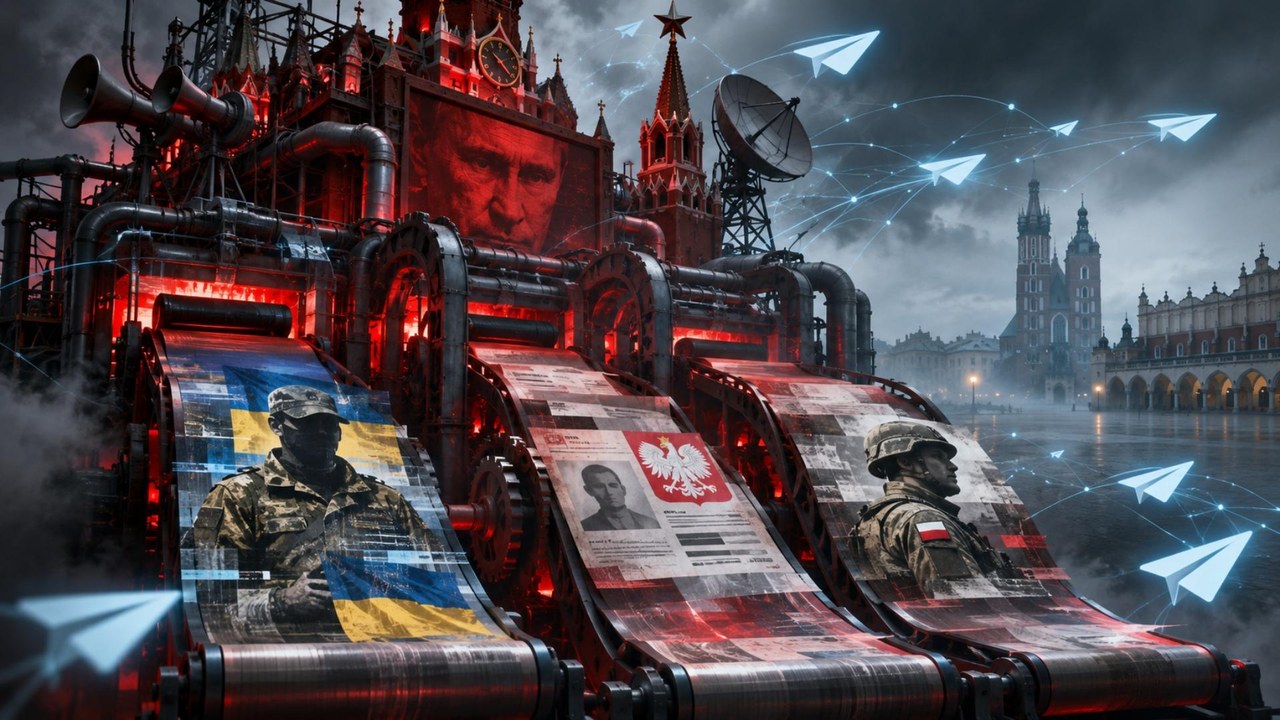

After a mass shooting in central Kraków that claimed six lives, the Polish authorities announced a large-scale disinformation campaign. Among the accounts spreading false reports were some with signs of links to Russia. Pro-government Russian Telegram channels are trying to find a “Ukrainian trace”, in particular by attributing to the attacker links to the American organisation Forward Observations Group (FOG), whose members visited Ukraine during the war and supported Ukrainian soldiers. Official Moscow has not yet commented on the events in Kraków: the Russian embassy in Poland is only reporting on the condition of an injured Russian woman.
In brief
- After the shooting in Kraków, which claimed six lives, the Polish authorities announced a large-scale disinformation campaign
- Dozens of suspicious accounts with signs of links to Russia were identified on social media
- Pro-government Russian Telegram channels tried to link the attacker to Ukraine
- The gunman was alleged to have links to the American Forward Observations Group (FOG), whose members have visited Ukraine. No evidence of such a link has been found
- Official Moscow has not commented on the tragedy. The Russian embassy in Poland is monitoring the condition of an injured Russian woman
On 7 November 2026 a mass shooting took place in the centre of the Polish city of Kraków. Six people were killed and another 16 were injured, including the attacker himself. According to the Polish authorities, a 24-year-old Polish citizen drove a car onto the Main Market Square and opened fire on passers-by. Police officers engaged him in a shoot-out, wounded him and detained him. The gunman later died in hospital. The bodies of three relatives were subsequently found at his home. According to the latest information from Poland’s Interior Ministry, the attacker was influenced by far-right ideology.
Almost immediately after the attack, false reports began to spread on social media about the gunman’s identity, his possible accomplices and the actions of the police. The Polish authorities warned of disinformation and urged citizens to rely exclusively on official sources of information.
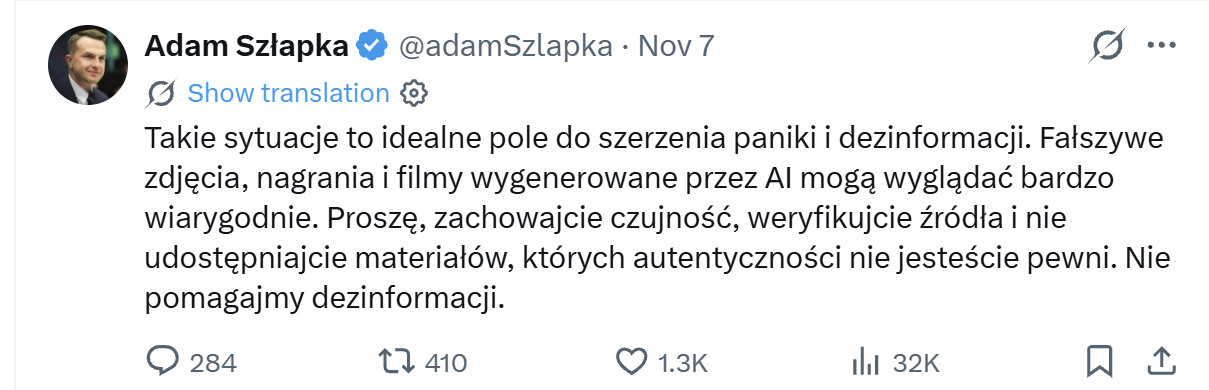
“Situations like this are the perfect ground for spreading panic and disinformation. Fake photos, recordings and videos generated by AI can look very convincing. Please stay vigilant, verify sources and do not share material whose authenticity you are not sure of. Let us not help disinformation,” Polish government spokesman Adam Szłapka wrote on X.
The Polish authorities did not stop at warnings. On the night after the attack, the leadership of the Ministry of Digital Affairs, headed by Krzysztof Gawkowski, held an emergency meeting on countering disinformation. Specialists recorded a surge in activity by accounts spreading false and unconfirmed reports and began taking steps to limit their spread.
During their monitoring, the ministry’s specialists also identified several dozen suspicious accounts that used the Russian language, Cyrillic script or references to Russia.
At the same time, the Polish authorities do not rule out a possible Russian trace in the attack itself. On 9 November Justice Minister Waldemar Żurek said that investigators have information that still needs to be verified. For now, he said, it is too early to speak of the involvement of foreign intelligence services in the Kraków tragedy.
The attacker’s identity
In the first hours after the shooting in Kraków, pro-government Russian Telegram channels published contradictory reports about the attacker: at first they spoke of two gunmen, but later, citing the Polish police, they reported that the attack had been carried out by one person, a Polish citizen.
The gunman’s equipment – camouflage uniform, helmet and body armour – became a separate topic. Russian and Belarusian media claimed that the attacker had allegedly served in the Polish army. According to Michał Marek, an expert at Poland’s NASK institute, some publications referred to a supposed confirmation from the Polish Defence Ministry.
Poland’s Minister of National Defence Władysław Kosiniak-Kamysz denied these reports. According to him, the attacker never served in the Polish army.
Before the attacker was identified, social media also carried claims that the gunman was allegedly Ukrainian. However, once his Polish citizenship was confirmed, these reports began to lose traction. But soon another version appeared: that the gunman had allegedly been a mercenary who fought on Ukraine’s side. And it was this version that Russian Telegram channels actively helped to spread.
Searching for a “Ukrainian” trace
The “Ukrainian” version was prompted by a patch on the attacker’s body armour. The Telegram channel SHOT claimed that it was the emblem of the American organisation Forward Observations Group (FOG), which it described as a private military company linked to foreign mercenaries fighting on Ukraine’s side.
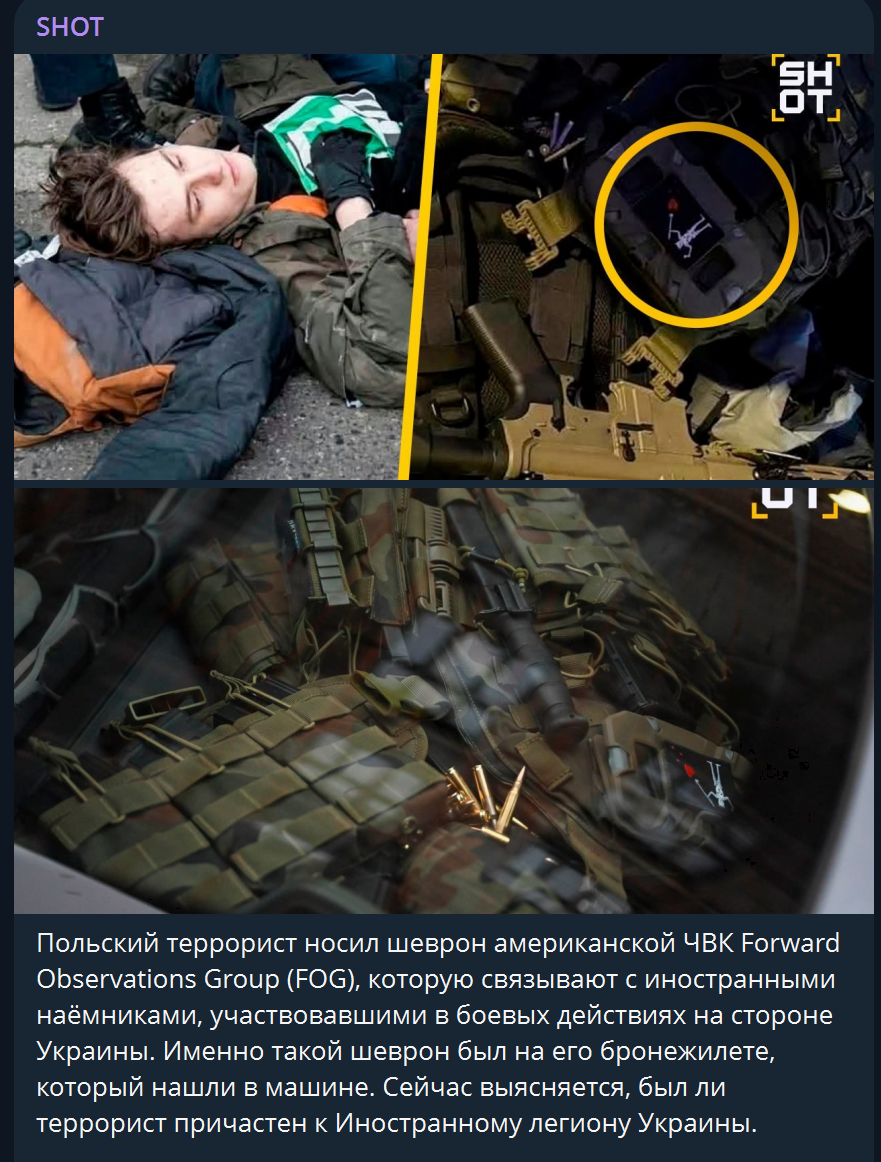
This version was also picked up by Russian media. NEWS.ru, for example, published an article headlined “Patch of American PMC found on gunman in Poland”.
However, it later turned out that the patch has nothing to do with FOG. It depicts a skeleton piercing a red heart with a spear – one of the variants of pirate symbolism. FOG does use a similar design, but on its emblem the spear points at the letter F, not at a heart.
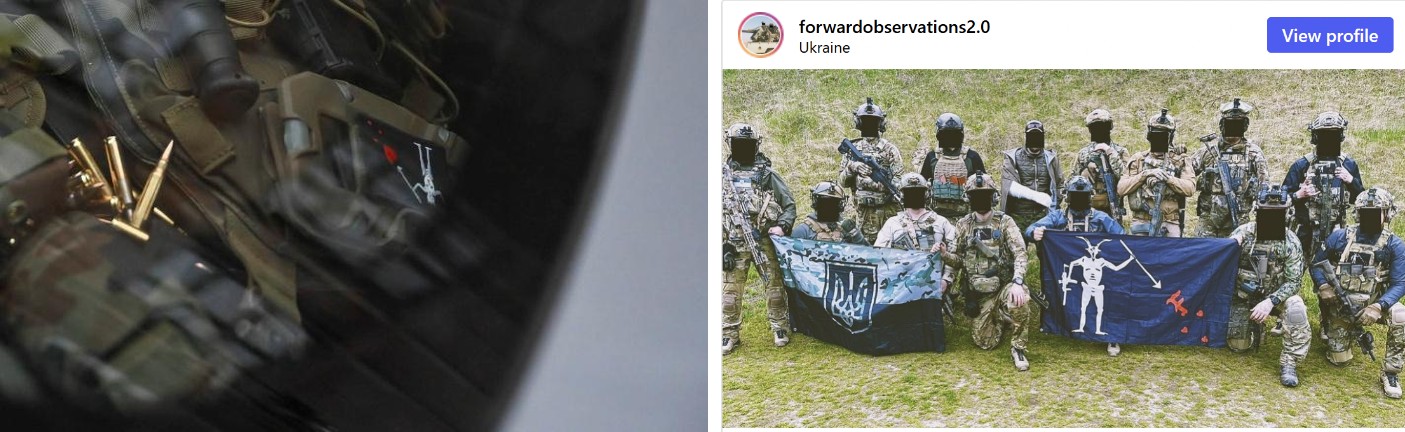
Photo collages also circulated widely on social media, placing images of the gunman and his body armour next to old photographs of armed men with FOG symbols. These images were taken at different times and did not confirm any links between the attacker and the organisation.
Russian political analysts predict a deepening political crisis in Poland
While pro-government Telegram channels were looking for a link between the attacker and Ukraine, Russian political analysts speculated about the possible consequences of the shooting for Poland itself. They linked the tragedy to the country’s internal problems and suggested that political confrontation might intensify.
Nikolai Mezhevich, chief research fellow at the Institute of Europe of the Russian Academy of Sciences, suggested in a comment to the newspaper VZGLYAD that the gunman’s actions may have been influenced by the information environment in Poland, in particular the constant coverage of wars and violence. At the same time, he acknowledged that the attacker’s motives could only be judged after the investigation.
Mezhevich also suggested that the Law and Justice party could exploit the tragedy ahead of the 2027 parliamentary elections, including in disputes over Poland’s policy towards Europe.
Military political analyst Alexander Perendzhiev, in an interview with NEWS.ru, linked the attack to the stand-off over Poland’s Constitutional Tribunal. In his view, the conflict between the highest authorities is increasing instability in the country and could lead to new upheavals.
Official Moscow’s reaction
The Russian authorities have not yet publicly reacted to the mass shooting in Kraków. Neither the Kremlin nor the Russian Foreign Ministry has commented on the attack or expressed condolences to the families of the victims. Unlike Moscow, Minsk did issue an official statement: Alexander Lukashenko expressed condolences to the Polish people, offered support to the families of the victims and wished the injured a speedy recovery.
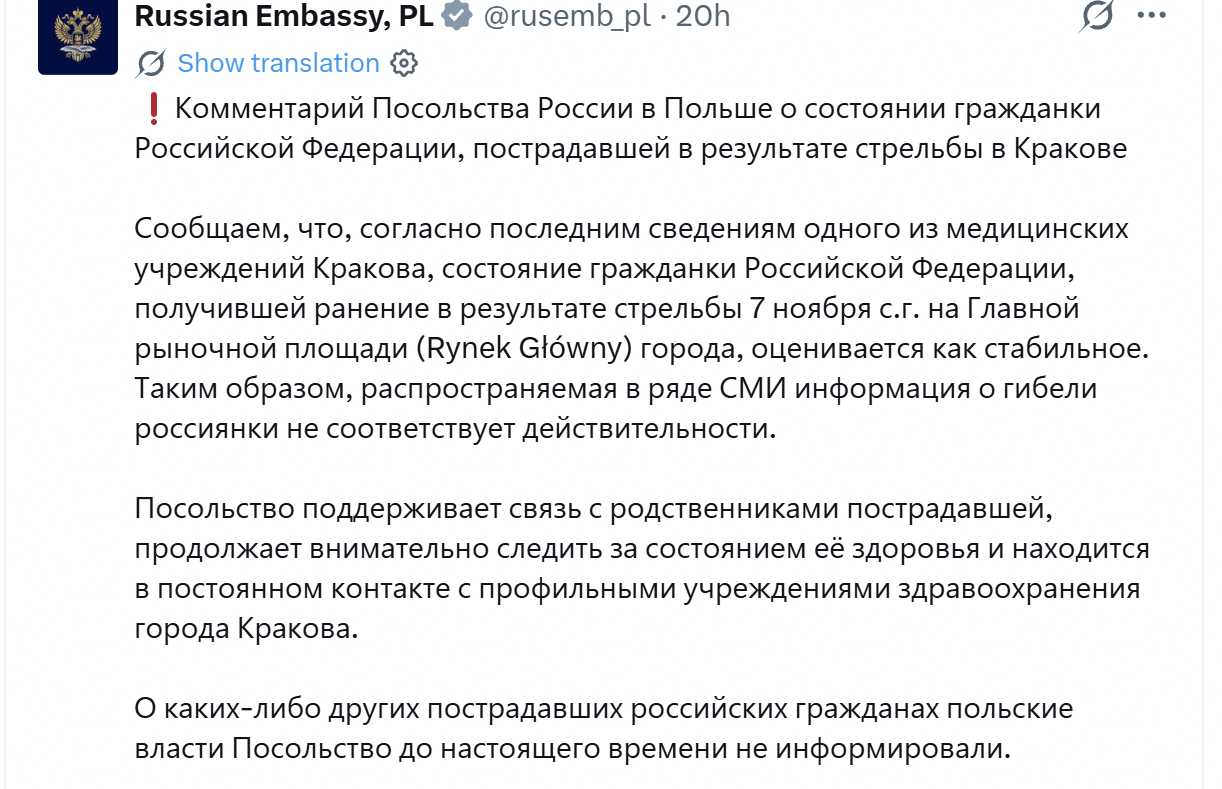
Meanwhile, the Russian embassy in Poland is following the situation closely, as a Russian citizen is among the injured. Diplomats confirmed that the Russian woman had been injured and said they were in contact with her relatives and medical institutions. On 8 November the mission clarified that the woman’s condition was stable and denied reports of her death. According to the embassy, it has received no information about other injured Russian citizens.
Official Russian and Belarusian sources cited in this text are for informational purposes only. Content from these sources may constitute disinformation or propaganda.