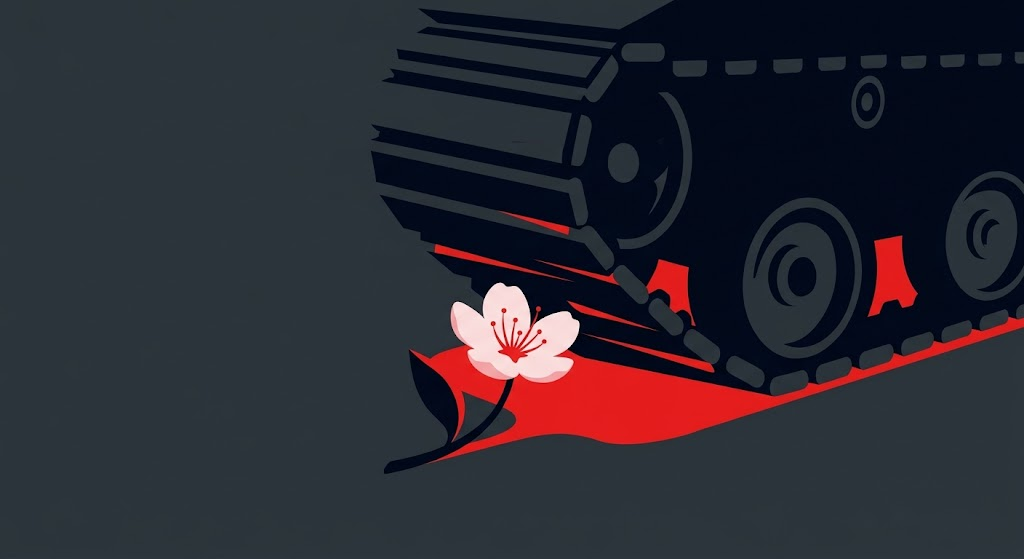

On the night of 21 August 1968, a 300,000-strong military force from the Warsaw Pact countries entered the territory of what was then Czechoslovakia on the Kremlin’s orders
For several centuries running, the defining feature of the pseudo-empire of Muscovite murderers and rapists—whether during the earlier days of the Tsarist regime, the communist dictatorship, or the current oligarchocracy—has been, and remains, a fierce and aggressive hatred of all states which, in the course of developing their own social systems, have chosen the path of freedom, democracy and the guarantee of fundamental human values. Deeply intoxicated, envious and embittered towards everyone (recall the occupier’s graffiti on the wall of a house in Bucha, looted in March 2022: ‘Who gave you permission to live so well?’) the ‘gendarme of Europe’, which has been terrorising Ukraine relentlessly for the eleventh year running, has instigated armed conflicts and carried out invasions of sovereign countries with the aim of preventing the spirit of freedom from flourishing, seeing this as a mortal threat to the existence of its own slave-owning entity. Exactly 58 years ago, Czechoslovakia too fell victim to its filthy canvas boots.
As a result of the brutal military invasion, all the progressive reforms of the ‘Prague Spring’ were rolled back, and its initiators, leaders and supporters were repressed by the new pro-Kremlin puppet regime. This intellectually and economically developed, and historically committed to democracy and pluralism of opinion, this Central European country was mired for two decades in the darkness of ‘normalisation’ – the de facto restoration of a totalitarian regime that lasted from 1969 right up until the start of the Velvet Revolution in November 1989.
In brief
- Socialism with a ‘human face’ – as an alternative to the social stagnation of the neo-Stalinist period
- Enslaved ‘tourists’ from Prague at the ‘Khrushchev dacha’ near Uzhhorod
- Why a hungry Dubček was afraid to eat borscht
- Moscow intended to form a new Czechoslovak government entirely under its control, but something went wrong
- ‘I am grateful to fate that I did not have to shoot at anyone, and no one shot at me…’
The expansion of civil rights and freedoms was regarded as an encroachment on the foundations of socialism
The socialist system, established in the wake of the Second World War, was regularly in turmoil. At the cost of immense effort, the Soviet leadership barely managed to ‘smooth over’ the economic difficulties and political crises that constantly arose in Czechoslovakia, Bulgaria, Poland and Hungary,
whilst not shying away from military intervention, thereby further exacerbating social problems at home and creating headaches for themselves on the international stage.
In 1967, Czechoslovakia began to plunge rapidly into social stagnation. The political rigidity and personal narrow-mindedness of Czechoslovakia’s president and party leader, the neo-Stalinist Antonín Novotný, accelerated the growth of dissatisfaction with the country’s leadership, not only amongst the masses but also within the ruling elite itself.
In January 1968, Alexander Dubček, leader of the Slovak Communists, took over as head of the Communist Party of Czechoslovakia. He spent his childhood and youth with his family in Bishkek, the capital of Soviet Kyrgyzstan, and in Nizhny Novgorod, Russia, and received his party training in Moscow. Accurately gauging the mood of his compatriots, Dubček launched large-scale social reforms which went down in history as the ‘Prague Spring’. The essence of the reforms, which aimed to give the socialist system a ‘human face’, boiled down to expanding basic social rights and freedoms that are now taken for granted: permitting the activities of genuinely civil society organisations, abolishing media censorship, and introducing market elements into the economy.
But the leaders of the USSR and its satellite states at the time – primarily Poland, the GDR, Bulgaria and Hungary – saw this as a mortal threat to the foundations of the socialist system, not only in the Czechoslovak Socialist Republic itself, but on a global scale! That is precisely why, between March and July 1968, the leaders of these countries – Leonid Brezhnev, Władysław Gomułka, Walter Ulbricht, Todor Zhivkov and János Kádár – at numerous meetings in Moscow, Warsaw, Dresden, sharply criticised the leadership of the Czechoslovak Communist Party for its course of political liberalisation in the country. However, to no avail.
The Soviet leadership insisted on holding a joint meeting of the leaders of the two countries, which was intended to settle all outstanding issues. It was due to take place in July 1968 in Moscow. But Dubček and his colleagues were absolutely unwilling to travel from their own country for this meeting and did everything in their power to ensure that the meeting between members of the Politburo of the Communist Party of the Soviet Union and members of the Presidium of the Central Committee of the Communist Party of Czechoslovakia took place on Czechoslovak territory. That was their demand. The Soviet leadership initially agreed to Dubček’s proposal to hold the talks in the Slovak city of Košice.
However, Ilnytskyi, First Secretary of the Transcarpathian Regional Party Committee—who had been consulted by his superiors in Moscow—advised, for security reasons, that the Slovak border town and major railway junction of Čierna nad Tisou, situated very close to the Ukrainian town of Chop, be chosen as the venue for the negotiations. The proposal was accepted.
On 28 July 1968, the Soviet delegation, comprising the entire party and state leadership, arrived at the military airfield in Mukachevo, Transcarpathia, on three separate flights, arriving at short intervals. Present were General Secretary Brezhnev, together with the ‘regular’ secretaries of the Central Committee, the Chairman of the Supreme Soviet, Pidhorny, the Head of Government, Kosygin, and the Party leader of the Ukrainian SSR, Shelest… From the airport, a motorcade took them to Chop. There, two specially prepared trains were waiting for them, heading in opposite directions: the Moscow train – in which each member of the Politburo was assigned their own carriage – was bound for Czechoslovakia, whilst the second, the Kyiv train, was bound for Kyiv. The members of the delegations stayed on these trains for the entire duration of the negotiations. In the morning, the delegation would travel to Čierna nad Tisou, and return home at lunchtime. After lunch, they would set off again for Čierna nad Tisou. In the evening, everyone would return to Chop.
The negotiations lasted for three days – from 29 July to 1 August. They were difficult and took place in a tense atmosphere. The Czechoslovak delegation conducted itself with confidence, defending its positions on principle and with sound arguments, whilst the Soviet leaders were not prepared for this. Consequently, neither side achieved its desired objective.
Following the fruitless negotiations, the Moscow delegation flew from Mukachevo to Moscow. Today, it can be stated with certainty that the ultimate consequence of the meeting in Čierna nad Tisou – and, most likely, the decisions taken in the train carriages in Chop – was the military intervention by the ‘brotherly’ countries against Czechoslovakia.
… On the night of 21 August 1968, Operation ‘Danube’ began, resulting in a 300,000-strong military force from the Warsaw Pact countries entering Czechoslovak territory from the USSR, Poland, the GDR and Hungary. The invasion began at 2 o’clock in the morning following a treacherous and false report, when a Soviet civilian aircraft requested an emergency landing at Ruzyne Airport near Prague. Having received clearance from the air traffic controller, the airliner touched down.
But it was not frightened civilian passengers who emerged from it, but… soldiers of the Soviet Army’s 7th Airborne Division. They blocked key facilities at the airfield, where Soviet An-12 military transport aircraft carrying paratroopers and military equipment began to land. Throughout 21 August, 24 divisions from Warsaw Pact countries occupied key locations across Czechoslovakia. Troops were deployed at 18 points from the territories of the then GDR, Poland, the USSR and Hungary. That same night, the buildings housing the Central Committee of the Communist Party of Czechoslovakia and Czechoslovak Radio and Television were brought under control.
The streets of Czech and Slovak towns were flooded with Soviet armoured vehicles, and bloody clashes took place between demonstrators and the invading forces. The military presence made further reforms impossible, and socialism in the Czechoslovak Socialist Republic never came to embody the ‘human face’ of socialism.
Soviet military personnel immediately isolated the top leadership of the Communist Party of Czechoslovakia, and the First Secretary of the Central Committee of the Communist Party of Czechoslovakia, Dubček; the Prime Minister, Černík; the Speaker of Parliament, Smrkovský; and three other influential party officials – Krieger, Šimon and Špaček – were flown to the military airfield in Mukachevo, and from there transported by armoured personnel carriers to the suburban residence of the Transcarpathian Regional Committee near the village of Kam’yanitsa, close to Uzhhorod, which was popularly known as the ‘Khrushchev Dacha’.
As the decades have passed, few of those directly involved in those events remain. We present here how the direct participants – the then party leaders of Ukraine and Transcarpathia, Petro Shelest and Yuriy Ilnytskyi – justified their actions in their memoirs, as well as how former military personnel recall these events.
‘I thought it was Poland…’
Yuriy Ilnytskyi: ‘After the meeting on 7 May in Moscow, matters began to move rapidly. Shelest rang me and asked me to arrange a meeting for him with Bilyak (First Secretary of the Central Committee of the Communist Party of Slovakia – ed.). On 22 May 1968, this extremely secret meeting took place in the village of Kam’yanitsa near Uzhhorod. They spent the whole night negotiating for Czechoslovakia to issue an appeal for help to the Soviet Union. Later, Bilyak ‘organised’ such a document…
Meanwhile, troops began to be deployed to the Zakarpattia Oblast. In June, there were a great many soldiers in the forests around Uzhhorod – both conscripts and mobilised reservists. On 20 August, Brezhnev rang me and told me that that evening, before the Soviet troops entered, someone should meet Bilyak’s wife and son at the border. My wife met them at the border, embraced them, gave them flowers, put them in the car and brought them to our flat at half past ten in the evening. As soon as we returned from the border, Brezhnev rang us again and asked where Bilyak’s wife was, and asked to speak to her. An hour later, our troops crossed the border.
On 22 August, I received a call from Moscow informing me that six members of the Presidium of the Central Committee of the Communist Party of Czechoslovakia would be brought to the Zakarpattia Oblast: Dubček, Černík, Smrkovský, Krieger, Šimon and Špaček. I was asked to make them comfortable and ensure a high standard of accommodation. I listened carefully to the instructions, but acted as I saw fit. I decided to accommodate them in two houses in Kam’yanitsa.
…It was just after midnight. I was just about to retire for the night when Brezhnev rang me on the secure line, asked how our guests were getting on, and ordered me to ensure that Dubček was brought to my office in Uzhhorod. I immediately passed on the General Secretary’s order to Zhabchenko, the head of the KGB department in the Zakarpattia Oblast, instructing him to ensure that Dubček wore dark glasses (as he might be recognised). When Dubček entered the office and saw me, he said: ‘Now I know where I am. Because I was being transported in an armoured personnel carrier and I thought I was in Poland’…
We spoke with Dubček in my office on the fifth floor. It was sweltering outside, as is typical for August, and the window was open (there was no air conditioning in Uzhhorod at that time – ed.). He walked over to the window and began to look out over the square. I recalled that in 1948, the son of Tomáš Masaryk, President of the First Czechoslovak Republic – Jan Masaryk, then Foreign Minister of Czechoslovakia – had thrown himself out of a window. Rumour had it that he hadn’t done it himself, but had been ‘helped’ to do so. Just to be on the safe side, I walked over to Dubček and, without interrupting our conversation, as if in passing, closed the window and stood beside him. Then, using the ‘internal’ telephone, I ordered lunch for two, which was brought to us in the lounge. I picked up my spoon to eat the borscht, but Dubček made no move to eat. It became clear to me why: he was probably afraid the food had been poisoned. So I swapped the plates and began to eat first. After that, Dubček began to eat reluctantly too…
Shortly afterwards, Brezhnev rang, asked how things were going, and informed me that Pidhorny (Chairman of the Presidium of the Supreme Soviet of the USSR – author’s note) would be speaking to my guest. And so it was. After speaking with Pidhorny, Dubček said: ‘A plane will fly to meet me in Mukachevo. I am to fly to Moscow on it.’ Later, Pidhorny telephoned me as well and instructed me to ensure the phased departure to Moscow of other members of the Presidium of the Central Committee of the Communist Party of Czechoslovakia. This took place on 23 August.’
‘Such actions by “friends” are not forgotten…’
Petro Shelest: “Our troops are in Czechoslovakia, whilst the situation there is dominated by right-wing, anti-socialist and anti-Soviet elements. The Central Committee, the government and the National Assembly are opposing us and our actions, demanding the immediate withdrawal of troops. Finally, Brezhnev instructed the intelligence services and the military to secretly remove Dubček, Černík, Smrkovský, Kriegel, Šimon and Špaček from Czechoslovakia against their will and wishes. The head of the KGB in Ukraine, Nikitchenko, was instructed to prepare isolated locations (but not in prison) for 6–8 people, to ensure appropriate security and protection, and to provide good food. All six men were secretly transported in armoured personnel carriers to Uzhhorod and housed in country mansions in the Carpathians.
The situation was becoming increasingly complicated. Hájek (Minister of Foreign Affairs of the Czechoslovak Socialist Republic – ed.) delivered a scathing anti-Soviet speech at the UN Security Council. Thus, the Czechoslovak issue had now officially become an international one. And it could not have been otherwise – the entire leadership had been secretly transported from the country to us: Dubček, First Secretary of the Central Committee of the Communist Party of Czechoslovakia; Černík, Prime Minister; Smrkovský, Chairman of the National Assembly; and three members of the Communist Party’s senior leadership. In essence, the only person we could speak to was Ludwig Svoboda – President of the Czechoslovak Republic. It was only through him that we could, to some extent, defuse the simply catastrophic situation. A conversation with him took place. It was not an easy one; indeed, it was almost humiliating for our side.
On 23 August at 22.00, all the political hostages were transported from Uzhhorod to Moscow. Dubček and Černík were received at the usual ‘official’ level. Svoboda was received in Moscow with respect. From 25 to 27 August, ‘negotiations’ with the Czechoslovaks took place in Moscow. If indeed that meeting can be called ‘negotiations’ at all, given that the top leadership of the Communist Party of Czechoslovakia and the government had been secretly removed from the country by force…
On the fourth day of the ‘negotiations’, a joint protocol was signed, intended to serve as a basis for the normalisation of relations between the Czechoslovak Socialist Republic and the USSR. It was signed by all participants in the meeting, except for Kriegel. We intended to form a new Czechoslovak government, to be approved by President Svoboda. But the ‘prospective leaders’ were frightened; they shied away from responsibility, and Indra (Brezhnev’s protégé for the post of head of the Czechoslovak government – ed.) ‘fell ill’. The question arose: what now? And there was no other option but to return the ‘political’ hostages home in their previous capacities. Svoboda, Bilyak, Lenart and Kolder were deeply concerned by this turn of events. Dubček, Černík, Smrkovský and Kriegel, who had been forcibly removed from their country and held in isolation for several days, could not simply get over it, come to terms with it or forgive us. On a purely human level, out of pride, such actions by ‘friends’ are not forgotten.”
Going to fetch water – in a tank…
Yuriy Orban, a pensioner and resident of the village of Strabychovo in the Mukachevo district: “I did my compulsory military service in an exemplary armoured unit in the Zhytomyr region. In 1966, holding the rank of second lieutenant, I was demobilised from the army and began working as an electric locomotive driver at the depot in the town of Chop. On 18 or 19 August 1968, a detachment from the military registration and enlistment office came to my hall of residence with an order to report immediately to the military unit in Uzhhorod. Literally two days later, at the stroke of midnight, we were roused by an alarm and the entire motorised infantry regiment set off towards the border.
The forced march, covering over 800 km to the Czech town of Tábor, 100 km from Prague, lasted three days. As we marched, the local population often threw whatever they could get their hands on at us and shouted various insults. We were understanding of this, because who would be happy to see a ‘guest’ approaching on a tank? There was one incident where a young Czech man lay down in front of the tank. We came to an abrupt halt and saw that, about 30 metres away, his friend was taking a photograph of the scene. Assessing the situation, my mechanic decided to give the lad a fright: he pressed the accelerator, the engine roared at full power, but the tank moved off smoothly. In a split second, the lad jumped to his feet, ran along the pavement and hid in a recess in the wall…
When we reached the Slovak town of Zvolen, the external fuel tank ran out – the mechanic hadn’t managed to switch the fuel supply to the internal tank in time and the engine cut out. I climbed out of the turret to bleed the air from the fuel pump. Just then, I felt someone pulling me down by my overalls.
At that very moment, my commander, who had seen that one of the locals was trying to drag me off the tank, shouted over the radio: ‘Shoot, or he’ll kill you!’ I pulled my pistol from my breast pocket, and that was enough to send my attacker running away.
Near Zvolen, we came under machine-gun fire. It was the second day of the march. I’d grown tired of sitting in the turret, so I’d settled down on the armour. Because of the roar of the engine, I didn’t hear the shots, but I did see the bullets, about 20 cm from my foot, shatter the metal box covering the wiring. Then, at a fork in the road just outside the town, one of the tanks was hit by a grenade launcher. A tank unit of the Bulgarian army witnessed this and fired its gun at that building…
The tanks, travelling at speed, did not always fit through the narrow city streets, and there were no bypass roads at that time. I myself saw how, in one such narrow spot, the corner of a building was struck by one tank, then a second, a third… and by the time the tenth had passed, it was already driving over the ruins of the shattered building.
During one of our stops, the commander ordered me to fetch a bucket of water. Nearby was some sort of building with its gates firmly shut. I asked the guard on duty there to fetch some water, but he refused. When I returned with an empty bucket, the commander told me off and said not to come back without water. So I set off for water a second time… on a tank. Upon seeing the muzzle of the tank gun pressed against the gates, the guard—despite his advanced age—rushed to open them and fetch me some water…
At the camp where we arrived, there was a Czech artillery unit. When they learnt of the invasion, they rolled out their guns and set them up around the perimeter of their unit. We surrounded them in a ring, then another unit formed a double ring. But, thank God, not a single shot was fired.
My personal ‘intervention’ in Czechoslovakia lasted three months. After that, I and many other reservists were sent home. Looking back on those events, I have always been grateful to fate that I did not have to shoot at anyone, and that no one fired at me…’
Vasyl Ilnytskyi