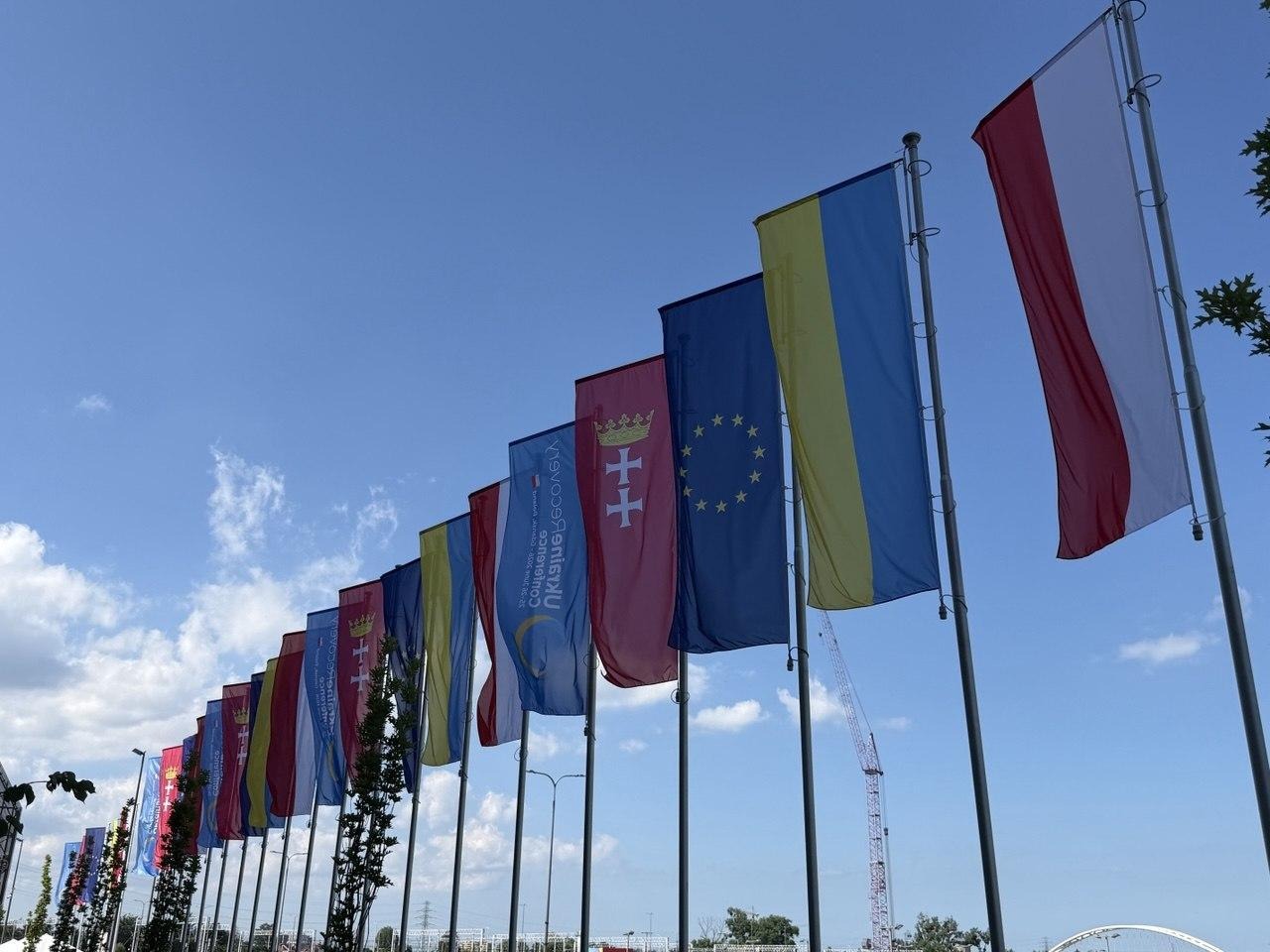

More than 7,000 participants, delegations from dozens of countries around the world, hundreds of journalists, and nearly 200 agreements signed totaling approximately 10 billion euros. The Fifth Ukraine Recovery Conference (URC 2026), held in Gdańsk, demonstrated once again that Ukraine’s reconstruction has long ceased to be merely a Ukrainian matter. Today, it is one of the key global projects for security, economic development, and the future of all of Europe.
In brief:
- Ukraine’s reconstruction has become a global priority. The Ukraine Recovery Conference in Gdańsk brought together approximately 7,500 participants, including government delegations from around the world, international financial institutions, and businesses that view Ukraine’s recovery as an investment in Europe’s security and future.
- Nearly 200 agreements worth approximately 10 billion euros were signed. The agreements cover the energy sector, the defense industry, infrastructure, housing construction, and community development.
- Security was featured as a separate track of the conference for the first time. Participants discussed the protection of critical infrastructure, energy resilience, and mechanisms for insuring against war risks for investors.
- The EU reaffirmed its long-term support for Ukraine. European Commission President Ursula von der Leyen announced the first tranche of aid to Ukraine totaling over 3 billion euros out of a total package of 90 billion euros and emphasized the irreversibility of Ukraine’s European future.
- The main takeaway from the conference is that the world has not grown tired of Ukraine. Despite the war, international businesses, governments, and civil society continue to seek opportunities for cooperation, investment, and the joint reconstruction of Ukraine.
It is symbolic that the conference was hosted in Gdańsk—the city where the “Solidarity” movement was born, a movement that became a symbol of the struggle for freedom and democracy in Central and Eastern Europe. The choice of host city was no accident.
Polish Prime Minister Donald Tusk emphasized that Gdańsk proves that even after the most devastating destruction, revival is possible if there is solidarity and a shared will to act. According to him, Ukraine’s reconstruction is not just about infrastructure or the economy, but first and foremost about the ability to build a future based on truth, mutual respect, and cooperation.
Reconstruction and Security—Now Inseparable
One of the main innovations of URC 2026 was the inclusion of a separate track on “Security and Defense” in the agenda. Previously, this topic had not been a separate section of the conference.
Russia’s war against Ukraine has demonstrated that it is impossible to discuss investment, urban reconstruction, or economic development without ensuring basic security. That is why participants discussed the protection of critical infrastructure, energy resilience, the development of defense technologies, and mechanisms for insuring against war risks.
Oleksiy Sobolev, Ukraine’s Minister of Economy, Environment, and Agriculture, emphasized that insuring against war risks is no longer just a Ukrainian issue but a global challenge. The willingness of international businesses to invest in countries facing security threats depends on the effectiveness of such mechanisms.
Europe Confirms: Ukraine’s Future Lies in the EU
Despite the absence of Ukrainian President Volodymyr Zelenskyy at the conference, the forum’s political representation remained exceptionally high.
European Commission President Ursula von der Leyen arrived in Gdańsk and announced the provision of the first tranche of financial aid to Ukraine, amounting to over 3 billion euros out of a total package of 90 billion euros. Her statement that “investing in Ukraine is investing in Europe’s future” effectively became one of the conference’s key messages.
The President of the European Commission emphasized that the opening of negotiation chapters on Ukraine’s accession to the European Union served as a historic signal of the irreversibility of Ukraine’s European choice. In fact, an important message was conveyed in Gdańsk: Ukraine’s reconstruction is part of a broader process—the integration of Ukraine into the European political and economic space.
Gdańsk became the venue for a global coalition in support of Ukraine
The Ukraine Recovery Conference 2026 once again confirmed that the issue of Ukraine’s reconstruction has long gone beyond the scope of bilateral Ukrainian-Polish relations and even the European agenda. An international coalition in support of Ukraine effectively gathered in Gdańsk. Alongside the leadership of Ukraine and Poland were leaders and high-ranking officials from the European Union, as well as representatives of dozens of countries and international financial institutions. That is precisely why the URC 2026 in Gdańsk can be described as more than just a reconstruction conference. It became an international forum where participants discussed the future architecture of European security, new economic opportunities, and Ukraine’s place in the European and global order after the war.
The presence of Slovak Prime Minister Robert Fico was particularly significant. Despite his controversial statements regarding Russia’s war against Ukraine, he traveled to Gdańsk and participated in discussions on humanitarian aid and Ukraine’s reconstruction. This demonstrated that even countries with differing approaches to certain aspects of supporting Kyiv recognize the need to participate in Ukraine’s future recovery.
The Slovak Prime Minister emphasized that large-scale hostilities cause immense human suffering and catastrophic destruction of infrastructure, and their negative consequences are already being felt far beyond Ukraine’s borders. Robert Fico clearly outlined his country’s vision: “I believe that the EU should support peace initiatives. This destructive war has no military solution and can only end at the negotiating table.” The Slovak politician noted that the European community must return to the fundamental principles of global security, including, in particular, respect for sovereignty and diplomatic pressure.
Investors Have Not Lost Interest in Ukraine
Despite the fifth year of full-scale war, interest in Ukraine remains strong.
A telling example occurred at the booth for the Donetsk and Luhansk regions, where an investor from Germany—who currently lives in France—expressed interest in opportunities to participate in the future reconstruction of Mariupol and other temporarily occupied cities, while struggling to understand how one could invest in rebuilding territories that are still occupied by Russia.
Such stories demonstrate that the international business community thinks strategically and already views Ukraine as a future destination for large-scale investments. However, foreign investors need more information about investment opportunities in Ukraine.
As mentioned above, the conference resulted in the signing of nearly 200 agreements, memorandums, and letters of intent totaling approximately 10 billion euros. The agreements cover the energy sector, the defense industry, infrastructure, housing construction, and community development.
Mariupol Is Already Planning for the Future
The topic of rebuilding Ukrainian communities took center stage at the conference.
Vadym Boychenko, head of the Mariupol City Military Administration, presented social housing projects for Mariupol residents in Bila Tserkva.
The governments of Germany and France, as well as major European financial institutions, are already contributing to the funding. In total, this involves hundreds of millions of euros in investments.
This is an important signal for all of Ukraine: even cities that are currently occupied are already planning their future and seeking partners for post-war reconstruction.
“Today, communities such as Mariupol or other communities in the Donetsk region have been relocated to various cities across Ukraine and have their own new legal addresses. And today, these cities do not operate independently but live together with their communities. Taking Mariupol as an example, we are now present in 22 cities and have a population of 200,000. It is precisely for such communities that locations have been selected where we will build Ukraine’s first affordable social housing. Bila Tserkva is a case in point. We have now brought a finalized project that has passed expert review: on 10 hectares of land, we want to build 1,200 apartments specifically for our community. We have just signed an agreement with the German government. It is providing funding to the company Rehau for windows in this project for Mariupol. This is a modest but important investment. The amount is 5 million euros. We spoke with the French, submitted an application, and won this project. The 7.5 million euros is additional funding for this project in Bila Tserkva. There will be water and heating. The French will build 400 apartments on our site alongside what has already been designed; they will design and build them together with us. This project includes 5 million from the German government and 7.5 million from the French government. We will also be talking with the Danish government, which has tentatively agreed to provide additional funding for projects such as social housing for Mariupol. And there is a huge amount of money there that we need to secure for Ukraine. We’re talking about 400 million euros. There are already banks that have received a mandate from the European Commission—as a grant component and as a guarantee for their operations in Ukraine. These are the European Investment Bank, the European Bank for Reconstruction and Development, and the Council of Europe Development Bank. Today, they will help us develop and create this critically important social infrastructure in Ukraine,” emphasized Vadym Boychenko.
Reconstruction Begins at the Grassroots Level
Throughout URC 2026, it was consistently evident that genuine international cooperation does not arise solely on political stages.
Representatives from communities, the business sector, the civil society sector, and international organizations held dozens of meetings, agreed on new partnerships, and discussed specific projects.
Natalka Panchenko, head of the “Euromaidan-Warsaw” civic initiative, noted that it is precisely at such forums that genuine international cooperation takes shape: people find common ground and begin to work together.
And it is this human interaction that is perhaps the conference’s most significant outcome.
“A great many people came; representatives from many countries—not just from Europe—gathered here. I met people from Canada and the United States, as well as representatives of their businesses and non-governmental organizations. This means that the world is interested in Ukraine’s reconstruction. And it means that Ukraine is by no means alone. I really like that work is in full swing, and it’s evident. I myself had a huge number of meetings. Many non-governmental organizations are reaching out to one another, discussing joint projects, and talking about how to move forward. Some have already started working. The same goes for the business community. Today we attended a business panel, followed by a session featuring Ukrainian and Polish entrepreneurs. I spoke with them briefly. The momentum is very positive, — said Natalka Panchenko.
Gdańsk Reminded Ukraine of Peace
For many participants from Ukraine, these few days in Gdańsk provided an opportunity to experience a normal, peaceful life—if only briefly. Without air raid sirens or the sounds of explosions. To breathe in the sea air, stroll along the sunny Baltic coast, and remember what Ukraine is fighting for.
URC 2026 demonstrated the most important thing: the world has not grown tired of Ukraine. On the contrary—it is increasingly realizing that Ukraine’s reconstruction is an investment not only in rebuilding destroyed cities but also in a safe, democratic, and strong Europe of the future. Gdańsk became the place where solidarity once again took on practical meaning—in the form of contracts, investments, partnerships, and shared responsibility for the future of Ukraine and all of Europe.
Author: Svitlana Mialyk