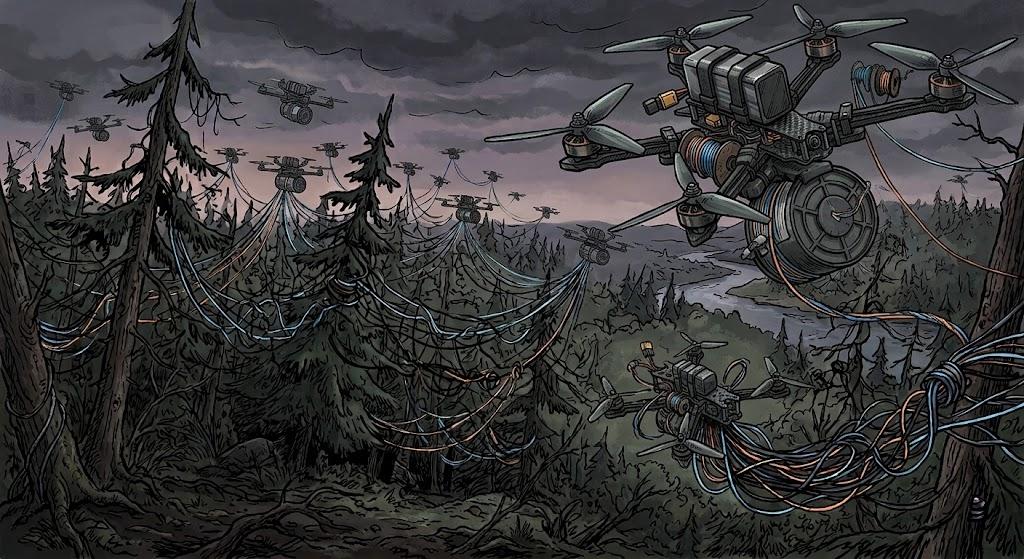

Ukrainian troops report the mass appearance of a “cobweb” over Ukraine’s forests along the line of contact. The fibre stays in the trees after the use of a new type of FPV drone that is invisible to electronic warfare systems. As they fly, these drones unspool kilometres of optical fibre, and it is through that fibre that they keep in contact. Nataliya Hozak, head of Greenpeace Ukraine, told Black Sky about the danger the technology brings.
In brief:
- Russia is making mass use of fibre-optic drones along the line of contact because their signal cannot be intercepted.
- The drones, trailing spools of optical fibre behind them, have formed nets over Ukraine’s forests.
- The scale of the potential damage cannot be assessed because active fighting is under way.
- The fibre is dangerous to birds and small animals living in the forests.
- The greatest danger from optical fibre is the microplastic that will enter the soil and water as it breaks down.
Why Russia is making such heavy use of fibre-optic drones
Fibre-optic FPV drones are controlled by a signal transmitted directly to the device through a thin optical cable, which the drone unspools as it flies from a special reel attached underneath.
Unlike radio-frequency drones, fibre-optic ones have a significant advantage: their link cannot be tracked or intercepted, which makes detecting and neutralising such a device harder.
Standard signals intelligence, which responds to radio emissions, is entirely powerless here. Portable radar devices or acoustic sensors are used to detect these drones approaching.
Another advantage of optical fibre is the stability of the link. Drones transmitting images through a cable do not lose signal quality because of distance or terrain.
For all these advantages, “cable” drones have one substantial drawback: the fibre itself. The thread the drone trails behind it sharply reduces its manoeuvrability, and the link can break from the slightest damage to the cable. The average range of a fibre-optic drone is roughly 20–30 km. To fit that much cable on a reel without overloading the drone, the wire is extremely thin – from 0.2 to 0.5 mm – which makes it vulnerable to damage.
Why Ukraine’s forests are covered in “cobwebs”
Along the line of contact, where the distance between the sides is relatively short, fibre-optic drones are extremely effective because they go unnoticed. But after every launch of such a drone, threads of optical fibre are left behind. They are a by-product of its work, accumulating on trees and bushes and forming “cobwebs”.
Ukrainian soldiers of the 57th Motorised Infantry Brigade published a video titled “The ‘cobweb’ is killing the forest”, showing the contamination of Ukrainian forests with optical fibre from drone use on the Vovchansk axis in the Kharkiv region. There is also evidence of similar contamination of forests in the Donetsk and Chernihiv regions.
Nataliya Hozak, head of Greenpeace Ukraine, says ecologists currently have no access to assess the scale of the contamination because of the heightened danger:
“Field research cannot be carried out at the moment, but we are following the situation through accounts from soldiers who are in those areas, and we are gathering all available information so as to have a rough idea of the scale. As far as we know now, the whole line of contact is covered with the residue of fibre-optic drone activity, and as the technology develops the radius of contamination is only growing.”
Why the fibre nets over the forests are dangerous
Because drones trailing up to 30 km of optical cable are used so often, a “cobweb” forms over the forests. The ecologist Nataliya Hozak says the fibre is dangerous first of all to birds, which can become entangled and trapped.
“The greatest danger from the nets of optical fibre forming over the forests is to birds. There are already recorded cases of birds getting tangled, and even isolated cases involving large horned animals, but for now these are individual recorded cases that do not look like a mass phenomenon,” Nataliya Hozak says.
The ecologist points to cases where birds use optical fibre to build nests, but considers that entirely natural, since birds constantly use materials that are easy to find.
Why optical fibre will become even more dangerous once it “disappears”
Optical fibre is a modern material made of glass and plastic. A relatively brittle material that is easy to damage, it behaves quite differently as it decomposes. The polymers used as a protective sheath break down quickly at first. Under sunlight and weather the fibre will begin tearing into smaller particles within a few years. Once in the soil the process slows to decades, but full decomposition should not be expected, because after that first breakdown the polymers turn into microplastic, which decomposes far more slowly still – roughly 0.12% over 22 months – which points to hundreds of years for full decomposition.
“The biggest problem with optical fibre is the microplastic to come. It can build into the food chains of plants. Animals can absorb it in various ways and will accumulate it in their digestive organs. It is inert and has no nutritional value, but it clogs the animals’ organs, so they cannot feed properly,” Nataliya Hozak says.
Microplastic itself is not chemical contamination – it does not react with other substances – but in excessive quantities it can disrupt the ordinary working of ecosystems.
The head of Greenpeace Ukraine stresses that microplastic can accumulate in soils and over time be washed into water bodies. Once in the soil, plastic affects the health of plants, soil organisms and bacteria, and changes the soil’s physical and chemical properties. The interaction of microplastic with fertilisers and crop protection products requires separate study, as it may affect yields.
In water bodies the consequences are more predictable. The ecologist describes layers of microplastic already being found on the ocean floor. Plastic settles in dense layers and obstructs the life of small marine creatures, and also enters the digestive organs of other inhabitants of the water.
“This is a fairly long-term story that we will not see quickly. But I predict that in a certain number of years we will find the remains of this same microplastic in the Black Sea too. This is a long-term effect of the war, and for decades, if not centuries, we will be observing and repairing the consequences,” Nataliya Hozak stresses.
Is there any way to prevent the consequences
Unlike anti-drone netting, the fibre-optic “cobweb” has no clear structure or size, and its chemical composition is entirely different. Protective nets are made of various kinds of plastic, whereas optical fibre, as we have established, combines both glass and plastic, which makes recycling impossible.
Nataliya Hozak notes that anti-drone nets put up by people are far easier to collect and dispose of, even when damaged, whereas with optical fibre that is practically impossible.
A separate factor is time. There is no access to the areas where fighting is under way, so the optical fibre may already begin turning into microplastic faster than ecologists and volunteers are able to assess the full scale of the contamination.
Yulia Derdiuk