
Because of the Russian blockade, residents of the town of Oleshky in the Kherson region have been without access to basic necessities for more than four months. More than 2,000 people are still in the town, among them around fifty children. Kateryna Dorosh, who coordinates war crimes documentation at the Skhid SOS charitable foundation, told Black Sky what the situation in the town is now and whether there is any way to help people.
In brief:
- Russian troops occupied Oleshky in the first wave of the offensive during the full-scale invasion in 2022. Since then the humanitarian situation in the town has been growing worse.
- More than 2,000 civilians are currently in the town, almost fifty of them children.
- The situation with food and access to medicines is getting worse by the day.
- Ukrainian troops are delivering food by drone, but the amount of this aid is critically small.
- European human rights organisations are drawing attention to the critical humanitarian catastrophe in the town, but the only access to it is through Russia.
Why there is a humanitarian crisis in Oleshky
Oleshky in the Kherson region lies on the left bank of the Dnipro directly opposite the city of Kherson; across the river, the regional centre is just 9 kilometres away.
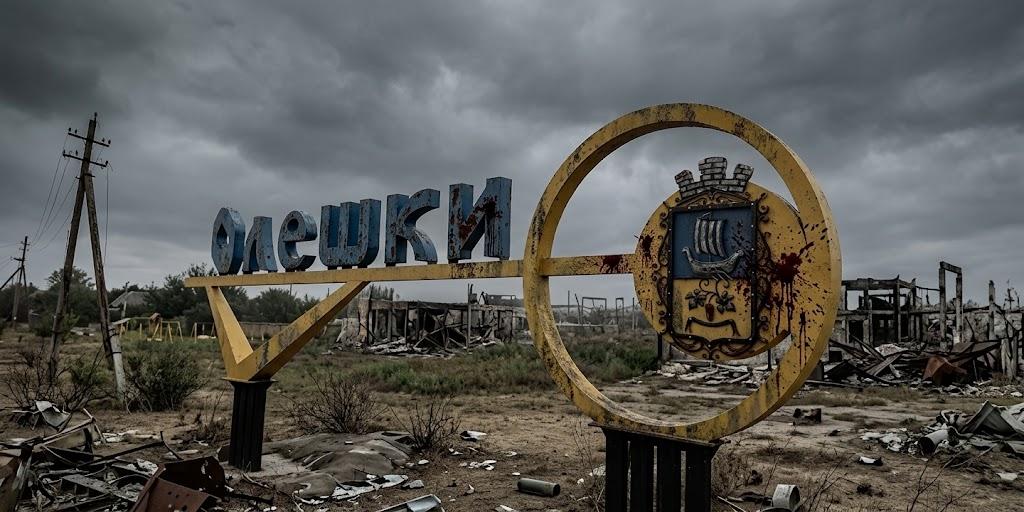
Oleshky was occupied by Russian troops on 24 February 2022. Since then the humanitarian situation in the town has been deteriorating. After the Kakhovka dam was blown up in the summer of 2023, the town was flooded. Some residents died, and even more lost their documents and personal belongings, which became one of the reasons why residents were unable to leave the ruined town.
Kateryna Dorosh, who coordinates war crimes documentation at the Skhid SOS charitable foundation, says the situation in the town began to deteriorate from the start of the full-scale invasion. People gradually lost electricity, water supply and gas. As early as March 2026, volunteers began recording critical cases of food shortages.
“In recent months the situation has become many times worse. On top of that, people are in constant danger. The town is under FPV drone attack. Russia is hunting people, civilians who are simply moving around the town. We recorded a case where a civilian woman went out to feed stray cats, an FPV drone struck her deliberately, and her body lay by the roadside for several weeks.”
What the situation in Oleshky is today
Around two thousand civilians still remain in the town, among them around fifty children, as well as people with limited mobility. According to the UN monitoring mission, the food situation has been worsening since the end of May 2026. Skhid SOS staff, however, say they began recording cases of food shortages as early as February. If at the beginning of spring it was still possible to buy some food in the town at inflated prices, by the beginning of summer that possibility had disappeared entirely. Supplies to the town stopped.
Kateryna Dorosh says that in summer the town’s residents tried to provide for themselves by growing food in vegetable gardens and on their plots, but winter is coming and there is no food in the town.
“From recent testimonies and open sources, we have information that in August and September people are already starting to eat tree bark and leaves, making some kind of soup from them and trying to feed themselves that way.”
Why residents could not evacuate
A significant part of the town is cut off from the mainland by the Dnipro, while the roads that remain on land have been completely mined since the start of the full-scale invasion. This makes it harder both to bring humanitarian aid into the town and to evacuate the population.
“We have the testimony of a woman who was wounded in such an FPV drone strike while trying to leave the town. They were driving out, and a drone hit the car. The woman was wounded, and the other woman travelling with her was killed. So there are no safe roads for bringing in aid or for people to leave,” says Kateryna Dorosh.
Another factor preventing people from leaving was the destruction of the Kakhovka dam. The town was flooded, and as a result many people were left without documents. The Skhid SOS war crimes documentation coordinator says a significant number of residents were unable to pass Russian filtration when leaving the town and were forced to return.
“There are many different situations in which a person simply cannot leave. For example, relatives with limited mobility, seriously ill people, people who have no documents or money to move. These are psychological and material factors. Despite all this, they are civilians who have the right to protection and humanitarian aid, even if they did not evacuate earlier,” Kateryna Dorosh stresses.
Is there a way to deliver aid to Oleshky
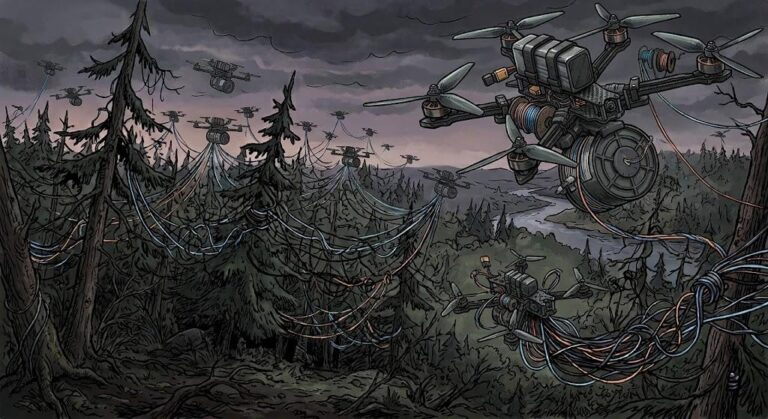
On 27 September the head of the Kherson Regional Military Administration reported the delivery of 4,000 kg of food. Ukrainian troops launched a hundred drones to various locations in the town and dropped food parcels. The head of the administration said such operations have been carried out since March, but Russian troops systematically try to disrupt food deliveries.
Kateryna Dorosh says that because the land routes are mined, air delivery currently remains the only way to get any amount of aid into the town. These deliveries are critically important, but their volume is too small to provide all residents with what they need.
Even assuming that everyone is able to receive the aid, which is practically impossible because of the drone danger in the town, 4,000 kg for 2,000 people is not enough food for a long stay under occupation.
Volunteers note that the only effective way to save the town’s residents is to organise a humanitarian corridor, but no one other than Russia has access to the town.
Can Europe influence the situation in Oleshky
Kateryna Dorosh believes Ukraine is practically powerless in the situation that has arisen. Volunteers have no direct access to the occupied territories and cannot help the local population. The only possible option, therefore, is to draw the international community’s attention to the problem, so that European partners help bring about a dialogue with Russia on a local ceasefire and a humanitarian corridor out of the town.
Such decisions take time, which the residents of occupied Oleshky do not have, Kateryna Dorosh believes:
“In March and April we already came out with public statements and tried to stir up the international community and Ukrainian state bodies: pay attention to Oleshky. But only now, in September, do we have a reaction. So we have to understand that everything that happens, all the reactions, come with a huge delay. And, unfortunately, this works against the town’s population.”
In mid-September the Verkhovna Rada Commissioner for Human Rights, Dmytro Lubinets, published an appeal on the humanitarian catastrophe in Oleshky in the Kherson region, and on 20 September Ukraine’s Foreign Ministry announced its intention to raise the issue of Oleshky at the UN General Assembly in New York.
The UN and the Red Cross have already published statements referring to the critical situation and violations of international humanitarian law. In particular, the spokesperson for the UN Secretary-General, Stéphane Dujarric, said the UN is working to reach people in the worst-affected regions of Ukraine.
The EU has also spoken of attempts to send humanitarian aid to help Ukraine protect itself. A similar statement was made by the EU’s High Representative for Foreign Affairs and Security Policy, Kaja Kallas, who stressed at the same time that the story of Oleshky is a reminder that the issue is not territory but people.
The European Union is demanding a humanitarian corridor for the town’s residents, European Commission spokesperson Eva Hrnčířová said. The spokesperson also said the EU considers the situation unacceptable and is trying to secure humanitarian access to Oleshky with the help of international partners.
Kateryna Dorosh believes it is now very important to distinguish between statements and concrete action, since no international organisation currently has access to the town:
“What matters very much now is exactly how international organisations will manage to obtain permission to access this territory and receive direct guarantees from Russia that the humanitarian workers who go in there, and the people who will be evacuated from there, will not come under fire or be detained,” Kateryna Dorosh stresses.
Yulia Derdiuk