On 19 August 1991, the Uzhhorod City Council was the first in Ukraine to condemn the Moscow State of Emergency
They say that great things are best seen from afar. Similarly, the significance of any major social event is only properly appreciated years later. The extraordinary session of the Uzhhorod City Council, which took place exactly 35 years ago, undoubtedly belongs to this category. To enable the modern reader to fully understand its significance and the social atmosphere that preceded it, let us take a brief historical look back at those years.
In brief
- The ‘cosmetic overhaul’ of the Soviet empire could not deliver the expected results, as the loosening of the ruling party’s dictatorship and the easing of the repressive measures that formed its foundation produced the exact opposite outcome
- Only two councils – the Uzhhorod City Council and the Lviv Regional Council – dared to condemn the actions of the rebels on the very first day of the coup in Ukraine
- We understood that, should the ‘emergency committee’ prevail, everyone would be held accountable
- Colonel Soinov, commander of the Uzhhorod military garrison, assured the councillors that he would not lead the garrison under his command out onto the city’s streets. It was a courageous move by a true officer
The final convulsions of a dying empire
In the early 1990s, the Soviet ‘empire of evil’ was falling apart at the seams. The economy of this vast country was hurtling rapidly and inexorably towards the abyss. Its decline was caused by three powerful geopolitical factors: the involvement of Soviet military forces in the decade-long war in Afghanistan (1979–1989), the man-made disaster at the Chernobyl Nuclear Power Station (1986) and the subsequent clean-up of its catastrophic consequences, as well as the country’s entanglement in an exhausting ‘arms race’ imposed upon it by the administration of US President Ronald Reagan. All this required enormous financial and material resources, which could only be obtained by cutting spending on the social needs of its own people. Which was done with ‘success’…
Generations born during the era of Ukrainian independence clearly cannot even imagine the situation at that time. At the turn of the 1980s and 1990s, the shelves of Soviet grocery shops – which, in the ‘country with the world’s tastiest ice cream’, had never exactly been overflowing with abundance – became almost entirely empty. An acute shortage of meat and dairy products became a familiar occurrence for a long time.
In Uzhhorod in the late 1980s, to buy a bottle of milk for the children, I had to queue outside the grocery shop from 7.00 am, an hour before it opened. As there wasn’t enough milk to go round, only those who were quickest in the fierce jostling were lucky enough to get their hands on some. Butter was delivered only to certain grocery shops in the city once a week – on Thursdays – and was sold for barely an hour or an hour and a half. There was no meat or meat products at all in state-run shops. Meat products were sold exclusively in consumer co-operative shops and at markets, but at… three times the price charged in state-run shops. Vodka, wine and cigarettes could only be purchased with special vouchers.
To buy an ‘Elektron’ colour television, a fridge or other household electronics, you had to join a waiting list and wait several months. More or less decent imported clothing was bought at triple the price at ‘flea markets’ from resellers known as ‘fartsovshchiki’, or had to be made by tailors you knew at home, as the products of the Soviet ‘light industry’ were only really fit for garden scarecrows…
The new and relatively young Soviet leader, Mikhail Gorbachev, who inherited supreme power in 1985 following a series of deaths, occurring at intervals of up to a year and a half, of his elderly predecessors Leonid Brezhnev, Yuri Andropov and Konstantin Chernenko, was well aware of the critical nature of the situation. Together with like-minded colleagues, he set about the ‘Sisyphean’ task of saving the dying empire by implementing radical reforms. He proclaimed a policy of ‘perestroika’, which envisaged lifting the ban on private enterprise in certain sectors, easing repression against dissidents, permitting the formation of informal civil society organisations, allowing pluralism of opinion in the media, freedom of assembly and demonstration, and, subsequently, a multi-party system.
However, these ‘cosmetic changes’ could not deliver the expected results; because the loosening of the ruling party’s stranglehold and the curbing of repressive measures—which had been the cement holding the empire together—along with the expansion of private enterprise in the economy, produced a diametrically opposite result: a strengthening of centrifugal tendencies and the desire of the union republics to declare their own state independence. Which is precisely what subsequently happened.
At the very outset of Gorbachev’s ‘perestroika’, the majority of the country’s citizens welcomed the reforms as a breath of fresh air in a room filled with a heavy, stifling stench. At the same time, the conservative wing of the ruling regime and the repressive apparatus realised that they were losing their absolute power and personal privileges, and therefore reacted with extreme hostility.
An article in the newspaper *Sovetskaya Rossiya* by the Leningrad lecturer N. Andreeva, entitled ‘I Cannot Compromise on Principles’, served as a kind of political manifesto for the orthodox faction; in it, she cast serious doubt on the correctness of the ‘perestroika’ course.
Progressive reforms introduced by the centre were very often met with outright disregard, or even fierce resistance, from local authorities. This was particularly true in Ukraine, where, despite sweeping personnel changes and the ‘winds of change’ in Moscow, the odious pillar of the Brezhnev regime, the Ukrainophobe Volodymyr Shcherbytskyi, continued to rule. The rock band ‘Braty Hadyukiny’ from Lviv, popular in those years, ‘sang the praises’ of the Ukrainian political realities of the time as follows: ‘And in Ukraine there is order and peace: the nightingale chirps, ting-ting-ting, toch-toch-toch, the Party and God are with us!’…
The Kremlin hardliners, backed by the KGB, saw the collapse of the USSR as inevitable and decided to remove Gorbachev from power and return to the undivided dictatorship of the Communist Party and the secret services. On the morning of 19 August 1991, the country’s inhabitants and the whole world learnt from television and radio that the country’s president, Gorbachev, whilst on his summer holiday at his dacha in Crimea, had suddenly fallen ill and was no longer able to perform the duties of head of state. All power was to be transferred to a new body not provided for in the Constitution, the State Committee for the State of Emergency (in Russian: GKChP). This move was the final convulsion of the dying ‘evil empire’.
Almost the entire country was shocked by what it heard. But it was the authorities at various levels who were perhaps most ‘at a loss’. For them, of all people, keeping silent, stepping aside and waiting to see which side would prevail was simply not an option. They had to take a stand. And doing so was no easy task, for whoever you supported, you risked – immediately or in time – losing not only your post and ruining your career, but also your personal freedom.
Over the course of three and a half decades, many different studies and memoirs have been written about how Ukraine’s highest-ranking officials behaved in this situation, and how, in the midst of the confrontation with the State Committee for National Security, Ukrainian state independence was born, proclaimed on the sixth day following the failed coup attempt.
But there was also local self-government, which reflects the immediate aspirations and sentiments of its electors. As it happened, the overwhelming majority of local councils in Ukraine adopted a wait-and-see approach at the time. Only two councils – the Uzhhorod City Council and the Lviv Regional Council – dared to condemn the actions of the rebels on the very first day of the coup.
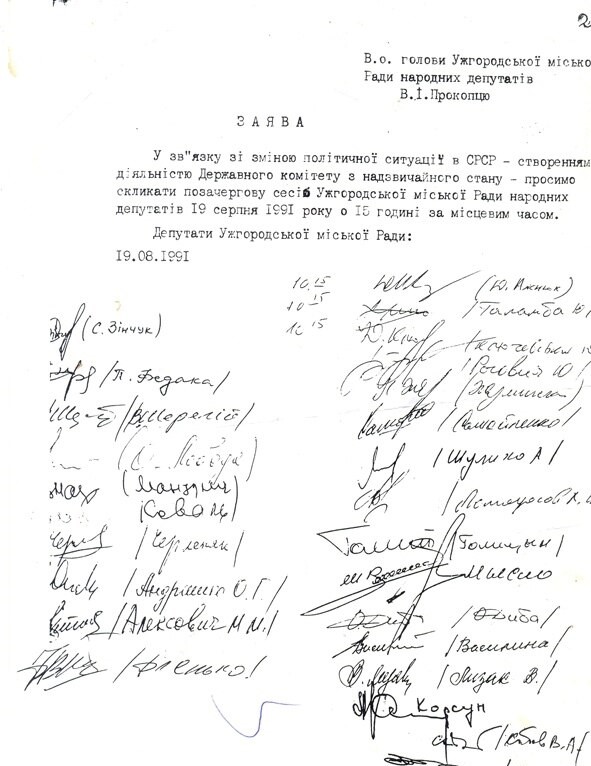
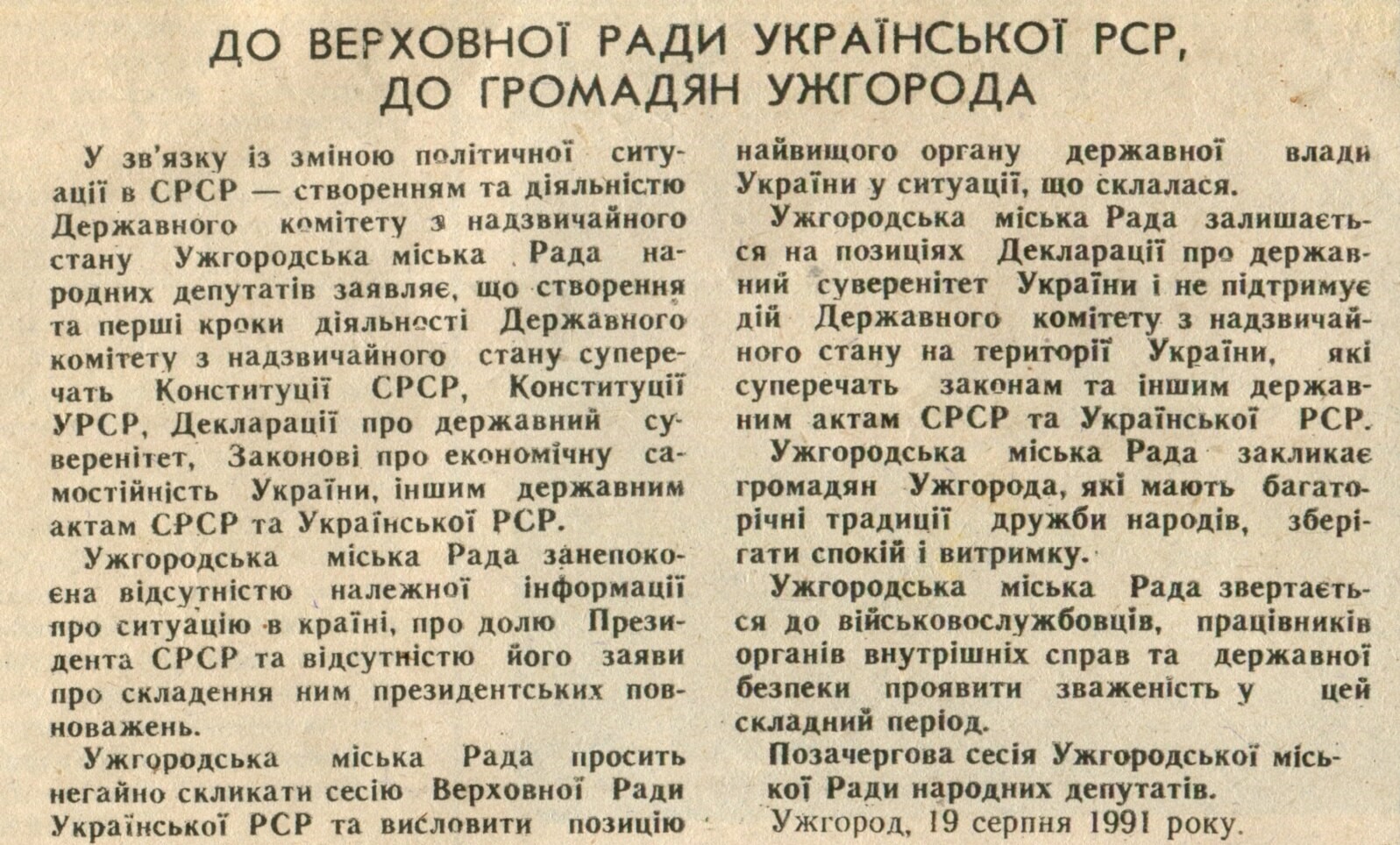
The majority of councillors on the Uzhhorod City Council of the first democratic convocation, even in the absence of their chairman, Emil Landovsky, behaved with dignity, responsibility and even courage. It initiated the immediate convening of an extraordinary extraordinary session. With 59 out of 67 councillors present at the session voting in favour, an ‘Appeal to the Supreme Council of the Ukrainian SSR and to the citizens of Uzhhorod’ was adopted, in which it was emphasised that ‘The Uzhhorod City Council stands by the Declaration on the State Sovereignty of Ukraine and does not support the actions of the State Committee for the State of Emergency on the territory of Ukraine’ and contained a call to the Verkhovna Rada of Ukraine ‘to convene a session immediately and express the position of Ukraine’s highest state authority on the current situation’.
On the eve of the 35th anniversary of those events, I spoke to some of the councillors who had adopted that fateful decision and asked them to recall how it came about.
“We did what we had to do back then”
Yurii Azhnyuk, Doctor of Physical and Mathematical Sciences, research fellow at the Institute of Electronic Physics of the National Academy of Sciences of Ukraine (Uzhhorod)
Following the reforms introduced by Gorbachev—primarily in the political and ideological spheres—genuine elections were held in the country (until then, only one candidate from the ‘unbreakable bloc of Communists and independents’ had stood for each parliamentary seat). This competitive environment enabled people with independent and active civic stances to come to power, particularly at the local level.
At that time, I was one of 125 councillors on the Uzhhorod City Council. We were elected in the 1990 elections – the first and only ones during the Soviet era in which voters chose between two or more candidates. The composition of the councillors was very interesting: it included various social strata of the city’s population, different age and ethnic groups, and a range of political orientations. Some councillors aligned themselves with the Communist Party line. Other councillors, whose political views represented a broad spectrum, were generally in favour of democratic change.
At their first meeting, this group succeeded in electing Emil Landovsky, an associate professor at Uzhhorod University, as council chair. Unlike today, there was no clear division along political party or business interest lines at that time; everyone voted according to their own judgement.
At a time of radical change in the country, local councillors were not only dealing with local issues but were also actively responding to broader political matters. It is therefore no surprise that on 19 August 1991, having heard on the radio that morning (the internet had not yet been invented, and there was a radio in the kitchen of practically every flat) about the coup in Moscow, I, like many other councillors, immediately went to the city council. Upon meeting my fellow councillors, I heard one of them say: ‘We must convene a session.’
According to the council’s rules of procedure, an extraordinary session could be convened by the council chair or at the request of 25 councillors. The council chair, Landovsky, was on a business trip abroad that day, so we decided to collect 25 signatures from councillors. I quickly typed up the relevant motion on a typewriter (computers hadn’t yet become part of everyday life back then), and the required number of signatures was collected straight away.
The quorum of councillors present was met, and the session got underway. A group of young councillors (Yuriy Azhnyuk, Yuriy Halamba, Oleg Dyba, Yuriy Klyuchivskyi and Oleksandr Samoilenko) drafted a city council resolution stating that the Uzhhorod City Council stood by the Declaration on the State Sovereignty of Ukraine and did not support the activities of the USSR State Committee for the State of Emergency.
Among those councillors who supported this draft resolution were activists from the People’s Movement (at that time Ukraine’s main opposition patriotic force), members of other civil society organisations, the council leadership represented by First Deputy Chair Vasyl Prokopets, and councillors who did not associate themselves with any particular political forces, but who boldly and unequivocally spoke out against a Communist comeback. And one more detail comes to mind: Sasha Samoilenko nudged me in the side with his elbow and gave me a meaningful look when Oleksiy Korsun, a councillor and deputy head of the regional KGB (or KDB – State Security Committee), was signing the motion to convene the session. Until then, I’d never had any dealings with representatives of this notorious organisation. Yet Oleksii Mykhailovych, both then and later, proved himself to be a genuine person and a Ukrainian patriot. This is a detail that has stayed with me for life: do not be too quick to judge people solely by their position or rank.
I am sometimes asked who was the main coordinator of convening the session and the subsequent course of events. As a direct participant, I would say: in my opinion, there was no single coordinator. It was the concerted effort of many concerned people. Everyone surely realised that, should the ‘emergency committee’ prevail, everyone would be held accountable. Why we weren’t afraid – I don’t know. But it turned out that it wasn’t all that important. We did what we had to do at the time – we expressed our opinion as an elected body.
The protests in Moscow on 19–21 August 1991 turned the tide of events. The State of Emergency Committee retreated. And on 24 August, the Verkhovna Rada of Ukraine adopted the Act of Declaration of Independence of Ukraine, which the Ukrainian people confirmed in a referendum on 1 December with 90 per cent of the vote. A week later, the leaders of Russia, Ukraine and Belarus, meeting in Belovezhskaya Pushcha, declared that the Soviet Union had ceased to exist.
Ukrainian independence came about peacefully. But that hardly ever happens. There are two exceptions in history – Norway’s separation from Sweden (1905) and Slovakia’s from the Czech Republic (1993). In all other cases, the former metropolis will invariably want to conquer you again. Especially if that mother country is Russia. By a twist of fate (Russia was bogged down for several years in two wars in Chechnya), we were given a ‘breathing space’. Over these years, we have grown stronger. We have grown incredibly stronger and forged a political nation. And that is why we stand firm!
The war with the Muscovites has been going on for twelve years now. Four and a half of those have been full-scale. And among those who are defending us with weapons in their hands on the front line today are two members of the Uzhhorod City Council who took decisions in the council chamber on 19 August 1991. They are Oleg Dyba and Serhiy Zinchuk. Back then, they were just over twenty. Now, they are well into their fifties. And what they are doing on the front line today is far more important than what they (and all of us together) did here back then. May they be successful!
‘Now it is our sons who are fighting for Ukraine’s freedom and independence at great cost in bloody battles’
Petro Khodanych, writer and woodcarver, Honoured Master of Folk Art of Ukraine, associate professor at the Transcarpathian Institute of Postgraduate Pedagogical Education:
‘19 August is the Feast of the Transfiguration of the Lord, a patronal feast day in Uzhhorod. Usually on this day, my father would come into town from the village and we would go to church together. But then, first thing in the morning, I received a call from Uncle Mykola, who was an avid listener to Radio Svoboda: ‘Petro, have you heard? There’s some sort of GKChP in Moscow.’
I started phoning my fellow MPs. Everyone had already heard the news, but what was it all about? Finally, on the television screen, after the ballet *Swan Lake*, they showed the GKChP members.
Vice-President Yanayev was visibly agitated, the papers in his hands trembling. Unable to contain his agitation, he announced the removal of President Gorbachev from power and the transfer of authority to the GKChP. It was clear that a junta had seized power in Moscow. What were we to do?
We decided to gather at the city council. By lunchtime, nearly a hundred councillors had arrived. What were we supposed to talk about when there was no information at all? There were discussions and heated exchanges about whether it was appropriate to hold an extraordinary session. In the end, we decided to hold the session and express our stance on the rebels. After that, quite a few of yesterday’s microphone-lovers quietly left the chamber. But we had a quorum.
We realised that if a state of emergency were to be declared, the final say would lie with the army. During my speech, I asked Colonel Soinov, the commander of the Uzhhorod military garrison and a city councillor, whether he would deploy troops onto the streets of Uzhhorod. A great deal depended on his answer. And an order for the military to patrol the city could have arrived at any moment, as the group of rebels included Defence Minister Yazov and KGB Chairman Kryuchkov. The colonel remained silent for a while, and then assured us that he would not deploy the garrison under his command onto the city’s streets. It was a courageous move by a true officer! By a majority vote, we adopted an Appeal to the Supreme Soviet of the Ukrainian SSR and the residents of Uzhhorod, in which we declared the actions of the mutineers to be unlawful.
At the time, it seemed to us that peace lay ahead, along with the building of a happy and long-dreamed-of state. But… But even the passing of decades has not dispelled the imperialist mindset from the minds of the Muscovites who, in August 1991, put a stop to the State Committee for the State of Emergency; and now our sons – including my own Mykhailo – are defending Ukraine’s freedom and independence at a terrible cost in bloody battles. Now, at last, we realise that the agony of disintegration is an exceedingly long and complex historical period, and that the fall of empires is a protracted process involving great human suffering.”
“We will never return to the Soviet era!”
Osip Loboda, journalist at Transcarpathian Regional Radio:
“Before recalling the events of 19 August 1991, I would like to refer to 16 July 1990, when the Verkhovna Rada of Ukraine adopted the first fateful document of the modern era – the Declaration on the State Sovereignty of Ukraine. It was a veritable explosion that finally roused Ukrainians from their lethargic slumber. In the Baltic republics, the Lithuanian ‘Sajudis’ was already ‘thundering’, the People’s Fronts of Estonia and Latvia were actively at work, and demonstrations involving thousands were taking place in Azerbaijan and Georgia – whilst Ukraine, meanwhile, was still slumbering…
19 August that year fell on a Monday, the start of the working week. And, of course, there was the traditional editorial ‘bulletin’ on the regional radio station.
People gathered as if in a daze, for from the very break of dawn the radio had been broadcasting the news that a State Committee for the State of Emergency (GKChP in Russian) had been established in the country, whilst television was continuously showing *Swan Lake*. My older colleagues, who remembered the Stalinist era, shook their heads gloomily and asked: what will happen next? The younger ones, for the most part, remained silent. The management said that no programmes would be broadcast. And nobody knew what would happen. At that time, I received a call from the Uzhhorod City Council, of which I was a councillor, asking me to come and sign a motion to convene an extraordinary session. Naturally, I went straight to the town hall.
Several dozen fellow councillors had already gathered there, and we quickly sorted out all the formalities for holding a legitimate session. It began at 3.00 pm and resulted in a resolution condemning the actions of the State Committee for the State of Emergency. And in the evening of the same day, on the independent radio station ‘Uzhhorod-Contact’, a live programme was broadcast featuring councillors Yuriy Azhnyuk, Yuriy Halamba, Oleksandr Samoilenko and myself, which also addressed the unconstitutional nature of the actions of the Moscow GKChP members. Such are my memories of 19 August 1991.
And the day of 1 December 1991, when the All-Ukrainian referendum on the ratification of the Act of Declaration of Independence of Ukraine took place, has also been etched into my memory for life. It was the first day of winter, yet outside it was warm and sunny. As I walked through the city, I caught myself thinking: here is Uzhhorod – just as it was, just as it is: the same streets, the same buildings, the same people. But no! Not the same! Because they are no longer Soviet! And we will never return to the Soviet era.”
Vasyl Ilnytskyi