Following the decision by the Supreme Court to revoke the registration of Yabloko’s federal list for the State Duma elections, the party has decided to scrutinise its political opponents using the same criteria that the court applied to it. Potential violations — ranging from copyright infringements to foreign funding — amount to 200 pages.
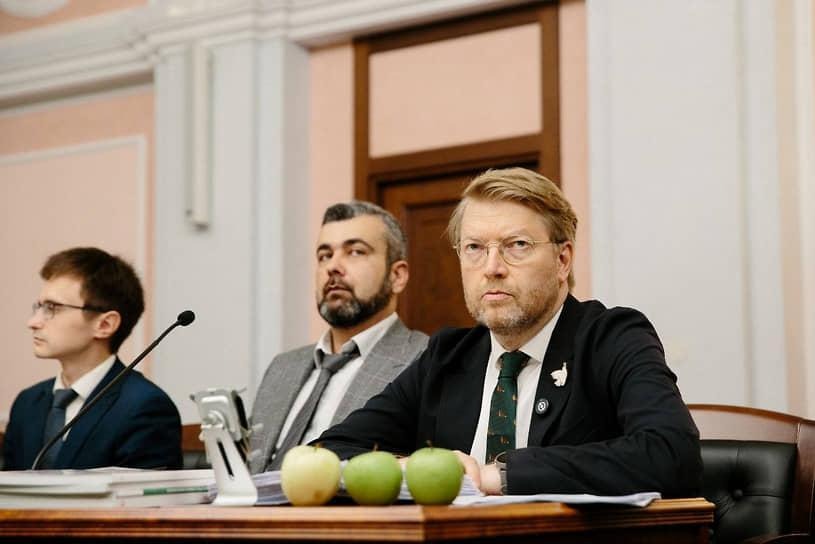
Yabloko chairman Nikolai Rybakov sent the materials to Central Election Commission chair Ella Pamfilova, along with an open letter in which he called for either the party’s list to remain registered or for the elections to be cancelled.
In brief:
- ‘Yabloko’ has reviewed the Supreme Court’s reasoning behind its decision to revoke the party’s federal list registration for the State Duma elections
- The grounds for disqualifying the party were rouble donations from Russians who had received money from abroad, posts in support of ‘Yabloko’ on social media, and copyright infringements
- Based on the Supreme Court’s ruling, ‘Yabloko’ analysed the activities of other parties admitted to the State Duma elections
- The potential violations amounted to 200 pages
- Yabloko’s chairman, Nikolai Rybakov, sent the compiled materials to the Central Election Commission
- Rybakov in an open letter to CEC Chairwoman Pamfilova: either maintain the registration of Yabloko’s list or cancel the elections
The Supreme Court’s reasoning
On 10 August, the Russian Supreme Court upheld a claim by the ‘Rodina’ party and revoked the registration of Yabloko’s federal list for the State Duma elections. According to the reasoned judgement, which the court sent to the party, the grounds for revoking the federal list were rouble donations from Russians who had received money from abroad, posts in support of ‘Yabloko’ on foreign social media platforms, and copyright infringements. The court did not accept some of the allegations, including those concerning incitement to extremism.
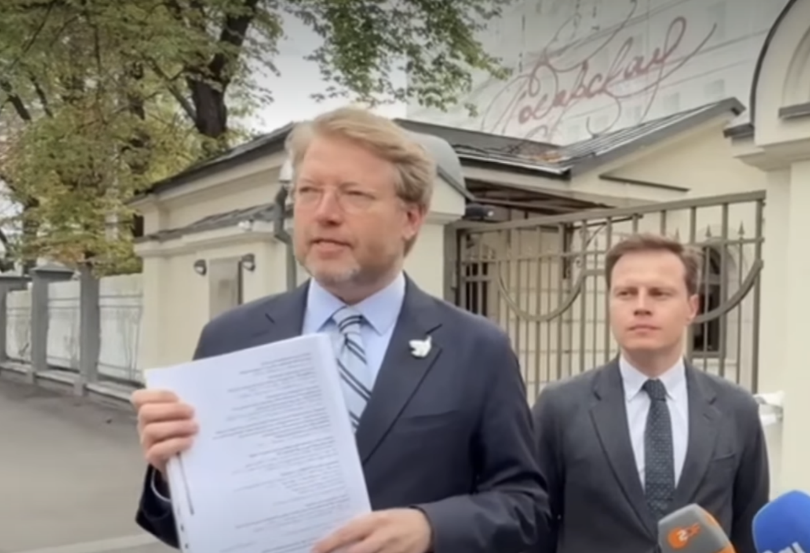
The court identified signs of ‘foreign funding’ in donations made by individuals. According to data from Rosfinmonitoring, presented by CEC representative Sergei Sakharov during the hearing on 10 August, between 9 July and 2 August, money was transferred to ‘Yabloko’ by individuals who, during the same period, had received a total of around 2.8 million roubles from foreign sources. In total, Rosfinmonitoring identified 74 individuals among the party’s donors and other contractors who had received around 80 million roubles from foreign entities.
Party representatives explained in court that the fact that donors received money from abroad does not in itself imply that the party was receiving foreign funding. For example, a person might have received funds from the sale of foreign shares, whilst making donations from their own funds obtained in Russia. The defence claimed that the party had returned any questionable donations to the senders. However, the Supreme Court found that ‘Yabloko’ had not provided evidence that these funds had been returned.
The court cited the dissemination of material about ‘Yabloko’ on social media and online platforms, access to which is restricted in Russia, as a further ground for removing the party from the electoral register. The ruling mentions Instagram, Facebook, X and YouTube. The court referred to data from ‘Medialogia’: between 27 June and 6 August, there were around 67,800 posts about the party that appeared to constitute pre-election campaigning, with a potential reach of 527 million users. After the party list was registered on 29 July, more than 40,000 such posts were recorded.
In the court’s view, the publication of this material could not have been paid for from the election fund, whilst the costs of its distribution were estimated at 88 million roubles. Under the law, expenditure on election campaigning incurred outside the election fund and exceeding 35 million roubles constitutes grounds for cancelling the registration of a federal list of candidates. However, the court rejected the defence’s arguments that the posts had been published by social media users and the media on their own initiative, without any agreements with the party.
The claims relating to copyright infringement concerned the use of data from the Levada Centre, the logos of other political parties, drawn portraits of Dmitry Medvedev and Viktoria Boni, a still from Sergei Bondarchuk’s film *War and Peace*, and lines from the song *May the Sun Always Shine*. In the court’s view, the party should have obtained the consent of the rights holders before using this material.
Expose them all
Having reviewed the Supreme Court’s ruling, Yabloko analysed the activities of other parties admitted to the State Duma elections on the basis of the court’s reasoning. Opponents were assessed according to three criteria: the use of copyrighted material in campaign materials; media and social media posts about the parties that could be regarded as unpaid advertising; and donations from Russian organisations that had received funds from foreign contractors.
The Anti-Corruption Policy Centre (CAP) of the Yabloko party examined the donors to political parties. Of particular interest were companies with overseas contracts, foreign clients and international links. According to the CAP, in recent years five Russian political parties have received more than one billion roubles from companies with links to foreign funding. The lion’s share of this sum—811 million roubles—went to ‘United Russia’.
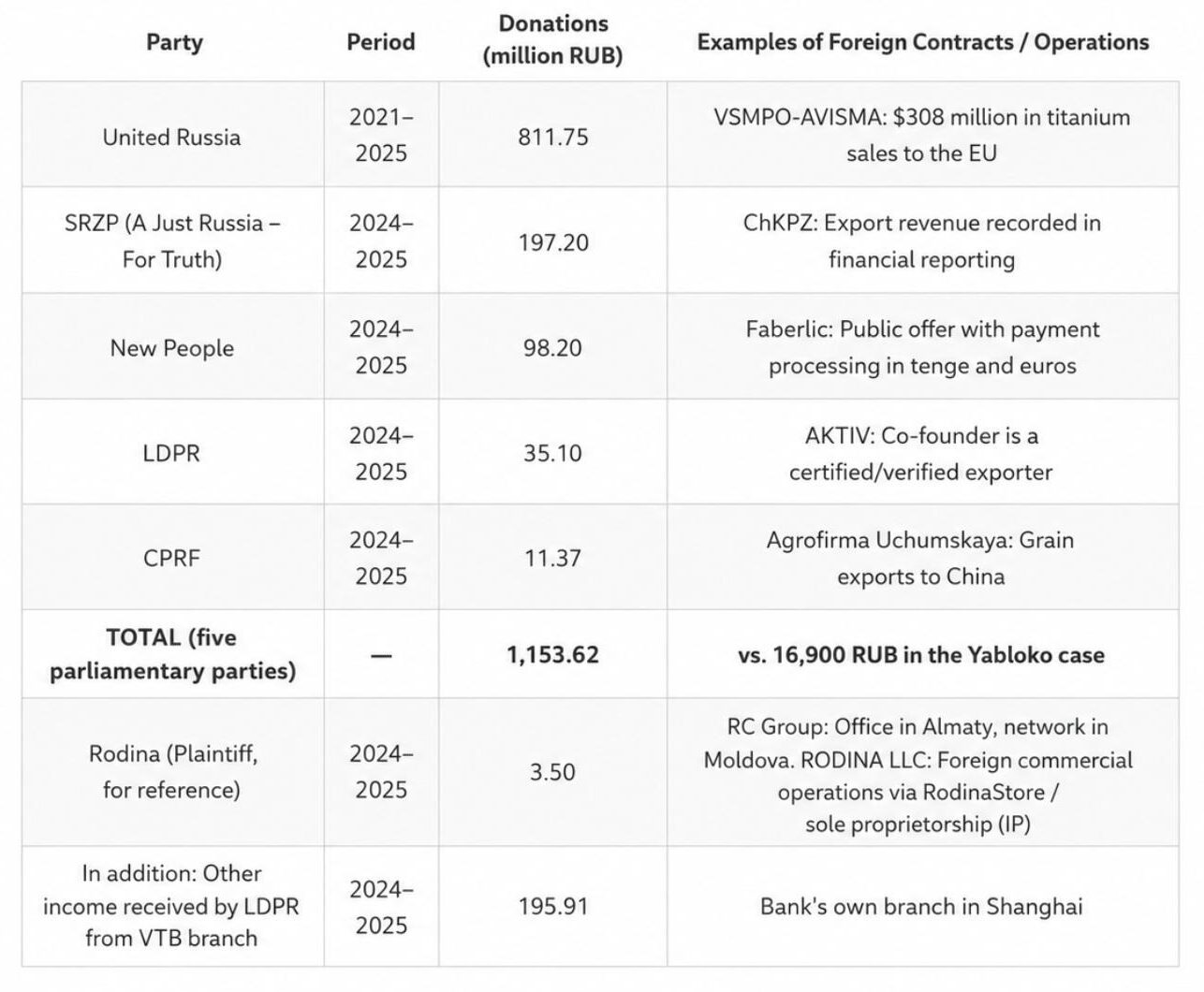
The authors of the report emphasise that, in itself, the foreign economic activity of a Russian entity does not transform its money into prohibited foreign funding of a political party. However, if the criterion applied when the ‘Yabloko’ list was deregistered is to be considered sufficient grounds for such a decision, then the same approach must be applied to other participants in the elections.
By the same standard, ‘United Russia’, the SRZP, ‘New People’, the LDPR, the CPRF and ‘Rodina’ should be removed from the electoral race.
A similar situation applies, according to data from ‘Yabloko’, to the other grounds specified in the Supreme Court’s ruling. Signs of copyright infringement can be found in the campaign materials of all election participants. This concerns the use of the logos of ‘Channel One’, the ‘Russia-1’ and NTV television channels, as well as video material from Russian media outlets.
Unpaid advertising may include all publications about the parties’ activities on websites, in media aggregators, on news agency feeds, and on the Telegram and MAX networks. Yabloko estimated that ‘United Russia’ alone had 233,800 such publications between 28 June and 14 August, with a potential reach of 487.8 million.
‘Let’s not turn the CEC and the Supreme Court into a circus’
Having compiled potential violations by candidates in the State Duma elections into a single document—which ran to over 200 pages—the chair of Yabloko, Nikolai Rybakov, addressed an open letter to the head of the Central Election Commission, Ella Pamfilova, and the members of the CEC.
According to Rybakov, the grounds on which the court annulled the registration of the ‘Yabloko’ list pose a threat to Russia’s entire electoral system. He believes that the precedent set will allow parties and individual candidates to be removed from the elections on the basis of circumstances which, in themselves, do not indicate actual breaches of electoral law.
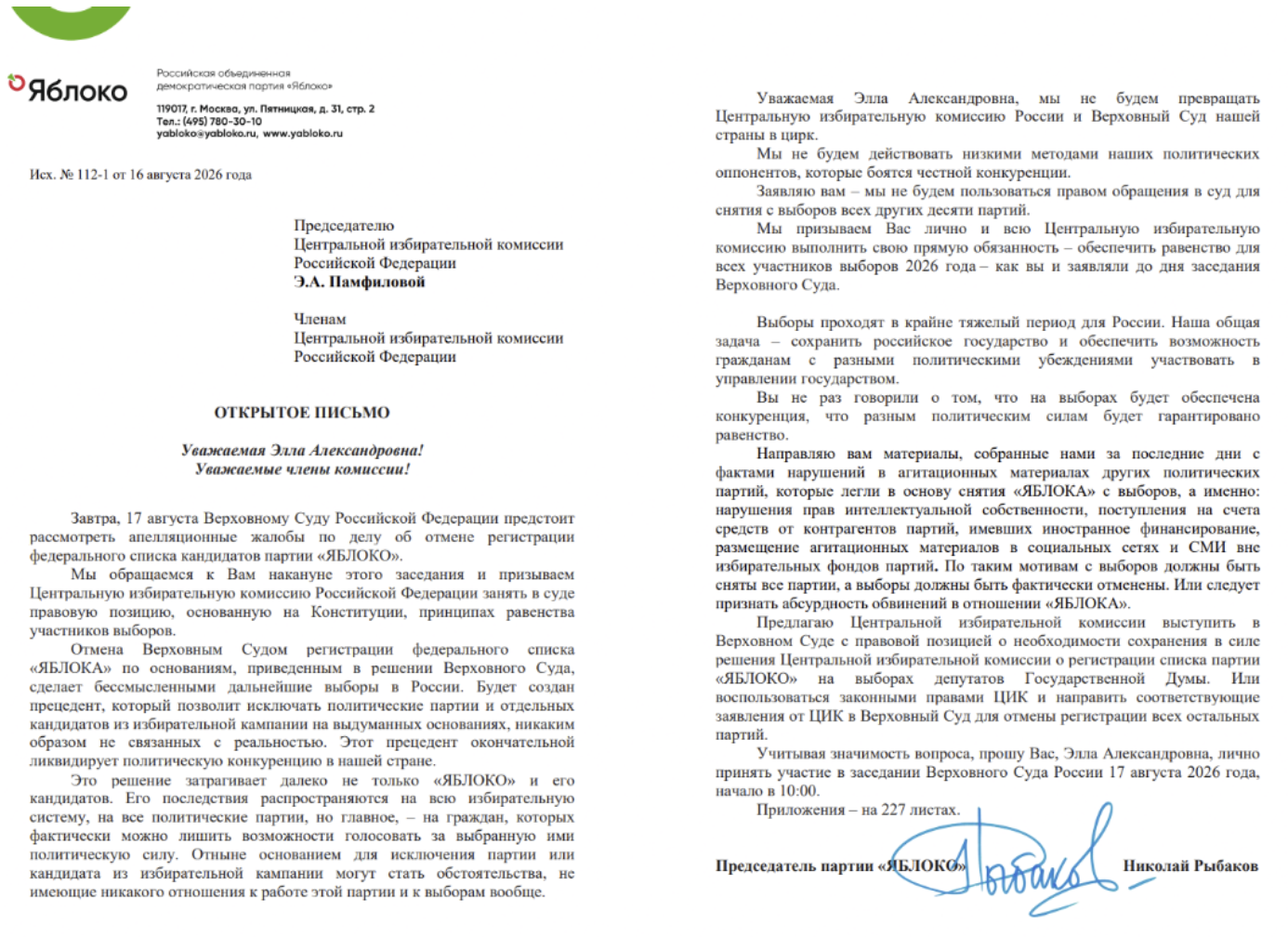
Rybakov emphasised that ‘Yabloko’ has no intention of applying to the courts to have other parties removed from the elections, despite the facts that have come to light.
We will not turn Russia’s Central Election Commission and our country’s Supreme Court into a circus. We call on you personally and on the entire Central Election Commission to fulfil your direct duty – to ensure equality for all participants in the 2026 elections – as you yourselves stated prior to the Supreme Court hearing.
The chair of Yabloko asked Ella Pamfilova to attend the Supreme Court hearing on 17 August in person, at which the appeal against the decision to revoke the party’s federal list of candidates will be considered.
In Rybakov’s view, the Central Electoral Commission should either uphold the registration of Yabloko’s list or submit an application to the Supreme Court to revoke the registration of all other parties.
Official Russian and Belarusian sources cited in this text are for informational purposes only. Content from these sources may constitute disinformation or propaganda.