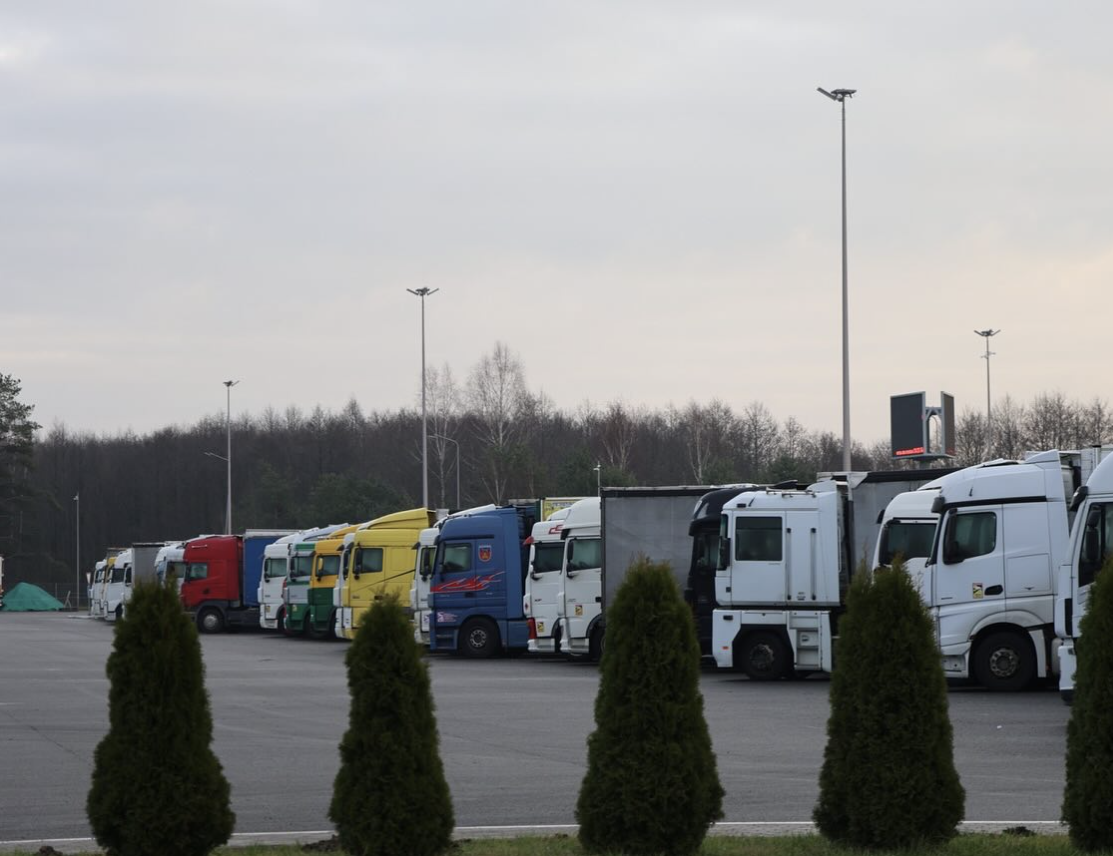

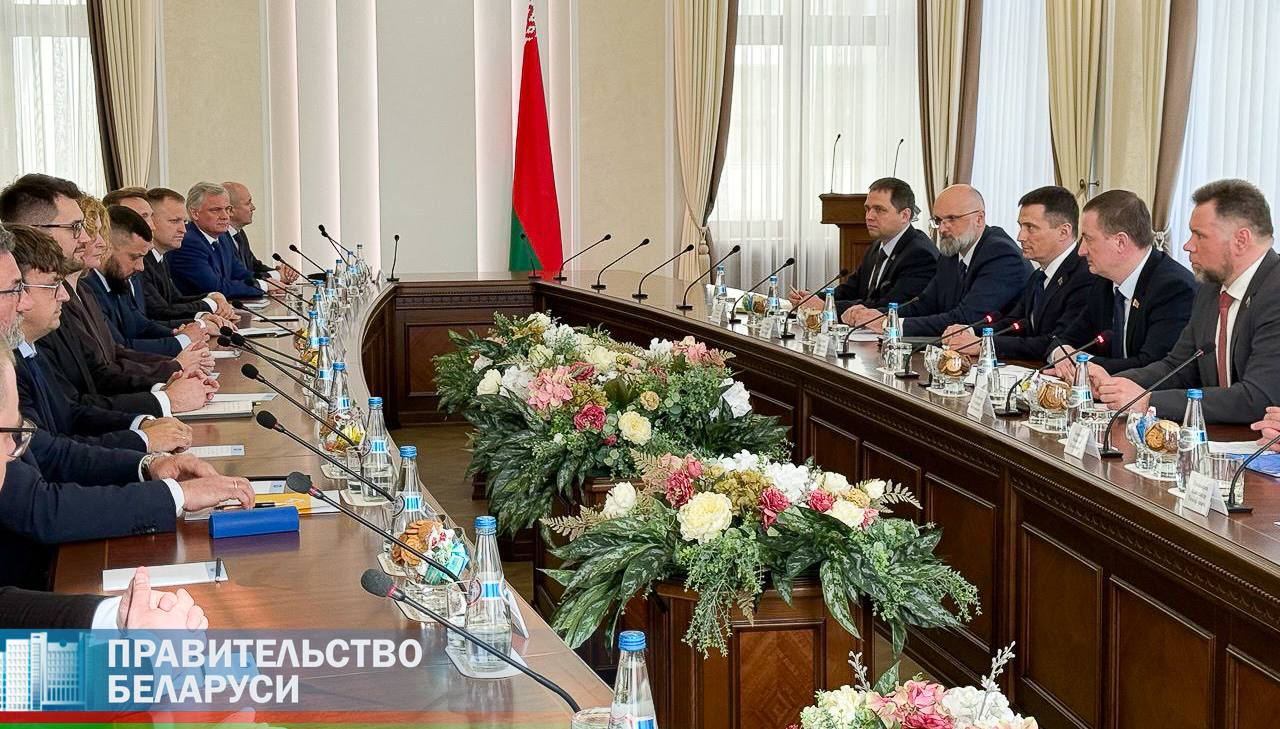
A group of Lithuanian and Polish truckers met in Minsk with Prime Minister Alexander Turchin. They discussed the return of trucks stranded on Belarusian territory. While the problems faced by Lithuanian companies have long been in the public eye, almost nothing is known about the losses suffered by Polish businesses. For the Belarusian side, the affected Polish carriers also came as a surprise.
In brief:
- Belarus has imposed restrictions on trucks with Lithuanian license plates leaving the country
- Polish carriers who registered their vehicles in Lithuania were also affected by the restrictions
- To resolve the issue, the carriers wrote a letter to Alexander Lukashenko
- Businessmen were invited to Minsk for a meeting with Prime Minister Alexander Turchin
- Carriers were promised that their vehicles would not be confiscated and that fees for storing trucks at parking lots in Belarus would be significantly reduced
- The final decision on the fate of the trucks will be made by Alexander Lukashenko, taking into account the political context and international negotiations.
Victims Twice Over
It all began in 2023, when Poland, following the sentencing of journalist and activist of the Union of Poles in Belarus Andrzej Pochobut, closed the Bobrovniki-Berestovitsa border crossing on the Belarusian-Polish border. In response, Minsk restricted the movement of Polish trucks on its territory: they could only cross the border at the Belarusian-Polish section; travel through Lithuania and Latvia was prohibited. These restrictions did not apply to carriers from other countries.
Another phase of tension in bilateral relations was linked to the “West 2025” military exercises, which took place in Belarus in September 2025. At that time, Poland closed the border for nearly two weeks. Polish trucks were unable to leave Belarus during this time, and carriers staged protests, but the situation returned to normal after the border crossings reopened. The risk of border crossings being closed is heightened by regular incursions of illegal migrants from Belarusian territory.
To avoid a repeat of such problems, some Polish carriers re-registered their vehicles in Lithuania, whose border with Belarus appeared more or less predictable at the time. But only until October 2025. In response to mass raids by weather balloons carrying contraband cigarettes from Belarus—which effectively paralyzed operations at Vilnius Airport—Lithuanian authorities closed the border crossings several times over the course of a month. Minsk, in turn, stopped allowing trucks with Lithuanian license plates to leave the country, impounded them, and issued a bill—about 120 euros per day. At times, truckers were threatened with the confiscation of their property. However, Belarus did not fully take into account the specifics of the European transport business, as a significant portion of the Lithuanian vehicles that ended up “held hostage” actually belonged to Polish companies.
As Jacek Sokół, vice-chairman of the Committee for the Protection of Polish Carriers and Employers, told “Black Sky,” the Belarusian consul in Warsaw was very surprised when he heard about the problems faced by Polish carriers.
“I spoke twice with the Belarusian consul in Warsaw. I explained our situation to him. I described how all this happened, why our semi-trailers are on the other side, and why they are registered in Lithuania. The consul then told me that the Belarusian side did not expect the ban on semi-trailer traffic and the return to the country to affect Polish carriers as well. It came as a surprise to them.”
How many Polish and Lithuanian vehicles are stranded in Belarus?
This is perhaps the most difficult question in this entire story. Answers to it vary significantly among the carriers themselves as well as among the official authorities of Lithuania and Belarus.
In November 2025, the Belarusian State Customs Committee reported that there were 5,000 Lithuanian trucks and trailers in Belarus awaiting the reopening of the border. Erlandas Mikenas, chairman of the Lithuanian Road Carriers Association (Linava), cited a figure of 4,000 Lithuanian trucks and trailers at the time. However, he later revised the data, and the number turned out to be four times smaller—913 vehicles. For its part, Lithuanian customs, after an additional check, calculated that as of January 9, 2026, 261 vehicles had not returned to Lithuania.
As of March 2026, more than 60% of the trucks stranded in Belarus in October had been returned to Lithuania. This was stated by Darius Buta, a representative of the Lithuanian National Crisis Management Center. According to him, Linava provided an updated list showing that 1,418 tractor-trailers and semi-trailers were parked at special parking lots in Belarus. “868 vehicles have already returned to Lithuania,” he noted.
As for Polish vehicles, Jacek Sokul estimates that there may be about 1,500 truck-trailer combinations and semi-trailers in Belarus.
“At this point, we do not know the exact number of semi-trailers or complete truck-trailer combinations that are on the Belarusian side. This is because a significant portion of carriers are not members of any associations. As Poles, we remain the owners of the vehicles, even though these semi-trailers are registered in Lithuania. I emphasize that our status as European Union citizens entitles us to such registration. We simply leased our semi-trailers to a company that manages them, but in the registration documents we are still listed as the owners.”
Last Hope for Minsk
In response to the release of the trucks, Minsk demanded that Vilnius hold meetings at the political level. In Lithuania, this was called blackmail, and they agreed to technical negotiations. Lithuanian carriers also put pressure on the government, even threatening to block highways, but the country’s authorities made it clear: businesses that work with Belarus must assess the risks and, accordingly, be prepared to bear unforeseen expenses.
Minsk did not publicly make any demands on Poland regarding the return of the trucks. In fact, until recently, the problems faced by Polish carriers were known only to a small circle of people. Jacek Sokul said that he had appealed to Polish authorities several times for help in resolving the issue, but received neither a response nor support for his appeals.
After trying every possible solution over the course of four months, the carriers decided to address the source of their problems and wrote two letters to Alexander Lukashenko: one from Lithuanian companies, the other from Polish ones. Some time later, the businessmen were invited to Minsk for a meeting with Prime Minister Alexander Turchin, whom Lukashenko had tasked with addressing this issue.
According to Jacek Sokul, vice-chairman of the Committee for the Protection of Carriers and Employers of Poland, the Belarusian prime minister generally understood the situation and reassured the carriers.
“As for the declarations, we haven’t yet heard any specifics like: ‘You will be able to leave by such-and-such a date under such-and-such conditions.’ We will receive a final answer within a week. This also applies to the parking fee. We were assured that it will be reviewed. We explained to the Prime Minister that in many cases, the fee—which has been accruing for four months and amounts to about sixteen thousand euros per semi-trailer—often exceeds the value of the vehicle itself. The point is, that everything should remain within the bounds of common sense. The Prime Minister listened to our comments, heard them out, and told us to hope for the best and not to worry. All the rumors circulating in our transport community that this property will be seized are untrue. Nothing is known about such procedures, and no such steps are being taken.”
The final decision on the fate of the trucks stranded in Belarus will be made by Alexander Lukashenko. It is known that Prime Minister Turchin sent him the government’s recommendations after meeting with the carriers. In this situation, Lukashenko will likely be guided not so much by economic expediency as by political calculations. After all, it was no coincidence that Lithuanian and Polish businessmen were invited to Minsk on the eve of the visit by Donald Trump’s special envoy for Belarus, John Cole.
Authors: Olga Semashko, Artur Zhak