A Conversation with a Ukrainian Armed Forces Soldier During His Short Leave
Lately, there has been a lot of negative talk about internally displaced persons from eastern Ukraine who, faced with the choice between staying in their homes under occupation and fleeing into the unknown with only the belongings that fit in a backpack, chose the latter. Perhaps we have indeed come face-to-face with a “clash of mentalities” during this time, as a certain segment of internally displaced persons—having traveled a thousand kilometers to relatively safe regions— stubbornly refuse to change their established worldviews, cultural norms, and daily habits—rooted in the influence of “Russian World values”—in a new and fundamentally different living environment. But by no means are all “easterners” like this. Many of them have been defending their homeland since the start of Putin’s aggression.
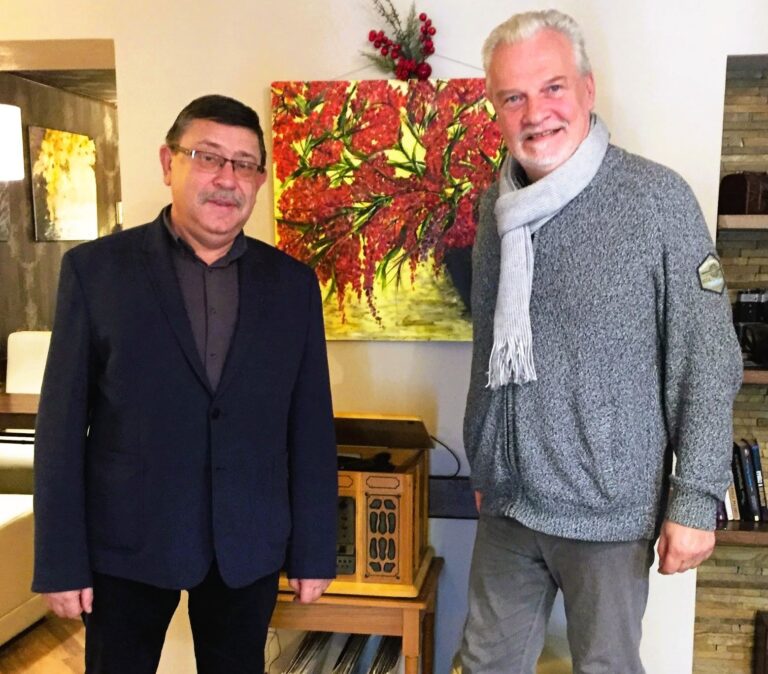
Among the ranks of Ukraine’s brave defenders is Boris, a 41-year-old resident of Lysychansk. He joined the Armed Forces of Ukraine even before the full-scale invasion by the Russians—back in 2019. For all five years of this war, Boris has been serving in a brigade that has consistently held the Ukrainian front lines in the Donetsk region. As Russian occupation forces approached Lysychansk in March 2022, nearly his entire family left their hometown. His wife and two young sons went to Poland, while his retired parents went to Uzhhorod. It was right here in our city that I had the opportunity to speak with Boris when he came to visit his family for a few days’ leave.
In brief:
- A true representative of the Ukrainian Donbas
- A war no one expected…
- The large number of people forcibly mobilized through “busification”—these are people who are neither mentally nor physically prepared to fight
- Over the years of war, the nature of the war itself has changed
Serving in the Armed Forces of Ukraine was a conscious choice
Boris’s childhood and youth were much like those of many of his peers. From first through ninth grade, he attended the only Ukrainian-language school in Lysychansk. In 2000, he enrolled in a local mining technical school, where he was trained to explore for and extract minerals from the earth’s depths. After completing his education, he went to work at the Lysychansk Soda Plant, which had provided jobs and income for several generations of his family over many decades. At the same time, Boris continued his part-time studies at Donetsk State Technical University, majoring in civil engineering.
When he started his own family, the need to buy a home became urgent, so he left his job at the plant and began traveling to work as part of a construction crew.
In 2017, when eastern Ukraine was already ablaze with Russian fire, a group of men from the Donbas arrived to install industrial equipment at a mine in the town of Sosnivka in Lviv Oblast. Relations with the locals were generally peaceful, though not without some criticism. People would say, “Our guys are defending your towns and villages, and here you are, just working for money…”
These accusations cut deep into Boris’s sensitive soul, constantly gnawing at his mind, for from a young age he had been fascinated by the true history of his native Luhansk region, absorbing with genuine interest the stories told by his parents and older family members—both about the glorious past of his homeland and its tragic chapters. In particular, he had heard about the brutal, large-scale Muscovite-Bolshevik repressions aimed at destroying the conscious Ukrainian peasantry under the guise of “dekulakization”—repressions from which Boris’s great-great-grandfathers Yegor and Fedir had suffered—as well as the artificially orchestrated Holodomor of 1932–33, the memories of his great-grandfather Matviy—a suicide soldier in a Red Army penal battalion—and his grandfather Mykola—a prisoner first in a Nazi concentration camp and, after the war, in Stalin’s Gulag. What he heard differed radically from the perception of the Donbas established during the Soviet era as the “all-Union boiler room” and the “cauldron of nations.”
But what particularly struck Boris was the funeral of a resident of Sheptytskyi, a town neighboring Sosnivka—a soldier in the Armed Forces of Ukraine who had died in combat in the Donbas, as virtually the entire mining town in Galicia knelt to bid farewell to their fellow townsman and hero on his final journey. So, after earning enough money to buy a new apartment and renovating it, Boris told his wife that he was going to join the military. She didn’t take his words seriously, since the young family had only just acquired their own home and was beginning to get back on its feet, and their two young sons and his parents—both veterans—needed his care. But his determination to join the ranks of the defenders of the Fatherland did not “fade,” and in 2019, Boris went to the military recruitment office and signed a contract with the Armed Forces of Ukraine. It’s worth noting that, in addition to Boris, two of his cousins also joined the Ukrainian military. Oleksandr—a soldier in the Luhansk Border Guard Detachment—was among those defenders of Ukraine who resisted the occupiers in the first hours of the Muscovite invasion, while Anton volunteered for the front lines during the war’s first week.
Meanwhile, some of Boris’s former classmates and childhood friends had already joined the “militia” and curry favor with the collaborators, and after the liberation of Lysychansk by Ukrainian troops under the overall command of Colonel Oleksandr Radievsky—who died heroically during fierce battles on the outskirts of the city—they fled with the occupiers to the “LPR.” The situation in the city after the expulsion of the Russian scum was not entirely clear-cut—the “waiters” remained to await Putin’s “liberators”…
War came before dawn
An interview at the military registration and enlistment office with a representative of the brigade played a decisive role in Boris’s choice of which unit to join. Upon learning of his civilian profession as a builder, she immediately offered him a position in the engineering and technical unit. About 80 percent of his new comrades were also guys from the Donbas; the rest came from virtually all over Ukraine. They built defensive fortifications—underground bunkers, dugouts, trenches, and firing positions—near Avdiivka and other frontline towns, and conducted engineering reconnaissance and demining operations. It wasn’t without the usual military-style showmanship. When Supreme Commander-in-Chief Volodymyr Zelenskyy was scheduled to arrive for an inspection of Avdiivka’s “industrial zone” during a “ceasefire,” the soldiers were ordered to line the trenches with fabric and cover everything with brand-new camouflage netting. It didn’t quite come to painting the grass green, but such window-dressing measures weren’t far off…
On the night of February 24, 2022, Boris was on guard duty at his combat unit, which was then based in Bakhmut. Toward dawn, he heard the sounds of loud explosions coming from the direction of Chasovoy Yar. Since there was a training range there, the soldiers didn’t immediately realize the true cause of the explosions. The only thing that alarmed everyone at the time was the unusually early hour of the shooting, since training exercises were usually conducted during daylight hours, yet the noise began long before dawn. The commanders had not warned their subordinates in advance about a possible Muscovite attack on Ukraine—because no such order had been given—so everyone had their own theories. Closer to noon, the sound of cannon fire could be heard. Approaching his unit’s weapons depot, Boris saw the gate wide open and the depot supervisor in a state of shock. On the commanders’ orders, the soldiers frantically grabbed Javelin and NLAV anti-tank systems and other weapons.
But no clear orders were coming from the unit’s command regarding where to take up defensive positions or where to advance. There was general confusion.
Every soldier feels fear, but not everyone shows it
A few days after the Russians’ invasion began, the fighters finally received a clear order to dig in outside the city. At the time, the soldiers in the brigade were in high spirits and even felt a certain sense of morale, Boris recalls. After a while, comrades from another brigade joined them and reported that they had dealt a heavy blow to the Russians and pushed them back. Everyone was certain that the war would end soon. The realization that it would be a long war and that there was a significant risk of dying only came when the occupiers launched a massive rocket barrage against Boris’s military unit.
Everyone is afraid of dying in war; after all, those who aren’t afraid don’t live long. Boris was no exception—he, too, felt fear. But experienced officers and sergeants are the first to overcome fear, control their emotions, and, by their example, instill confidence in their subordinates. That’s how it was in his unit. At the very beginning, there was also a sense of doom, since everyone knows that Muscovy is several times larger and more powerful militarily than Ukraine. As paradoxical as it may sound, during those difficult moments of waiting for the enemy’s advance, in the cold trenches, the soldiers—mostly from the Donetsk and Luhansk regions—cheered themselves up by singing Ukrainian songs and sharing jokes and funny stories. And this was despite the fact that the command of this particular brigade (and most likely others as well) did not psychologically prepare the rank-and-file soldiers for the fact that war would begin tomorrow and they would have to fight a long and brutal battle, suffering casualties.
“Everything flows, everything changes…”
Over the years of war, almost everything has changed—including the nature of the war itself. Whereas before, tanks, armored vehicles, and assault teams could move more or less openly across fields and roads, those days are now a thing of the past. Now every step, every movement is under visual surveillance. Even the deployment of mines and other barriers is carried out using unmanned systems. Drones are now hunting down other drones…
There have also been tremendous changes in the soldiers’ morale. After the initial days of shock and a sense of doom, the realization set in that the enemy can be successfully defeated. This is exactly what our heroes in the ranks of the Armed Forces of Ukraine have been doing successfully for five years in a row.
Despite successful combat operations and the liberation of Ukrainian territories captured in the first months of the war, the enemy continues to advance. Slowly, with incredibly heavy losses of personnel and equipment, but they are advancing nonetheless. And in these incredibly brutal battles, while inflicting colossal losses on the enemy, Ukraine’s brave defenders are being killed and maimed.
According to Boris, significant changes have also occurred in the personnel composition of the Ukrainian army. Unfortunately, not for the better. In the early years of the war, the majority of fighters in the ranks of the Armed Forces of Ukraine were those who consciously and voluntarily stepped forward to defend Ukraine. A large number of those forcibly mobilized today through the “busification” method are people who are neither mentally nor physically prepared to fight. And even in peacetime, they struggled to cope—some due to illness, others due to alcoholism and drug addiction. How can any of them be warriors?! And the state is in no hurry to motivate those capable of fighting. Today, a private’s monthly pay is 19,000 UAH. Bonus payments are awarded for each day of participation in combat operations. But these are not the kinds of sums that could motivate a person to risk their life and health. At the same time, almost every day, the media is filled with reports of millions and billions stolen from the state, yet not a single high-profile embezzler has been punished for it, and the investigations drag on for years…
After the war…
When I asked Boris what he plans to do and where he intends to go once the war is over, he gave a philosophical answer. He says the first thing is to survive. He definitely intends to return to his native Lysychansk—now distorted by the occupiers—to, to put it mildly, look into the eyes of those relatives and acquaintances who supported the occupation and lived there all these years in complete harmony with the invaders. But to stay and live nearby, breathing the same air as them—absolutely not! Because he cannot even guarantee to himself that he’ll be able to control his emotions toward the collaborators, whom he considers worse than the occupiers.
And only then does he dream of returning to his family—his sons, wife, and parents—and taking up his favorite profession: construction. In this field, the demand for such specialists in the new Ukraine will be immense and long-lasting, regardless of whether it’s a large metropolis or a small town in the eastern or western regions. A new Ukraine will need to be built everywhere and in every sense! Let’s wish Borys and his comrades the fulfillment of all their cherished dreams, the foremost of which is to return home safe and sound with Victory.
P.S. To ensure complete openness in our communication, I promised the soldier that I would not reveal his real name in this publication or name the brigade in which he serves.
Vasyl Ilnytskyi