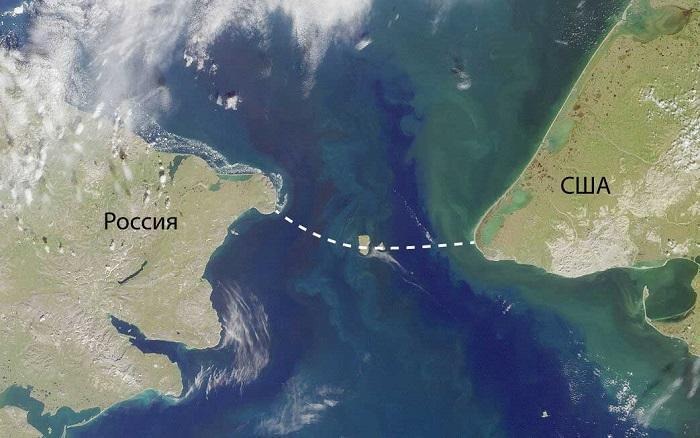

During the St. Petersburg International Economic Forum, Russia and the United States signed an agreement to design a tunnel across the Bering Strait. On the Russian side, the document was signed by Kirill Dmitriev, head of the Russian Direct Investment Fund (RDIF). No details were disclosed regarding the American company with which the agreement was concluded.
In a nutshell:
- Russia and the U.S. have signed an agreement to design a tunnel through the Bering Strait. Companies from Asia have also been invited to participate in the project.
- The main advocate for the project is RFPI head Kirill Dmitriev. According to him, the tunnel could become a “symbol of unity” between the two countries, but political obstacles must first be overcome.
- The plan calls for the construction of a 110-kilometer railway tunnel under the Bering Strait. Dmitriev hopes that, thanks to Elon Musk’s technologies, the project can stay within an $8 billion budget.
- In addition to the tunnel itself, thousands of kilometers of railroad tracks must be built on both sides of the strait. This entails investments worth billions of dollars.
- The idea of building a tunnel under the Bering Strait is over 150 years old. However, it has never been realized during all this time. Dmitriev’s project will most likely meet the same fate.
According to Dmitriev, the next steps in implementing the project should be clear by the end of the year. Companies from Asia have also been invited to participate in the tunnel’s design. The head of the RFPI noted that significant infrastructure will need to be developed on both sides, which is why many issues regarding this line of cooperation between the U.S. and Russia remain unresolved.
The Trump–Putin Tunnel
The project involves the construction of a double-track railway line in a tunnel under the Bering Strait, which will connect Eurasia with North America—more specifically, Russia’s Chukotka with Alaska. The tunnel would be approximately 110 kilometers long and—if completed—would become the longest undersea tunnel in the world, twice as long as the Channel Tunnel.
The project is being championed by Kirill Dmitriev, the Russian president’s special representative for foreign investment and economic cooperation and head of the Russian Direct Investment Fund (RFPI). It was he who presented this idea last October following a phone call between the presidents of Russia and the United States.

Dmitriev claimed at the time that the tunnel could become a “symbol of unity” between the two countries, but that political obstacles would first have to be overcome. U.S. President Donald Trump had previously called the idea interesting and noted that he would like to “think it over.”
“I recently heard about [the idea of] a tunnel from Russia to Alaska. I hadn’t heard about it before. We’ve just built a great highway in Alaska. It will give us access to many natural resources,” Trump said.
The press has already dubbed the project the “Putin–Trump Tunnel.”
A New Old Project
The Bering Strait, which is about 86 km wide at its narrowest point, separates the vast and sparsely populated region of Chukotka from Alaska. The small Diomede Islands—one Russian, Ratmanov Island, and one American, Krusenstern Island [currently known as Little Diomede Island – ed.] —lie in the central part of the strait, just 4 km apart.

The idea of building a transportation route across the strait has been around for at least 150 years. Various options have been proposed: a tunnel, a bridge, or a dam.
In 1890, Colorado Governor William Gilpin proposed the creation of a “cosmopolitan railroad” that would run through Siberia, the Bering Strait, and Alaska, connecting London, Paris, New York, Beijing, and Moscow into a single global network. At the end of the 19th century, however, the implementation of such a project was technically impossible, so it remained a futuristic idea.

In the early 20th century, the French engineer Baron Loïc de Lobel presented a design for a major Paris–New York railway line, part of which was to run through Siberia. The tunnel under the Bering Strait was not intended to be a through-tunnel—the plan called for an intermediate exit to the surface, with a station on Ratmanov Island. The project was even discussed at the court of Nicholas II, but was later abandoned.

In 1958, Tung-Yen Lin, a professor at the University of California, Berkeley, proposed a transportation link between Eurasia and America. He was renowned for his work on the application of prestressed concrete, and it was precisely this material that he proposed for the construction of a bridge across the Bering Strait, calling his concept the “Bridge of Peace.”
However, neither Soviet leader Leonid Brezhnev, to whom Lin presented the project in 1972, nor U.S. President Ronald Reagan, to whom the professor submitted a detailed plan in 1986, was enthusiastic about the Peace Bridge. The professor did not lose hope—he registered the company Inter-Continental Peace Bridge and began fundraising. According to his calculations, the Peace Bridge would cost $4 billion. However, Lin died in 2003 without raising the necessary funds, and the project was automatically closed.
Another drawing, this time depicting the “Kennedy–Khrushchev Bridge,” was sent to the USSR in the 1970s by the American Doug Sandstrom. He added the following note: “The Kennedy–Khrushchev Peace Bridge for the whole world can and must be built between Alaska and Russia. Immediately.”

The modern history of the project began in the 1990s. Its most ardent advocate was engineer Viktor Razbegin, who served as general director of “Fundament”—an association of scientific, design, and construction organizations specializing in foundation engineering—and later as vice chairman of the Council for Research on Generating Forces under the Russian Ministry of Economic Development and the Russian Academy of Sciences. A project coordination committee was established, bringing together representatives from a number of key ministries and regions, as well as a scientific council. In 1993, to promote the project, the international corporation Interhemispheric Bering Strait Tunnel & Railroad Group (IBSTRG) was registered in the U.S., with American engineer and entrepreneur George Koumal serving as its head. IBSTRG launched a program of technical and economic studies on both sides of the Bering Strait. The results were presented to the Russian and U.S. governments and were the subject of broad international discussion.
After 2014, the project was effectively put on hold due to a sharp deterioration in relations between Russia and the U.S. No intergovernmental agreement was signed, and no investors came forward. The InterBering organization itself continues to exist today as a private initiative platform. Recently, it has resumed publishing maps, historical materials, and new visualizations of the “China–Russia–U.S.” route.

In the 2000s, Russian authorities and a group of private investors also promoted a specific commercial concept for a megacorridor through the Bering Strait.
The TKM-World Link project called for the construction of a tunnel approximately 100 kilometers long between Chukotka and Alaska, the laying of a railway line through northeastern Russia, as well as the construction of power lines, gas pipelines, and a fiber-optic internet cable. However, the project never progressed beyond the discussion stage, and after 2014, it was completely shelved.
All hope rests with Elon Musk
Estimates of the cost of the project proposed by Dmitriev vary widely. Engineer Viktor Razbegin believes that at least $15 billion is needed, while Deputy Vladimir Koshelev cites a figure in the range of $100–150 billion. Dmitriev himself puts the figure at less than $8 billion. In his view, costs could be reduced by the modern technologies of The Boring Company, an American tunnel-building firm owned by American billionaire and former Trump ally Elon Musk. On his social media, Dmitriev posted a message addressed to the American billionaire: “Elon, imagine connecting the United States and Russia, the Americas and Afro-Eurasia, with the Putin–Trump Tunnel—a 70-mile route symbolizing unity. Previously, the estimated cost was over $65 billion, but thanks to The Boring Company’s technologies, it could drop to $8 billion. Let’s build the future together!” Musk has not publicly responded to this proposal.
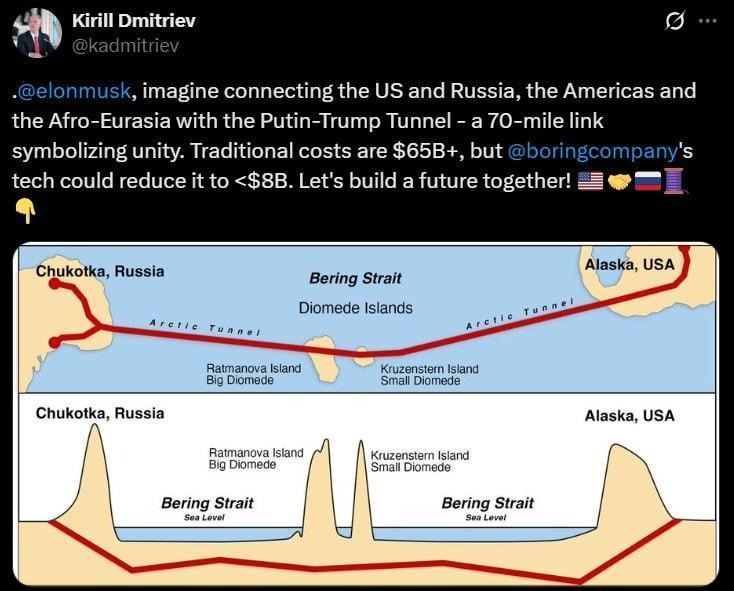
Building a tunnel through the Bering Strait makes no sense without creating the accompanying infrastructure. A railway line must be built to connect to the tunnel on both sides. In Russia, it would be necessary to extend the line—which currently ends in Yakutsk—to the village of Uelen in Chukotka. That’s about 3,700 km of track. On the American side, approximately 2,000 km of additional railroad tracks would need to be built.
InterBering estimated the approximate cost of the infrastructure at the time: a high-speed rail line in Russia, from Yakutsk to the Bering Strait, would cost between $100 billion and $115 billion; a high-speed rail line from Vancouver, Canada, to the Bering Strait in Alaska—between $170 billion and $200 billion.
The economic viability of the project is in doubt. Current trade between Russia and the U.S. does not exceed $4.5 billion. Given the scale of bilateral trade, this massive investment would simply never pay off for private Russian and American investors.
It will also be difficult to attract foreign investment: neither Russia nor the United States currently ranks among the most predictable countries in terms of political risk. Dmitriev mentioned that companies from Asia have been invited to participate in the design phase, but so far none of them has publicly declared such intentions.
To be fair, however, it should be noted that construction is not currently planned to begin. Russia and the U.S. have only signed an agreement to design the tunnel. For now, it has not even been determined what the next step will be. Most likely, the Trump–Putin tunnel will remain a phantom project of the “Anchorage spirit” era.
Volha Siamashko