
In the first two quarters of 2026, 4,200 people returned to Ukraine from the temporarily occupied territories via the Mokrany–Domanove pedestrian humanitarian corridor on the border with Belarus. However, the number of people returning to Ukraine is significantly higher, as the statistics do not include other routes of return via third countries.
In brief:
- On average, more than a thousand people per month cross the border into Ukraine via the Mokrany–Domanove humanitarian corridor to leave the territories temporarily occupied by Russia.
- Since 2022, the Ukrainian-Russian front line has been closed, so all exit routes lead through Russia.
- Russia is forcing Ukrainians to renounce their Ukrainian citizenship in order to enter Russian territory and be able to travel to other countries.
- Among the routes for returning to Ukraine, the most popular are the pedestrian humanitarian corridor through Belarus or travel to countries such as Georgia, Armenia, or Turkey.
- Individuals who have recently come of age and are trying to return to Ukraine face the most difficult identity verification process, as they were approximately six years old when the Russian aggression began.
What routes do Ukrainians use to return from the temporarily occupied territories?
Since 2022, the front line between Ukraine and Russia, stretching over 1,200 km, has been completely closed to crossings. As a result, the only option for people trying to return to Ukraine from the temporarily occupied territories (TOT) is to travel through Russian territory.
Dina Urich, co-founder and director of the NGO “Compass of Dreams,” explains that there are several routes for departure, the main one being a pedestrian route through Belarus, though even that is quite difficult.
“Currently, the route used by a large number of people—approximately 1,200 people per month—is the Belarus–Ukraine humanitarian corridor through the Volyn Oblast in Ukraine. To do this, they need to leave the temporarily occupied territory—wherever they may be—and enter Russian territory, then cross into Belarus, and finally walk through the humanitarian corridor. This is a pedestrian humanitarian corridor with only one functioning checkpoint: Mokrany–Domanove”,” says Dina Urich.
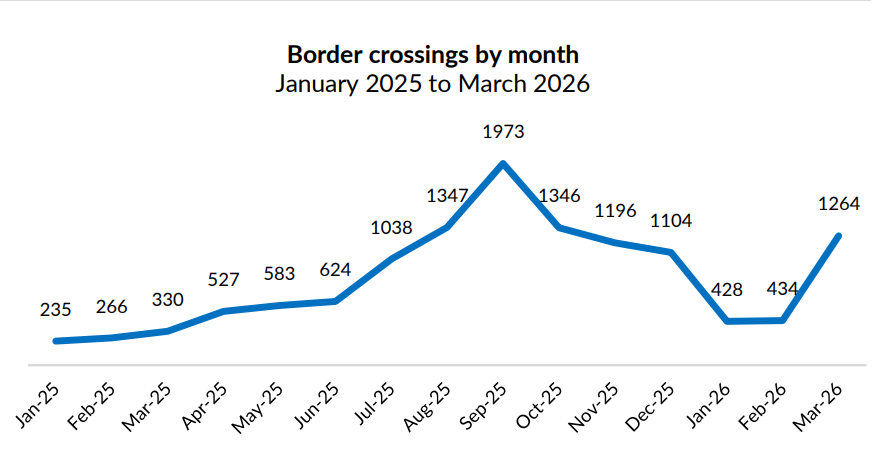
In the first two quarters of 2026, according to UNICEF Ukraine, more than 4,200 people returned to Ukraine, including over 200 children.
In the first quarter, the number stood at 2,126 Ukrainians, which is 61% more than during the same period in 2025.
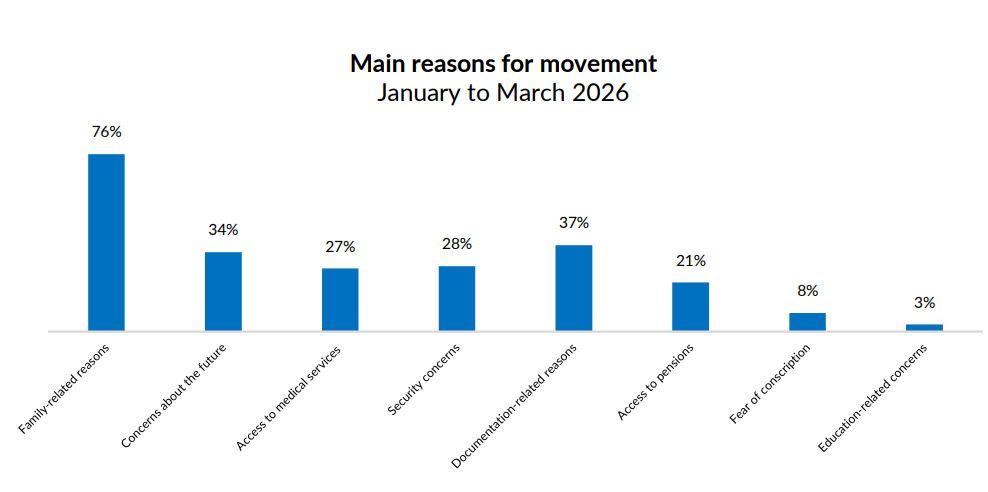
According to reports from UNICEF Ukraine, Ukrainians cited family circumstances as the most common reason for returning. Other reasons included concerns about the future, issues related to documentation, access to medical services, and others.
In addition to the humanitarian corridor, people are returning by other routes, such as through third countries like Georgia, Armenia, Turkey, or Kazakhstan.
How Ukrainians Leave the Temporarily Occupied Territories
After the closure of the corridors across the front line, for people who remained in the occupied territories, all routes out lead into Russian territory. To do this, they must first leave the temporarily occupied territories, which is also not easy.
The lack of necessary documents poses a major obstacle to leaving. Russia systematically forces residents of the occupied territories to obtain Russian passports; moreover, starting in September 2025, Russia will consider the presence of Ukrainians in the TOT without Russian documents—passports or “residence permits”—to be illegal. Those who have not obtained such documents remain hostages of the system and cannot leave the temporarily occupied territories, as the Russian screening system classifies them as violators.
Dina Urich explains that there is no single, established system of penalties for individuals who have not obtained Russian documents in the occupied territories. The most common form of punishment is fines, but their amounts can range from several thousand to tens of thousands of rubles. However, people also face other forms of pressure—from threats and intimidation to actual arrests for refusing to obtain a Russian passport.
The co-founder of the NGO “Compass of Dreams” believes that due to a reluctance to obtain Russian documents and “renounce Ukrainian citizenship”—as the occupying authorities frame it—a significant number of people remain in the temporarily occupied territories and do not dare to begin the journey back to Ukraine.
The procedure for renouncing citizenship is significantly more complicated than Russia tries to make it seem. The main components of this process are a personal application to a Ukrainian consulate and the signature of the President of Ukraine, since a person can only be stripped of citizenship by presidential decree. Given this, Ukraine does not recognize as valid any renunciations signed by citizens in the temporarily occupied territories or in Russia, and assists in restoring lost or expired documents upon their return to Ukraine.
How to Leave Russia
To enter Belarus, Ukrainian citizens leaving the temporarily occupied territories do not need a Russian foreign passport; domestic documents are sufficient.
However, as of January 20, 2026, children (those under 14 years of age) cannot leave Russian territory without foreign passports, which creates additional complications when a family with children attempts to leave the country.
When choosing a route through other countries, people should understand that entry into most countries is permitted only with a foreign passport. The process of obtaining Russian foreign travel documents can take up to several months.
However, having all the necessary documents does not guarantee successful passage through Russian border control. Many Ukrainians are subjected to additional checks, which may include an interview with Russian security service personnel.
In some cases, people are barred from leaving the country for 5, 10, or even 20 years, making it impossible for them to return to Ukraine.
Next stage of the journey: entering Ukraine
After successfully traveling to third countries, including Belarus, travelers must still cross the border into Ukraine. Different rules apply here as well, depending on the chosen route.
To cross the Mokrany–Domanove checkpoint—the only humanitarian pedestrian corridor on the Ukrainian-Belarusian border—people must have a valid Ukrainian identity document, typically an ID card. A Ukrainian international passport is not required in this case, but having one will make crossing the border easier.
“If a person does not have valid Ukrainian documents—whether they have been lost or have expired—they need to obtain a document called a ‘Certificate of Eligibility to Return to Ukraine,’ which is issued at Ukrainian consulates,” says Dina Urich.
The director of the NGO “Compass of Dreams” explains that the Embassy of Ukraine in the Republic of Belarus is located in Minsk and specializes specifically in issuing certificates of return—so-called “white passports”—so the procedure there takes significantly less time than in other countries.
The duration of the procedure ranges from one day to several months and depends on the documents the person has.
Entering Ukraine via other countries requires a foreign passport or a return certificate, but obtaining one at consulates in third countries (other than Belarus) can take months—which is why the route through the pedestrian corridor on the Belarusian-Ukrainian border remains the most popular option for people from the temporarily occupied territories.
Who Might Face Difficulties in Obtaining a “White Passport”
Parts of Ukrainian territory have been under Russian occupation since 2014. Children who turned eighteen this year were at least six years old at the time of the occupation, which complicates the process of verifying their identity upon returning to Ukraine.
Dina Urich, co-founder and director of the NGO “Compass of Dreams,” explains that in the absence of any Ukrainian documents containing a photo and capable of confirming a person’s identity, there is a separate procedure, but its duration can significantly extend the time a person spends abroad.
“Most often, these children, who have only recently come of age, do not have Ukrainian documents with a photo. A Ukrainian birth certificate does not include a photo, and they simply did not have time to obtain other documents. In such cases, a procedure involving witnesses is applied. One of their relatives must provide testimony confirming the person’s identity. This is a closed circle of people—immediate family members. Fortunately, this can be done not in person but online via video call,” says Dina Urich.
According to the founder of the nonprofit organization, even when the procedure involving witnesses is carried out, difficulties arise because family members were often opposed to their departure. That is why volunteers and civil society organizations recommend choosing routes through Belarus, where it is possible to obtain a “certificate of identity for return to Ukraine” much more quickly.
The identification procedure can take about two months, and during this entire time, the person is forced to remain and reside in the other countries through which they are traveling.
The co-founder of the NGO “Compass of Dreams” notes that when planning a trip, it’s always worth seeking assistance from civil society organizations that specialize in helping people return from the temporarily occupied territories. Volunteers can help plan routes, process documents, and provide housing and meals at stopovers along the way, if necessary.
Yulia Derdyuk