
About 30% of religious organizations in Ukraine belong to the Ukrainian Orthodox Church (Moscow Patriarchate). Ihor Todorov, a professor in the Department of International Studies and Public Communications at Uzhhorod National University, told “Black Sky” that the Russian Orthodox Church and the Moscow Patriarchate are not really about religion.
In short:
- The number of religious institutions maintaining ties with Russia remains the highest in Ukraine.
- Despite the introduction in Ukraine of a ban on religious organizations maintaining ties with the Russian Federation, the process of terminating their activities is being delayed due to legal formalities.
- Russia is blocking the transition of religious organizations of the UOC (MP) to the OCU and manipulating the issue of religion for political and geopolitical purposes.
Why was Ukraine deprived of its own church?
After the establishment of Ukrainian statehood, the question arose regarding the formation of the Ukrainian Orthodox Church, just as there are Serbian, Bulgarian, Romanian, and Greek Orthodox Churches, explains Professor Ihor Todorov:
“With the emergence of the Ukrainian state, of course, a Ukrainian Orthodox Church was supposed to be established, but in Moscow they decided that it was enough to simply rename it, leaving on this ‘Moscow Patriarchate’ suffix. Back then, in the early 1990s, there was evidence that one of the motives for opposing the autocephaly of the Ukrainian Church was money. The number of Orthodox Church parishioners in Ukraine at that time was greater than in Russia. And this, accordingly, meant a larger flow of funds.”
It was not until January 5, 2019, that a Ukrainian church independent of Moscow’s influence was established, when the Tomos of Autocephaly of the Orthodox Church of Ukraine (hereinafter OCU) was signed and it was granted the status of the fifteenth independent Orthodox church in the world.
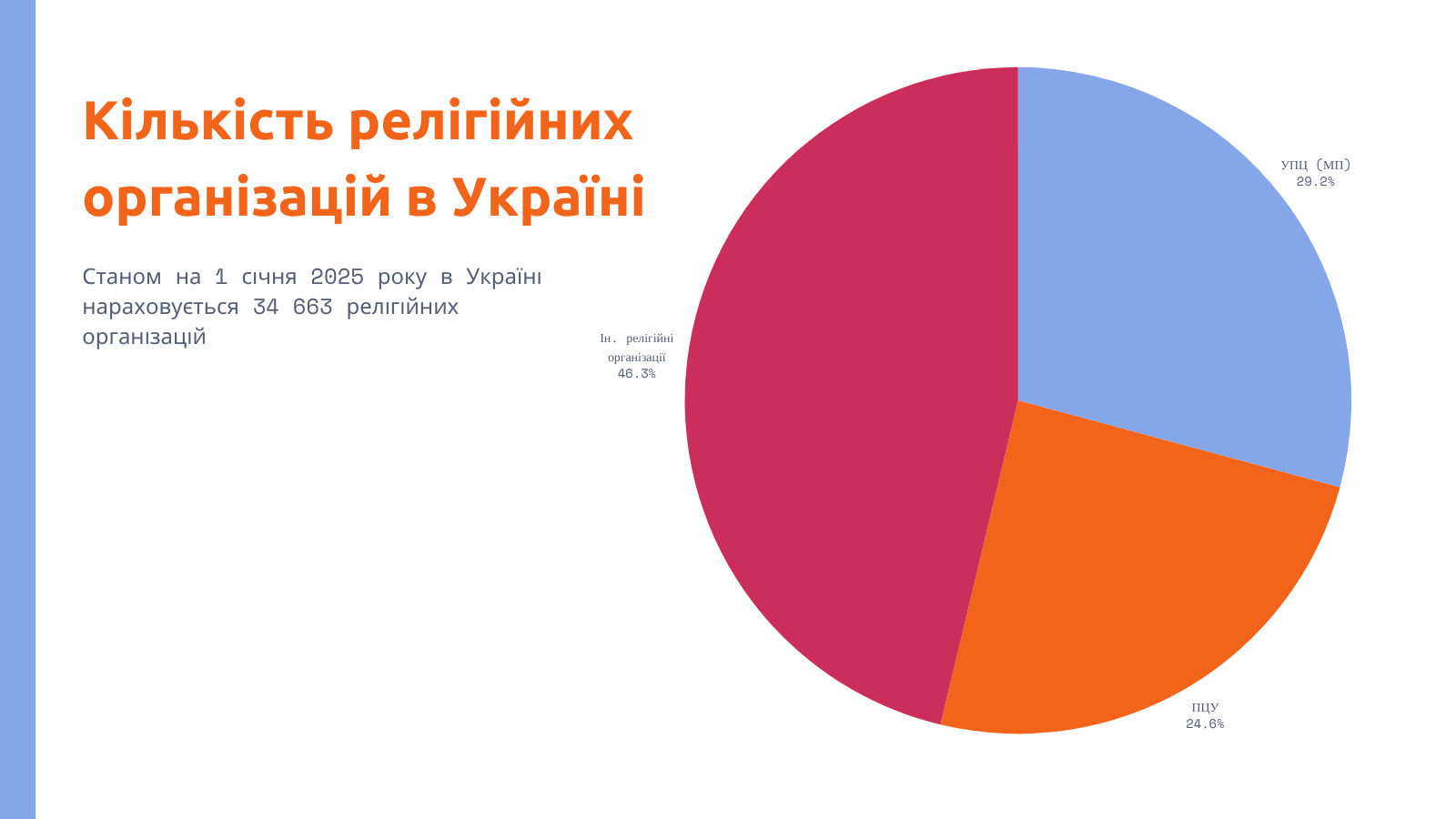
As of January 2025, the number of OCU religious organizations in Ukraine had reached 8,511. This number is linked to the reorganization in December 2019 of the Kyiv Patriarchate of the Ukrainian Orthodox Church; accordingly, all religious organizations, according to reports from the State Service of Ukraine for Ethnic Policy and Freedom of Conscience, have been classified as part of the OCU.
However, the number of religious organizations subordinate to the UOC (MP) remains higher—10,118. For comparison, there are a total of 34,663 religious organizations operating in Ukraine (according to the State Service of Ukraine for Ethnic Policy and Freedom of Conscience as of January 1, 2025). That is, over 29% of all religious organizations in Ukraine belong to the UOC (MP).
“I thought that finally, after the signing of the Tomos and the establishment of the OCU, most parishes would come under its jurisdiction. But while this process began more or less actively in 2019, it then slowed down. In 2022, it picked up again due to the war, but this is not a uniform process; it is accompanied by conflicts and is quite complex legally,” notes Professor Ihor Todorov.
Why is Russia trying to restore the influence of the UOC (MP) in Ukraine?
Prior to the establishment of the OCU in 2019, the Ukrainian Orthodox Church (Moscow Patriarchate) was the only officially recognized Orthodox church on the territory of Ukraine, which allowed it to develop a network and ensure a steady flow of parishioners. Professor Ihor Todorov draws attention to the extensive network of religious organizations of the Moscow Patriarchate, particularly in Zakarpattia:
“The infrastructure of the UOC (MP) is significantly more robust, with more parishes, monasteries, and clergy. Moreover, I have always wondered why the UOC (MP) predominates in the Zakarpattia region. Historically, there were certainly Orthodox Christians there, but in the interwar period they were subordinate either to the Serbian Orthodox Church or to other structures in Slovakia. When the Soviet Union came to Transcarpathia, the process of building up the church proved to be very powerful, and their hierarchs openly took a separatist stance».
The restoration of the rights of the UOC (MP) has been included in the list of Russian demands on Ukraine, which are being voiced in negotiations on the cessation of hostilities. Russian Foreign Minister Sergey Lavrov has repeatedly accused Kyiv of restricting the activities of the Orthodox Church in Ukraine and stated that Russia remains unwavering in its demands.
“Lavrov occasionally speaks of the oppression of the UOC (MP). A demand is being made to restore to the Russian Church all the privileges it held in Ukraine prior to 2014. Although it was only after the start of the full-scale invasion in 2022 that our state began taking very modest steps to restrict the activities of this church,”, emphasizes Ihor Todorov.
The professor recalls striking examples of Russia’s use of religious organizations to achieve political goals. For instance, the infamous Svyatogorsk Lavra in the Donetsk region, where weapons were stored and terrorists led by Girkin were based. The Pechersk Lavra, which became a hub of anti-Ukrainian activity in the very heart of the capital, and many others:
“Religious organizations of the Moscow Patriarchate are traditionally used to achieve purely political goals, and these political goals are tied to the elimination of Ukrainian statehood. This is why they started this war in 2014 and the full-scale invasion in 2022,” adds Ihor Todorov.
How is Russia blocking the transition of religious organizations from the UOC (MP) to the OCU?
On August 20, 2024, the Law of Ukraine “On the Protection of the Constitutional Order in the Sphere of Religious Organizations’ Activities” No. 3894-IX was adopted, which provides for the cessation of activities on Ukrainian territory by institutions associated with the Russian Orthodox Church. However, as early as May 27, 2022, the UOC (MP) adopted a decision on “autonomy and independence” at its Council and announced the severing of ties with the Russian Orthodox Church.
“Formally, in 2022, the UOC (MP) declared its independence from the Russian Federation, and this created certain legal problems. De facto, everyone knows that ties remain, but de jure, it is quite difficult to prove and enforce a ban on religious organizations associated with the aggressor. Religious freedom is enshrined in our Constitution and in international obligations, particularly in Council of Europe documents, and any actions could, in one way or another, be interpreted as persecution for one’s faith—a narrative actively exploited by Russian propaganda,” says Professor Ihor Todorov.
Even before the enactment of Ukrainian Law No. 3894-IX, actions by law enforcement agencies, primarily the SBU, had already taken place. Criminal cases were opened against individual clergymen, instances of collaboration were uncovered, and searches were conducted, which prompted the UOC (MP) to issue statements about severing ties with the Russian Federation, says Todorov.
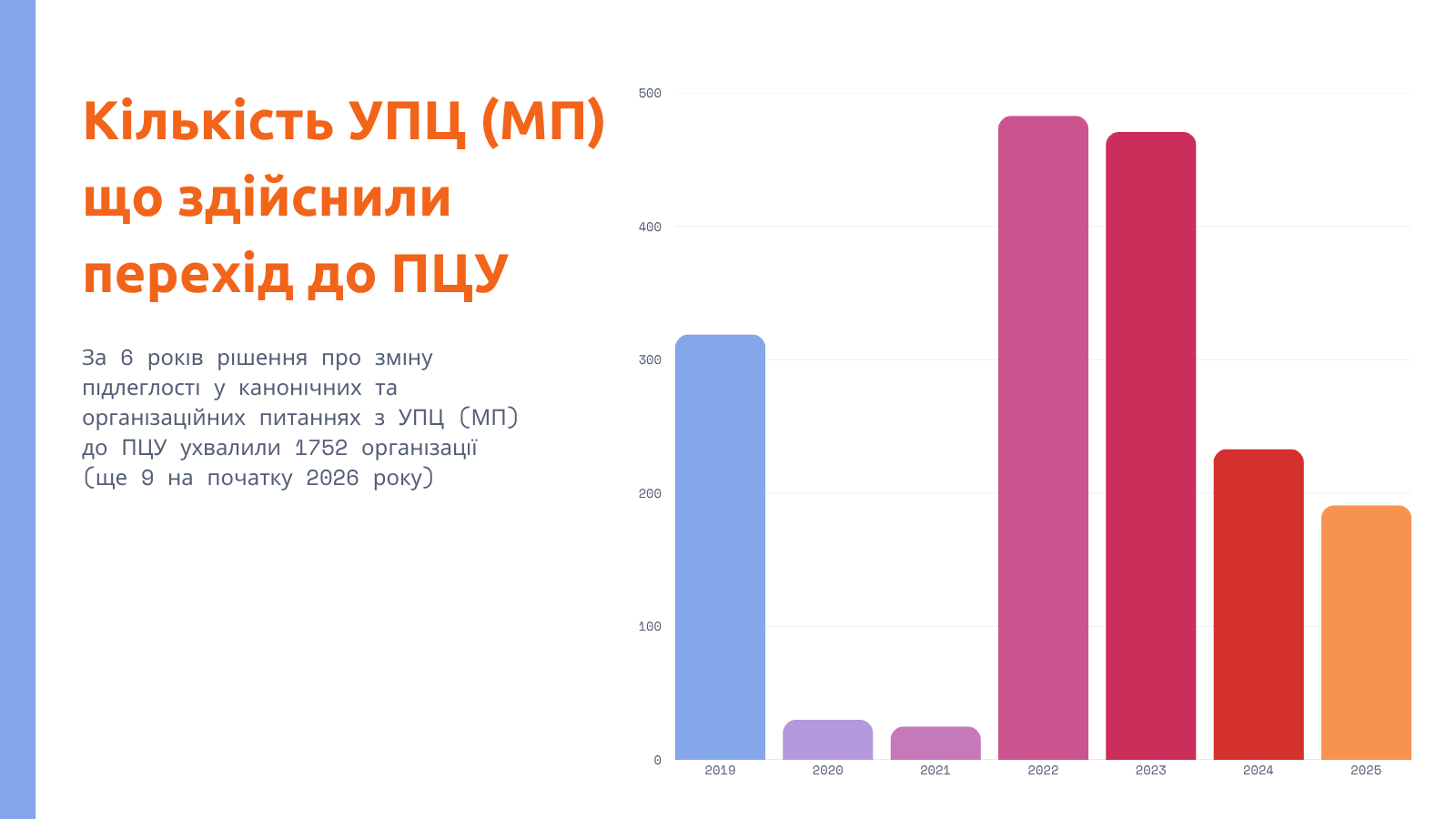
According to the State Service of Ukraine for Ethnic Policy and Freedom of Conscience, from the beginning of 2019 through February 2026, 1,761 religious organizations decided to transfer their canonical and organizational allegiance from the UOC (MP) to the OCU.
As of early 2025, 33 religious organizations of the UOC (MP) had ceased their activities.
“Among those serving in the UOC (MP) are very different people; one could say that the hierarchs are clearly subordinate to Moscow, but individual parishes are often led by patriotic individuals who, in principle, are open to dialogue with the OCU, but their leadership does not allow it, which is precisely why the transition of communities under the jurisdiction of the OCU is being hindered,” notes Ihor Todorov.
Yulia Derdyuk