
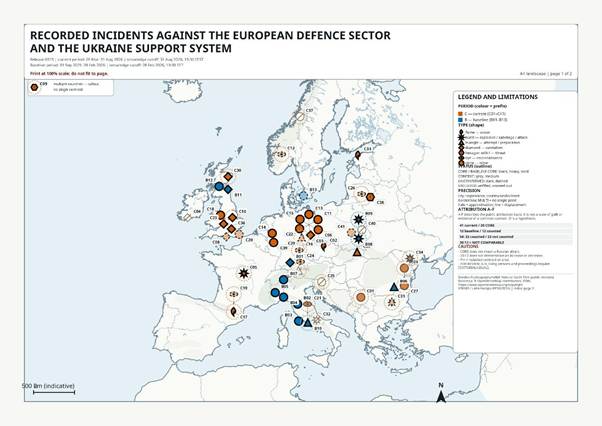
Of the 20 verified incidents targeting Europe’s defence sector and its supporting infrastructure between 1 March and 31 August 2026, two have either an indisputably confirmed or a probable Russian link. Of the 19 physical incidents, attempts, preparations and acts of intimidation, none can currently be unequivocally attributed to Russia on the basis of publicly available evidence; in two cases, Russia remains a possibility that has been publicly raised. This does not negate the existence of a Russian sabotage campaign; it shows the cost of premature attribution.
In brief
- The dataset covers 20 separate incidents: 19 events recorded in seven countries and one multi-country threat. The highest concentration is in Germany — eight — and the United Kingdom — five.
- The only confirmed Russian link is a statement by the authorities of the Russian Federation on 15 April identifying European drone manufacturers as potential targets. There is no evidence that it constituted an order or foreshadowed any of the subsequent incidents.
- The Russian hypothesis is being publicly examined in connection with the arson at a facility used by Milrem Robotics in Tallinn and is being considered in relation to the intimidation of RSI Europe in Vilnius. These are hypotheses, not attributions.
- In 15 cases, other explanations are better documented: primarily overt pro-Palestinian, anti-arms or climate activism, as well as domestic extremism. Two further cases remain unresolved.
- A broader Russian sabotage campaign is a fact confirmed in other European investigations. Evidence from one operation, however, cannot be transferred to an incident for which there is no independent chain of attribution.
Twenty records do not automatically mean twenty Russian attacks
BlackSky.Info’s findings cover three arson attacks, one act of sabotage against energy infrastructure, five acts of vandalism and a series of blockades, intrusions, attempts and preparations. Fourteen incidents were carried out, three remained at the attempt stage, one was thwarted during the preparation phase, and two records describe a threat or intimidation. No one was killed. In July, two police officers were injured; the sources do not confirm any injuries among employees of the targeted companies.
The geographical distribution may suggest coordinated pressure: Germany accounts for eight records, the United Kingdom five and France two, while the Czech Republic, Estonia, Slovakia and Lithuania have one each; in addition, there is a multi-country threat. The targets were entities in the defence industry or dual-use technology sectors; some support Ukraine.
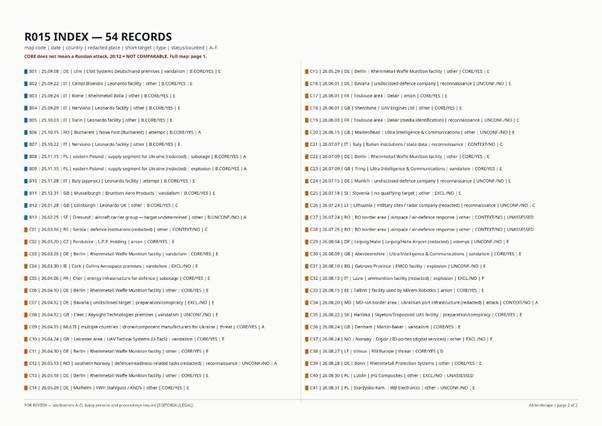
Similarity of targets does not prove a common perpetrator. Successive blockades of the Rheinmetall plant are separate incidents, but that does not make them a single covert operation. The target’s significance to NATO, the suspect’s nationality or the use of an incendiary device are not substitutes for evidence that an act was commissioned or directed.
The dataset is narrower than the debate on hybrid warfare might suggest. Almost all incidents concern companies, their facilities or personnel. None has a verified direct target in the transport or storage of supplies for Ukraine — facilities known from previous Russian operations.
An ‘incident’ does not always mean an ‘attack’, a ‘defence-sector target’ does not determine the motive, and a ‘benefit to Russia’ does not in itself prove that Russia commissioned it. Nevertheless, it is always worth asking the question: ‘Cui prodest?’ (who benefits?).
The Russian threat was explicit, but can it be regarded as an operational order?
On 15 April, the Russian Ministry of Defence published a list of European companies involved in the production of drones and components for Ukraine. Dmitry Medvedev, Deputy Chairman of Russia’s Security Council, described the listed facilities as potential targets. The Czech Ministry of Foreign Affairs summoned the Russian ambassador and protested against possible attacks, while a syndicated Reuters dispatch described the Russian communiqué and threats.
Here, the authorship is beyond doubt: the threat came from the authorities of the Russian Federation. The scope of this finding is, however, strictly limited. The publicly available material does not confirm that it was a target list approved for attack, that an order was issued to conduct operations on NATO territory, or that the communiqué is personally or operationally linked to any of the fires, break-ins or protests in the analysed set.
This is the distinction between political intent and firm attribution of an act. Russia openly threatened manufacturers, but this is not yet proof that its security services were behind every subsequent incident. A convergence of interests points investigators in a direction; it does not close the case. On the other hand, it is difficult to ignore the American ‘duck test’: if it looks like a duck, swims like a duck and quacks like a duck, it is most likely a duck.
Thirteen actions in Germany and the UK have an overt motive
The largest part of the twenty consists of thirteen overt direct actions: eight in Germany and five in the UK. Participants stated their demands and used flags and banners, while police described the events as demonstrations, blockades, trespass or damage to property.
In Berlin, the Rheinmetall Waffe Munition plant was targeted six times between 25 March and 9 July. The first action involved trespass and damage to property; the subsequent ones involved blockades or attempts to block access. An RBB report from 25 March noted a Palestinian flag and a protest by activists. A pro-Palestinian motive was also documented on 10 April, 30 April, 18 May and in a foiled attempt on 29 May. This is concrete material supporting an alternative explanation, not merely an absence of evidence pointing to Russia.
The Berlin plant belonged to the arms and ammunition sector, but reports described preparations for future production of ammunition components, not a production line already in operation. There are no grounds for saying that production or deliveries were halted. On 9 July, police said they had foiled a blockade and that two officers had been injured; the group gave a different account of events.
On 29 May, climate and anti-arms activists blocked access to FWH Stahlguss in Mülheim an der Ruhr, a company owned by KNDS that produces cast steel for armoured vehicles. Police described the action as a blockade held as part of an assembly and said proceedings had been initiated. On 28 August, pro-Palestinian demonstrators blocked Rheinmetall Protection Systems in Bonn; there were delays to delivery traffic, but according to WDR, the company continued to operate without disruption.
The UK cases form a similar cluster. On 24 April, there was a forced entry and damage at U-TacS near Leicester; six people were later charged in connection with the break-in and criminal damage, and in August all pleaded not guilty. On 1 June, access to UAV Engines in Shenstone was blocked and four people were arrested. Pool Re recorded the incident as a pro-Palestinian direct action and did not classify it as terrorism in its report.
According to the prosecution, on 9 July three people broke into Ultra Intelligence & Communications in Tring, causing damage estimated at £1.3 million. This is not a court finding; the defendants are awaiting trial. A month later, police in Scotland confirmed a break-in, vandalism and the arrest of two people at another Ultra facility. On 24 August, two people entered the Martin-Baker site in Denham and damaged property; police described the disruption as minimal. In each case, public statements indicated a pro-Palestinian motive. An organisation’s claim of responsibility does not determine the guilt of specific individuals, groups or intelligence services. Russian intelligence services have previously used people from both the far left and the far right, and such activity is by no means isolated.
In Pardubice and Cher, extremist leads are stronger
Two more serious incidents also have an alternative explanation that is better documented than Russian direction, although the proceedings have not yet reached a final legal conclusion. On 20 March, a facility belonging to L.P.P. Holding in Pardubice burnt down. The company develops unmanned technologies and cooperates with Ukraine. Sources differ, however, on the building’s function: the ABW calls it a production hall, while AP describes it as a warehouse. There are no grounds for claiming that production or deliveries were interrupted. The ABW detained two Polish nationals suspected of aiding a terrorist act; neither pleaded guilty.
Public statements by Polish and Czech authorities did not identify a Russian connection. The ABW, however, said that an extremist group had claimed responsibility for the arson, citing opposition to cooperation between the arms industry and Israel. Czech detention proceedings also described the suspect’s alleged links to a pro-Palestinian movement targeting Elbit Systems. This is procedural court material, not a judgment, but it means the Pardubice incident cannot be presented as confirmed Russian sabotage.
On the night of 6–7 April, three energy installations in the Cher department supplying the KNDS and MBDA plants were set alight. A message reading ‘Action contre la guerre’ was left at the scene, and the Paris public prosecutor’s office assigned the case to units dealing with terrorism. Initial losses were estimated at several million euros, and power was provisionally restored. The French Interior Minister told the National Assembly that the radical far left is moving from symbolic protest to violent anti-militarism. He did not attribute this act to the far left, and the perpetrators remain unknown — although this appears to be an open secret.
Delair and Skyeton remain unresolved
Two of the 20 records — the attempted attack on Delair and preparations for an attack on Skyeton — remain without a conclusive lead. The later reconnaissance involving Delair is separate context and is not counted here. On the night of 31 May to 1 June, incendiary devices were thrown near the plant outside Toulouse. The damage was minor, or the devices proved ineffective, and the drone manufacturer’s operations were not disrupted. Delair had previously reported delivering 150 drones to the Ukrainian armed forces, so the choice of target is significant, but this alone does not conclusively establish the perpetrator’s identity.

Two days later, a man born in Belarus was seen filming the prototype; after his arrest, prosecutors charged him with passing the footage to a contact in Russia. A local report describes two separate proceedings. The man was initially also suspected of attempted destruction, but no evidence of his involvement in the arson or of a common instigator has been disclosed. The mere fact that both threads concern Delair is not enough to link them.
In Haniska, near Prešov, Slovak police foiled preparations for an arson attack on the Skyeton unmanned systems plant, formerly known as Tropozond. A flammable mixture, tools, a camera and a hand-drawn plan were seized; three people were charged, and a fourth was later detained. According to police, around 70 employees could have been at risk, and the potential damage could have reached tens of millions of euros. The Slovak police chief said on 28 August that there was no evidence that Russia was behind the plot.
On 1 September, there was an important procedural correction: the court released the Ukrainian suspect, finding that there was not even an indication that he knew of the arson plot; the prosecutor appealed against the decision. This does not invalidate the information about the foiled preparations, but it is a reminder that a charge does not prove knowing involvement.
Milrem and RSI: Russia is a hypothesis under investigation
In both cases, the Russian hypothesis carries greater weight because it has been raised publicly by the authorities or the relevant institution. It still does not reach the level of probable, let alone confirmed, attribution.
On the night of 14–15 August, a fire broke out in a building used by Milrem Robotics in Tallinn. The Estonian Public Prosecutor’s Office said that possible arson and attempted sabotage are being investigated; no one was injured. Latvia’s VDD detained three Latvian citizens and opened proceedings concerning assistance to a foreign state in activity against another state, but did not name any of them. Estonian Prime Minister Kristen Michal confirmed that possible Russian involvement is one of the lines of inquiry. This is a hypothesis under investigation, not grounds for labelling the fire a Russian attack. According to Milrem’s CEO, the incident did not affect production or deliveries to Ukraine.

On 27 August, funeral wreaths and a photograph of a living member of the management team with a black ribbon were left outside RSI Europe’s headquarters in Vilnius. The incident was filmed and the footage circulated online. One person was detained. Lithuania’s National Crisis Management Centre assessed that the method of intimidation and the accompanying narrative were consistent with a possible modus operandi of the Russian security services, but did not identify the organiser or the person who commissioned it. The phrase ‘consistent with the method’ describes a hypothesis, not evidence that Moscow directed the operation.
In the Milrem case, Russia is a viable line of inquiry, while in the RSI case the relevant institution sees a pattern of informational and psychological pressure. That is something, at least.
Other investigations confirm the Russian modus operandi
Caution over the set of twenty does not undermine the existence of a Russian sabotage campaign in Europe. Other investigations describe recruitment via messaging apps, the division of tasks among those carrying out the acts, payments in cryptocurrencies, documentation of the results and the use of footage for propaganda purposes.
In March 2026, Eurojust reported the dismantling of a group linked to self-igniting parcels. A joint investigation by Germany, Lithuania, the Netherlands, Poland and the United Kingdom identified 22 people suspected of acting on behalf of Russian military intelligence. The parcels caught fire in 2024 in Germany, Poland and the United Kingdom; one began to burn at Leipzig Airport just before being loaded onto an aircraft. According to Eurojust, those carrying out the acts were recruited via a messaging app, and payment was often made in cryptocurrencies. Two cases have reached the courts; suspicions must still be distinguished from convictions.

In March 2026, Latvia’s VDD referred the case of arson attacks on railway signalling cabinets and a locomotive in August 2025 to the public prosecutor’s office. The agency said the actions were linked to Russia; those carrying them out filmed the fires and sent the footage to those who had commissioned them, and the material was subsequently presented as events taking place in Ukraine. This is a concrete chain linking physical damage, intermediaries and an information operation.
Even stronger material comes from Poland. The Internal Security Agency (ABW) described a group of at least 30 people acting with the direct support of and on behalf of the FSB. Sixteen of its members were convicted; their tasks included reconnaissance of infrastructure and preparations to derail trains carrying weapons and aid for Ukraine. In another case, the ABW identified Russian tasking, instructions and funding for arson attacks carried out in Poland by a Colombian national. The same man had previously been convicted in the Czech Republic for setting fire to a Prague tram depot; according to the Czech Prime Minister, Russian intelligence services were involved.
What distinguishes attribution from intuition is communication with those commissioning the operation, the flow of funds, an identified structure, procedural material or a formal statement by an authority. The Russian model uses intermediaries and blurs the line between intelligence, crime and sabotage. The nationality of the perpetrator says little, and without information about the tasking, not everyone involved can be labelled an intermediary for the Russian services.
Poland – WB Electronics and JFG Composites
On 1 August, a fire occurred at the WB Electronics facility in Skarżysko-Kamienna. According to the National Prosecutor’s Office, the fire was deliberately started using a flammable charge, and losses exceeded PLN 15 million. The investigation was opened, among other lines, into possible activity on behalf of a foreign intelligence service, but by the time the article was published no state, service or suspect had been identified. The investigation is ongoing, and once again one is tempted to call it an open secret.
On 30 August, a fire engulfed a production hall and offices at JFG Composites in Lublin, a company that produces components for the aviation industry. The roof partially collapsed, no one was injured, and the owner estimated the losses at around €5 million. Prosecutors opened an investigation, but the cause and the perpetrator were unknown.
The absence of a public lead does not prove that Russia had no connection to the case. It means only that, at present, there are no grounds for asserting one. This guards against both a premature accusation and the premature closure of the investigation.
Leipzig after 31 August strengthens the context, but does not alter the twenty
The importance of later information is illustrated by the incident of 4 August at Leipzig/Halle Airport. At the cut-off for the dataset, it had been confirmed that a drone carrying explosives had been found and that flights had been temporarily suspended. At that point, however, the intended target had not been sufficiently established, nor had any direct link to transport for Ukraine, and attribution remained open. On 1 September, the position changed fundamentally. The German government formally identified Russia as the perpetrator of the hybrid attack in Leipzig. According to the authorities, the drone’s configuration, the explosive material and the ignition technique matched methods known from other Russian operations; the device was found in the airport area near Ukrainian transport aircraft. AP described the attempt as a drone attack carrying an explosive payload. Moscow rejected the accusation.
The German daily Süddeutsche Zeitung has reported on a Russian link to a foiled drone attack at Leipzig Airport. Two men have been implicated in the attempted strike using explosive-laden drones: a Russian-born Latvian citizen and a Russian passport holder residing in Belarus.
According to investigators, the first suspect — a Latvian national — flew to Berlin at the end of July, hired a car, and travelled to Leipzig. On 2 August, two days before the planned attack, he returned to the capital and left Germany. German security services suspect that he may be in direct contact with Russian intelligence.
DNA traces belonging to the second suspect were found on one of the drones, on the inside of an explosive-filled can and on a transceiver antenna mounted on a tree near the airport. He had previously come to the attention of law enforcement agencies across several European countries. In April, he obtained a tourist visa in Minsk, which he used to enter Italy before travelling overland to Germany.
This case clearly shows that the lack of attribution on the day of an incident can change as the investigation progresses, and that only publication by the competent authority justifies the wording ‘formally attributed perpetrator’.
The balance: 1 Russian threat, 2 leads under investigation, 17 with no lead
The answer for the period from 1 March to 31 August 2026 is therefore as follows: the closed dataset comprises 20 incidents, of which 19 concern physical actions, attempts at such actions, preparations or physical intimidation, while one concerns an explicit Russian threat against drone manufacturers.
In two cases — Milrem Robotics and RSI Europe — Russia remains a viable, publicly raised line of inquiry, but without attribution. The remaining 17 contain no publicly available material pointing to Russia. Of these, 15 have other, better-documented explanations: thirteen overt activist actions in Germany and the United Kingdom, an extremist motive in Pardubice, and an anti-militarist lead in Cher. The last two cases, Delair and Skyeton, currently have neither positive evidence of Russian involvement nor an established alternative explanation.
The fact that specific acts of subversion have so far only rarely been formally attributed to Russia does not mean that there is no Russian sabotage in Europe. The Eurojust, VDD and ABW cases, together with the attribution of the Leipzig incident disclosed on 1 September, show that, according to the findings of the competent authorities, Russian structures have organised or supported physical actions posing a risk to property, transport and, potentially, human life. An accurate picture requires both findings to be held together: Russian sabotage is real, but that reality does not entitle anyone to attribute to Moscow incidents for which the evidence specific to the case does not confirm Russian involvement.
Author: Artur Żak