
This amount would barely cover even a week of the war, and to plug the budget gap caused by rising military spending, Russian business leaders would need to “contribute” 30 times more. If the oligarchs refuse to pay voluntarily, the government may impose additional taxes or resort to nationalizing property. The authorities are already making it clear: under the conditions of the “special military operation,” the wealth of certain Russians appears indecent and even provocative.
In short:
- In March, Putin held a closed-door meeting with the oligarchs, where the idea of “voluntary contributions” for the “special military operation” was raised.
- Businessmen have already transferred 220 billion rubles; the funds are being recorded as non-repayable payments
- This amount is insufficient to cover the budget deficit caused by military spending, which currently stands at about 6 trillion rubles
- In addition, there is a proposal to introduce a tax on excess profits for oligarchs to replenish the budget
- Businesspeople who refuse to align with the Kremlin and pay up may face nationalization: since the start of the war, Russia has stepped up the process of seizing assets for the state
Of their own volition
The proposal for Russian oligarchs to “voluntarily” finance the “special military operation” was made in March during a closed-door meeting between President Vladimir Putin and top executives of the country’s major companies. Putin’s press secretary, Dmitry Peskov, later confirmed that such a conversation took place, but according to him, the initiative to help the motherland did not come from Putin, as was initially claimed, but from the businessmen themselves.
“The truth is that one of the meeting participants did indeed say that he considered it necessary for the state to allocate a certain large—very large—sum of money, and that was his personal decision.”
According to Peskov, the businessman explained this move by noting that “the overwhelming majority of the meeting’s participants had started their businesses in the 1990s, and for the most part, of course, those beginnings were connected in one way or another to the state.” “Many consider it their duty to make such contributions,” Peskov noted, adding that “Putin welcomed this initiative.”
According to The Bell, at least two businessmen expressed their willingness to donate money for the war directly at the meeting. One of them was Suleiman Kerimov; in his case, the amount in question was 100 billion rubles.
The second was Oleg Deripaska; the amount of his donation was not specified.
According to data from the publication “Expert,” payments from oligarchs have already begun to flow into the budget. They are transferred in tranches of several billion rubles from the accounts of the billionaires’ subsidiaries and are recorded as non-repayable payments.
According to the government portal “Electronic Budget,” as of the end of May, the total amount of such transactions to the treasury from non-state organizations stood at 220 billion rubles. This is 130 times the amount of non-repayable payments originally budgeted: only 1.7 billion rubles were expected from this source of revenue.
However, the donations received from Russian businesses would last for less than a week of the war, which, according to estimates by independent media, cost approximately 260 billion rubles per week in 2025.
To cover the current budget deficit, which has been caused by military spending, Russian oligarchs would need to donate 30 times more.
The war is costing more than forecast
The Russian budget allocates 12.9 trillion rubles for “national defense” in 2026—one-third of the country’s total spending. However, the war is costing Russia much more this year than the authorities had anticipated. Back in February, Finance Minister Anton Siluanov sent a letter to the government estimating the deficit caused by additional military spending at 2 trillion rubles. In a worst-case scenario, it could rise to 4 trillion by the end of the year, the Ministry of Finance warned, proposing to freeze non-military spending by several trillion rubles. No decision was made to cut spending.
Following the escalation of the situation in the Middle East and the subsequent significant rise in energy prices, Russia believed that the deficit could be reduced through additional revenue from the sale of oil and petroleum products. However, no positive trend has been observed so far: according to the latest data from the Ministry of Finance, the federal budget deficit for January–May 2026 amounted to 6.01 trillion rubles, or 2.6% of GDP. This is the largest budget shortfall since the start of the war, and the amount is nearly double the annual forecast of 3.786 trillion rubles. If this trend continues, budget expenditures on the war will exceed even the Ministry of Finance’s most pessimistic forecasts.
The Obscenely Rich
It has not been reported which major Russian business leaders attended the March meeting with Vladimir Putin. The content of such meetings is not usually disclosed, and since the start of the war in Ukraine, even the list of participants has been classified. Judging by past experience, such events typically involve the owners of the largest companies, many of whom appear on the Forbes lists.
In 2025, despite the war and sanctions, Russian oligarchs were doing quite well. The number of billionaires with Russian citizenship increased: 146 people, compared to 125 the previous year. Their combined wealth grew from $577 billion in 2024 to a record $625.5 billion. This is more than all Russians have in their ruble-denominated term deposits; as of February 1, 2026, citizens’ savings totaled $587 billion.
The top spot on the Forbes list is currently held by Alexey Mordashov, owner of Nordgold and CEO of the Severgroup holding company, with a record $30 billion. His position has strengthened mainly due to the rise in gold prices—up nearly 80% over the past year. Valentina Matvienko, Chairwoman of the Federation Council, has already asked the oligarch to share his wealth with the state. She effectively called on Mordashov to allocate part of his fortune to the needs of Russian regions, suggesting that he “bring some of his offshore assets back” to Russia.
The Bloomberg Billionaires Index reports that the wealth of Russia’s richest businesspeople continues to grow in 2026: up by $19.392 billion since the start of the year. The ranking, which includes the world’s 500 richest people, features 20 Russians.
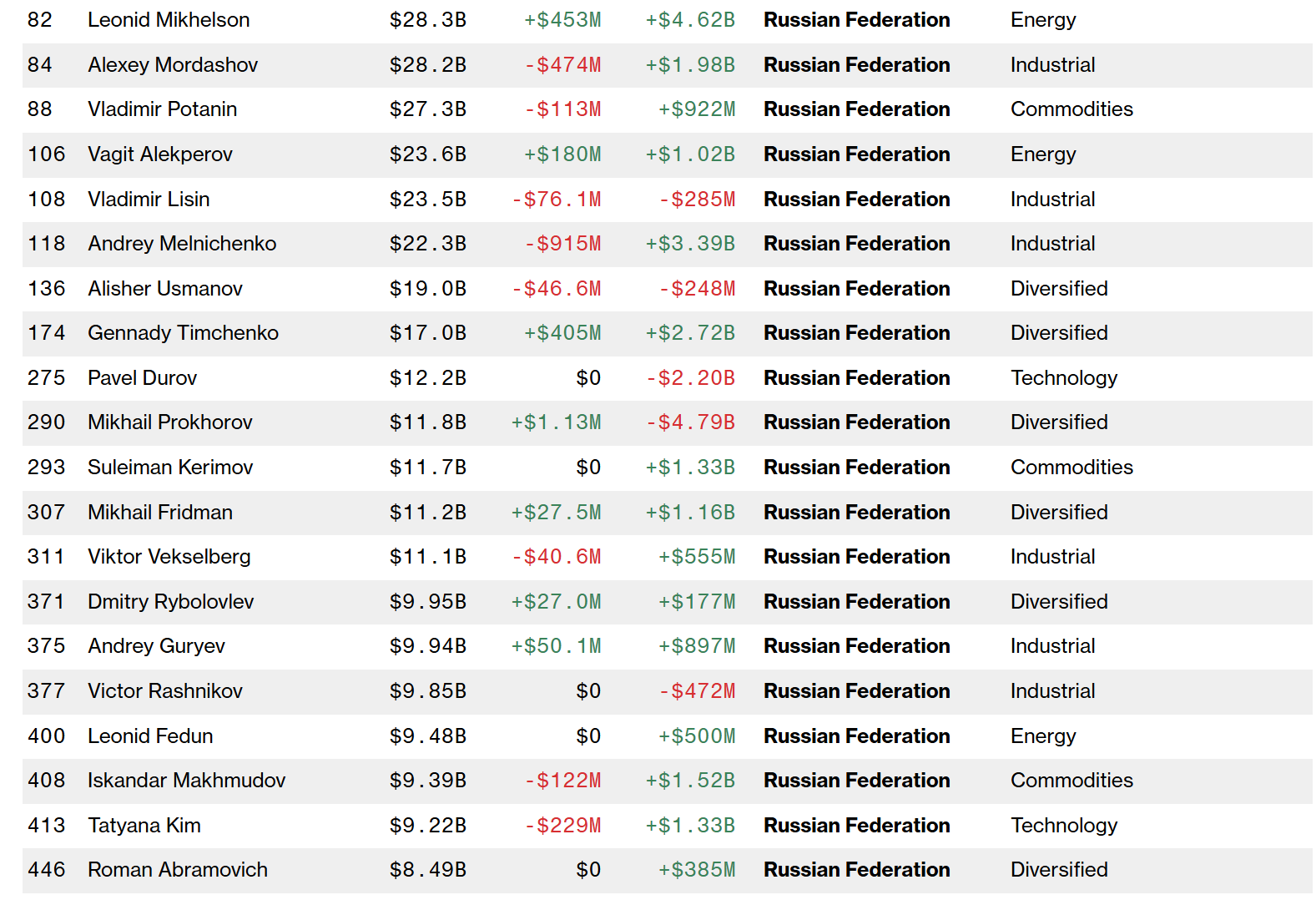
State Duma Deputy Sergey Mironov also took note of the billionaires’ ranking and stated that the rapid growth of the fortunes of Russia’s wealthiest citizens amid a special military operation appears indecent and provocative.
It’s high time to share the windfall profits from the exploitation of national assets, which were bought up for pennies back in the day.
Windfall Tax
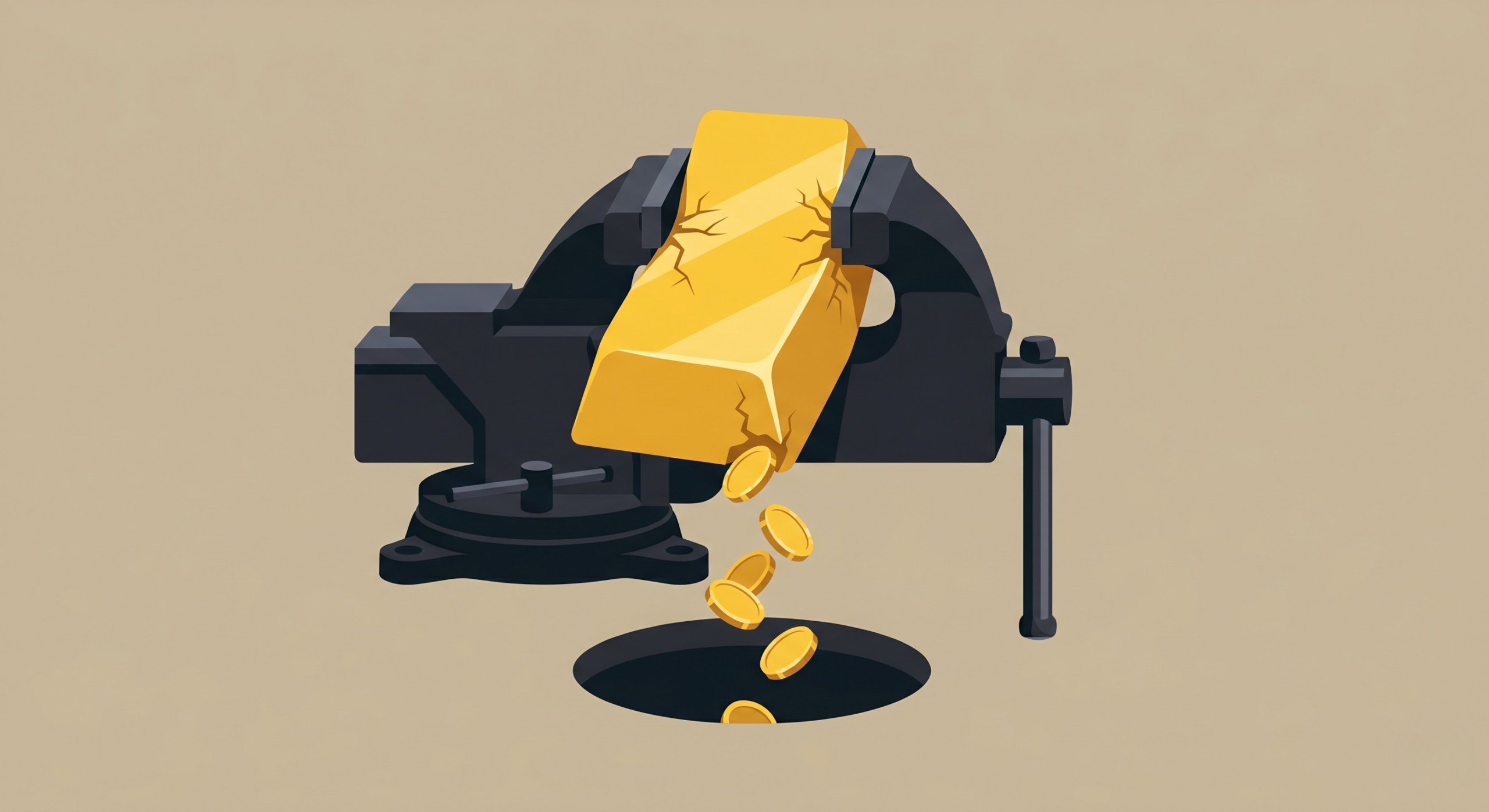
To replenish the budget, the government is considering the possibility of introducing a windfall tax.
A windfall tax is a one-time or temporary levy that the state imposes on companies whose profits over a specific period have significantly exceeded a historical baseline. Such profits are typically driven by external circumstances—such as market price spikes, currency depreciation, or temporary market shortages.
Russia had already implemented this measure in 2023. At that time, the additional tax applied to companies whose average profit for 2021–2022 exceeded 1 billion rubles.
The tax rate was 10% or 5% for early payment. Actual budget revenues turned out to be higher than projected: instead of the expected 300 billion rubles, the Russian treasury received 318 billion.
Now, the government has not only recalled this successful method of replenishing the budget but has also proposed doubling the rate to 20%. As of June, no official decision on the excess profits tax had been made.
Alexander Shokhin, head of the Russian Union of Industrialists and Entrepreneurs (RSPP), asserts that it will not be possible to replicate the situation of 2023, since at that time many companies’ excess profits were linked “both to the devaluation of the national currency and to favorable external market conditions for many export goods,” whereas such conditions do not exist now. In his assessment, companies are not currently making a profit; “many are operating at a loss.”
Sergey Nosov, Governor of the Magadan Region, spoke very passionately on the subject of the tax. In his opinion, the introduction of such a tax could completely destroy gold mining:
I think that such measures simply won’t save the budget or the economy as a whole. But the message—that is, ‘don’t invest, don’t get rich, don’t grow’—will be very clear, and a long-term one at that. And I would think very carefully before implementing this.”
The governor cited “voluntary contributions” by companies to the state budget as an alternative to a windfall tax.
The Specter of Nationalization
Following Vladimir Putin’s meeting with the oligarchs and Dmitry Peskov’s subsequent comments on the privatization of Russian industry in the 1990s and ties to the state, the Institute for the Study of War (ISW) concluded that the Kremlin may be preparing to nationalize the assets of Russian businessmen for the war effort.
Although Vladimir Putin has repeatedly asserted that the authorities do not support nationalization, practice shows that, against the backdrop of the war, property is being increasingly seized from businesspeople and members of the elite in Russia.
The General Prosecutor’s Office is directly responsible for the seizure of assets. According to its data, in 2025 alone, property worth more than 4 trillion rubles was transferred to state ownership, including strategic enterprises with a total market capitalization of around two trillion rubles.
Rosimushchestvo, the agency that manages nationalized property, reported that since 2022, “approximately 805 companies have been transferred to state ownership.”
The state seizes assets due to tax arrears or violations of anti-corruption laws. The basis for nationalizing a strategic enterprise may be the owner’s foreign citizenship or even a residence permit. Sometimes a businessman may be accused of extremist activities or of financing organizations banned in Russia. The state may also challenge the results of privatizations carried out in previous years.
Among those “nationalized” in 2025 are individuals featured on the Forbes list.
For example, Dmitry Kamenshchik lost Domodedovo Airport on the grounds that, while holding both Russian and foreign citizenship, he owned a strategic asset. The court ruled that Denis Shtengelov and his father Nikolai were extremists, transferring the assets of the KDV Group (the “Yashkino,” Calve, “Three Crusts,” etc.) to the state. In 2026, the high-profile case of billionaire Vadim Moshkovich, founder of the Rusagro agricultural holding, made headlines. The prosecutor’s office alleges that he had previously used his position as a senator to benefit his business. The court froze his assets, including his stake in “Rusagro.”
As for challenges to the results of privatization in previous years, the authorities finally offered businesses an “incentive” and passed a law that limits the statute of limitations for violations in privatization deals to ten years. In other words, the oligarchs have been given guarantees that the results of the 1990s privatizations will not be revisited, even in cases “where not all procedures were carried out in accordance with the law,” according to the explanatory note.
However, the new rules apply only to those who are on good terms with the Kremlin and follow its recommendations, since the law’s provisions do not extend to lawsuits involving “anti-corruption” and “anti-extremist” cases.
Volha Siamashko
Official Russian and Belarusian sources cited in this text are for informational purposes only. Content from these sources may constitute disinformation or propaganda