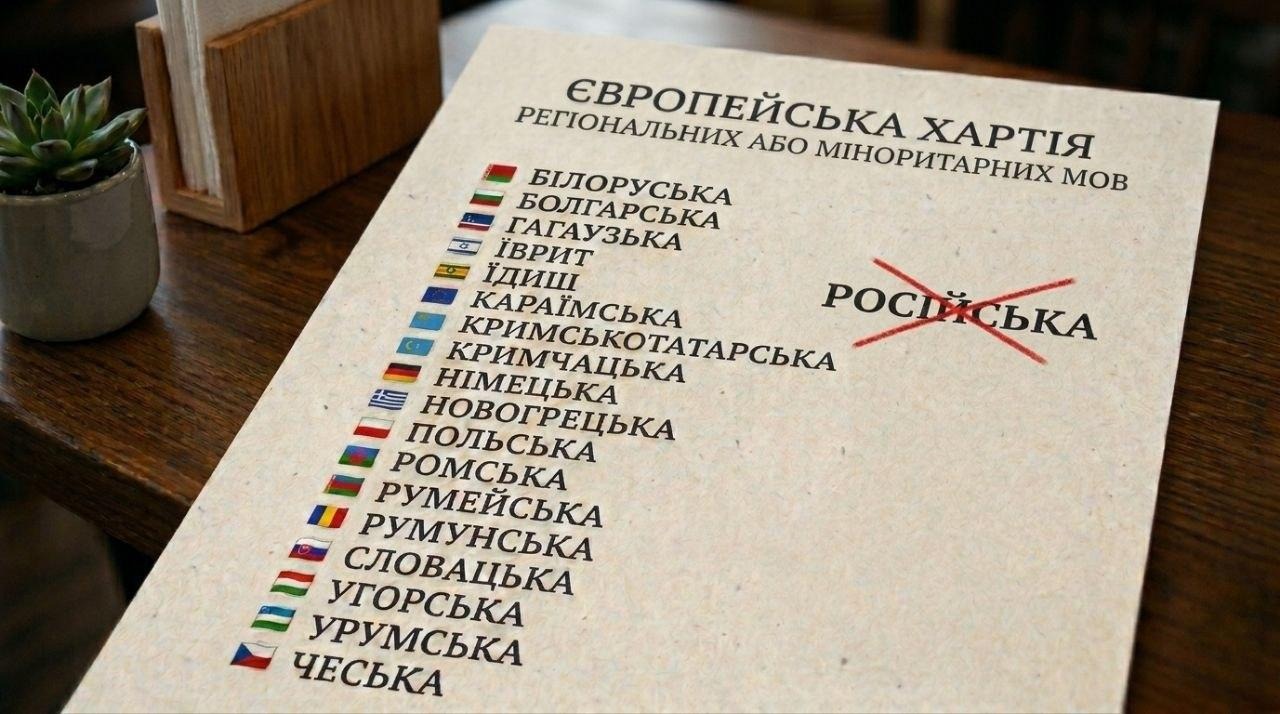

On June 12, Zelenskyy “celebrated” Russia Day by signing a law that removes Russian from the list of languages protected under the European Charter for Regional or Minority Languages.
In brief:
- The Law “On Amendments to Certain Laws of Ukraine in Connection with the Update of the Official Translation of the European Charter for Regional or Minority Languages” was adopted by the Verkhovna Rada of Ukraine on December 3, 2025.
- On June 12, Zelenskyy signed the law, thereby approving changes to the list of languages protected under the European Charter and removing Russian from the list.
- Czech, Crimean Tatar, Krymchak, Karaim, Yiddish, and Hebrew were added to the list of languages subject to protection. In total, the list includes 18 languages.
- In Russia, the termination of protection for the Russian language in Ukraine was called “neo-Nazism in action.”
- The International Committee of the European Charter supported the exclusion of Russian from the list of languages subject to protection in Ukraine, emphasizing the Russian Federation’s manipulative actions related to language protection.
Is it now forbidden to speak Russian?
The European Charter for Regional or Minority Languages provides for the protection of the languages of indigenous peoples and national minorities within a country’s territory and guarantees that the state will promote the development and support of these languages in the regions where they are used, in particular by supporting cultural activities, providing opportunities to learn the language at all levels, allowing access to the courts in the language of national minorities, and ensuring access to administrative services.
Each country that has ratified the European Charter creates its own list of languages considered regional or spoken by national minorities within its territory. It also independently determines the level of protection and the range of measures to be implemented to enshrine the special status of a particular language.
In addition to Russian, the Moldovan language was removed from the list due to the recognition of Romanian as the official language of Moldova.
The changes stipulate that Ukraine no longer undertakes any obligations to support and expand Russian-language cultural projects or media outlets, nor is it obligated to provide Russian language instruction at any level of education; this also applies to administrative services and the courts. Instead, the Charter applies only to the special status of language protection and does not concern everyday use.
What other changes are provided for by Law No. 4699-IX
In addition to removing the Russian language from the list of languages protected by the European Charter, the provisions of the amendment law provide for a fundamental change to the list of languages covered by protection. In fact, the list of languages protected by Ukraine is one of the largest in the Council of Europe, notes Yevheniia Kravchuk, deputy chair of the Parliamentary Committee on Humanitarian and Information Policy and a member of the permanent delegation to PACE.
Ukraine applies the provisions of the Charter to the following languages: Belarusian, Bulgarian, Gagauz, Hebrew, Yiddish, Karaim, Crimean Tatar, Krymchak, German, Modern Greek, Polish, Romani, Rumei, Romanian, Slovak, Hungarian, Urum, and Czech.
In the law “On Amendments to Certain Laws of Ukraine in Connection with the Update of the Official Translation of the European Charter for Regional or Minority Languages,” the list of languages was expanded to include Czech, Crimean Tatar, Krymchak, Karaim, Yiddish, and Hebrew. This sends a clear signal that Ukraine is ready to protect the languages and support the culture of indigenous peoples within the country’s territory, but has no intention of giving the aggressor state additional leverage.
“Russian has been removed from the list, as it is not at risk of extinction and certainly does not require additional support in Ukraine, let alone funding from the state budget,” notes Yevheniia Kravchuk.
What myths are being spread in the Russian information space regarding the law
Draft Law No. 4699-IX was adopted back in December 2025 and subsequently submitted to the President for signature.
At the time, Russian media called the adoption of the law hasty and accused the Ukrainian government of attempting to derail peace talks, since one of Russia’s demands in the context of ceasing hostilities is granting Russian the status of an official language in Ukraine and abolishing quotas on its use in the media, education, and public life.
Despite claims of haste, Zelenskyy did not sign the law for over half a year.
At the same time, Russian media actively spread claims that the use of Russian in Ukraine was banned and illegal. The media accused Ukrainian lawmakers of depriving most of Ukraine of its rights and of effectively placing the Russian-speaking population outside the law and the Constitution. However, the exclusion of a language from the list of the European Charter for Regional or Minority Languages does not regulate the language’s use in everyday life and does not impose restrictions on its use.
Another set of myths concerns the illegality of this decision, claiming that such bans restrict citizens’ rights and contradict the Constitution of Ukraine. In 2025, Maria Zakharova, an official spokesperson for the Russian Ministry of Foreign Affairs, even called on international organizations to objectively assess these actions.
Article 10 of the Constitution of Ukraine, which Russian media outlets cite, states that Ukraine guarantees the free development, use, and protection of the Russian language and other languages of Ukraine’s national minorities. However, Part 5 of this article specifies that the use of languages in Ukraine is determined by law. Furthermore, the provision on “protection” does not extend to the specific privileges granted to the languages of national minorities under the European Charter. It should be noted separately that in 2015, the Russian Federation was recognized as an aggressor state, and Russian as the language of an aggressor state.
But in some respects, the Russian media were correct—the adoption of this law is a clear signal from Ukraine that the Russian Federation’s demands regarding the official status of the Russian language will not be considered. Zakharova accused the Ukrainian side of lacking interest in a peaceful resolution of the conflict. In doing so, the official used the propaganda cliché “Kyiv regime.”
Has the rhetoric of the accusations changed?
After Zelenskyy signed the law, Zakharova called these actions “neo-Nazism in action.”
Meanwhile, as the media began promoting messages about the failure of Ukrainization, Spiridon Kilinkarov, a former Ukrainian lawmaker who was added to the list of traitors for propaganda activities in favor of Russia, appeared as an expert on language issues in Ukraine. His statements include quotes suggesting that, despite the Ukrainian authorities’ attempts to launch the process of Ukrainization, an increasing portion of the population in Ukraine is switching to Russian. However, according to the results of a survey conducted by Gradus in February–March 2026, 62% of Ukrainian citizens speak Ukrainian in their daily lives.
Who supported the change
Ruslan Stefanchuk, Speaker of the Verkhovna Rada of Ukraine, called the President’s decision fair and lawful, noting that the new measure is an integral part of Ukraine’s European commitments:
“This is a fair and logical decision. The language of an aggressor state cannot benefit from the protective measures created to support the languages of indigenous peoples and national communities.
Ukraine is protecting its official language, respecting linguistic and cultural diversity, and stripping Russian imperial influence of the privileges it has abused for years,” wrote Stefanchuk.
A similar reaction came from Europe. Despite statements from the Russian Federation regarding the illegality of the measure, the Committee of Experts of the European Charter for Regional or Minority Languages condemned Russia’s aggression against Ukraine and supported the Ukrainian government’s decision, emphasizing that the Russian side had used the status of Russian as a minority language in Ukraine as a pretext for aggression.
The Committee of Experts points out that, in accordance with Article 5 of the Statute, nothing in it “shall be interpreted as conferring any -any right to engage in any activity or take any action contrary to the purposes of the Charter of the United Nations or other obligations under international law, including the principle of the sovereignty and territorial integrity of states”.
Yulia Derdyuk
Official Russian and Belarusian sources cited in this text are for informational purposes only. Content from these sources may constitute disinformation or propaganda.