While the Kremlin is counting the profits from the unexpected surge in oil prices, the stability of Russia’s export logistics is under threat. Ukraine is systematically attacking oil infrastructure: this week, drone strikes temporarily halted shipments of crude through Baltic ports, and the Druzhba pipeline has been under repair for several months. At the same time, the EU is tightening controls over the operations of the so-called “shadow fleet,” which increases risks to the stability of supplies.
In brief:
- Ukraine is striking Russia’s “oil” ports: drones are attacking Ust-Luga, Primorsk, and Novorossiysk. Supplies via the Druzhba pipeline to Hungary and Slovakia have not been restored
- The West is considering new sanctions against Russia’s “shadow” fleet. In response, Russia has promised to resort to military action if its tankers are blocked
- Due to logistical problems, Russian oil exports are falling and may reach their lowest level since the war
Today, about 80% of Russia’s oil exports are shipped by sea, while the remaining volumes are transported via pipelines to the west and east. Before the imposition of large-scale sanctions related to the war in Ukraine, the “pipeline-to-sea” supply structure was nearly equal. In 2022, oil logistics were rapidly restructured: the focus shifted to sea shipments, while simultaneously diversifying sales markets and forming a “shadow fleet.”
In 2025, according to data from Russian Deputy Prime Minister Alexander Novak, 94% of oil exports went to friendly countries, primarily China and India. Exports to European countries totaled 25 million tons, which is four times less than in 2021.
In total, according to Novak, Russia exported 238 million tons of oil in 2025. This is comparable to 2024 volumes and slightly higher than in pre-war 2021—when exports stood at 230 million tons.
“Druzhba” going down the tubes: oil seeks new routes
In the eastern direction, the key route remains the “Eastern Siberia–Pacific Ocean” pipeline, with deliveries to the port of Kozmino and a branch to Mohe, China.
In the western direction, the Russians effectively have only one operational oil pipeline left—“Druzhba.” It runs from Almetyevsk in Tatarstan—through Samara and Bryansk—to Belarus.
At the Russian-Belarusian border, near the town of Unecha, the Baltic Pipeline System-2 (BTS-2) branches off from the main system, leading to the port of Ust-Luga in the Leningrad Region.
In Mozyr, Belarus, Druzhba splits into two branches: the northern branch, supplying Latvia, Lithuania, Poland, and Germany; and the southern branch, supplying Ukraine, the Czech Republic, Slovakia, and Hungary.
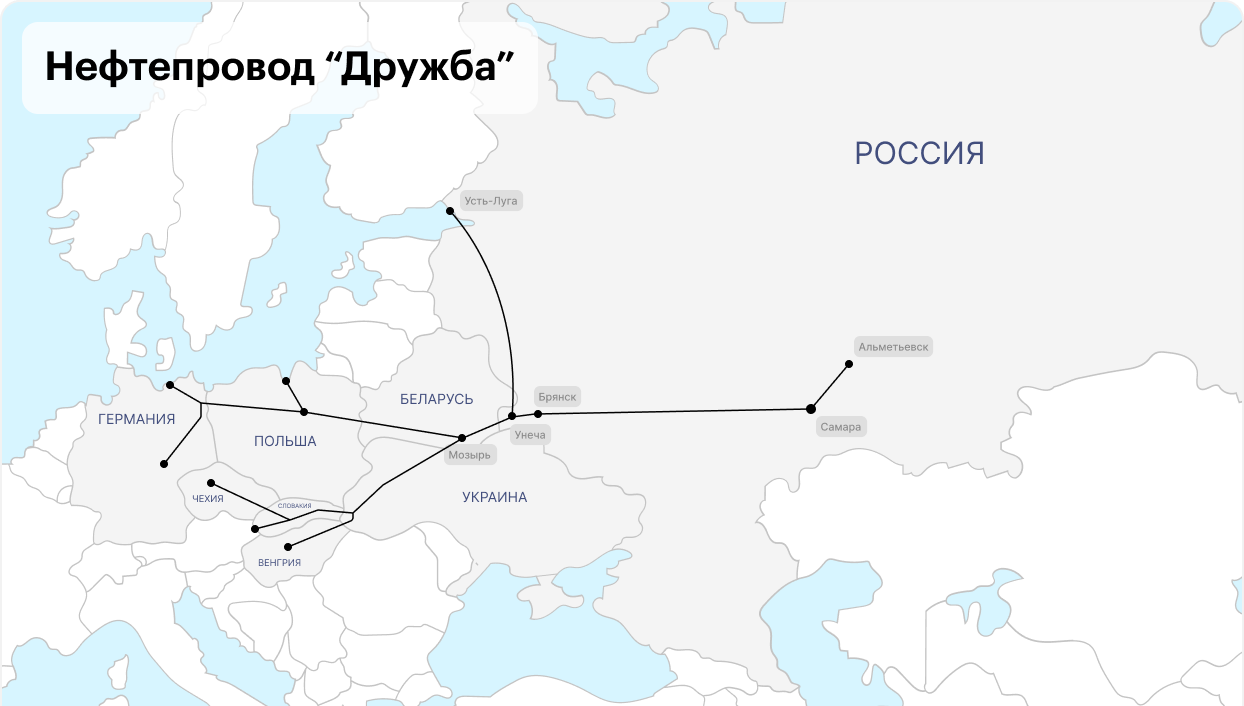
Due to sanctions imposed by the EU, Russian oil supplies via the northern branch of the Druzhba pipeline were effectively halted in 2022. In the southern direction, exports continued only to Hungary and Slovakia. In the spring of 2025, the Czech Republic completely abandoned Russian raw materials and, according to statements by the authorities, is not considering a return to Russian energy sources.
Additional risks for the southern branch of Druzhba emerged in January 2026: Ukraine reported damage to pipeline equipment in the west of the country as a result of a strike by a Russian drone and halted oil pumping to Hungary and Slovakia. Supplies via the pipeline have not yet been restored, forcing Russia to reallocate the freed-up volumes toward maritime logistics: in February, approximately 200,000 barrels per day—which had previously gone to Hungary and Slovakia—were redirected to tankers.
Ports Under Fire
The port of Primorsk, where the Transneft terminal is located, remains Russia’s largest oil hub on the Baltic Sea. In 2025, more than 46.6 million tons of oil were transshipped through it, including via the so-called “shadow fleet.”
On the night of March 23, 2026, Ukraine attacked Primorsk. According to preliminary data, both the tank farm and the oil loading infrastructure were damaged. Due to the fire, the port was forced to suspend shipments. As of Tuesday evening, the fire had not been brought under control.
On the night of Wednesday, Ukraine attacked another Russian port on the Baltic Sea—Ust-Luga. This is one of the key export hubs through which oil, naphtha, fuel oil, jet fuel, and diesel are transshipped. A fire broke out at the port following a series of explosions.
On the Black Sea, Novorossiysk remains the key port for Russian oil exports, with a throughput capacity of over 40–50 million tons per year. The main destinations for shipments are European countries (via the Mediterranean Sea) and Asian markets. On the night of March 2, the port was struck by drones, and reports indicated damage to the Sheskharis oil terminal. The previous attack on this facility was recorded in November 2025.
According to estimates by market analysts, total Russian oil exports from ports on the Baltic and Black Seas in March could drop to 1.7 million barrels per day—the lowest level since the start of the war.
The Shadow Fleet: A Game Without Rules
Following Russia’s full-scale invasion of Ukraine in 2022, Western countries announced a price cap of $60 per barrel on Russian oil transported by sea. In response, Russia and its affiliated players began buying up old tankers to circumvent these restrictions in international waters. Later, these vessels would be dubbed Russia’s “shadow” fleet. To trade sanctioned oil, the tankers disable their vessel identification systems, falsify their location data, and sail under the flags of other countries. It is difficult to say exactly how many such tankers Russia is using today. According to some estimates, there are about a thousand.
EU countries, the UK, and the US are trying to combat Russia’s “shadow” fleet using available mechanisms. For example, they track vessels that Russia uses in “gray” schemes and add them to the sanctions list. For instance, the EU’s list already includes about 600 such tankers, and it is constantly growing.
International maritime law does not authorize the detention of such tankers in international waters, but this is possible in the territorial waters of EU countries, and France has already carried out several detentions of tankers carrying Russian oil. Earlier, the U.S. military seized at least nine tankers linked to Russia.
Russia has threatened to resort to military action if NATO countries block its tankers in the Baltic Sea, stated Nikolai Patrushev, Assistant to the President of the Russian Federation and Chairman of the Maritime Council. He called the concept of a shadow fleet a “legal fiction,” and described all attempts to obstruct such trade as “absolutely illegal under international law.”
Official Russian and Belarusian sources cited in this text are for informational purposes only. Content from these sources may constitute disinformation or propaganda.