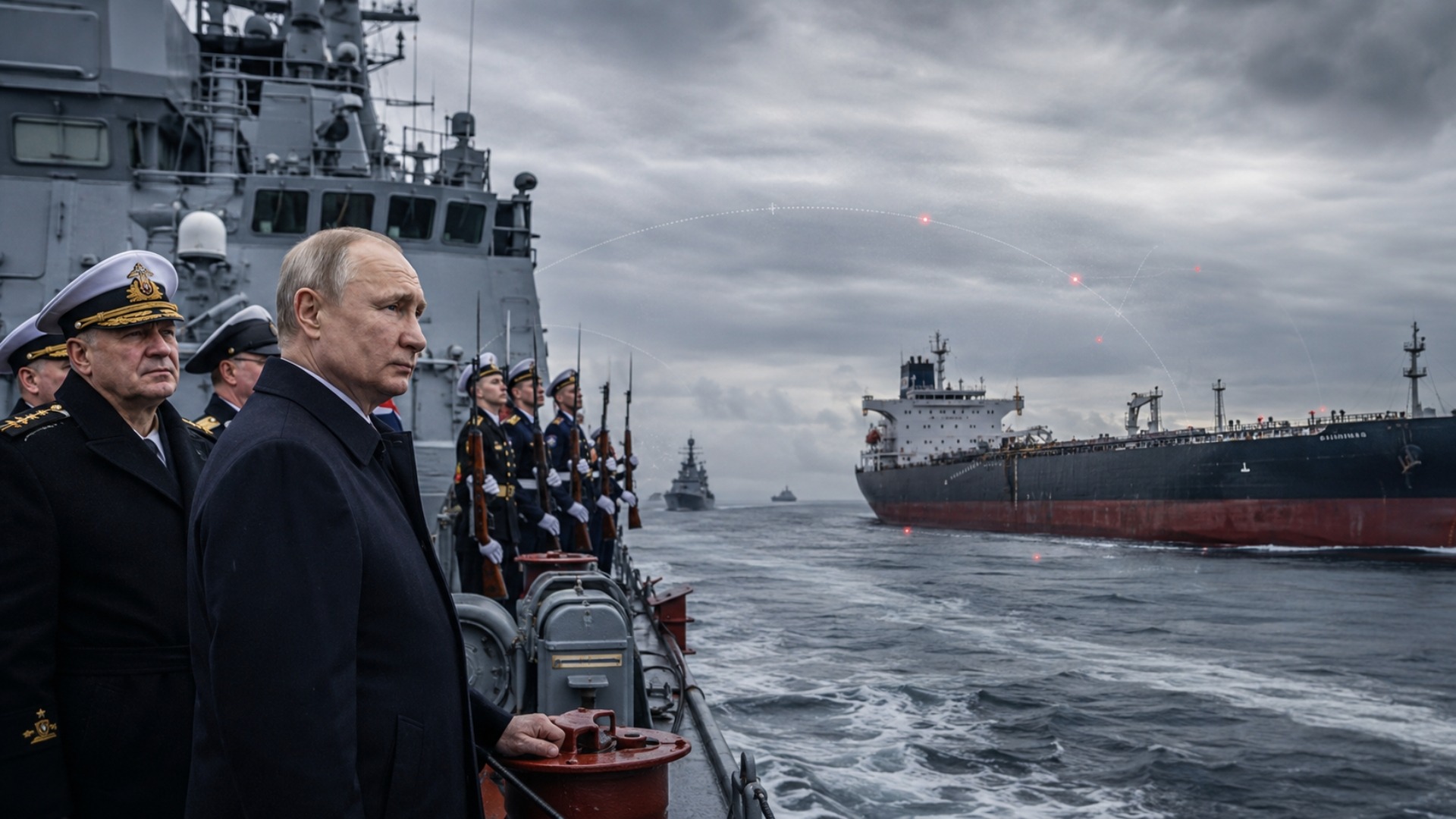

Vladimir Putin has promised a ‘mirror response’ if Western countries begin seizing vessels linked to Russian trade. He did not mention sinking them: the threat is intended to deter Europe from enforcing sanctions, on which Russian oil export revenues depend.
In brief
- On 12 August, aboard the cruiser ‘Varyag’, Putin made a conditional statement regarding retaliation. He instructed the Ministry of Defence to prepare appropriate proposals.
- Admiral Viktor Liina, Commander of the Pacific Fleet, declared his readiness to carry out inspections and detain vessels from states that Russia considers ‘unfriendly’.
- The EU has imposed restrictions on 673 vessels in Russia’s shadow fleet. However, placing a vessel on the sanctions list does not automatically grant the right to board it on the high seas.
- The inspections of the tankers South Star and Toa Payoh were linked to suspicions of flying a false flag; these were not seizures. The British detention of the Smyrtos was on different grounds and resulted in criminal charges being brought against the captain.
- Oil and gas account for around a fifth of Russia’s federal revenue. Sanctions increase trading costs, but China and India continue to receive the bulk of Russian oil.
- The most likely scenarios are escorting, putting pressure on crews and selective attempts at detention. An attack on a properly marked merchant vessel on the high seas would represent a significantly higher threshold for escalation.
What exactly did Putin say?
The Russian President spoke on 12 August aboard the missile cruiser ‘Varyag’, whilst observing Pacific Fleet exercises off the coast of Sakhalin Oblast. In the Kremlin transcript, he described the planned seizure of Russian vessels and the sale of confiscated property as “piracy and robbery”. “If this is put into practice, we will be forced to respond in kind,” he said. Russia would also have to act beyond the waters where the initial incident took place.

The statement refers to retaliatory measures against shipping, but does not specify their form. Putin did not announce the sinking of tankers, missile strikes or war with Europe. Instead, he stated that the Ministry of Defence had been instructed to prepare proposals; the same instruction was also given to the Pacific Fleet. This is more than mere rhetorical improvisation, but it is still not an order to seize vessels nor a set of rules of engagement.
Admiral Viktor Liina replied that the fleet may inspect and detain vessels from ‘unfriendly states’. According to him, between 24 April and 6 August, 1,001 vessels passed through Russia’s exclusive economic zone near the southern Kuril Islands, including 379 flying the flags of states that Moscow considers hostile. These figures come from the Russian command, not from an independent traffic survey. Furthermore, an exclusive economic zone does not grant the coastal state jurisdiction equivalent to that of territorial waters.
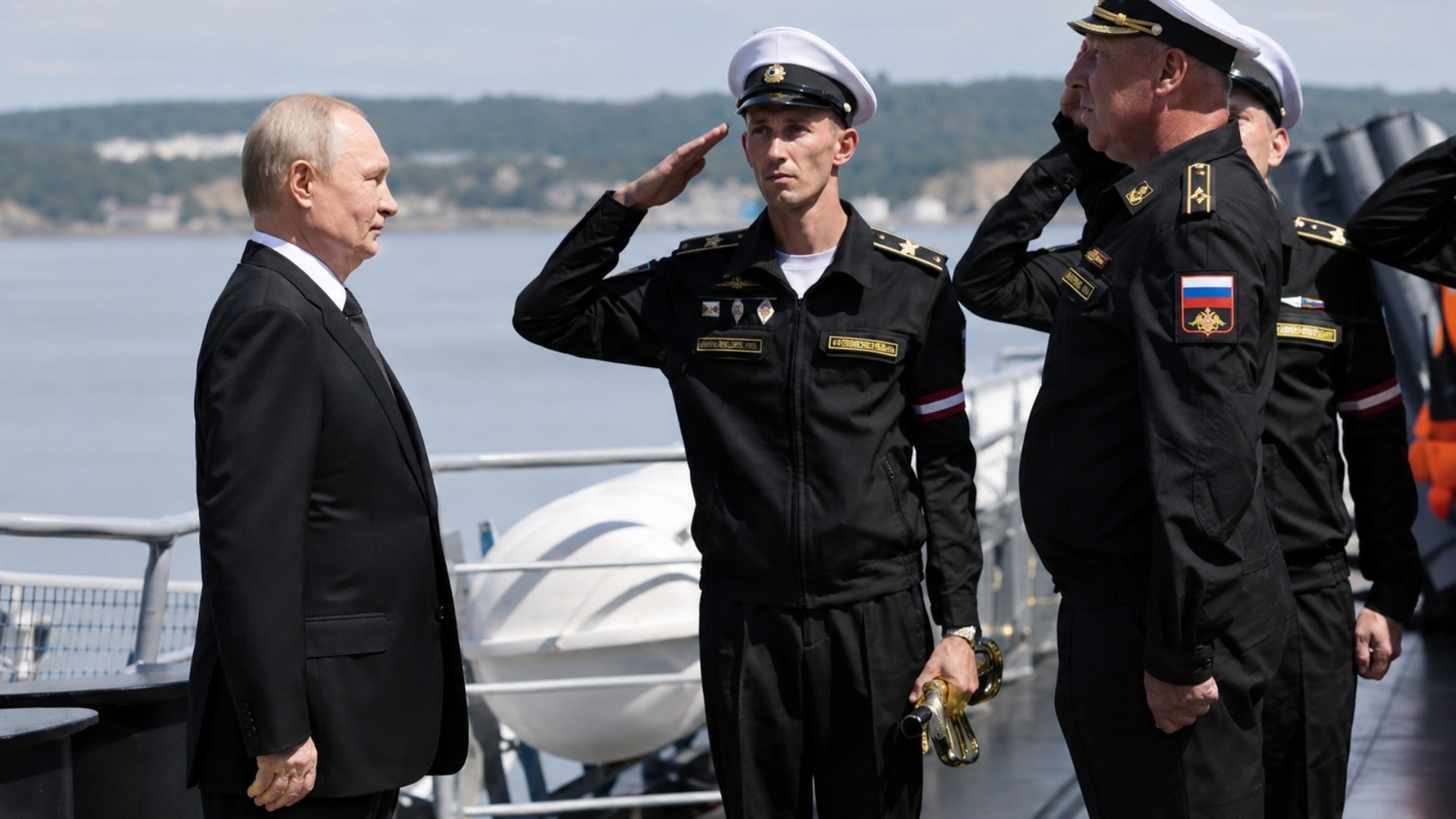
The Russian response was coordinated — the Russian Foreign Ministry condemned the inspections carried out as part of the EU’s Operation IRINI. Dmitry Medvedev went further: he wrote on X and MAX that Russia has the right to ‘attack’ vessels in its own or ‘neutral’ waters if it suspects they are transporting cargo for the enemy. This is an escalation of the threat, not an announcement of the start of an operation; ‘neutral waters’ are not a clear-cut legal category in this context.
Inspecting a vessel does not mean confiscating it
The Russian narrative blurs the distinctions between boarding, detaining and seizing a vessel. Meanwhile, the latter three cases have different factual circumstances and legal grounds.
On 20 July, IRINI forces boarded the South Star (IMO 9263186), which was suspected of flying a false flag, in order to verify its nationality. On 2 August, a similar procedure was applied to the Toa Payoh (IMO 9298492) west of Pantelleria. The Italian Ministry of Defence reported that the basis for the action was Article 110 of the United Nations Convention on the Law of the Sea. The two-hour inspection did not result in any seizures; IRINI did not have such a mandate.

The case of the Smyrtos (IMO 9389100) is different. On 14 June, British military personnel boarded the tanker in international waters and detained it for investigation. According to Lloyd’s List, the Cameroonian register had previously struck the vessel off its roll, which could have provided grounds for considering it stateless; the authorities’ statements do not contain a full legal assessment. The National Crime Agency reported that the captain had been charged with supplying prohibited Russian oil to a third country.

Placing a vessel on the list may entail a ban on entering port, receiving services or carrying out transactions. It does not confer a general right to detain the vessel on the high seas. A separate basis is required: the consent of the flag state, a provision in a treaty, the statelessness of the vessel, or port or territorial jurisdiction.
Why the Russian definition of ‘piracy’ is misleading
The Convention on the Law of the Sea generally leaves vessels on the high seas under the exclusive jurisdiction of the flag state. Article 110 permits a warship to carry out an inspection, in particular, on the basis of reasonable suspicion of piracy, the slave trade, unauthorised broadcasting, lack of nationality, or passing itself off as a vessel flying another flag. Therefore, suspicion of false registration carries significance that the mere fact of being included on a sanctions list does not.
Piracy, as defined in Article 101, involves actions undertaken for private gain by the crew of a private vessel against another vessel on the high seas or outside the jurisdiction of states. An operation by naval forces acting on the orders of a state does not meet this definition. In Putin’s rhetoric, ‘piracy’ is a political, rather than a legal, classification.
This does not mean that every detention by the West is lawful: the decisive factors are the location, the flag, the vessel’s conduct and the extent of the sanctions. Russia’s attempt to detain a duly registered vessel solely on the grounds of its Western cargo has no basis under Article 110. On the high seas, this would violate the principle of the flag state’s jurisdiction and the freedom of navigation; further classification would depend on the force used.
Why the Kremlin defends the shadow fleet
The ‘shadow fleet’ is not a cohesive formation under Russian command. It is a network of tankers, intermediaries, opaque companies, registries and insurers. Indicators of risk include frequent changes of name and flag, manipulation of AIS data, ship-to-ship transfers and insurance policies that are difficult to verify. Not every one of these practices is illegal, but their combination can conceal the owner, the origin of the cargo or breaches of sanctions.
It is estimated that the Russian shadow fleet comprises 1,400–1,500 tankers with weaker insurance cover; similar networks are used by Iran and Venezuela. Sanctions lists are more limited. Following the 21st package, the EU imposed restrictions on 673 vessels. In April, the UK had 544 vessels on its list, whilst the US applies asset freezes against vessels and operators designated by OFAC. These regimes overlap but are not identical.
The G7 price cap does not prohibit everyone from buying Russian oil. It denies coalition companies access to transport, financing and insurance if the crude is sold above the set threshold. The EU lowered the cap in 2025 from 60 to $47.60 per barrel; adjustments have been suspended until July 2027. The shadow fleet reduces Moscow’s dependence on these services at the cost of more expensive freight, financing and greater risk.
Sanctions increase the cost of the war, but have not halted exports
Revenues from oil and gas remain key, but do not constitute the majority of the Russian budget. The plan for 2026 envisaged 8.92 trillion roubles in oil and gas revenues out of total revenues of 40.28 trillion roubles, i.e. around 22 per cent. Data from the Russian Ministry of Finance, cited by Reuters, nevertheless indicate significant volatility: in 2025, revenues from this source fell by 24 per cent, and in the first five months of 2026 were approximately 30 per cent lower than a year earlier.
The pressure has not halted the flow of oil. According to a July analysis by the Centre for Research on Energy and Clean Air, 53 per cent of Russian seaborne exports were transported by sanctioned tankers in the shadow fleet, whilst 42 per cent were carried by vessels under the jurisdiction of G7 countries and their partners. This reflects both the scale of the circumvention of restrictions and the extent of Russia’s vulnerability in ensuring compliance with the price cap.

First and foremost, the geography of trade has changed. The US Energy Information Administration estimated that in the first half of 2025, Russia exported 4.3 million barrels of oil and condensate per day, compared with 4.8 million in 2024. China received around 2 million barrels per day, India 1.6 million, whilst Europe’s share fell to 11 per cent. China is the largest market, but not automatically a buyer for every Russian operation. This relationship is asymmetrical: Moscow needs Asian buyers more than they need a single supplier.

A series of detentions will not stop the funding of the war. However, it may widen the discount on Russian oil, increase insurance costs and transit times, take high-risk vessels out of service, and force Moscow to deploy military ships to protect trade. It is precisely this rise in costs that explains the Kremlin’s sharp reaction.
What the Russian Navy can do without an open war
According to the Russian Ministry of Defence, around 60 ships, submarines and support vessels, 30 aircraft and over 13,000 military personnel took part in the Pacific Fleet exercises. The manoeuvres covered the Sea of Japan, the Sea of Okhotsk and the north-western Pacific Ocean. They demonstrate the ability to escort and board vessels near their own bases, rather than to maintain constant control over several remote waters.
Russia has already crossed the lowest threshold: its warships are escorting individual tankers, whilst the Royal Navy is recording an increase in activity by Russian vessels. The next stages involve surveillance, radio calls, obstructing movement, exerting pressure on the flag state, or inspecting a vessel of unclear status. These measures make it possible to increase the risk to the shipowner without crossing the threshold of open confrontation.
Russia may also disrupt navigation and conduct information operations, but there is no evidence that a decision has been taken to apply these measures against a specific vessel. The armed seizure of a properly marked vessel on the high seas would risk an exchange of fire and a reaction from the flag state. Its NATO membership would not trigger an automatic invocation of Article 5; the allies would assess the circumstances of the attack.
The Pacific demonstration does not address vulnerabilities in the Black Sea
The ‘Varyag’ and the Pacific Fleet are intended to demonstrate that Russia can shift the pressure beyond Europe. This does not negate the consequences of the Ukrainian naval campaign. Following missile and drone attacks, Russia transferred many valuable ships from occupied Sevastopol to Novorossiysk, as a Russian official acknowledged in 2024. Carnegie points out a reduction in the fleet’s ability to carry out long-range strikes and amphibious operations, as well as its diminished freedom of manoeuvre.
The Black Sea Fleet, however, has not ceased to exist: it has retained its ships, aircraft, coastal defences and ‘Kalibr’ missiles. Local superiority and a readiness to escalate are sufficient to exert pressure on unarmed shipping. Protecting global trade would require forces already dispersed around the world, logistics and access to ports, which Moscow does not possess in every region.
The Pacific Ocean sends an additional signal. Japan has protested against military exercises near the disputed Southern Kuril Islands, whilst Moscow had previously threatened to retaliate against the deployment of Typhon systems in Japan. At the end of July, Russia and China concluded a joint patrol lasting more than two weeks. At the same time, Beijing criticised Japan’s defence ‘white paper’ for its description of activities around Taiwan, regarding the issue of the island as an internal matter for China.
This convergence of events increases the pressure on Tokyo, but does not prove that Beijing will support the Russian detentions. China has an interest in maintaining maritime trade and has not announced any participation in retaliatory measures. The joint exercises confirm military coordination, not a joint decision to carry out an operation against civilian shipping.
Where does the threshold for further escalation lie?
Putin’s threat is altering the calculations of shipowners and European states, as it shifts the dispute over sanctions from law firms to the decks of ships. It also provides Russian commanders with a political justification for preparing options for escorting and detaining vessels. However, this does not prove that the Kremlin has selected a target, established a legal basis or agreed to the use of force.
The real test will be the first Russian intervention carried out following this statement: its location, the status of the flag, the crew’s behaviour and the measures taken. An inspection of a stateless vessel would be an attempt to exploit an existing loophole in maritime law. The detention of a duly registered vessel solely on the grounds of its Western cargo would signify an attempt to impose Russian ‘symmetry’ by force — and a shift from deterrent rhetoric to the direct undermining of freedom of navigation.
Author: Artur Żak
Official Russian sources are cited solely for informational purposes. The information they publish may contain elements of disinformation or serve as a propaganda tool.