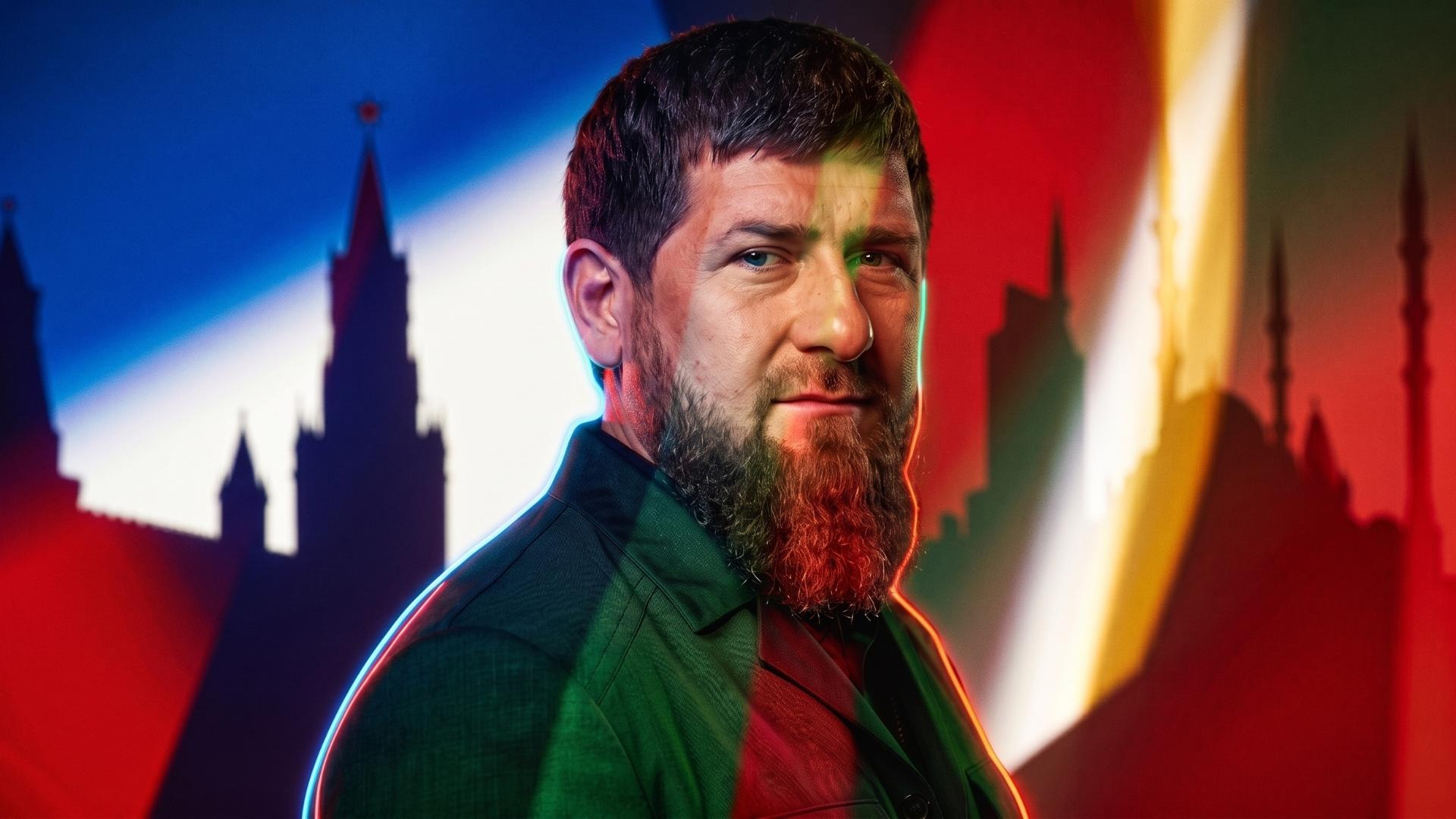

Ramzan Kadyrov has used Russia’s full-scale war against Ukraine to greatly expand the security structures that remain under Grozny’s strong influence, and the Kremlin’s Chechen gauleiter now claims 36,243 authorised posts. Recruitment from outside Chechnya, coercion and the promotion of his sons point to an effort to preserve a loyal core and prepare the clan for succession, but they do not amount to direct proof of a ready-made plan for Russia after Putin.
In brief
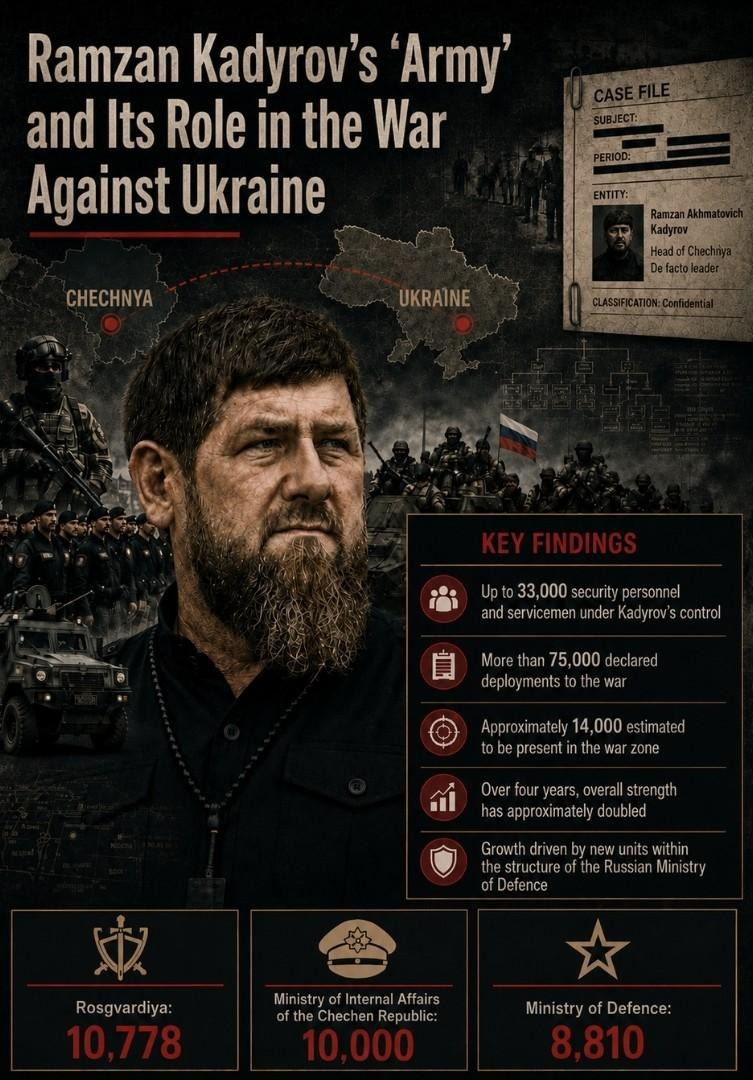
- Kadyrov has declared a total of 36,243 authorised posts. These are federal formations; it is not known how many posts are actually filled.
- Memorial has reconstructed around 29,600 relatively well-documented authorised posts, rising to 33,200 once less certain positions are added. The data point to a substantial increase.
- ‘Akhmat’ does not mean Chechens. In parts of the volunteer system, recruits from other regions predominated, and the figures for those ‘sent’ include rotations and successive contracts.
- Forced recruitment is confirmed by several independent sources. At the same time, some ‘Akhmat’ units take part in heavy fighting and suffer casualties.
- The careers of 20-year-old Akhmat and 18-year-old Adam show preparations for succession, but the law requires a candidate for head of Chechnya to be 30 years old.
36,243 authorised posts, but not a private army
The figure is accurate as a quotation, but not as a verified personnel count. On 25 March 2025, Kadyrov reported that as of 1 February the ‘authorised strength’ of the republic’s security structures stood at 36,243. It is not known how many posts were filled, how many personnel could be deployed in combat or how many of them were Chechens.
Kadyrov himself compared this figure with 4,800 authorised posts in 2003. A span of that length, however, takes in the republic’s post-war reconstruction, the creation of formations for the invasion and the expansion of the police and Rosgvardia. The comparison shows the scale of political ambition, not the rate of growth since February 2022.
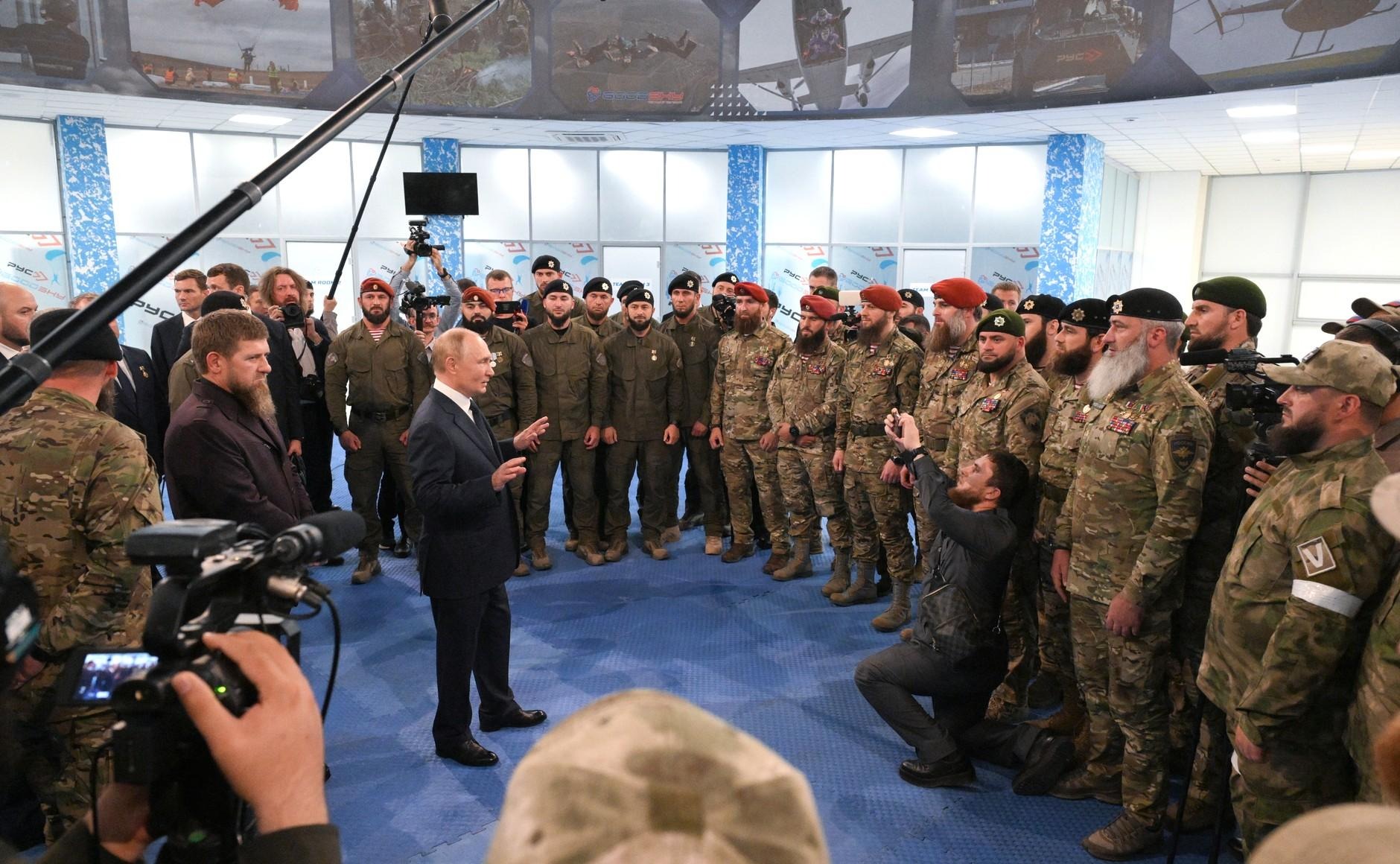
This is not a single formation with a separate Kadyrov budget. The regiments and battalions formally belong to Rosgvardia, the Russian Ministry of Defence or the Russian Ministry of Internal Affairs. Moscow sets the authorised establishment, pays the salaries and retains legal instruments of control. Grozny contributes the selection of personnel, patronage and a personal chain of loyalty consolidated over the years.
‘Kadyrov’s army’ can therefore only be shorthand: federal formations under the strong political and personal influence of the head of Chechnya. Neither purely private nor simply federal. In this respect, Russian federalism can be as inventive as its statistics.
The Memorial Human Rights Centre reconstructed around 29,588 relatively well-documented authorised posts, rising to 33,188 when estimated positions are included. The authors caution that some formations are difficult to track and that an authorised post does not mean a person in barracks.
That caution is well founded. In November 2022, more than a thousand vacancies were reportedly still open in Chechen federal structures; in other cases, it was not possible to confirm that a unit had reached its declared strength. We therefore know the administrative outline of the system better than its actual readiness.
Before the invasion, the apparatus was estimated at 16,000–18,000 personnel. That may not be the same category as today’s figure of 36,243. The cautious conclusion is that since 2022 the nominal scale of the system has grown substantially and has probably come close to twice the earlier estimates.
The war gave Kadyrov new regiments and federal funding
After 2022, new formations included the 78th ‘Sever-Akhmat’, 349th ‘Akhmat-Rossiya’ and 1434th ‘Akhmat-Chechnya’ regiments, formally subordinated to the Ministry of Defence; three regional battalions; and the 204th ‘Akhmat’ Special Regiment. Rosgvardia received a battalion named after Baysangur Benoyevsky. Older formations also remain active, including the 141st ‘Sever’ Regiment, OMON and SOBR.
The Kremlin needed manpower and images of mobilisation. Kadyrov presented the new formations as proof of his loyalty to Putin while simultaneously increasing the number of armed posts filled within a system that answers to Chechen commanders. Moscow financed a force that serves at the front, stabilises the region and strengthens the position of its leader.
Federal subordination remains a safeguard: the centre can change commanders, funding and missions. In a crisis, however, the effectiveness of these tools would depend on whether people whose careers and families are tied to Grozny would carry out an order from Moscow. The essence of the system lies in that tension.
The federal budget foots the bill. In 2024, non-repayable transfers accounted for around 78.8 per cent of Chechnya’s revenue: 149 billion roubles against 37 billion raised by the republic itself, as The Moscow Times calculated. For 2026, the equalisation grant alone was budgeted at 58.93 billion roubles. Kadyrov’s power today is therefore financially intertwined with Russia – an important argument against the secession thesis.
Not all federal money flows through the republic’s budget. The salaries of some soldiers and law-enforcement personnel are paid directly by ministries in Moscow. That is precisely why the expansion of the apparatus can simultaneously increase Kadyrov’s local power and the Kremlin’s financial leverage.
Who is really fighting under the ‘Akhmat’ banner?
Statements from Grozny have conflated residents of Chechnya, local law-enforcement personnel, soldiers from ‘Akhmat’ units and volunteers trained in Gudermes. The word ‘Chechen’ has migrated from the name of a unit to everyone in uniform. That is convenient for propaganda, but analytically wrong.
According to the Chechen authorities, more than 75,000 people have been sent to the war. Memorial estimated that in January 2026 about 14,000 people linked to various Chechen structures were there at any one time. The first figure is the cumulative total of deployments: it counts rotations and successive contracts signed by the same individual. It does not mean 75,000 unique soldiers.
Novaya Gazeta Europe established that, in the first group it analysed from spring 2022, 908 of 928 people came from Chechnya. In the next, 388 of 1,496. By summer, around 80 per cent of recruits in the volunteer segment it studied were coming from outside the republic. This proportion must not be extrapolated to all ‘Akhmat’ units. It does, however, show that the label remained Chechen while the personnel pool was opened to all of Russia.
In 2024, Alaudinov himself said that the segment under his command was around half Russian, a quarter Chechen and a quarter drawn from other nationalities. This was the commander’s own statement, not an independent count, but it confirms the direction of change: ‘Akhmat’ had become a recruitment brand larger than the republic.
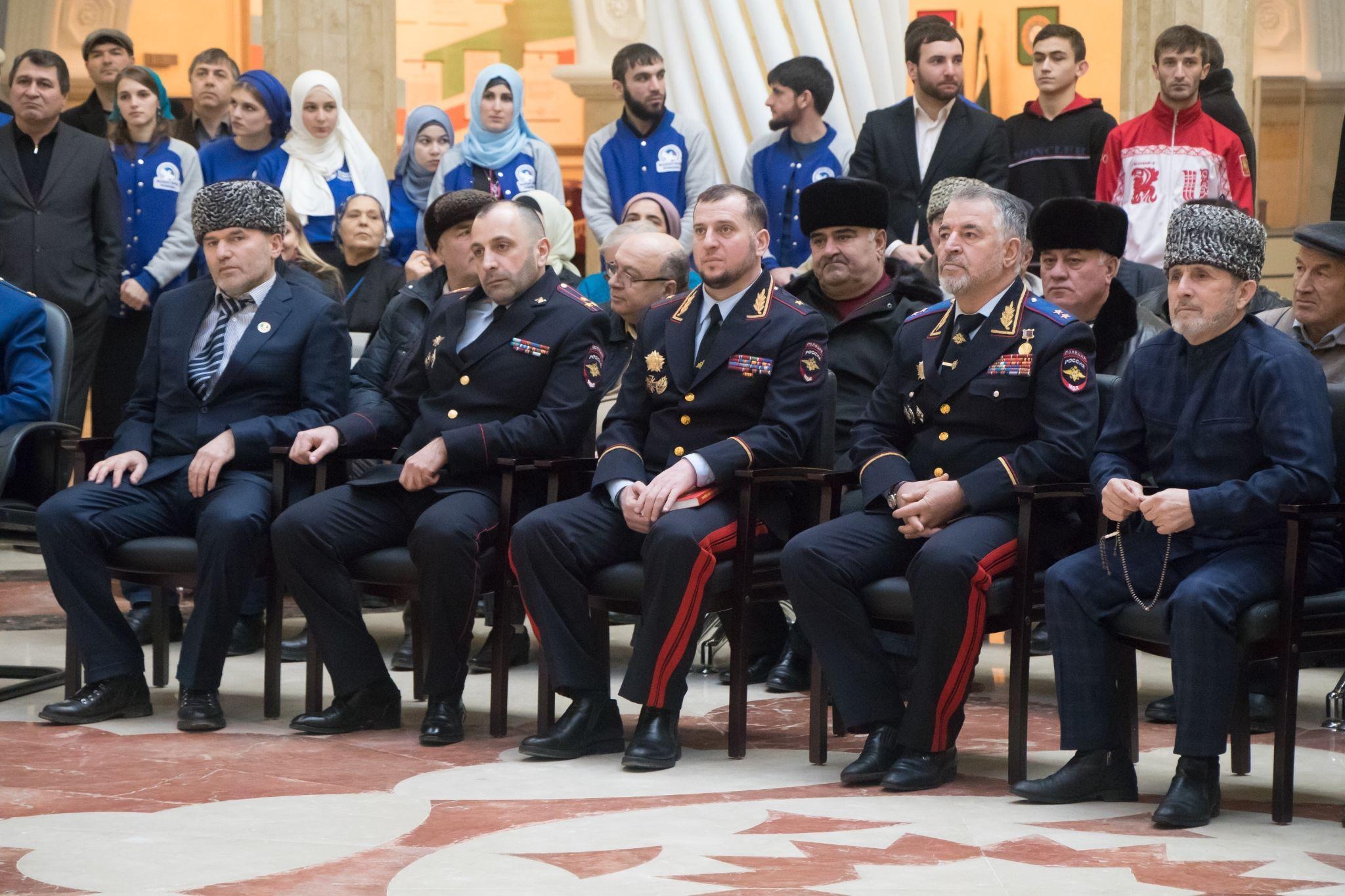
The mechanism supplied the Kremlin with soldiers, gave Grozny political capital and may have reduced the need to send people embedded in the local coercive apparatus. A recruit from outside Chechnya is no worse a soldier, but is less deeply rooted in the system that controls the republic.
Gudermes is recruiting fewer and fewer people
Magomed Daudov’s figures show a decline in the number of contracts: more than 9,000 from April to December 2022, around 6,000 in 2023, 5,400 in 2024, 3,374 in 2025 and 1,016 in the first four months of 2026. These are contracts, not necessarily new recruits. Novaya Gazeta Europe found cases of fifth and sixth rotations, each preceded by a new contract.
The trend is nevertheless clear. The pool of willing recruits is shrinking as awareness of the risks at the front grows. Gudermes remains an all-Russian recruitment hub, but returning soldiers increasingly keep the numbers up. More authorised posts are not generating a correspondingly large flow of new recruits.
In Chechnya, coercion is making up the shortfall in voluntary enlistment. Important Stories has described detentions and threats against families, while Kavkaz.Realii has reported pressure on public-sector employees. The details differ, but several sources confirm the same pattern: detention or loss of employment is being used as a recruitment tool.
Novaya Gazeta Europe spoke to 178 families of 183 men killed in action. Of the 113 men sent to the front from October 2024, the relatives of 97 said the contract had been forced on them. The publication also documented 67 round-ups between autumn 2024 and spring 2025. These figures do not amount to a complete count for the republic, but the abuses can no longer be described as isolated.
The exact monthly quotas imposed on police stations, the sums demanded for detainees’ release and the size of individual round-ups are less well substantiated. These details rest on the reporting of a single newsroom. The coercive mechanism itself rests on much stronger evidence than any of its numerical illustrations.
Coercion and external recruitment make it possible to obtain personnel without proportionately depleting the politically most valuable core. This does not mean that the ‘real Kadyrov loyalists’ stayed in barracks. The visible pattern, however, is consistent with allocating risk according to a person’s usefulness at the front and in maintaining control of Chechnya.
The losses are real, but the public tally does not capture them
By 5 August 2026, Kavkazsky Uzel had identified 265 people from Chechnya killed in the war, compared with 2,061 from Dagestan. This does not prove that Chechen losses are eight times lower. The project counts publicly confirmed deaths, whereas in Kadyrov’s republic an obituary is politically unwelcome information and families are under intense pressure.
Mediazona notes that its name-by-name database is incomplete and that information sometimes reaches it years later. With ‘Akhmat’, there is an added labelling problem: a resident of the Urals serving in a unit with a Chechen name should be counted by origin, not by the patch on his uniform.
Estimates that more than two thousand residents of Chechnya have been killed remain the claims of individual media outlets. The publicly documented figure of 265 is a lower bound, not a final toll; the degree of undercounting is unknown.
The full losses among recruits from outside the republic fighting under a Chechen label are also unknown. Attributing them to Grozny would inflate the ‘Chechen’ toll; attributing them only to their regions of origin would obscure the way Kadyrov supplies personnel for the war. Two counts are therefore needed, but no complete version of either is publicly available.
Kadyrov’s forces fight, but the risk is not evenly distributed
Any picture of ceremonial second-line units would be false. Forces linked to Grozny fought near Hostomel and Mariupol, in the Donbas and in Kursk Oblast. Apti Alaudinov’s ‘Akhmat’ unit does conduct combat operations, as does the 78th ‘Sever-Akhmat’ Regiment, which has suffered heavy losses. Kadyrov therefore does not send only other people’s men, nor does he always keep his own away from the line of fire.
Memorial nevertheless assesses that the main burden of regular combat has fallen on Alaudinov’s volunteer formations, many of them recruited outside Chechnya. Many Rosgvardia and Ministry of Internal Affairs units performed security or policing duties. This pattern is consistent with protecting the personnel most useful for controlling the republic, although it does not prove that a single plan to conserve cadres exists.
Alaudinov must also be separated from the simplistic image of a private commander in Kadyrov’s service. He has his own ties within the federal apparatus and commands a mixed pool of contract servicemen. It is not known to what extent Grozny could control him in a dispute with Moscow. This is another reason not to present the 36,243 authorised posts as a monolithic force.
After Ukrainian forces entered Kursk Oblast, Alaudinov confirmed that five soldiers from the 1434th ‘Akhmat-Chechnya’ Regiment had been taken prisoner. This does not prove that the entire formation fled; subsequent fighting by ‘Akhmat’ in that sector is documented.
During the Wagner Group mutiny, Kadyrov called it ‘a knife in the back’ and announced that he would deploy his forces. The Chechen columns, however, did not clash with Wagner fighters in Rostov. Logistics, the winding down of the mutiny or reluctance to take the risk may have been decisive. The episode showed the value of Kadyrov’s forces during a crisis at the centre; it did not amount to a set of instructions for using them against Moscow.
The Baysangur Battalion: a reserve closer to Grozny
Formed in 2023, the Rosgvardia battalion named after Baysangur Benoyevsky is stationed in Grozny and is well equipped, and Adam Kadyrov has been seen around the unit. It is commanded by Bechan Chalayev.
Memorial puts its nominal strength at around 300 men. Publicly available material shows modern weaponry and strong symbolic trappings, but does not allow its training or its actual manning level to be assessed. Adam’s proximity is politically telling, but it does not replace Rosgvardia’s formal chain of command.
According to Novaya Gazeta Europe, the unit’s publicly documented presence in the war was limited to two small deployments: around 20 men in spring 2024 and another contingent in August 2025. The Sheikh Mansur Battalion, formed at roughly the same time, was sent to the front as early as December 2023.
Baysangur may serve as an internal-security reserve and a place to develop personnel for the family’s younger generation. This remains a hypothesis, not evidence of a secret plan for succession or secession. What the public data mainly show is that different units have been exposed to the front to differing degrees.
Akhmat and Adam enter the family power structure
In November 2023, Akhmat Kadyrov became First Deputy Minister for Sport and Youth Policy; in February 2024, Minister for Youth Affairs; and three months later, Minister of Sport. Since January 2026 he has combined the ministerial portfolio with the post of Deputy Chairman of the Government, as his official profile confirms. This is the civilian track: budget, personnel, youth and representation of the authorities.
Adam was given the security track. At 15, he became head of his father’s security detail; later he was made curator of the Special Forces University in Gudermes and of the republic’s Ministry of Internal Affairs. In April 2025, he became Secretary of Chechnya’s Security Council. Reuters noted that this was his fourth official role since 2023; Chechen statements also style him as an aide to the head of the republic. The extent of his authority remains debatable; his access to commanders is a fact.
Proekt identified 96 of Kadyrov’s relatives holding positions in the state or in businesses linked to the authorities – the highest number among the 1,329 Russian officials examined. The broad methodology does not mean 96 members of a single staff; it shows the scale of the family network.
In 2026, the promotions were accompanied by an accelerated effort to build prestige. Adam was awarded the title Hero of Chechnya for a second time in June, while Akhmat received the same honour on 7 August. Medals do not confer competence. In Kadyrov’s system, however, they build a public biography that politically compensates for youth and lack of experience.
The pace of appointments is one of the strongest pieces of evidence that preparations for succession are under way, although it does not identify a successor. It resembles a division of portfolios: Akhmat is gaining executive experience, while Adam is accumulating positions within the security apparatus. Formal office and access to coercive power reinforce each other.
Why Kadyrov’s son will not immediately take over Chechnya
Under the Electoral Law of the Chechen Republic, a candidate for head of the region must be 30 years old. Akhmat is 20, Adam 18. If Ramzan Kadyrov were suddenly to leave office, neither could legally take his place.
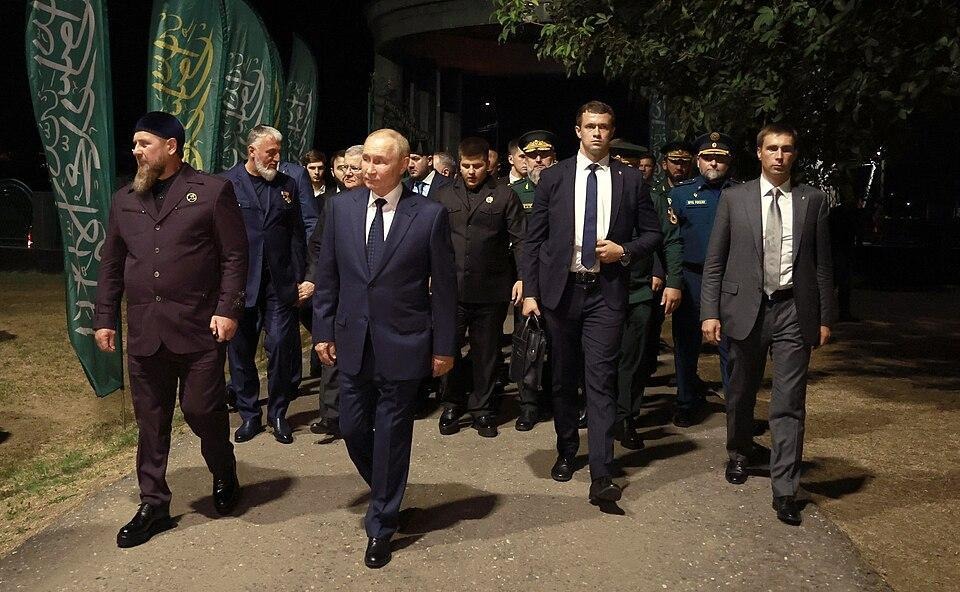
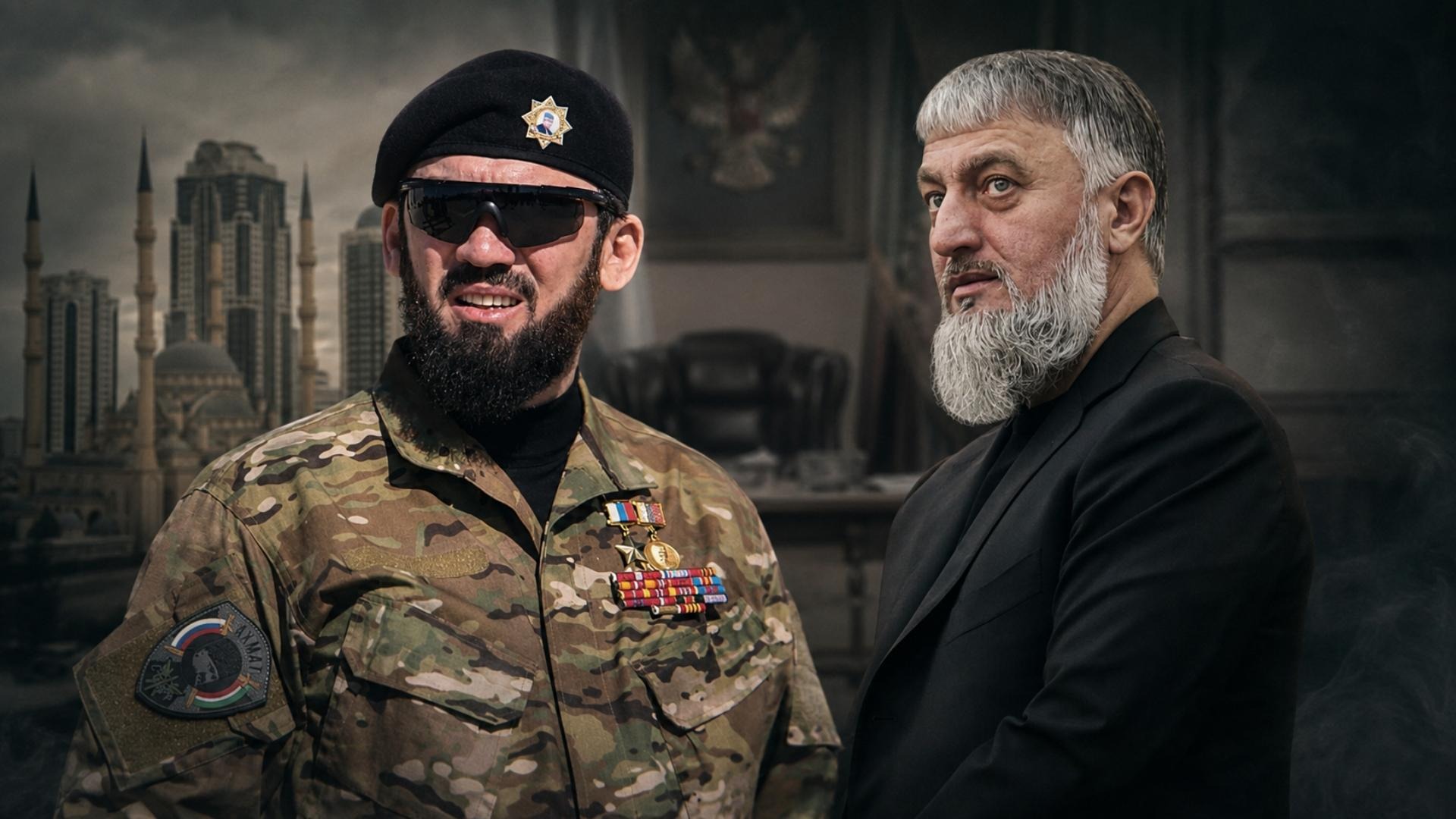
A temporary regency is therefore a logical scenario: a senior member of the elite, such as Magomed Daudov or Adam Delimkhanov, would formally run the republic until the successor reached the required age. There is, however, no public document or credible account indicating that such an arrangement has been agreed with the Kremlin.
The appointments have been accompanied by repeated reports about Kadyrov’s health. Novaya Gazeta Europe based a specific diagnosis on anonymous sources; later information from Ukrainian intelligence likewise lacks publicly available medical documentation. What we know is that there is uncertainty, not a confirmed diagnosis.
That distinction matters. Possible health problems strengthen the rationale for such preparations, but do not allow a date to be set for succession or establish that health is their sole driver. In an authoritarian family-based system, promoting relatives is an insurance policy even for a leader in full health.
Kadyrov is not leaving the stage, however. On 6 August 2026, he was registered as a United Russia candidate in elections scheduled for 20 September, after Putin’s public endorsement. He is grooming successors, but is still seeking another term for himself.
Russia after Putin: an insurance policy, not an operational plan
Most of the evidence supports the simplest explanation: Kadyrov is expanding the apparatus to protect the current regime. The next most plausible explanation is preparation for a family-clan succession. New formations, control over personnel and his sons’ careers fit both purposes without requiring the assumption that Grozny already has a map for Russia after Putin.
The case that he is increasing his negotiating autonomy vis-à-vis Moscow is also strong. Every regiment and the ability to recruit across Russia raise the cost of a conflict with Kadyrov. Federal funding and subordination, however, limit his freedom. He is strong within Putin’s system precisely because he is not independent of it.
A reserve for a future crisis in Russia remains a plausible but indirect interpretation. An apparatus capable of protecting Grozny, the family and key facilities would be invaluable if the centre ceased to issue effective orders. It could serve in negotiations with Putin’s successor or help ride out factional fighting. Its usefulness, however, does not prove the existence of an operational plan.
The separatist hypothesis is the weakest. There is no evidence of preparations for secession, a break with Moscow or independent supply lines. Federal posts, weapons, salaries and budgetary dependence all point against it. Kadyrov may be accumulating insurance against a weakening of the centre without intending to leave Russia. The insurance policy works best for as long as the Kremlin pays for it.
Russia’s war against Ukraine has strengthened Kadyrov’s security ecosystem and allowed the costs to be spread more widely across recruits from outside Chechnya, people forced into contracts and units more exposed at the front. Family preparations to preserve influence are also documented. We still do not know how many of the 36,243 authorised posts are filled, the full scale of losses, whether any decision on a regency has been taken or whether any plan exists for Putin’s departure. Kadyrov is accumulating capabilities useful in several kinds of crisis. This is more than propaganda about ‘Akhmat’s army’, but less than a ready-made scenario for Russia after Putin.
Author: Artur Żak
Official Russian and Belarusian sources cited in this text are for informational purposes only. Content from these sources may constitute disinformation or propaganda.