
or How Ukraine’s Traitors Came to Power and Who Helped Them
On March 29, 1998, Ukraine held its first parliamentary elections under a mixed system, as stipulated in the new 1996 Constitution of Ukraine. The key principle of the electoral system was 50/50. Under this principle, 225 deputies were elected through a proportional representation system in a single nationwide district from political parties and electoral blocs, while another 225 were elected through a first-past-the-post system in single-member districts. The electoral threshold for parties and electoral blocs was 4%. Thirty political parties and blocs participated in the elections, but only eight political forces managed to clear the 4% threshold.
The national democrats prepared diligently for the elections the People’s Movement of Ukraine led by Vyacheslav Chornovil, officials from Prime Minister Valery Pustovoytenko’s “ruling party” (NDP), the bloc of nostalgic Soviet-era sycophants led by Oleksandr Moroz and Oleksandr Tkachenko (SPU-SelPU), Pavlo Lazarenko’s “Hromada,” the first oligarchic party; the now-banned Communist Party of Ukraine (CPU) of the openly collaborationist traitor Petro Symonenko, who fled Ukraine at the start of the large-scale Muscovite invasion; as well as the “Progressive Socialists” (PSPU) led by Natalia Vitrenko, funded by Russian businessman Mikhail Kurochkin, and Viktor Medvedchuk’s SDPU(O), a party carefully disguised as the social democracy popular in Europe.
In short:
- In 1997–98, Transcarpathians helped lay the foundations in Ukraine for pro-Kremlin structures, which to this day remain the core of treason and a haven for modern-day collaborators
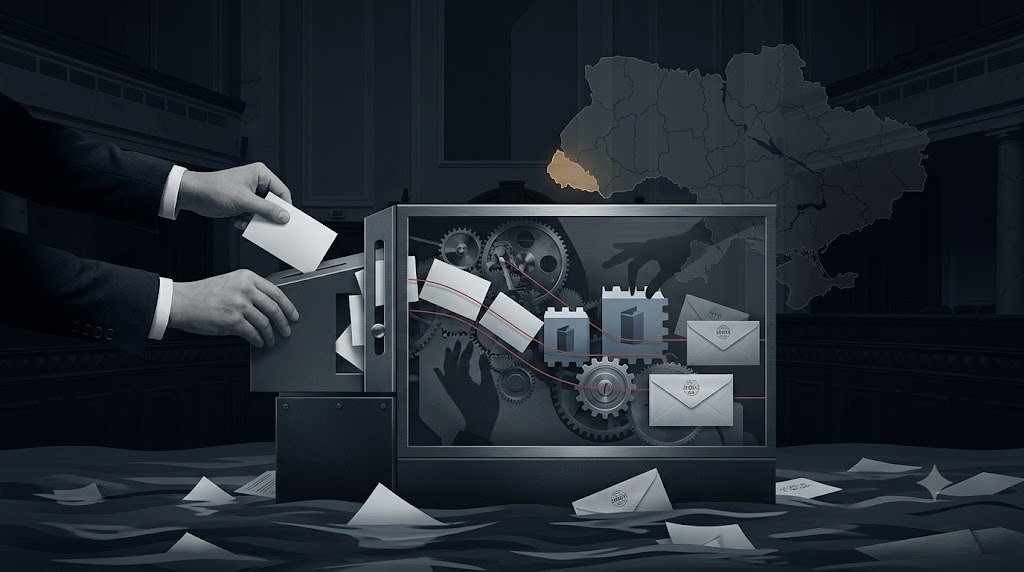
- The Central Election Commission, headed by Mykhailo Ryabets, artificially “pushed” Viktor Medvedchuk’s SDPU(O)—a party that was virtually unknown and unpopular in every region of the country—past the 4% threshold by “fabricating” 4.01% of the vote for it
- How Nestor Shufrich first became a People’s Deputy with a paltry 16.8% of the vote
- The “flood”—as a means of purging the government
Ryabets’ election math
The leader of the “United Social Democrats,” Viktor Medvedchuk, understood perfectly well that one man alone is no warrior, and that to influence parliamentary decision-making, he needed his party to have the largest possible representation in the newly elected Verkhovna Rada.
However, the reality was not in his favor—in the vast majority of Ukraine’s regions, the SDPU(O) enjoyed neither popularity nor influence, with the exception of Zakarpattia and, to some extent, Chernivtsi Oblasts. It was on these regions that Viktor Medvedchuk placed his main bet during the election campaign.
First and foremost, Putin’s future godfather adopted Joseph Stalin’s famous saying: “It doesn’t matter how people vote; what matters is how the votes are counted,” which reveals the essence of manipulative and authoritarian electoral processes, where the actual expression of citizens’ will is of no consequence, since the result is predetermined by those who count the votes and control the election commissions. That is precisely why the position of CEC chair—responsible for counting the votes “correctly”—was offered to Mykhailo Ryabtsev, a member of parliament from Zakarpattia, and he was awarded the title of “Honored Lawyer of Ukraine” in advance, while the Svalyava electoral district, where he had previously run for office, was split between the Mukachevo and Irshava electoral districts. We’ll see how this plays out later.
And yet another influential Transcarpathian—whom the Soviet regime’s “social elevator” had elevated from the more-than-modest position of milk seller at a collective farm kiosk in the village of Pylypets to the chairmanship of the Central Election Commission—also played a key role in advancing the career of the future traitor to Ukraine. After graduating from high school in his native village in 1977 and earning a positive recommendation from the Party Committee of the local Lenin Collective Farm, Mykhailo enrolled in the History Department at Uzhhorod State University. During his student years, he became deeply involved in civic activities. This is likely why, after receiving his degree in history, he did not go on to teach schoolchildren but instead became the deputy director and later the director of the student dormitory, the chair of the trade union committee, the university’s legal advisor, and a part-time student at the law faculty of Lviv State University. This period also marked the start of his legal career: he served as head of the legal department of the Transcarpathian Regional State Administration (1992–1994) and as head of the Department of Justice in the Transcarpathian region (1994–1996).
In June 1994, in a runoff election, Mykhailo Ryabets was elected a People’s Deputy of Ukraine from the Svalyava Electoral District No. 173. As his parliamentary term was coming to an end in 1998 and the election day for deputies to the Verkhovna Rada of the Third Convocation was approaching, Ryabets’ “moment in the spotlight” arrived.
In exchange for agreeing not to run in the restructured electoral district and to fully support representatives of the SDPU (O)—who were already in the good graces of President Leonid Kuchma—he became chairman of the Central Election Commission of Ukraine.
Today, only professional political scientists recall the twists and turns and consequences of the 1998 parliamentary elections in Ukraine. Meanwhile, their results gave rise to future bloody events for Ukrainian statehood. At that time, to the great surprise of the expert community, the SDPU(O) unexpectedly cleared the 4% threshold and gained the status of a parliamentary party, while its leader, Viktor Medvedchuk, became deputy speaker and, later, following a parliamentary “coup,” first deputy speaker of the Verkhovna Rada. Many people at the time emphasized that the Central Election Commission (CEC), headed by Ryabets, had artificially “pushed” a party—which was little-known and utterly unpopular in every region of the country—past the 4% threshold by “fabricating” 4.01% of the vote for it.
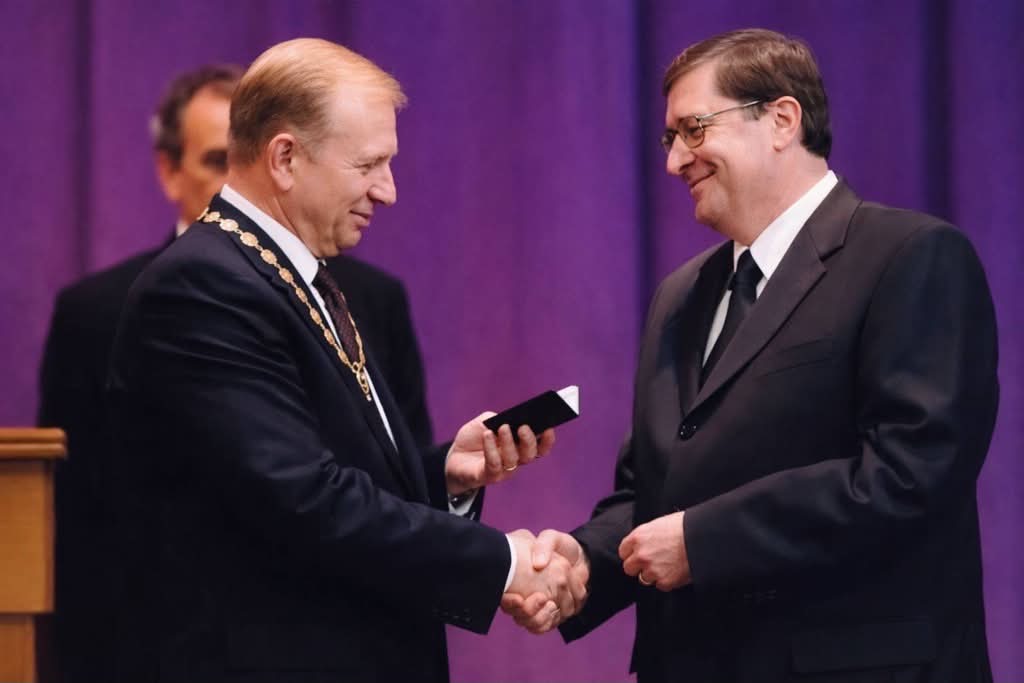
Later, in 2010, the Kyiv-based website “Glavkom” stated: “Since his resignation as head of the CEC in February 2004, Mykhailo Ryabets has rarely been mentioned in the Ukrainian media. (…) And although some still accuse him of having helped the SDPU(o) clear the 4% threshold in 1998 in exchange for “suitcases of dollars,” there is virtually nothing else to hold against him.” Isn’t that enough?
Three years later, the Uzhhorod newspaper RIO practically confirmed the same violations that paved the way for the legitimization in Ukraine of Putin’s “Trojan horse”: “If Mykhailo Ryabets had any opponents, they actually had little negative to say about him. The main criticism leveled against him was that, while serving as head of the Central Election Commission, he ‘padded’ the vote count by a few tenths of a percent for Medvedchuk’s SDPU(O) party so that it could reach the 4% threshold required to enter parliament.” Ryabets did not refute the media’s claims…
Mykhailo Ryabets’s activities during those years were generously rewarded with high government honors. In 1998, 2000, and 2003, President Kuchma, under Medvedchuk’s patronage, awarded Ryabets the Order “For Merit” in all three classes; in 2003, Prime Minister Viktor Yanukovych awarded him an Honorary Certificate of the Cabinet of Ministers, and in 2009, President Viktor Yushchenko awarded him the Order of Prince Yaroslav the Wise.
Ryabets’ political career ended in a significant and symbolic way—in 2004, decked out in orders, he left his post as head of the Central Election Commission and began working as… an advisor to the Prime Minister of Ukraine, and later to the fugitive president and traitor to Ukraine, Viktor Yanukovych.
The Artificial “Birth” of Shufrich’s Mandate
But let’s return to the elections of March 29, 1998. The contribution of voters in Zakarpattia Oblast to the SDPU (O)’s overall result was the highest in Ukraine—31.17% of the vote! Medvedchuk’s party achieved its second-highest result—by a wide margin—in Chernivtsi Oblast, with just 9%. The popular regional newspaper *FEST*, in an analytical article titled “The ‘Red’ Father in Ukraine Can Only Be Defeated When All Political Forces Act as a United Front,” dedicated to the results of the parliamentary race, reasonably noted: “Time will tell to what extent voters’ hopes will be fulfilled.” For now, however, THEY HAVE LIVED UP TO the expectations of the united Social Democrats and secured their representation in parliament, because without the votes from Zakarpattia, the party would never have crossed the 4% threshold.”
In addition to promoting the party list, Medvedchuk fought desperately for every seat in the “majority” races, demonstrating his unlimited influence over state institutions in the process. The situation in the Uzhhorod electoral district was particularly telling in this regard. The clear frontrunner in the race here was a charismatic, self-assured, and rather brazen mayor-turned-businessman—until recently an ally and associate of Medvedchuk (we remember his 1997 appeal to voters in the Irshava electoral district to vote for Medvedchuk!) Serhiy Ratushniak, who by that time had already “privatized,” to put it mildly, a significant portion of the city’s municipal property. As his rival, the “truncated SDPU members” (as Medvedchuk’s party members were called in private conversations) put forward a candidate who had failed in previous elections—a budding entrepreneur in the energy sector, Nestor Shufrich, a People’s Deputy from the “OPEZ” faction who is now another suspect in a treason case. People close to Ratushniak said that he had already booked a banquet at a restaurant where he planned to celebrate his parliamentary seat in grand style. But it didn’t happen! Two days before the vote, the Supreme Court of Ukraine carried out a legal “Caesarean intervention,” removing Ratushniak’s name from the ballot.
Officially, this was because he had not resided in Ukraine for the required five years, as he had been a citizen of Slovakia until 1994. But in Uzhhorod, the real reason for this decision was seen as Medvedchuk “clearing the way” for Shufrich to enter parliament.
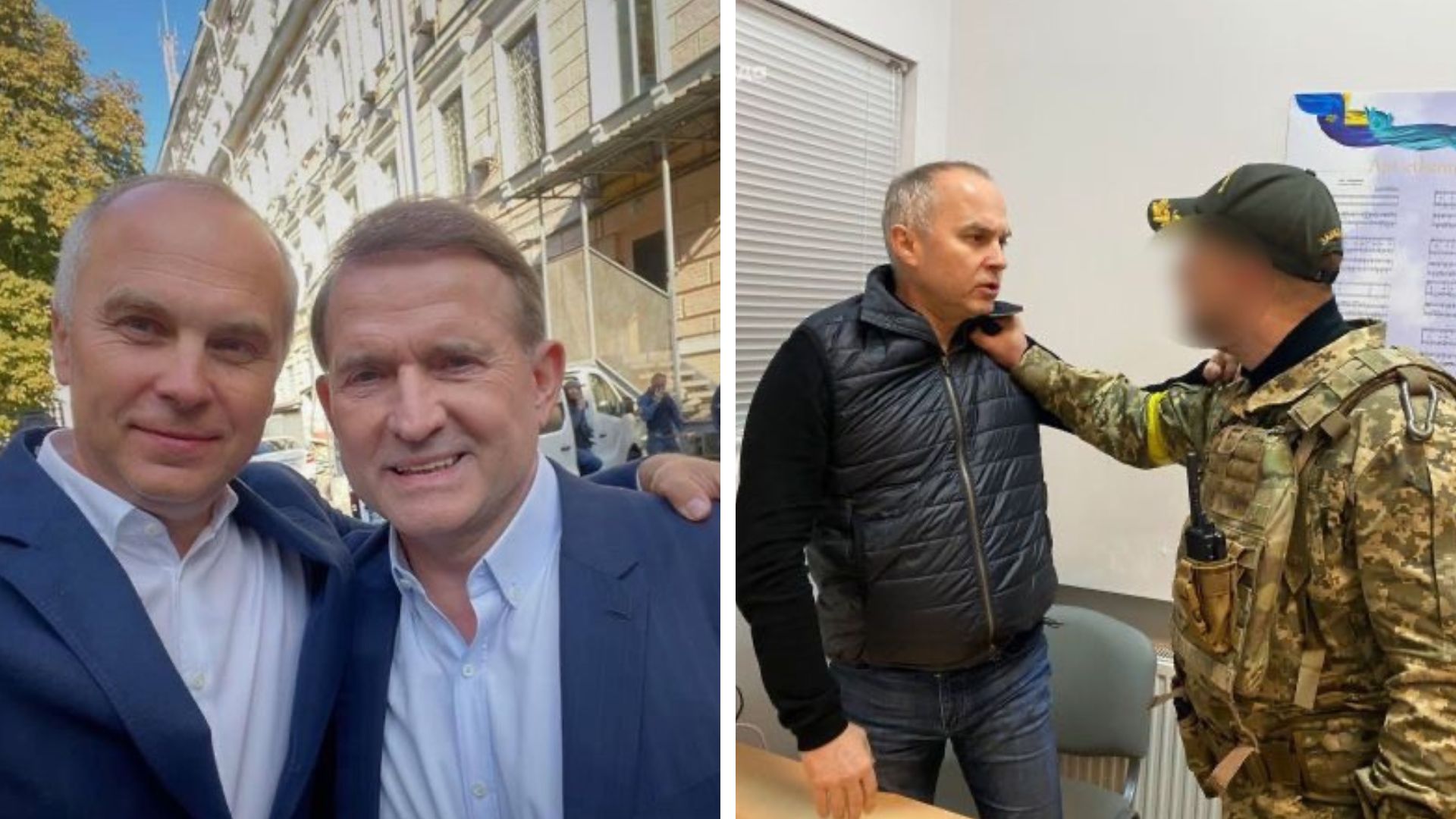
That is exactly what happened. According to the district election commission, first place went to Medvedchuk’s party colleague Shufrich, who became a People’s Deputy with a meager 19,779 (16.8%) votes. At the same time, there were as many as 20,019 invalid ballots! In the vast majority of them, the surname “Ratushniak” had been written in. In addition, another 20,805 voters cast “against all” ballots, which was also a form of protest. But by then, it no longer mattered.
Along with Shufrich, his party colleagues Medvedchuk (Irshava electoral district, 90.16% of the vote) and Hryhoriy Surkis (Mukachevo electoral district, 63.42% of the vote) won parliamentary seats in their respective districts, with even former Ryabets voters casting ballots for them. These were the only three pitiful majority-system seats in all of Ukraine won by the united Social Democrats.
Thus, it was the people of Transcarpathia—some through thoughtless, others through self-serving expressions of will— and some through conscious work generously paid for by today’s traitors to the state—contributed to laying the foundations in Ukraine for future “Russian World” organizations and other pro-Kremlin structures, which even today remain the core of treason and a refuge for the newest collaborators.
The Flood—As a Means of Purifying the Government
Medvedchuk’s party’s overwhelming victory in Transcarpathia enabled it to form a vertical chain of command in the region from among its obsequious supporters, whose numbers grew daily like a raging mountain torrent during the spring flood. Despite the immense pressure of socioeconomic problems—the most acute of which were arrears in salary and pension payments, rising unemployment, and the plundering of the region’s natural resources, particularly in the forestry sector—the number of people eager to work for local government agencies only grew. And to do so, just as in the days of the communist empire, one had to have a party membership card in one’s pocket. Only this time, it wasn’t the CPSU, but the SDPU(O). And the people, thirsty for power, flocked to the party en masse—entire families at a time!
A few lines above, I mentioned the flood season in a figurative sense. But in November 1998, Transcarpathia was hit by a real flood—after record-breaking autumn rainfall, the worst catastrophic flood in a century occurred, leading to widespread destruction of homes, roads, bridges, and social and industrial facilities across virtually all cities and districts.
Ukraine had never experienced a flood of this magnitude before, and the then-Minister of Emergency Situations, Kalchenko, compared its scale to the recent flood in China. Since one-third of the region’s residents found themselves in the flood zone, the situation demanded swift, sound, and coordinated decisions from local and regional authorities—similar to those demonstrated six months earlier during Medvedchuk’s party’s campaign to enter parliament. But in this regard, the vast majority of Transcarpathian officials demonstrated their inability to act in critical situations in an unconventional, bold, and—most importantly—effective manner.
Against the backdrop of widespread government helplessness and immaturity, only the mayor of Mukachevo stood out: Viktor Baloha, a successful young entrepreneur and CEO of the trading firm “Barva,” who was elected to this position six months ago. On that anxious night of the flood, he not only coordinated rescue operations but also personally used his own SUV to evacuate people from flooded homes; and at the break of dawn, he promptly made the necessary decisions that the victims had been waiting for.
In the first days following the flood, President Kuchma arrived in Transcarpathia, accompanied by Medvedchuk and other high-ranking officials. They visited several of the towns and districts hardest hit by the raging waters, listened to the outcries and pleas of the victims, and spoke with local officials. Everywhere, people painfully recounted to the head of state the tragedy that had destroyed their modest livelihoods and familiar way of life in an instant, and, of course, they complained about and cursed the local authorities. Except in Mukachevo. Here, residents expressed their gratitude for the humanitarian aid provided in the early days and for the mayor’s firm promise to help rebuild their destroyed homes. The mayor stood beside the president, listening to the sincere and hopeful words of the people of Mukachevo.
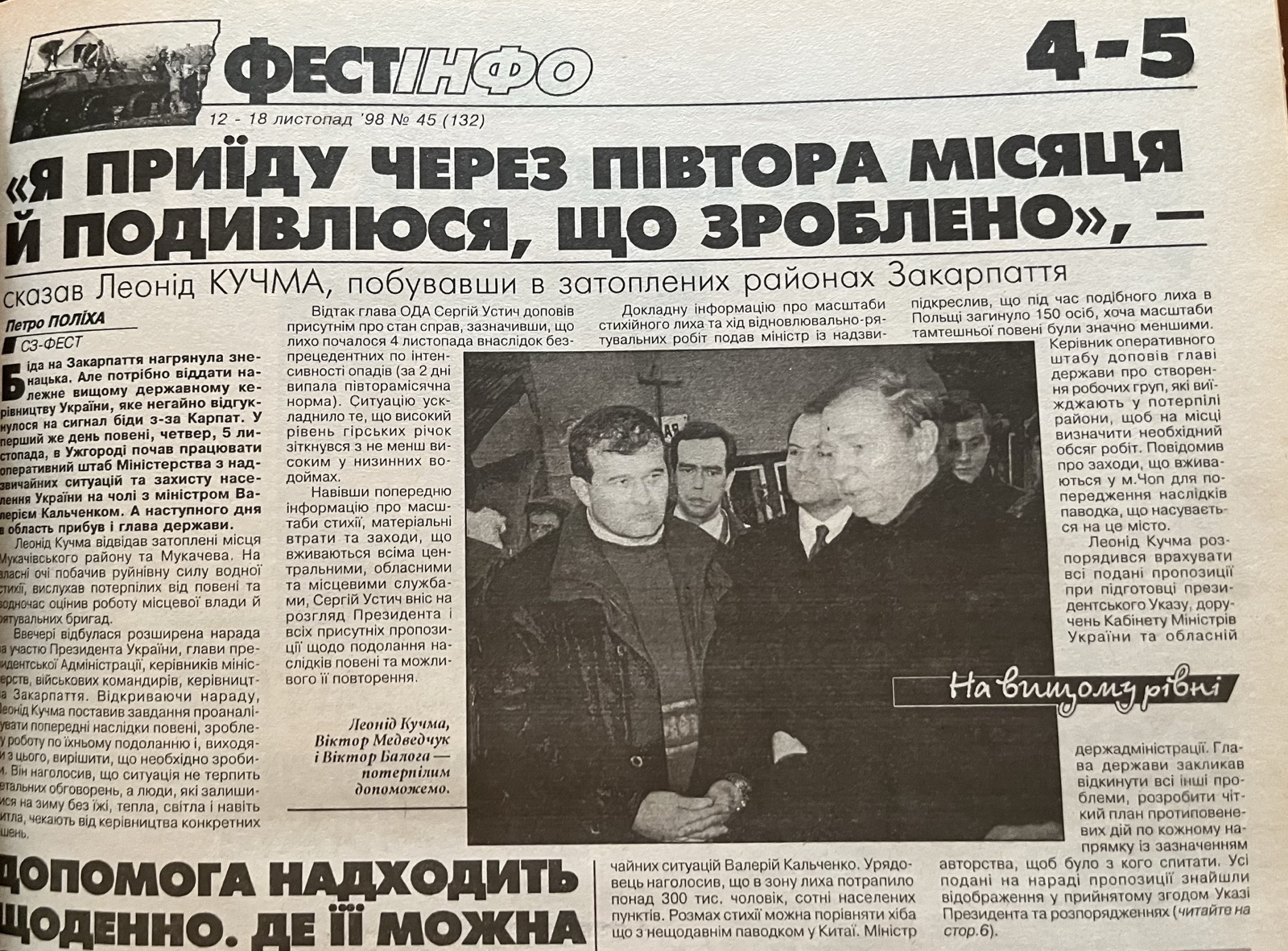
A month later, Kuchma, as promised, returned to Transcarpathia to see for himself how the cleanup efforts following the natural disaster were progressing. In Mukachevo, Baloha showed him the sites where homes for affected families were being built with state funding. There, government officials spoke with construction workers and local residents. “If a month ago there was confusion and despair, today people are convinced that the state will not leave a single family to face this tragedy alone,” Kuchma concluded. And six months later, when the first victims were already settling into their newly built homes, he appointed Baloha as head of the Transcarpathian Regional State Administration.
At first, the new regional head treated the overwhelming presence of Medvedchuk’s party members in regional and local government with caution and even tolerance. Medvedchuk insisted that Ivan Rizak, head of the regional branch of the SDPU(O), be appointed first deputy head of the Regional State Administration; Rizak had demonstrated his complete personal loyalty to Medvedchuk as early as the first elections in 1997. To this end, he personally flew to Uzhhorod on a charter flight and returned to Kyiv with the first copy of the nomination for Rizak, signed by Baloha.
It was precisely this appointment—imposed on Baloha—that marked the beginning of the future large-scale, protracted, and uncompromising confrontation between Medvedchuk and his party colleagues on one side, and Baloha and his supporters and allies on the other—a complete “de-partization” of the Transcarpathian authorities and the famous Mukachevo mayoral election, which “shook the world.” But that is a topic for the next story.
Vasyl Ilnytskyi