
The administration of US President Donald Trump supports a proposal to buy the foreign assets of the Russian oil company Lukoil, valued at roughly $20 billion. The New York Post reported this on 9 October, citing a source in the US government. According to the paper, the talks have advanced considerably and the deal could be signed within the next two weeks.
In brief:
- US media: Russian President Vladimir Putin discussed a possible Lukoil deal with the US president’s special envoy Steve Witkoff and with Jared Kushner
- Lukoil’s foreign assets include oil refineries in Bulgaria, Romania and the Netherlands, oil production projects in Iraq and Kazakhstan, and petrol station networks in Europe and the United States
- After US sanctions were imposed, Lukoil lost the ability to manage part of its foreign assets in full and is now trying to sell them
- The leading contender for Lukoil’s foreign assets is currently said to be a consortium headed by the American billionaire Todd Boehly
- The consortium also includes the US state-owned International Development Finance Corporation, entities belonging to the brother of the UAE president, Sheikh Tahnoun bin Zayed Al Nahyan, and the Qatari billionaire family Al Khayyat, which has business ties to Donald Trump’s circle
- One of the key US requirements is that Lukoil must not gain free access to the proceeds of the sale while sanctions against it remain in force. The money is to be held in a special account
- It is not yet known whether the final terms have been agreed with the Russian side
The New York Times earlier reported that the sale of Lukoil’s foreign business had become one of the subjects of Russian-American talks on settling the conflict in Ukraine. According to the paper, Russian President Vladimir Putin discussed a possible deal with the US president’s special envoy Steve Witkoff and Donald Trump’s son-in-law Jared Kushner during their meeting at the Kremlin on 5 September. The paper’s sources said the Russian side viewed the sale as an opportunity to demonstrate the prospects for economic cooperation with the United States. The White House, the US Treasury and Lukoil have not commented on the matter.
Further evidence that negotiations on the sale of the foreign business are under way comes from the financial statements of the subsidiary LUKOIL International GmbH, published at the end of September. The document states that the company “is conducting intensive negotiations with potential buyers and expects to conclude a sale agreement”.
An oil empire with the Kremlin’s approval
Lukoil is one of Russia’s largest oil and gas companies. It is engaged in the exploration and production of oil and gas, in oil refining and in the sale of petroleum products. The company was created in 1991 with the participation of Vagit Alekperov, who then headed it for three decades. In April 2022, after British sanctions were imposed on him, Alekperov stepped down as president of Lukoil but remained one of the company’s largest shareholders. According to available data, he owns about 28.3% of its shares. Alekperov is also among the wealthiest Russian businessmen: in the 2026 Forbes ranking his fortune was estimated at $29.5 billion, which placed him third among Russian billionaires.

For decades Alekperov maintained direct contacts with Vladimir Putin and secured the Kremlin’s backing for Lukoil’s foreign projects. In particular, he obtained Putin’s approval for the expansion of the company’s petrol station network in Europe, as well as for projects in Iraq, Uzbekistan, Kazakhstan and Bulgaria.
Caught in the sanctions trap
Lukoil had been actively developing its foreign business since the late 1990s, seeking to turn itself into an international oil and gas corporation. In 1998 the company bought an oil refinery in Romania, in 1999 one in Bulgaria, and in 2000 it entered the American market by acquiring the Getty petrol station chain.
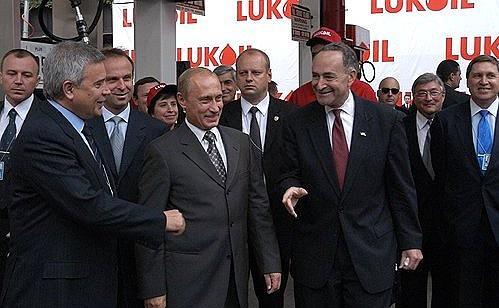
In 2005 Lukoil paid $1.95 billion for Nelson Resources, which held stakes in oil fields in Kazakhstan, and in 2009 it bought 45% of an oil refinery in the Netherlands. That same year the company won a contract to develop one of Iraq’s largest fields, West Qurna-2.
Over two decades Lukoil spent about $40 billion on acquiring foreign assets. By 2026 their value was estimated at roughly $22 billion.
As Reuters established, as early as 2014 Vladimir Putin recommended that Russia’s largest businessmen dispose of their Western assets, fearing that these might be confiscated as relations with the West deteriorated. Vagit Alekperov did not follow that recommendation: he expected that an international presence would help shield Lukoil from political risks. For more than ten years the strategy worked.

In October 2025, however, the United Kingdom and the United States imposed blocking sanctions on PJSC LUKOIL, which affected both the company itself and its subsidiaries. The European Union did not impose sanctions on Lukoil, but it restricted trade in Russian oil and petroleum products and added to its sanctions list Litasco Middle East DMCC, a company linked to Lukoil, which the European authorities accused of facilitating the operations of the Russian shadow fleet.
Against the background of these restrictions, Lukoil lost the ability to manage part of its foreign assets in full. In Bulgaria, the Lukoil Neftochim Burgas refinery and other enterprises of the group were placed under the management of a special administrator appointed by the authorities. In Iraq, the state-owned Basra Oil Company took over the running of the West Qurna-2 field.
At the same time, a significant share of Lukoil’s international projects had already been run not by the company itself but by its partners. In Kazakhstan the operator of the Tengiz field is Tengizchevroil and of the Karachaganak field Karachaganak Petroleum Operating, while the pipeline system of the Caspian Pipeline Consortium is run by JSC CPC-R. In Azerbaijan, the development of the Shah Deniz gas field is led by the British company BP.
In the Netherlands, the Zeeland Refinery operates within a joint venture with the French company TotalEnergies, while the Romanian refinery Petrotel-Lukoil, which belongs to Lukoil, stands idle.
In legal terms, Lukoil retains stakes in many of these assets, since their sale has not yet been completed.
The deal as part of high politics
Initially Lukoil expected to sell its foreign business as a single package – through the sale of the Austrian subsidiary LUKOIL International GmbH, which owns a significant part of the group’s foreign assets. That was precisely the scheme envisaged by the deal with the American investment fund Carlyle, concluded in January 2026. Assets in Kazakhstan were excluded from the transaction.
At the end of July that deal lapsed, never having received final approval from the American authorities. As the Financial Times reported, the transaction became stuck in interagency clearance involving the US National Security Council, the State Department and the Department of Energy. According to the paper, the sanctions regulator OFAC had by then already given its preliminary consent. On 9 October Carlyle confirmed that it was no longer holding active talks on the purchase.
The leading contender for Lukoil’s foreign assets is now considered to be a consortium headed by the American billionaire Todd Boehly, a former co-owner of the football club Chelsea. According to the Financial Times, the potential deal involves the state-owned US International Development Finance Corporation (DFC), entities of Sheikh Tahnoun bin Zayed Al Nahyan – the brother of the UAE president – and the Qatari billionaire family Al Khayyat. The Middle Eastern investors have previously had business dealings with Jared Kushner and with entities linked to Steve Witkoff.

According to Financial Times sources, the state-owned DFC could receive about 15% of the shares in the new company. At the same time, the majority of seats on the board of directors is to be reserved for DFC and Todd Boehly. This would allow the Americans to take key decisions on managing the assets regardless of who holds the bulk of the capital.
One of the key requirements of the US Treasury is that Lukoil must not gain free access to the proceeds of the sale while sanctions against it remain in force. The money is to be paid into a special blocked account under American jurisdiction, and the assets sold are to pass entirely out of Lukoil’s control. It is not yet known whether the final terms have been agreed with the Russian side.
Despite the absence of final approval for the deal from American regulators, the reports of Vladimir Putin’s talks with representatives of Donald Trump’s administration and the White House’s support for Todd Boehly’s consortium give grounds to believe that the deal has already secured political backing at the highest level – in both Moscow and Washington.
Author: Olga Siamashko