


Neoreactionism and the Dark Enlightenment are no longer merely an online provocation by a handful of bloggers operating at the intersection of philosophy, technology, and the radical right. It is the language through which parts of the American tech elite, alt-right circles, and conspiracy theorists describe liberal democracy as a worn-out, ineffective system doomed to be replaced by the hierarchical rule of experts, capital owners, and technological sovereigns.
The greatest risk, however, does not lie in the existence of a single secret headquarters controlling the neo-reaction, QAnon, the alt-right, and Russian propaganda. A more precise description is a layered network of resonance: ideas, media, platforms, personal contacts, tech circles, radical political movements, and influence operations. Russia does not need to control the entire ecosystem to benefit from it. It is enough for it to amplify existing narratives: anti-liberal, anti-democratic, anti-Ukrainian, anti-institutional, and conspiratorial.
In short:
- Neoreactionism rejects liberal democracy in favor of a hierarchical order governed like a corporation or a technocratic monarchy.
- Russia’s strongest ties are to the alt-right, QAnon, and right-wing conspiracy theories, rather than to the core of Neoreactionism (NRx) itself.
- QAnon was not a straightforward Russian project from the start, but Russian propaganda effectively exploited its channels and language.
- In Ukraine, the best-documented connections are those between transnational white supremacist circles and the historical milieu of the Azov/National Corps movement.
- NRx’s ties to Ukraine are primarily indirect: ideological, discursive, and technological, rather than organizational.
What is the Dark Enlightenment?
The Dark Enlightenment, known as Dark Enlightenment, is a radical anti-democratic movement that emerged at the intersection of tech-driven blog counterculture, Silicon Valley libertarianism, anti-egalitarianism, and far-right critiques of modernity. Its proponents argue that liberal democracy is not a mechanism of freedom, but a system of diffuse control in which the media, universities, government, popular culture, and NGOs perpetuate the dominance of the progressive consensus.
From this perspective, the problem is not merely the quality of political elites or the inefficiency of specific institutions. The problem is said to be the very principle of democratic equality. Neoreactionaries reject the belief that people have an equal capacity to participate in politics, that the majority can exercise control over power, and that liberal institutions limit the arbitrariness of those in power. Their answer is the opposite: the more democracy, the more chaos; the more egalitarian language, the less effective governance; the more civic control, the weaker the state.
This is precisely why the Dark Enlightenment is returning to public debate today. Not because it created a mass political party or a unified governing program. Its significance lies elsewhere: it provides a language of radical critique of democracy to certain circles that have money, technology, access to communication platforms, and growing political ambition.
Curtis Yarvin, Nick Land, and the Core of Neoreaction
The central figure of American neoreaction remains Curtis Yarvin, who previously wrote under the pseudonym Mencius Moldbug. It was he who, on the blog Unqualified Reservations, developed a vision in which modern democracy appears as a sham system: formally based on elections, but in practice subordinate to what he calls “the Cathedral.”

The Cathedral does not refer to a single organization. It is a concept describing a presumed institutional-cultural bloc: universities, the mainstream media, the bureaucracy, Hollywood, expert organizations, and liberal parties. According to Yarwin, these entities impose progressive axioms on society: equality, inclusivity, anti-racism, feminism, multiculturalism, and liberal constitutionalism. The neo-reactionary sees in this not pluralism, but a mechanism of domination.
Nick Land introduced a different language into this discourse: accelerationism, a fascination with the breakdown of modern political forms, technological intensification, and moving beyond the humanistic limitations of liberalism. For Land, capitalism, technology, and intelligence are not tools subordinate to humanity. They are forces capable of transcending humanity, democracy, and the morality of modern egalitarianism.
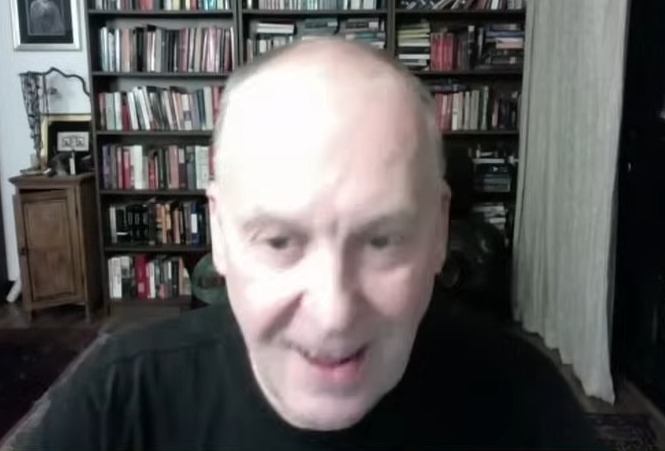
Yarvin and Land differ in style, temperament, and sphere of influence. The former constructs quasi-systemic projects and the language of political engineering. The latter offers a more philosophical, cold, and at times catastrophic vision of acceleration. They are united by the conviction that liberal democracy is a weak, hypocritical construct incapable of real control over the future.
The State as a Corporation: Technomonarchy Instead of a Republic
Yarvin’s most recognizable idea sounds provocative: the state should be run like a company. In this vision, the president, parliament, courts, public opinion, and the media do not form a system of checks and balances, but rather obstacles to efficient management. The corporate state would have an owner or sovereign, the equivalent of a CEO, who bears full responsibility for results and is not hindered by democratic rituals.

This is not merely a longing for a strong leader. Neoreaction attempts to rewrite the language of politics into the language of ownership, management, and efficiency. The citizen becomes a customer or a shareholder. Political rights give way to the possibility of “exiting” the system. If a given corporate state functions poorly, the individual can move to another.
The mechanism of control, therefore, does not rely on elections, but on the market and competition between political orders.
In this logic, one can easily recognize the imagination of Silicon Valley. A startup is portrayed as an organism capable of rapid decision-making, explosive expansion, and the subordination of resources to the founder’s single vision. Democracy looks like an outdated operating system by comparison: slow, prone to disruption, and too bound by procedures.
Peter Thiel is not merely an NRx ideologue, but his statements and activities have made him an important point of reference for technopolitical right-wing circles. In 2009, he wrote that he no longer believed freedom and democracy were compatible. In another context, he spoke of a startup as a structure akin to a monarchy. For the neoreactionary imagination, these are not minor provocations. They are signals that part of the tech elite is beginning to treat democracy not as a prerequisite for freedom, but as a transaction cost.

The California Ideology and the Language of the New Hierarchy
Neoreactionism does not stem from classical European monarchist nostalgia, though it readily draws on images of the king, the sovereign, and hierarchy. Its modernity lies in the combination of radical free-market libertarianism, startup culture, transhumanism, and the belief that the future belongs to those who adapt more quickly to technological acceleration.
This creates a unique blend: anti-state distrust of bureaucracy merges with the dream of a state run like a private platform; the language of individual freedom shifts into praise for hierarchy; fascination with intelligence and innovation becomes an argument against political equality.

Transhumanism adds to this puzzle the conviction that humanity is a transitional entity. Artificial intelligence, biotechnology, cognitive engineering, and digital environmental control are set to usher in an era in which old political institutions will prove too slow and too human. Accelerationism adds a more brutal idea to this: the processes of disintegration should not be halted, but accelerated, because only a crisis will reveal the new order.
In practice, this language often leads to technocratic anti-egalitarianism. Inequality is then not a problem to be reduced, but a supposed fact of nature that must be politically acknowledged. Democracy ceases to be a mechanism for the peaceful resolution of conflicts and becomes a cognitive error: a system that allows the majority to block those who “know better.”
Alt-right and QAnon: From Metapolitics to Mobilization
Neoreactionaryism is not the same as the alt-right or QAnon. This distinction is necessary. NRx is primarily an intellectual and blog-philosophical movement, with a strong foundation in the language of technology, libertarianism, and anti-democratic state theory.The alt-right is a broader political and cultural movement encompassing white nationalists, misogynistic internet subcultures, the anti-immigrant right, meme communities, and radical influencers. QAnon, in turn, is a conspiracy belief system centered on the deep state, satanic elites, covert operations, and a redemptive conflict with the deep state.

These circles are not a single organization, but their discourses overlap. NRx provides elite justifications for rejecting democracy. The alt-right translates anti-liberalism into racial, cultural, and identity-based conflict. QAnon mobilizes emotions by creating a simple map of the world: treacherous elites versus the awakened people.
The result is a political ecosystem where abstract criticism of democracy intersects with memes, conspiracy theories, anger toward institutions, and the cult of a strong leader. This is more important than formal membership. Contemporary radical movements do not always need legitimacy, statutes, or offices. Often, platforms, influencers, shared linguistic codes, and the constant conviction that official reality is a lie are enough for them.
The Russian Dimension: Influence Operations and Pre-Packaged Narratives
The Russian state has been exploiting Western political divisions for years, but not every division is the result of Russian intelligence operations. In the case of neo-reactionism, the alt-right, and QAnon, this distinction is crucial. There is no basis for claiming that the core of the American NRx was designed, financed, or centrally controlled by Russian state institutions. There are, however, strong grounds for discussing Russian exploitation of the broader right-wing conspiracy information infrastructure.

The best-documented activities concern Russian influence operations targeting audiences susceptible to anti-elitism, nativism, conspiracy thinking, and hostility toward liberal institutions. The Internet Research Agency (Агентство интернет-исследований), RT (Russia Today), structures linked to the Russian state apparatus, and operations attributed to the GRU and FSB operated in a space where the alt-right and QAnon served as useful conduits. Not always as conscious partners. Often as amplifiers of content that aligned with their own biases.
The mechanism is simple. The Russian narrative does not need to convince the audience to support Russia. It is enough that it deepens distrust toward one’s own government, the media, the courts, elections, science, NATO, the European Union, or Ukraine. The greater the cognitive dissonance, the easier it is for Moscow to portray the liberal West as a hypocritical, decadent system doomed to collapse.
Dugin, RT, Internet Research Agency, FSB, GRU: evidence and resonance
Alexander Dugin is sometimes described as the “brain of the Kremlin,” which makes the picture more blurred than clear. His actual role is more that of an ideological broker: a figure linking Russian imperial anti-liberalism with Western far-right circles, traditionalists, monarchists, anti-globalists, and parts of the conspiracy-oriented internet.
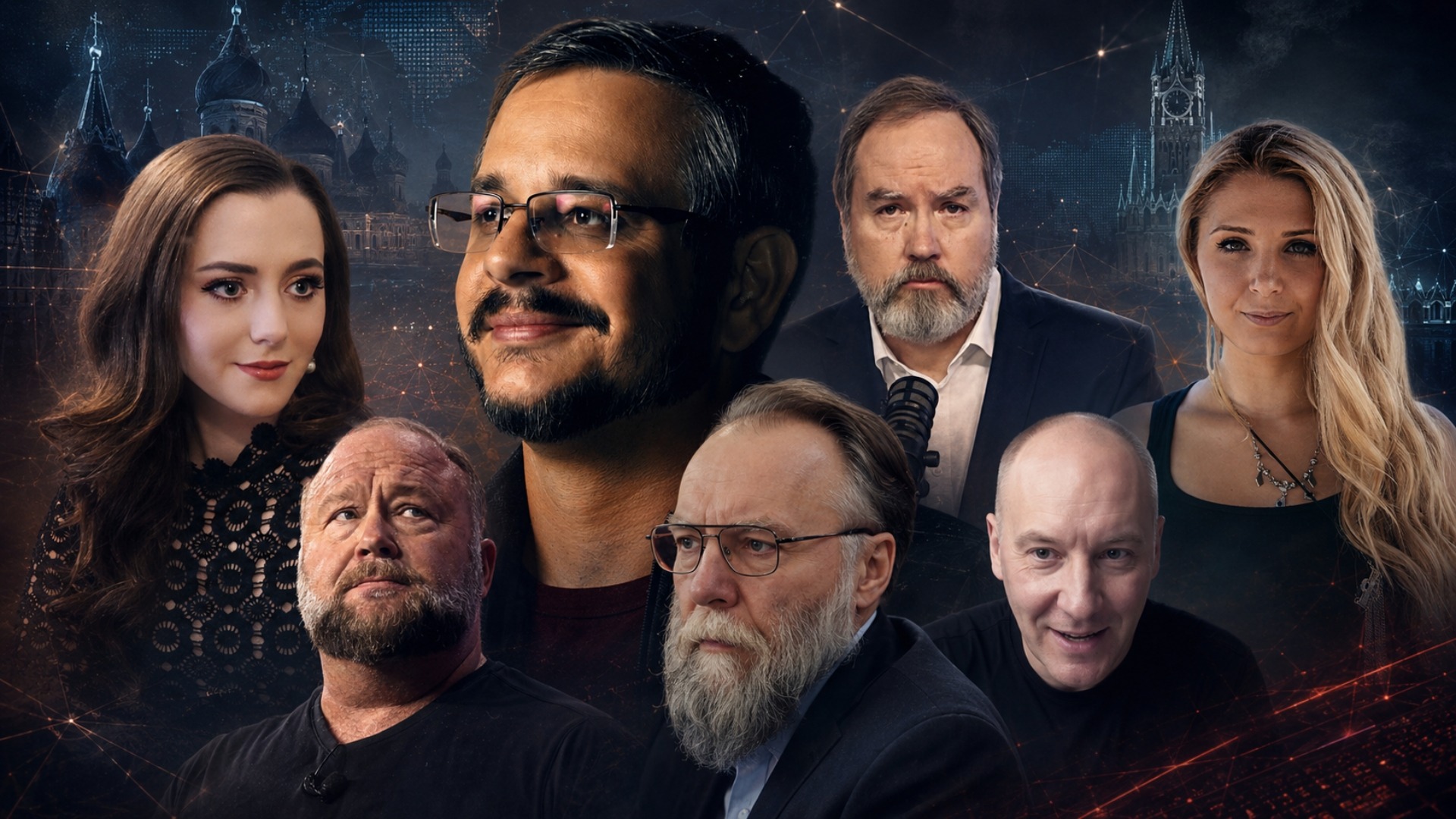
Alexander Dugin acts more as an ideological broker and media hub than as the undisputed architect of Kremlin policy. Platforms associated with Dugin’s circle have shown contacts with figures from the Western far right, including Nick Land, Alex Jones, David Knight, Lauren Southern, Brittany Pettibone, and Auron MacIntyre. These are media and ideological connections, sometimes personal ones. They should not automatically be described as funding, espionage, or organizational subordination. They are significant, however, because they form a transmission channel for concepts: anti-liberalism, empire, criticism of modernity, rejection of egalitarianism, and praise for civilizational confrontation.
More hard-hitting material concerns state-sponsored operations. The Internet Research Agency crafted narratives tailored to American cultural debates. Russian bots and influence accounts amplified content targeting Western electoral processes. The GRU carried out hacking and information operations in which Western alt-right influencers may have served as early amplifiers, even if there is no evidence that they acted in concert with Russian intelligence. The FSB and RT appeared in separate threads concerning media infrastructure, bot farms, and funding of political content favorable to Russian objectives.
The most accurate description, therefore, is this: Russia possessed and continues to possess the tools of a state influence operation; the Western radical right provides it with a receptive audience; between these spheres, there are points of contact, mutual reinforcement, and, in some cases, financial and media ties. It does not follow from this that every NRx author is part of a Russian operation.
QAnon as a conduit, not a Moscow-founded project
QAnon is particularly useful for Russian propaganda because it does not require a coherent doctrine. Its strength lies in its ability to absorb any narrative: the deep state, child trafficking, secret laboratories, vaccines, Soros, Ukraine, NATO, Satanism, the global government. It is an open system that functions more like an interpretive framework than an organization.

This is precisely why Russian narratives could easily pass through QAnon channels. The example of “biolabs” in Ukraine illustrates this mechanism exceptionally well. Russian state media and pro-Russian channels introduced the claim about alleged American biological laboratories, and the QAnon community gave it its own meaning: a secret experiment by the elites, evidence of the crimes of the deep state, an element of a hidden war against humanity. The message then spread to far-right media, influencers, and the broader internet.
This does not prove that QAnon originated as a Russian project. It proves something else: that the conspiracy ecosystem created in the U.S. has become a vulnerable distribution infrastructure for Russian disinformation. For influence operations, this is often enough. Moscow does not need to write the script from the first page if it can add its own chapter to a narrative that the audience already believes.
Ukraine through the lens of the alt-right: Azov, National Corps
The Ukrainian dimension of this topic requires particular precision. For years, Russian propaganda has sought to portray the entire Ukrainian state as a far-right project. This is a false and politically expedient narrative from the Kremlin. At the same time, one cannot ignore the fact that in the years following 2014, some Ukrainian far-right circles did indeed maintain contacts with the transnational alt-right network and white supremacists.
The best-documented channel does not concern the NRx in the strict sense, but rather the relations between American and European white supremacists and the historical milieu of the Azov movement, the National Corps, and the circle of Olena Semeniaka. This involves conferences, mutual promotion, travel, recruitment efforts, the presence of Western activists in Kyiv, and aspirations to build a right-wing international.

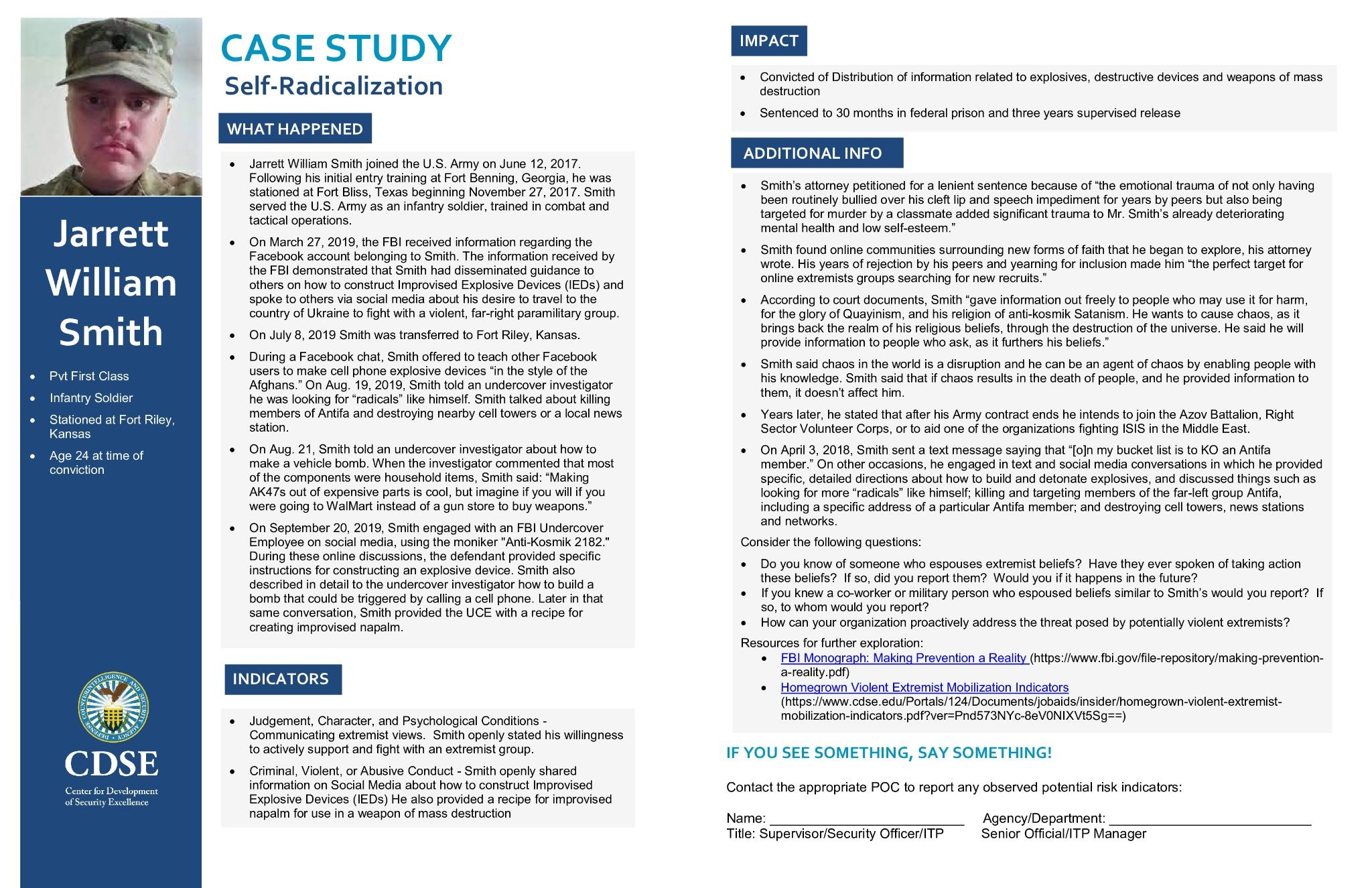
The case of Robert Rundo and the Rise Above Movement is one of the most striking examples. American extremists traveled to Europe, including Ukraine, seeking contacts, training, and a symbolic foothold in circles they portrayed as more militant than the Western right. Similarly, there were connections to the Atomwaffen Division, Jarrett William Smith, and others for whom Ukraine was an imagined place to gain experience or join a transnational network of the radical right.

This does not mean that Ukraine as a state is an alt-right project. The far right is weak electorally, has not seized central power, and its influence is uneven. It is more visible in so-called street politics, symbolism, youth mobilization, online propaganda, and certain institutional niches than in actual control over the state. This distinction is necessary, because without it, my analysis will end up serving Russian disinformation.
QAnon and Ukraine: “biolabs,” Telegram, and the deep state
QAnon in Ukraine did not have a credibly confirmed formal organization comparable to a party, movement, or registered structure. Its influence manifested itself rather through the permeation of narratives: about the deep state, secret laboratories, child trafficking, globalists, Chabad-Lubavitch, Soros, world government, vaccines, and war as a cover for the elites’ covert operations.
Telegram played a special role. In the Russian and pro-Russian information space, Telegram channels combined war narratives, anti-Ukrainian, anti-Western, and conspiracy narratives. Some of them were aimed at a Ukrainian audience, some at a Western one, and some operated in several languages at once. Within this ecosystem, the narrative of Ukraine as a site of secret experiments, elite corruption, and a “globalist war” could circulate among Russian channels, the American QAnon movement, and local “spreaders” of conspiracy theories.
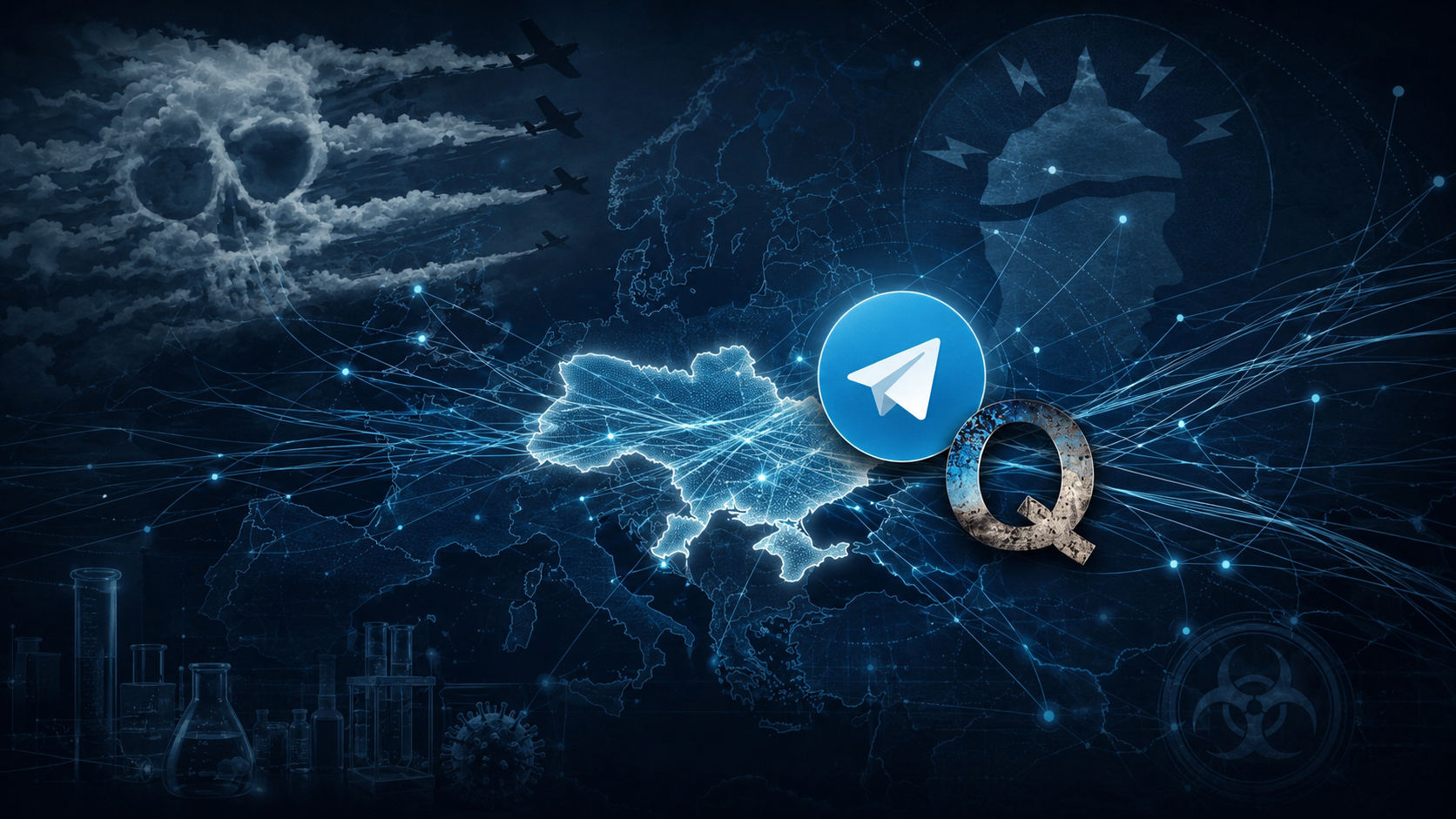
The narrative of Ukrainian “interference” in the 2016 U.S. election, accusations regarding biolabs, and stories portraying Ukraine as a base for the deep state all served the same purpose: to reverse the narrative of aggression. Russia ceased to be the state waging an aggressive war, while Ukraine was to appear as a suspicious area controlled by secret Western networks. This is a classic mechanism of information warfare: there is no need to prove an alternative reality; it is enough to cognitively contaminate the existing reality.
NRx and Ukraine: Palantir, War Technology, and the Limits of Interpretation
The connections between Neoreactionism and Ukraine are significantly weaker than those of the alt-right. There is no indisputable evidence that Curtis Yarvin, Nick Land, or organized NRx circles have established a lasting political structure, think tank, party, foundation, or concrete political program in Ukraine. However, three phenomena are evident: the circulation of ideas, commentary on the “Dark Enlightenment,” and indirect technological connections.
The most concrete connection runs through Palantir, a company co-founded by Peter Thiel. Palantir has played a role in the Ukrainian ecosystem of data, projects for mine clearance, reconstruction, battlefield analytics, and tools based on artificial intelligence. This is significant because it demonstrates the tangible presence of the American military-tech sector in Ukraine. However, it is not proof of a transfer of neo-reactionary doctrine to the Ukrainian state.
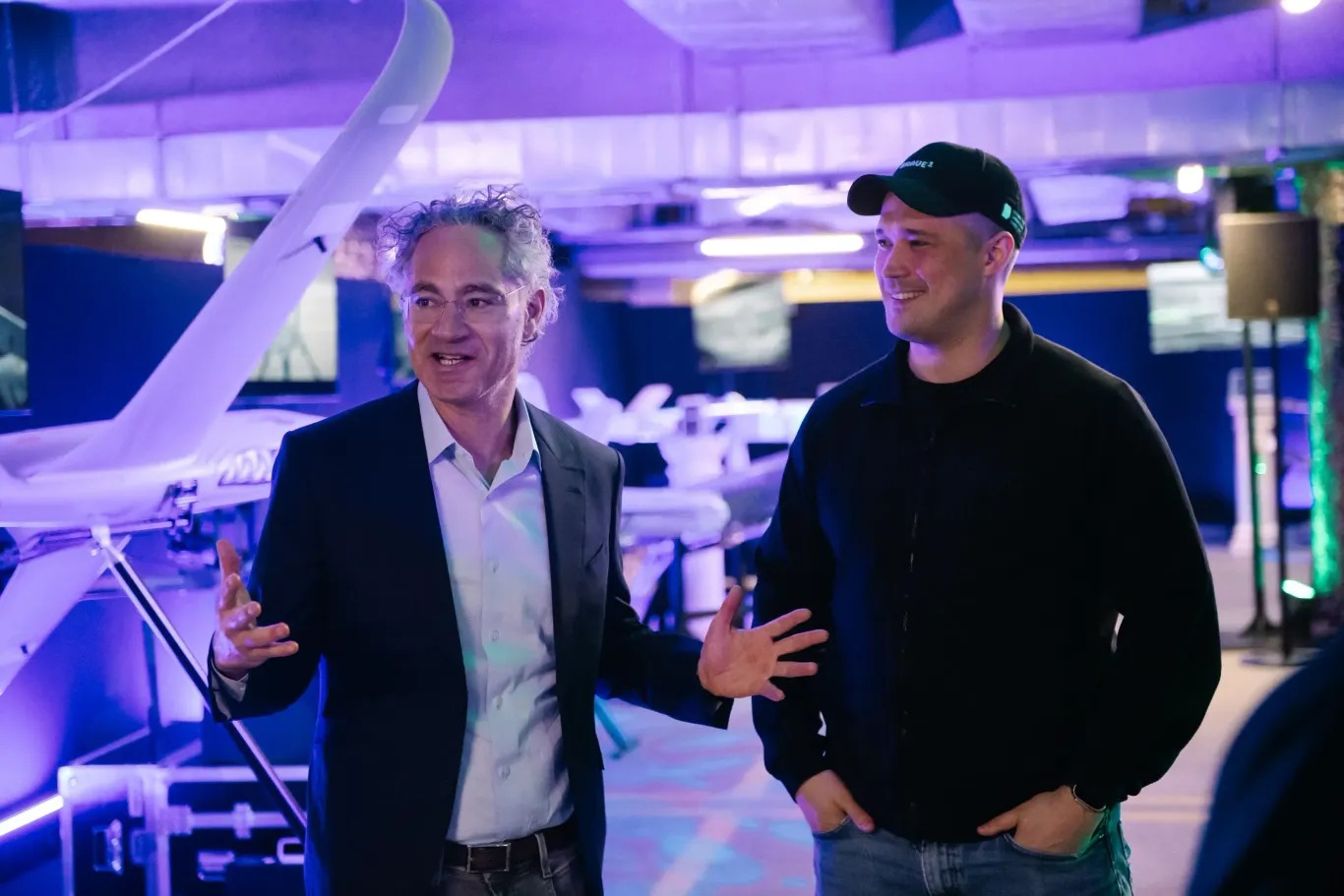
Here, one must guard against the temptation to overinterpret. Palantir can be analyzed as an element of military data infrastructure, a technology partner, a Big Tech actor, and a company connected to the broader world of American technopolitics. However, it cannot honestly be claimed that Ukraine’s cooperation with Palantir signifies the adoption of Yarvin’s ideas, a technomonarchy, or a dark enlightenment. That would be a conflation of levels: technological, ideological, and systemic.
Counterarguments and Reservations
The first caveat concerns Russia. There is no basis for claiming that the entire core of American neoreactionism is funded or controlled by Russian state institutions. Curtis Yarvin may echo theses converging with Russian imperial rhetoric toward Ukraine, and Nick Land may appear in Dugin’s media sphere. This is still not proof of agency, funding, or organizational control.
The second caveat concerns QAnon. It was not, from the outset, a simple Russian project. It was an American conspiracy ecosystem that Russian propaganda was able to exploit effectively. The difference is fundamental: origin is not the same as exploitation.
The third caveat concerns Ukraine. One must not equate the entire Ukrainian state, Ukrainian society, or the Ukrainian Armed Forces with far-right circles. The far right in Ukraine was electorally weak and did not seize central power. Its influence was real in certain niches, but uneven and limited.
The fourth caveat concerns Azov. The current military structure cannot be mechanically equated with the entire former political-ideological milieu of the National Corps or the Alt-right international. There are personal, symbolic, and historical continuities, but describing them requires separating the military formation from former political and networked projects.
The fifth caveat concerns language. The similarity of concepts is not proof of organizational dependence. Dugin’s anti-liberalism, Yarvin’s anti-democracy, QAnon’s conspiracy theories, and the alt-right’s white nationalist imagination can reinforce one another without a single command. Media, ideological, financial, and operational relationships must be described separately.
Why does this matter for information security?
The problem with neoreactionaryism, the alt-right, and QAnon is not solely about radical views. A democratic state can survive the presence of ideological fringes. More dangerous is the moment when radical language begins to permeate technological elites, mass communication channels, platform infrastructure, and transnational influence operations.
Neoreactionary ideology provides justification for stripping the majority of society of political agency. The alt-right frames the crisis of liberalism as an identity struggle. QAnon turns politics into a conspiracy in which the opponent is not a competitor but part of a hidden evil. Russian propaganda exploits these mechanisms because they erode trust in institutions and increase societies’ susceptibility to manipulation.
In this sense, the most important question is not whether a single centrally controlled network exists. What matters more is that an environment has emerged in which many different actors can utilize the same narratives. Technological anti-egalitarianism, conspiracy-driven mobilization, anti-Ukrainian propaganda, and Russian imperial revisionism do not need a common command center to work toward the same goal: undermining trust, pluralism, and democracy’s ability to defend itself.
The Dark Enlightenment is not a mass political movement, but neither is it an innocent intellectual game. Its significance lies in the fact that it lends an elite, technological, and seemingly rational language to an anti-democratic project. The alt-right and QAnon do something else: they bring anger, fear, and conspiratorial interpretations into mass circulation. Russia exploits this architecture wherever it can: it amplifies, distorts, hooks in its own narratives, and uses existing distribution channels.
The most honest assessment, therefore, is not that Moscow created the neo-reaction. Rather, one should conclude otherwise: the Russian state has learned to operate in a world where anti-liberal ideas, platform chaos, technological ambitions, and conspiracy politics create a common field of vulnerability. It is precisely this field that today poses a problem for democracy, information security, and state resilience.
Author: Artur Żak








.jpeg”, CC BY 3.0)