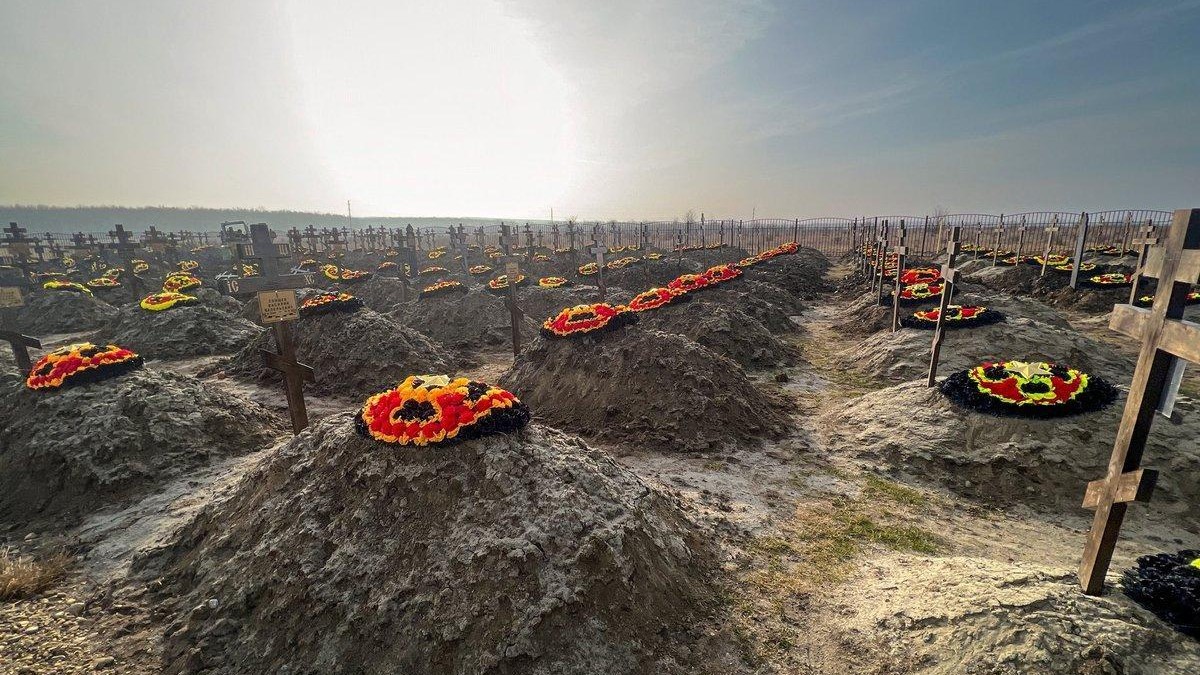

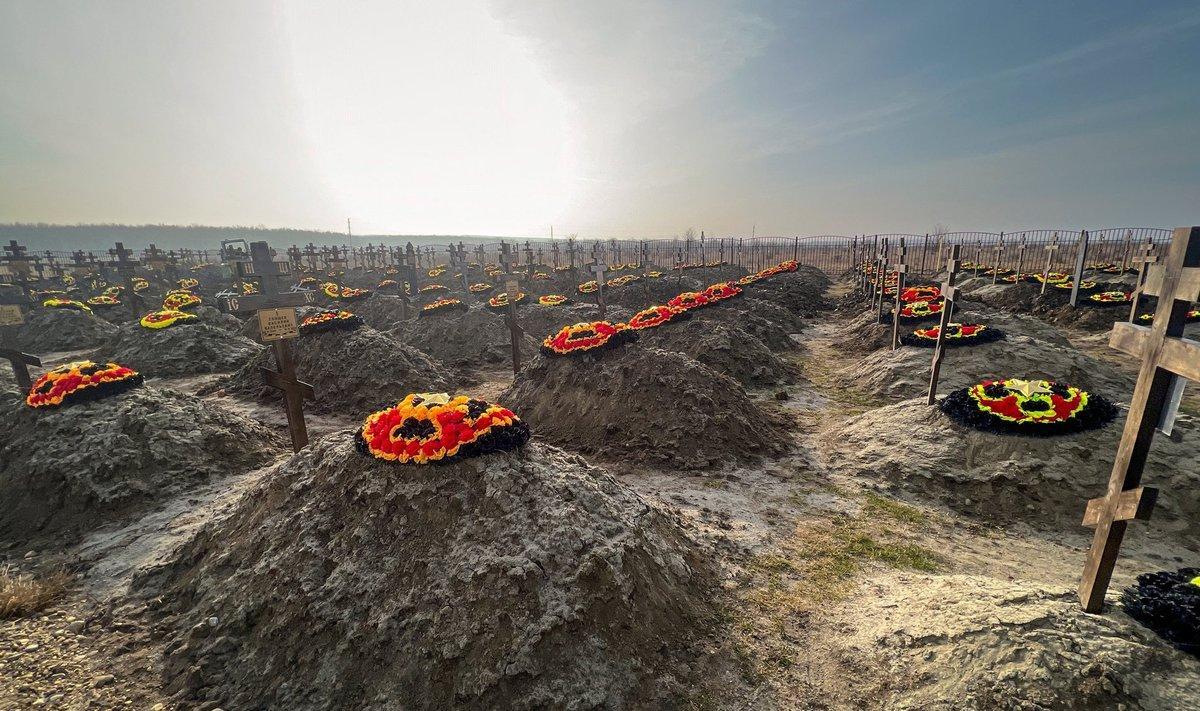
At least half a million people have died on Russia’s side since the start of the full-scale war against Ukraine. The real number of dead may exceed 700,000. These are the conclusions of journalists who, thanks to hackers, gained access to Rosstat’s internal data.
The Russian authorities themselves have not published official data on the number of dead for more than four years, while gradually closing access to other statistics that make it possible to estimate the scale of military losses indirectly.
In brief:
- Analysis of the Rosstat database obtained through a data leak allowed journalists to estimate the number of dead on Russia’s side since the start of the full-scale war at no fewer than half a million. The real number may exceed 700,000.
- Russian military losses grew significantly as the war went on. A particularly sharp rise in deaths was recorded in 2025.
- Thousands of foreign citizens are among the dead.
- For more than four years the Russian authorities have not published data on dead servicemen, consistently restricting access to demographic, social and budget statistics.
In early November 2026 the Belarusian hacker group Cyber Partisans and the Ukrainian group Silent Crow announced that they had breached Rosstat’s information systems. The data obtained in the breach – about 11.66 million unique records of deaths in Russia from January 2021 to the end of September 2026 – were handed to journalists. Analysis of this information made it possible to estimate the number of dead on Russia’s side since the start of the full-scale war in Ukraine.
When a serviceman is killed, this is first recorded in the documents of his military unit. Once the body is found and identified, a medical death certificate is issued. If a medical certificate cannot be issued, a special certificate issued by the military unit may serve as the basis for registering the death. If a serviceman goes missing, a court ruling declaring him dead may become the basis for registration.
On the basis of one of these documents, civil registry offices register the death and enter it in the Unified State Register of Civil Status Records, operated by the Federal Tax Service. From this register the information goes to Rosstat to produce mortality statistics.
The Rosstat database contains information on registered deaths, including dates of birth and death, sex, citizenship, occupation, and causes and circumstances of death. The data are anonymised and do not include the names of the deceased.
To check the reliability and completeness of the leaked data, journalists compared them with the register of inheritance cases of the Federal Notary Chamber, previously published official mortality statistics and lists of named Russian servicemen killed, compiled by independent investigators. Despite differences in methods of processing and interpretation, the newsrooms arrived at comparable estimates of the number of Russian servicemen killed.
So how many have died?
The Insider found at least 472,000 registered war-related deaths. Taking registration delays into account, it estimated the number of dead at about 485,000 at the end of September 2026, and at half a million at the time the investigation was published on 23 November.
Important Stories found about 499,000 records potentially linked to military losses. Of these, the journalists attributed 474,000 to military losses with a high degree of confidence. Taking registration delays into account, it estimated the number of dead at the end of September at no fewer than 611,000.
Novaya Gazeta Europe and the BBC Russian Service, after analysing the Rosstat database, found about 490,000 registered war-related deaths.
Germany’s Der Spiegel arrived at a similar result. At the same time, the journalists estimated the actual number of dead at the time of publication at about 600,000.
According to the Dossier Center, the number of dead is between 521,000 and 537,000. The count also includes foreign citizens who fought on Russia’s side.
The highest number of dead was arrived at in a joint investigation by Meduza and Mediazona. The journalists found about 490,000 registered war-related deaths. However, analysis of additional sources and statistical modelling suggested that the actual number of dead as of autumn 2026 could reach 700,000–720,000.
Delays in registering deaths
One of the key findings of the investigations was a significant gap between the date servicemen actually died and the date their deaths were officially registered.
Such delays may be linked to the impossibility of evacuating bodies from combat zones, lengthy identification of remains, paperwork, and court procedures to declare dead those servicemen listed as missing.
According to the BBC Russian Service, in 2025 an average of 150 days passed between a serviceman’s death and the discovery of his body, and 236 days until the death was documented. In August 2026 alone, the register recorded the deaths of more than 2,500 servicemen who had been killed back in 2025.
Journalists tried to estimate the scale of unregistered losses. According to Important Stories’ calculations, the Rosstat database may be missing the deaths of about 112,000 people.
Meduza and Mediazona concluded that as of autumn 2026 the actual number of dead may have exceeded the number of registered deaths by 210,000–230,000.
When and where did the Russian army suffer its heaviest losses?
Analysis of the Rosstat data shows a significant rise in Russian losses as the war went on. According to Important Stories, in 2022 an average of about 60 Russian servicemen died every day, in 2023 about 150, in 2024 more than 400, and in 2025 – 584.
In annual terms this corresponds to about 19,000 dead in 2022, 55,000 in 2023, more than 146,000 in 2024 and 213,000 in 2025. Data for 2026 remain incomplete: the leak covers only the first nine months of the year, and many deaths have not yet been registered.
Important Stories links the sharp rise in losses in 2025 to the battles for Pokrovsk in Donetsk region. On the territory of the Pokrovsk municipality alone more than 50,000 Russian servicemen were killed. In the outlet’s estimate, taking into account deaths not yet registered, the battle for Pokrovsk was the bloodiest operation of the entire full-scale war in Ukraine. There are almost a hundred registered deaths of Russian servicemen for every square kilometre of the municipality.
The fighting for Pokrovsk – an important transport and logistics hub of the Ukrainian army in western Donetsk region – lasted about two years. The Russian offensive began in February 2024. In February 2026 Russian forces took full control of the city, which they still hold.
Losses among foreign citizens
Journalists paid special attention to losses among foreigners who fought on Russia’s side. According to Important Stories, the Rosstat database contains records of the deaths of at least 6,000 foreign citizens, including holders of Ukrainian passports. But the real number of foreigners killed may be higher: about 75,000 records of dead servicemen contain no information on citizenship.
Novaya Gazeta Europe, excluding citizens of Ukraine and residents of the occupied territories from its count, found 4,495 foreigners killed. The largest numbers were citizens of Uzbekistan (about a thousand), Tajikistan (668), Belarus (578) and Kazakhstan (485). Outside the former Soviet space, the heaviest losses were among citizens of Colombia – 146.
Bloomberg took a broader approach to counting losses among foreign participants in the war, taking into account not only citizenship but also country of birth. Its journalists found 11,335 dead, more than 6,000 of whom already held Russian citizenship at the time of death.
The Bloomberg study also made it possible to trace how the geography of foreign recruitment into the Russian army changed. In 2023–2024 a notable rise in deaths was seen among people from Nepal, in 2024–2025 from Sri Lanka and China, and from late 2025 from Colombia, Kenya and Nigeria.
Who estimated Russian losses before the Rosstat breach, and how?
Throughout the war the General Staff of the Armed Forces of Ukraine has published daily estimates of Russian losses. According to its summary of 24 November 2026, total personnel losses of Russian forces since the start of the full-scale invasion stood at 1,641,489. The daily summaries do not list the number of dead separately.
An independent count of named Russian servicemen killed is kept by the BBC Russian Service, Mediazona and a group of volunteers. As of 23 November 2026 the researchers had established the names of more than 289,000 dead. This figure is a documented minimum, since by no means all deaths of servicemen become publicly known.
Britain’s The Economist also publishes its own estimates of Russian military losses. According to the latest data as of 16 November 2026, the number of Russian servicemen killed is estimated at 379,000–809,000, and total killed and wounded at 1.44–2.12 million.
The US Center for Strategic and International Studies (CSIS), in a report published in July 2026, estimated the Russian army’s total losses from February 2022 to the end of June 2026 at 1.4 million, including up to 450,000 dead.
Russia hides military statistics
Almost from the very start of the full-scale invasion, the Russian authorities stopped regularly publishing information on dead servicemen.
The last official figures on the total number of dead were released on 21 September 2022, the day partial mobilisation was announced. Then Russian Defence Minister Sergei Shoigu said that 5,937 Russian servicemen had been killed since the start of the war. Since then the Russian Defence Ministry has not published updated summary figures on the number of dead.
At the same time, the Russian authorities gradually restricted access to state statistics that made it possible to estimate the scale of military losses indirectly. Rosstat stopped publishing data on deaths from external causes, and the Social Fund of Russia stopped publishing detailed disability statistics, including disability due to military injury. The Defence Ministry stopped releasing data on the number of recipients of military disability pensions and survivors’ pensions. The restrictions also affected data on the number of combat veterans and on social payments to war participants and their families.
The restrictions also hit budget reporting. Analysis of federal budget execution data shows that the available financial statistics do not make it possible to establish even the total amount of state spending on payments to the families of dead servicemen.
Rosstat itself confirmed a cyberattack on its information systems on 1 November but denied a data leak. As of 24 November 2026 no public comments by the Russian authorities on the results of the journalistic investigations could be found.
Official Russian and Belarusian sources cited in this text are for informational purposes only. Content from these sources may constitute disinformation or propaganda.