
On 9 September 2026 Ukrainian drones struck two gas condensate plants belonging to Gazprom and Novatek in the Yamalo-Nenets Autonomous Okrug, roughly 2,800 km from the border, and for the first time the Yamal LNG complex, in which Chinese entities hold 29.9% of the shares, came within their reach. If the war begins to destroy the Russian raw-materials base that matters to Beijing, China may step up its pressure on the Kremlin – but at the beginning of October 2026 nothing indicates that this moment has already arrived.
In brief:
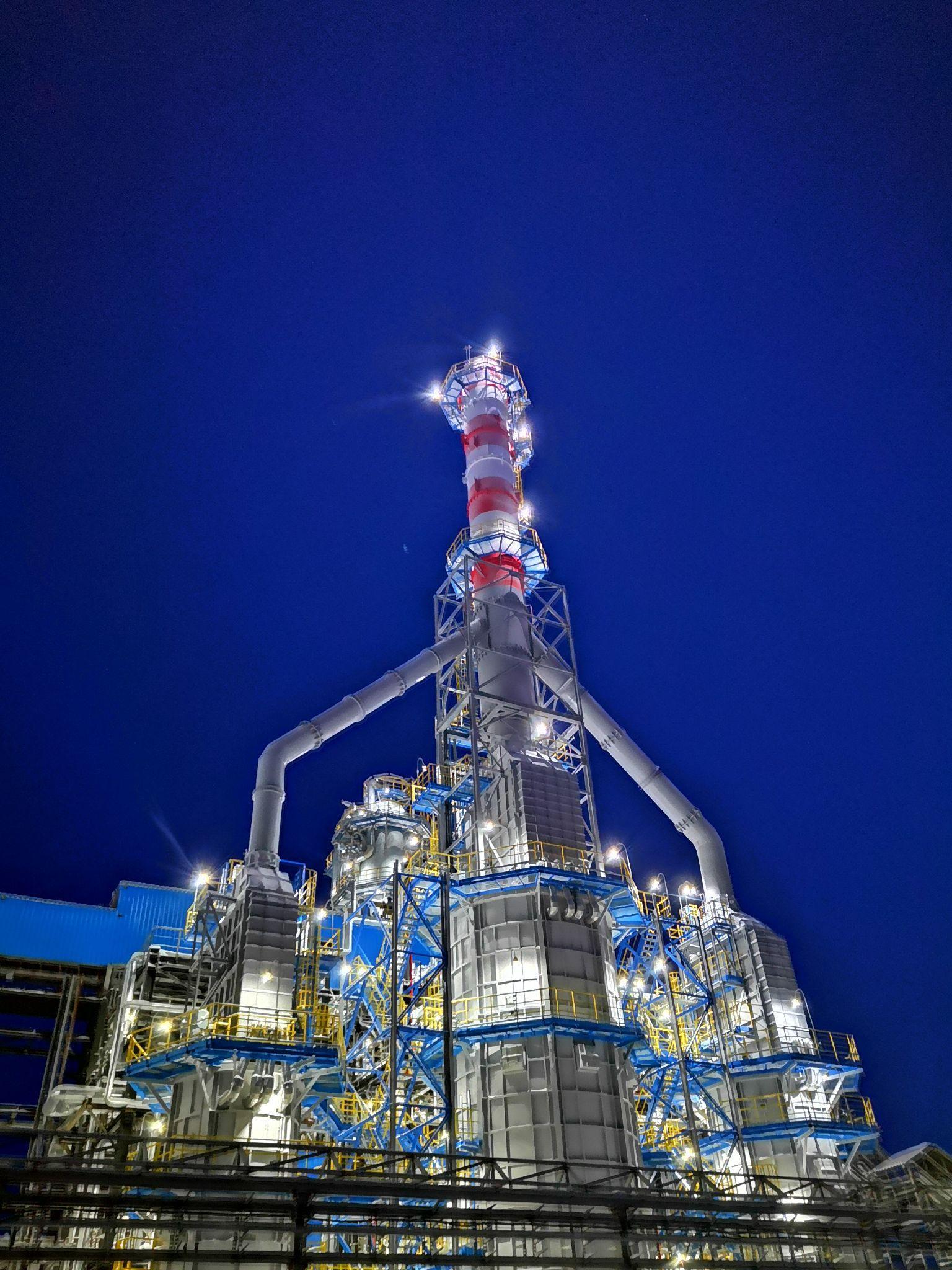
- On 9 September 2026 drones struck the Novy Urengoy plant for preparing condensate for transport (Gazprom Pererabotka) and Novatek’s Purovsky condensate processing plant, located roughly 2,800 km from the border with Ukraine in a straight line.
- In 2025 Yamal LNG exported 18.3 million tonnes of LNG – almost 60% of Russian exports; in 2026 nearly 89% of the cargoes from Yamal are going to the EU.
- CNPC holds 20% of the shares in Yamal LNG and the Silk Road Fund 9.9%; 29.9% in total.
- Regulation (EU) 2026/261 bans imports of Russian LNG under long-term contracts from 1 January 2027.
- On 1 October 2026 Vladimir Putin rejected the “energy truce” announced by Donald Trump and put Russia’s losses from the attacks on its refineries at around 1% of GDP.
From Saratov to Novy Urengoy: range as a political argument
On the night of 12–13 June 1943 the Luftwaffe began a series of air raids on the refinery in Saratov and, according to the Saratov “Book of Remembrance”, destroyed it “almost down to the foundations” in eleven days. From the Kharkiv area, where the front then ran roughly where it runs today, that is 650–700 km – one of the Luftwaffe’s longest-range operations on the Eastern Front.
Today the aggressor is coming from the east, and a defending Ukraine is multiplying that distance by four. According to the Special Operations Forces, on 9 September drones hit “two giants of the gas condensate industry”: the Novy Urengoy plant for preparing condensate for transport, owned by Gazprom Pererabotka, where, according to the Militarnyi portal, the de-ethanisation unit was damaged, and Novatek’s Purovsky plant. For now the scale of the destruction is a claim made by one side only.
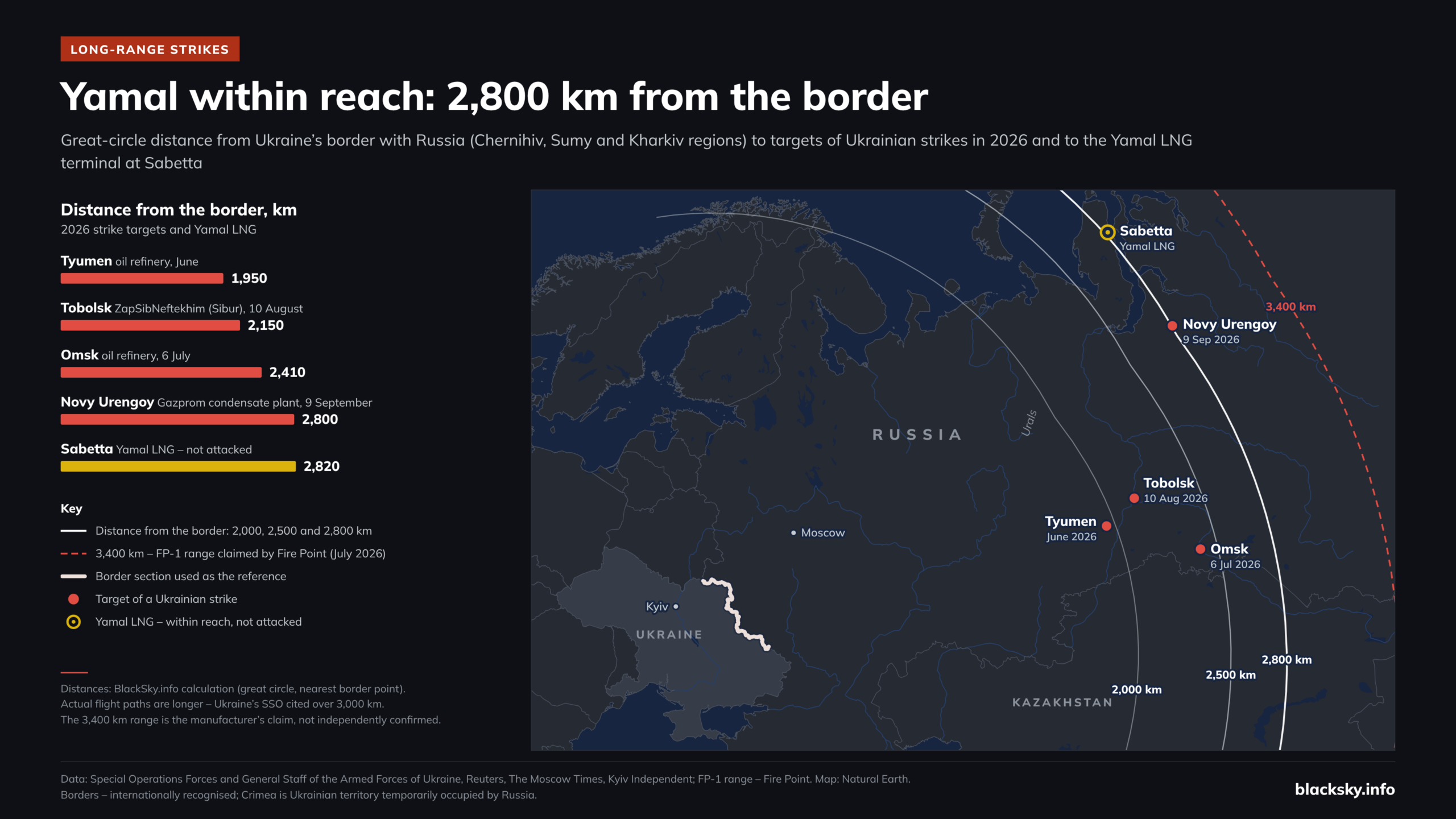
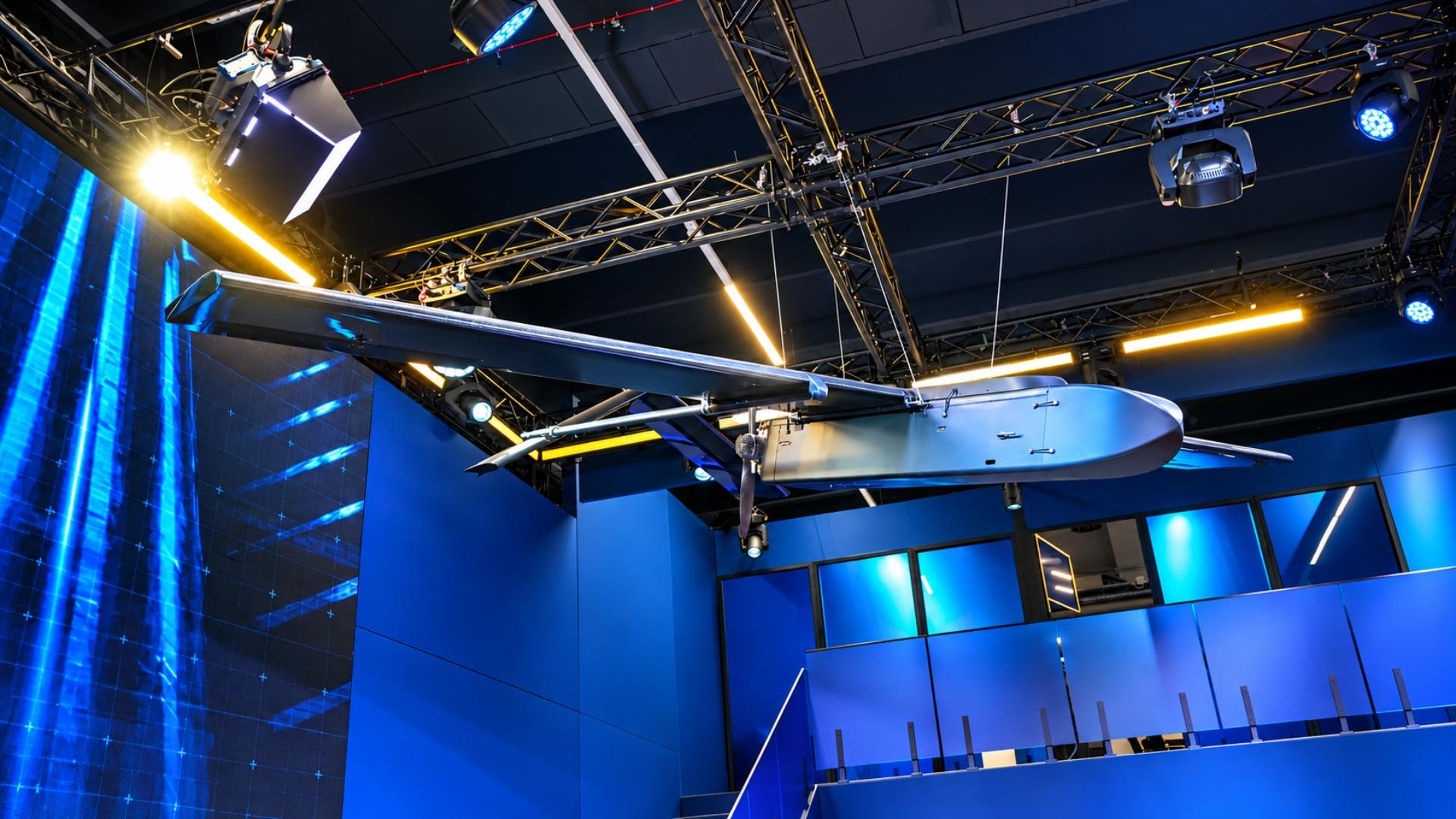
From the nearest stretch of the border, in the Sumy and Kharkiv regions, to Novy Urengoy is roughly 2,800 km measured along a great circle – that is the distance given by the independent outlet Verstka, and that is the distance my own calculations produce; reports of 3,000–3,300 km more probably describe the actual, longer flight route. Fire Point, the manufacturer of the FP-1, claims a range of 3,400 km for the modified version, dating from the July strike on the refinery in Omsk (roughly 2,300–2,500 km from the border). This is a figure declared by the manufacturer and not independently confirmed – just as it is not confirmed that this was the version used on 9 September.
Siberia without an umbrella: air defences cannot cover everything
Working from reports by Russian monitoring channels, I have reconstructed the drones’ approximate route: they skirted the large cities, where air defence systems are most likely stationed, and gradually veered to the north-east. They were last recorded in the Surgut area; after that, all the way to Novy Urengoy, roughly three hours of silence. That is about 560 km along a great circle, which, at the FP-1’s declared cruising speed of 140–180 km/h, is roughly how long the flight itself takes. A caveat is necessary: this is an OSINT reconstruction, and the absence of posts on Telegram does not prove the absence of radar tracking – at most it shows that no one managed or was able to react.
Russia’s reaction says more than the route itself. According to the state agency RIA Novosti, cited by The War Zone, a state of emergency was declared in the Khanty-Mansi Autonomous Okrug because of the drones, and six airports, including those in Surgut and Khanty-Mansiysk, temporarily restricted traffic. Russia already has to divide a limited number of modern air defence systems between the front, Moscow, airports, refineries and military plants – and the fuel crisis shows that it can no longer protect even the facilities on that list. Now facilities scattered beyond the Urals, in the tundra and the taiga, are being added to it. To put it arithmetically: the area that has to be covered grows in proportion to the square of the range, while defensive resources grow at best linearly.
The market priced in the range, not the losses – but against the backdrop of Hormuz
How serious was the attack itself? Without high-resolution imagery a reliable damage assessment is impossible, and I have no intention of guessing at it. The market responded faster: in the days after the attack TTF contracts for October delivery exceeded 80 euros per MWh – the highest level since December 2022 – and according to Bloomberg, cited by Ukraine’s NV, the strikes in the Arctic revealed new risks for the energy market.
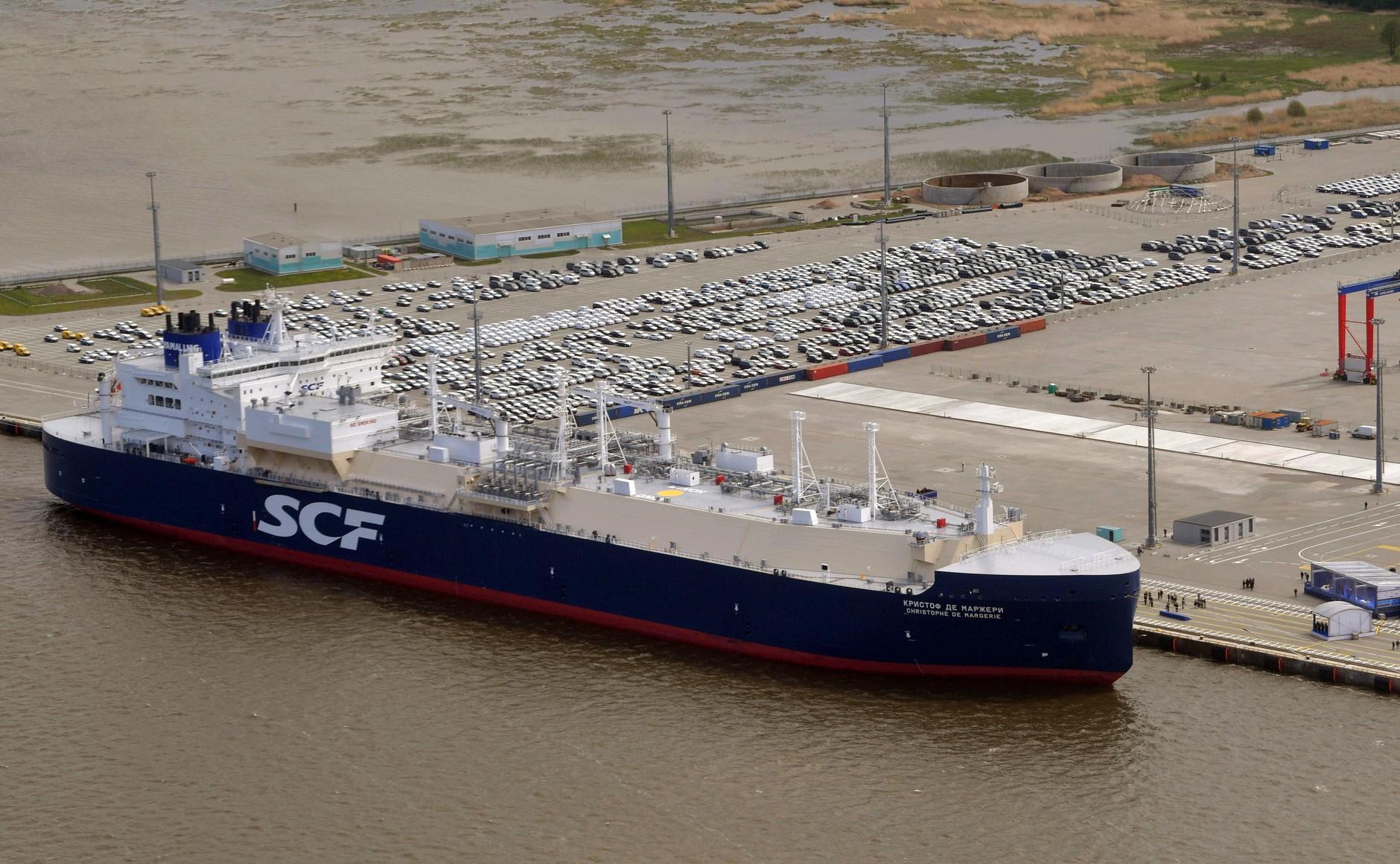
A paradox? The plants in Novy Urengoy and the Purovsky district process condensate that Europe does not need in critical volumes. So what the market priced in was not the losses but the range – facilities that nobody had hit before.
Here, though, I have to soften my own thesis. Gas prices had been rising for weeks for other reasons – the US war with Iran, disruptions in the Strait of Hormuz and the insufficient filling of European storage; it was these factors that Ekonomichna Pravda named as the main ones. Yamal was an additional risk, not the driver of the rise: the market added an Arctic premium on top of the Hormuz premium.
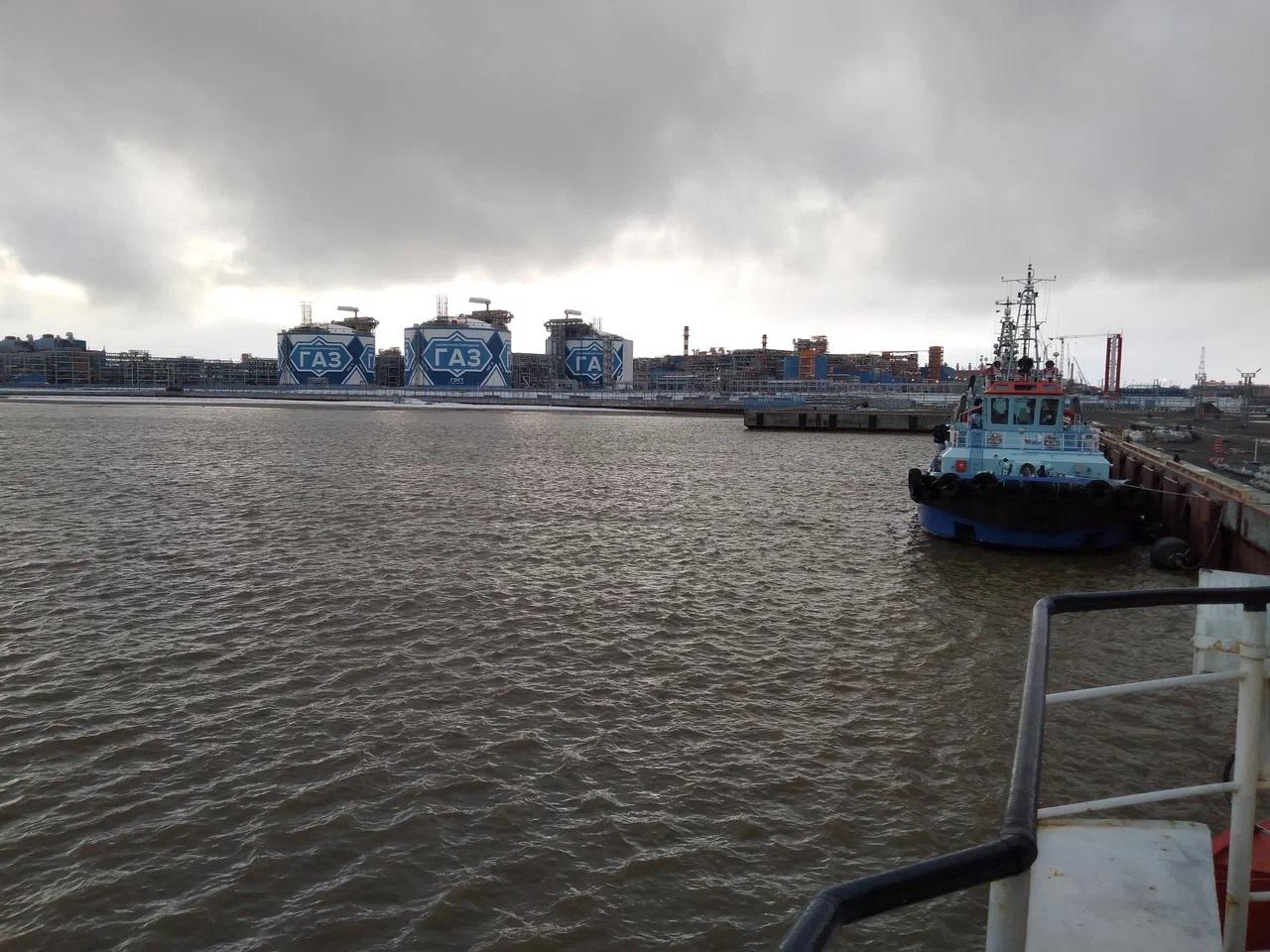
The most important thing about the new range is something else: Yamal LNG in Sabetta, roughly 600 km north of Novy Urengoy and roughly 2,900 km from the border. In 2025 the complex exported 18.3 million tonnes of LNG out of total Russian exports of 31.3 million tonnes – almost 60% (preliminary LSEG data). Europe remains the main consumer: between January and August 2026 nearly 89% of the cargoes from Yamal went to the EU, worth some 7.3 billion euros – more than in the whole of 2025 (Urgewald, using Kpler data).
Time is running out. Regulation (EU) 2026/261 bans imports of Russian LNG under long-term contracts from 1 January 2027. Will Ukraine, in solidarity with its allies, wait out those three months before turning to the infrastructure that brings the Kremlin billions? I do not know. What I do know is that the answer depends on more than Brussels.
Chinese capital is not a shield
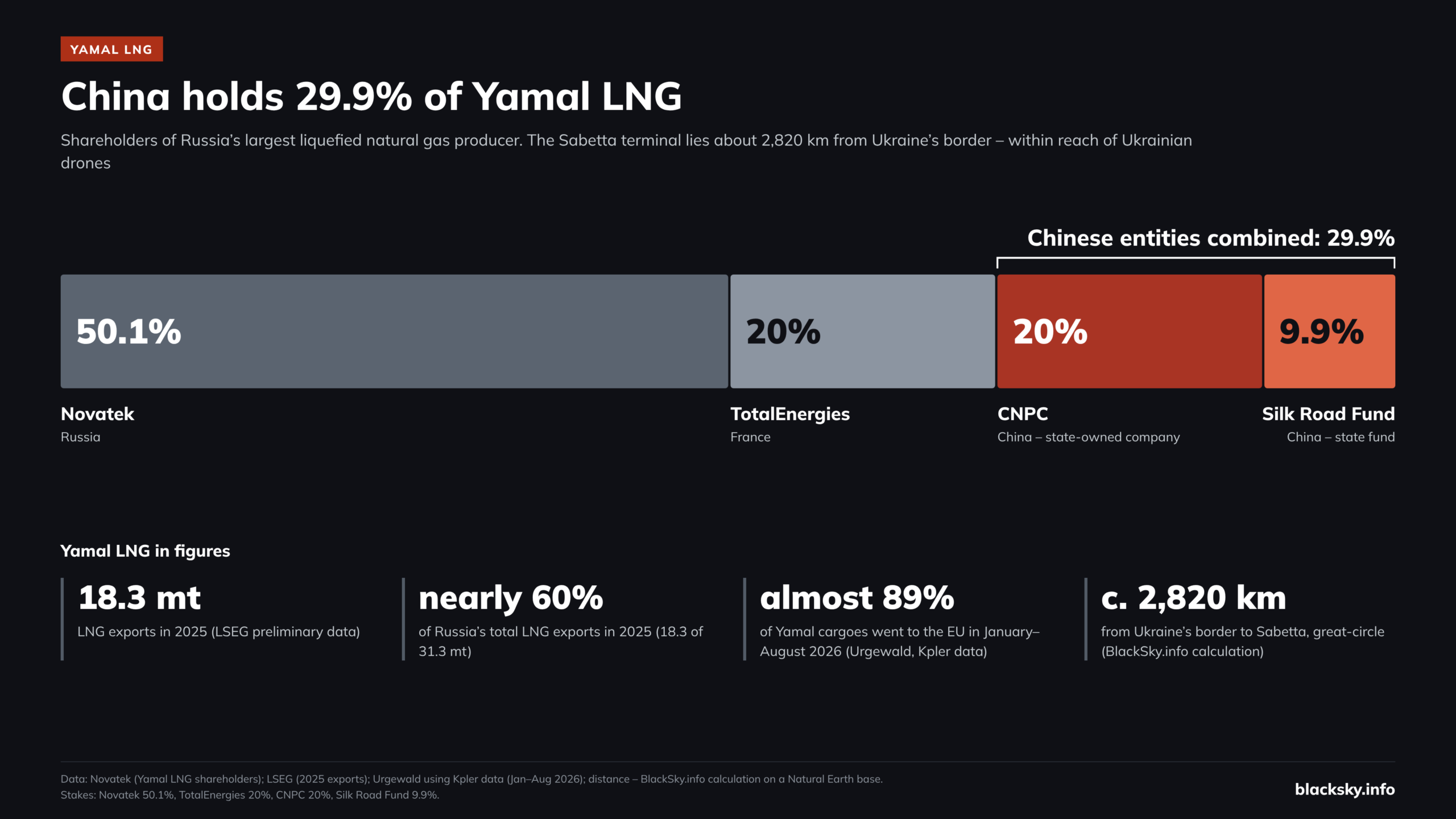
Sabetta is not only Russian money. According to Novatek’s own figures, the Chinese company CNPC holds 20% of the shares in Yamal LNG and the Silk Road Fund 9.9%, which together comes to 29.9%, that is “around 30%”. Here Beijing is a shareholder, not merely a customer.
Someone will say: Ukraine will not strike a facility into which Chinese money has been invested. Practice says otherwise. On 10 August drones hit ZapSibNeftekhim in Tobolsk, Russia’s largest petrochemical complex, owned by Sibur; according to a Reuters source, the plant has been shut down indefinitely. In Sibur, 8.5% of the shares belong to the Chinese company Sinopec.
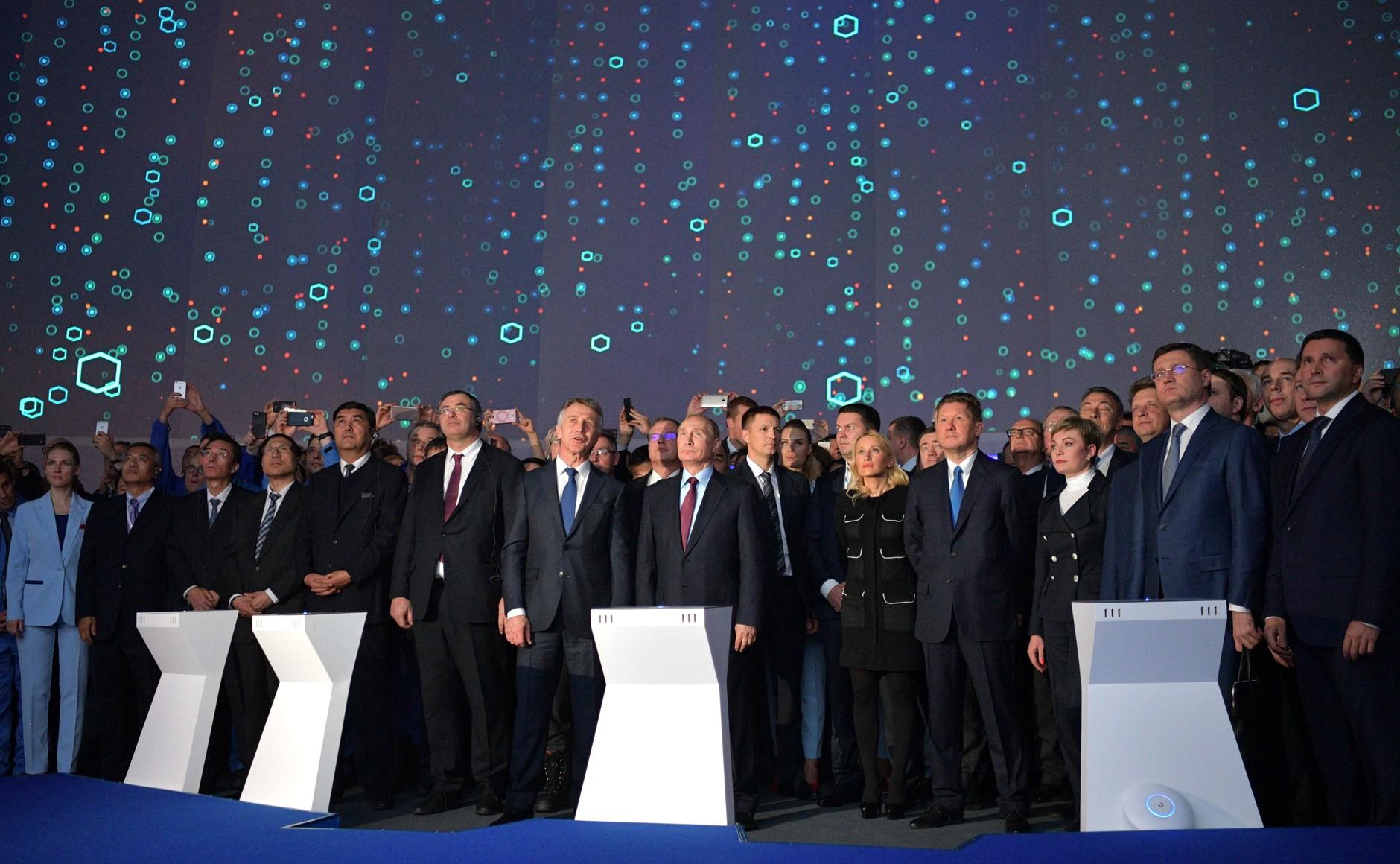
Beijing did not react – at least not publicly. Up to 2 October I had not come across any comment from the Chinese foreign ministry, CNPC or the Silk Road Fund on the attack on Novy Urengoy. The only clue is Ambassador Fu Cong’s statement at the UN Security Council of 25 August: China expressed “deep concern” that “vessels and assets of third parties are also coming under attack”. Whether this referred to Tobolsk, to tankers or to ships in Ukrainian ports is unknown; the wording is deliberately capacious. But the word “assets” is not used here by accident, in my view.
The war suits Beijing – until its own larder is on fire
Russian propaganda has for years celebrated a “friendship without limits”, even though China acts solely in its own interest. Chinese companies sell drones and components to both sides, though not in equal measure: according to an analysis by CSIS, in 2023 direct Chinese drone deliveries to Russia were worth 14.5 million US dollars and those to Ukraine 0.2 million, and since September 2024 Beijing has been restricting exports of key components. The war, meanwhile, deepens Russia’s economic and technological dependence on China.
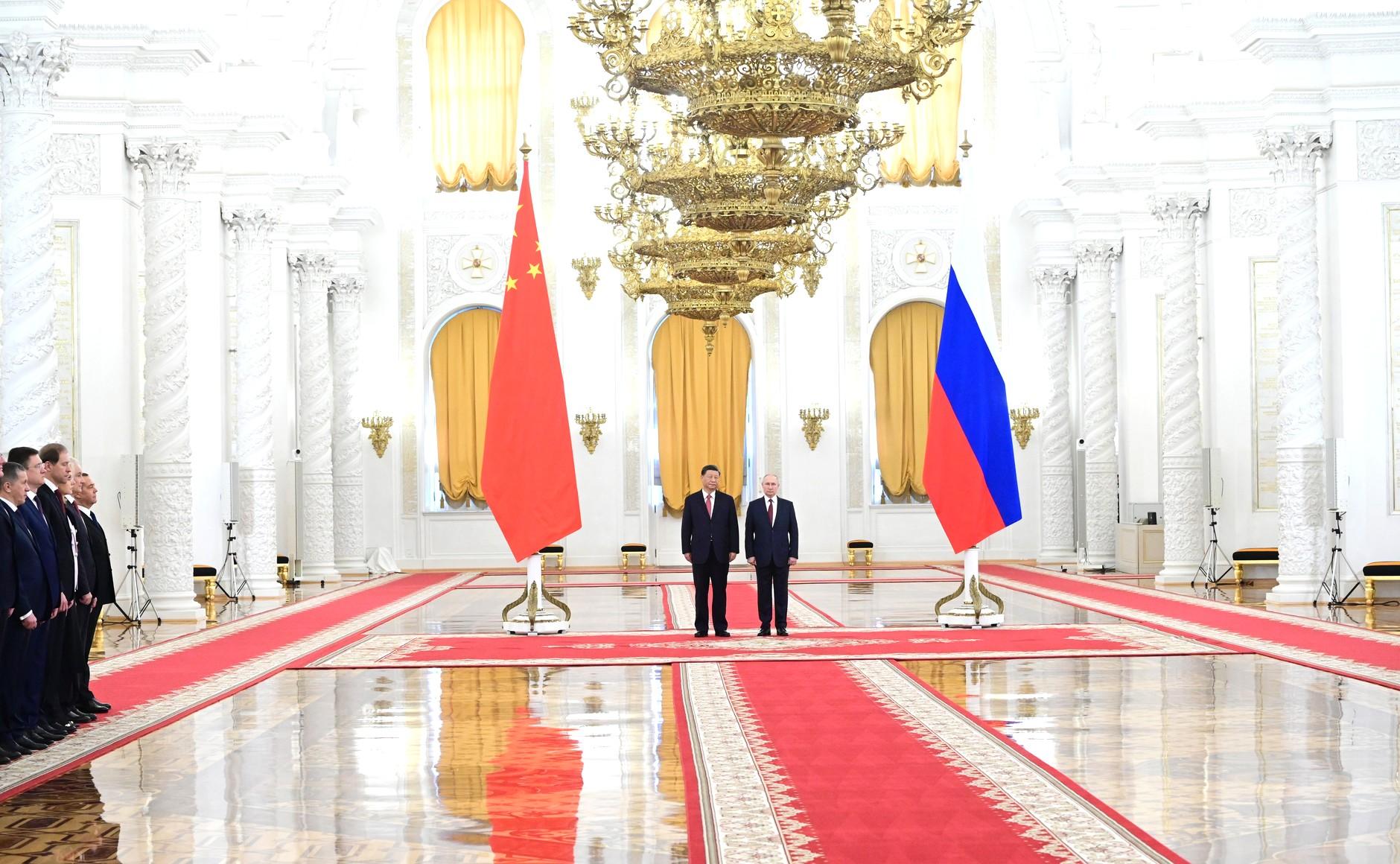
For Beijing, however, Russian raw materials mean more than cheap supply. They are an answer to the Malacca dilemma – the vulnerability to disruption of maritime transport that would be China’s Achilles heel in a confrontation with the United States. Erica Downs of the Center on Global Energy Policy at Columbia University estimates that 45–50% of Chinese oil imports pass through the Strait of Hormuz. The war with Iran turned that risk into a statistic: in the second quarter of 2026 Chinese oil imports fell by 32% compared with the previous quarter, and Russia remained their largest source.
Hence my working hypothesis: Beijing accepts the war as long as it deepens Russia’s dependence without jeopardising access to its raw materials. Dmytro Kuleba, Ukraine’s former foreign minister, put it well: China has no interest in Russia’s defeat, but no interest in its victory either, because a victorious Russia would demand an “equal” relationship instead of the present dependence.
“The Chinese need not simply Russia, but Putin specifically, because they understand him and he has signed up to commitments” – Dmytro Kuleba in an interview with Channel 5, December 2025.
When drones start reaching deposits and terminals, however, the balance changes. First Ukraine methodically destroyed refineries; now it has acquired the technical ability to reach facilities that are far more valuable to Beijing. A war that drives Russia into dependence is convenient for China. A war that burns down their Russian larder is not.
From “all parties” to Kyiv: signals, not a turn
In my reading of the transcripts of UN Security Council sessions after Kremenchuk (2022), Hroza (2023) and Okhmatdyt (2024), the same formula of Chinese diplomacy recurs: concern, regret, a call on “all parties” to show restraint – without naming the perpetrator. On 28 May 2026 the tone changed. China “took note of the reports of attacks on Kyiv”, expressed “deep concern” over civilian casualties and declared that it “condemns any attacks on innocent civilians”. According to the UN, at least five people were killed across Ukraine in the attacks of the preceding days, most of them in Kyiv.
The problem is that Ambassador Fu Cong had delivered the same formula six days earlier – at a session convened by Russia after the strike on a dormitory in occupied Starobilsk (as reported by the Chinese state outlet China Daily). What was new, then, was the mention of Kyiv, not the condemnation itself. This is symmetry, not a turn.
The same goes for the signals from closed-door talks. On 6 July in Oslo the head of Norwegian diplomacy, Espen Barth Eide, called his conversation with Wang Yi “constructive and promising”, and when asked whether China would use its influence over Moscow he answered cautiously (Reuters): “I am not a spokesman for China and I will not quote them, but there are certain hints in what they say.” On 10 July Volodymyr Zelensky said on Radio NV that, according to European leaders, China had reacted “very seriously, sharply and unequivocally” to Russian statements about the use of nuclear weapons. On 31 August Finland’s President Alexander Stubb told Politico how he had raised the subject with Wang Yi during the latter’s July visit to Helsinki.
“He said: we will never allow it to come to that. I think that is quite a good deterrent” – Alexander Stubb, President of Finland, in an interview with Politico, 31 August 2026.
Russia’s information machine responded within a day. On 1 September the newspaper Vedomosti ran a report under the headline “Chinese foreign ministry rejects Stubb’s words on guarantees over Russian nuclear weapons”, and pro-Kremlin portals went further, writing about the Finnish president’s “lie”. Meanwhile the Chinese foreign ministry spokesman Guo Jiakun, asked by Ukrinform, denied nothing: he referred to the communiqué on Wang Yi’s July visit and repeated that China’s position on the Ukrainian crisis and on nuclear weapons is “consistent and clear”. The mechanism is textbook: the headline adds content that is not in the quotation, and a reader who stops at the headline gets a “denial” that never happened.
So has Beijing changed its position on the war, let alone forced Putin to end it? No. Nuclear powers do not hold brotherly conversations, and in official statements the most one can count on is “concern”. These signals show that China is keeping its finger on the pulse and protecting its own interests – not that it is already applying pressure.
An energy truce: Putin thanked Trump, not Xi
On 14 September Donald Trump announced on Truth Social that “Ukraine has agreed not to strike Russian energy facilities” and that “Russia has agreed to do the same”. In Kyiv nobody had heard of any such arrangement; Zelensky declared his readiness on condition of reciprocity. Reality quickly disproved the post: on 20 September drones shut down the Moscow refinery in Kapotnya (Reuters), and on 30 September Russia carried out its heaviest massed strike in months against Ukraine’s energy system – for the first time using a drone with a warhead that cuts down high-voltage pylons.
Energy terror remains one of the Kremlin’s few trump cards: the front is static, there is no breakthrough, and Ukraine – as Zelensky said in July – is “squeezing” interceptor missiles for the Patriots out of its partners 5, 10 or 20 at a time. Giving it up before winter would mean that Putin had almost no serious means of pressure left. For Ukraine a truce would be objectively more valuable, all the more so because strikes on gas infrastructure would probably have been limited until 1 January anyway, out of regard for Yamal’s European customers. That the allies asked Kyiv to suspend attacks on oil production for the duration of the war with Iran is my hypothesis, not an established fact.
Trump has calculations of his own. The price of diesel in the United States recently reached a record $6.53 a gallon, and on 1 October the US president argued in the Oval Office that the problem with diesel stemmed not from the Middle East but from the strikes on Russian refineries. This is an attempt to shift responsibility for the consequences of his own war onto a country that has been fighting for survival for the fifth year. For China, however, simultaneous disruptions in the Persian Gulf and in Russia are not a matter of electoral ratings but a strategic problem – the strongest argument for the view that Beijing might take an interest in an energy truce.
The simplest indicator of Beijing’s involvement would be this: if Putin, replying to the truce proposal, thanks Xi Jinping, that will be a sign that China has pulled its levers. On 1 October, at Valdai, Putin replied. He called the exchange of “refineries for vessels” an absurdity, since sanctions block exports of Russian diesel anyway, admitted that the strikes on refineries had cost Russia around 1% of GDP, and thanked Trump for his efforts towards “resolving the Ukrainian crisis” (as reported by the pro-Kremlin site Lenta.ru). He spoke of Xi warmly, but not in this context. For now the test has come out negative – which does not rule out signals travelling through channels that are not visible. We have already written about the Kremlin’s games around the talks on the occasion of Witkoff and Kushner’s visit.
Asymmetry, not goodwill
The balance sheet as of today. Fact: Ukraine has drones capable of hitting targets some 2,800 km from the border; Yamal LNG, in which Chinese entities hold 29.9% of the shares, has come within their reach. Assessment: Beijing is watching the situation and protecting its assets, but is not applying pressure on the Kremlin in any way that could be documented. Forecast – and I will put it cautiously: if in 2027 Russia’s fuel and energy sector goes on burning and the Persian Gulf remains unstable, Beijing will have ever fewer reasons to tolerate a war that is destroying its rear. Chinese diplomacy may then start working towards real peace talks rather than the farce we are watching now.
Hence a line of reasoning I have been repeating for a long time: Putin can be stopped only by asymmetric responses to his terror – painful enough not merely to cost Russia dearly, but to change the interests of the states that sustain its capacity for aggression. An energy truce would be one of the possible outcomes. I am increasingly inclined to think that the date on which the war ends – and therefore the number of Russian corpses – is today also being decided in Beijing.
As early as the spring of 2014 Boris Nemtsov warned that Putin, by “delivering himself into China’s claws”, was exposing Russia to the threat of dismemberment, and of those who rule in the Kremlin he said that they were a “Chinese fifth column”. Twelve years on, however, it is Beijing that decides whether the Russian larder is a rear base for it or already only a burden. Beijing counts barrels, not victims – and that is why the drones over Yamal speak a language that is understood in Beijing better than any resolution.
Author: Artur Żak