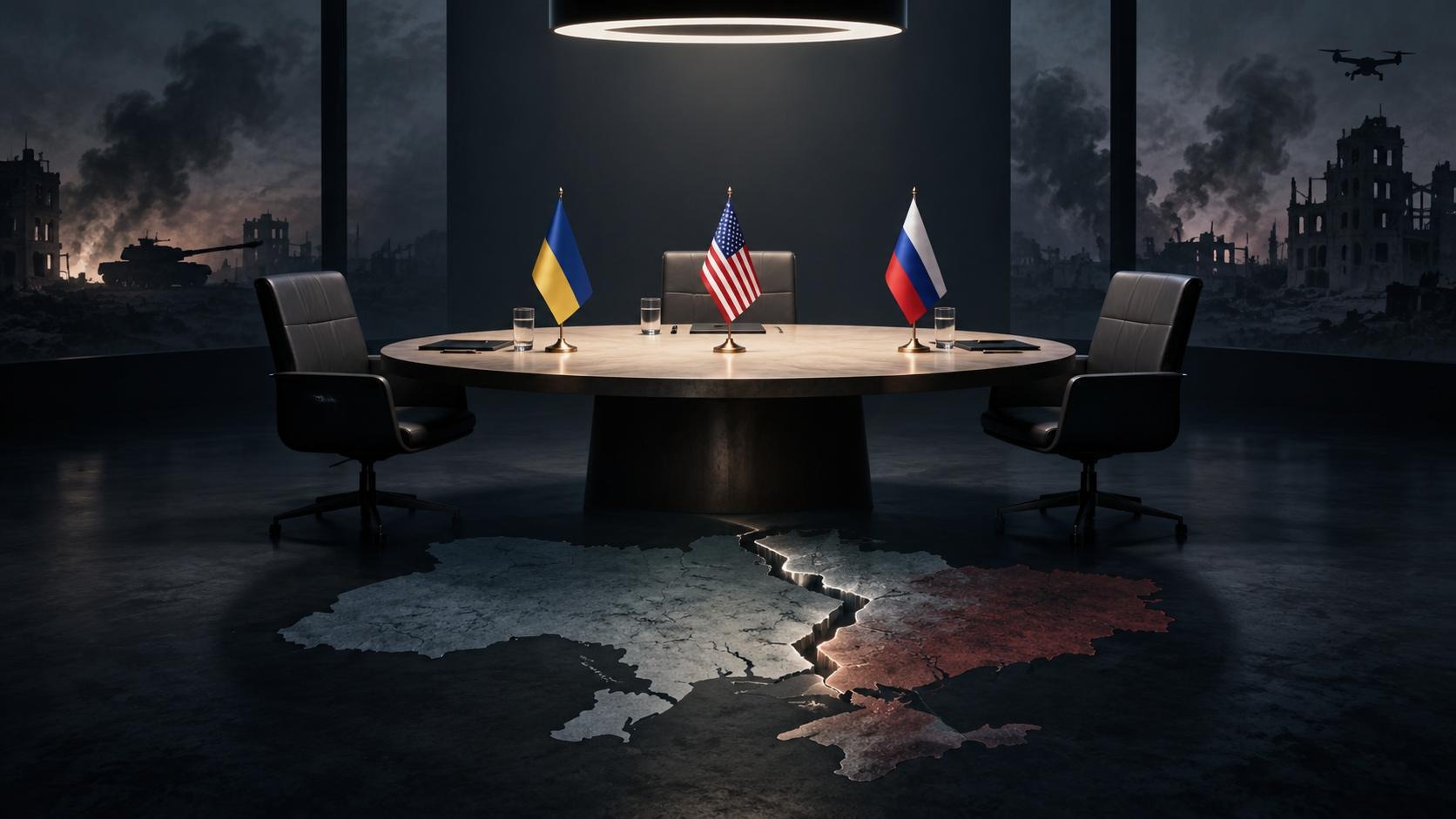

Ukraine is preparing for a new round of talks with Russia and the United States in October. Moscow says it is ready to return to a trilateral format, Washington speaks of searching for “the right formula”, and Kyiv insists on the need for a systematic negotiating process. Meanwhile the central contradiction of the Russian-Ukrainian war remains unchanged – territory, and the terms on which the war might end.
In brief:
- Ukraine is preparing for a new round of talks in October. Kyiv says it is ready for a trilateral format – Ukraine, the United States and Russia. Moscow is not ruling out a return to talks either.
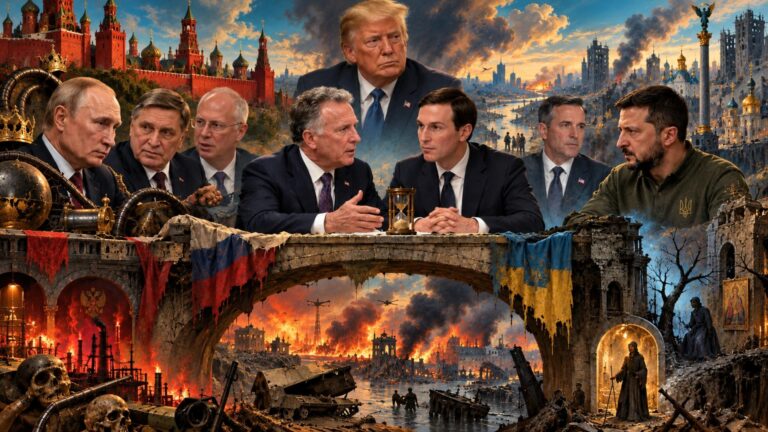
- The United States has stepped up its diplomacy. After the meetings between Steve Witkoff, Jared Kushner, Putin and Zelensky, Washington is trying to seat the parties at one table again and find a formula for ending the war.
- The main obstacle is territory. Russia insists on its territorial demands and Ukraine is not prepared to accept them. This is precisely what Kushner calls the hardest question in the talks.
- Talks do not yet mean that peace is closer. Even a possible halt to hostilities would not guarantee an end to the war. For Ukraine the fundamental questions are security guarantees and mechanisms that would stop Russia resuming its aggression.
- October may become the start of a new diplomatic stage, but not necessarily the end of the war. If the talks happen, their main result may be the creation of a permanent negotiating mechanism. Whether Russia is ready for real compromises remains unknown.
After a pause of several months, the process of negotiating an end to the Russian-Ukrainian war is once again at the centre of international diplomacy. On 12 September the head of Ukraine’s Presidential Office, Kyrylo Budanov, said that Ukraine was preparing for a new round of peace talks in October. He said this specifically concerned a trilateral format – Ukraine, the United States and Russia. The venue has not yet been disclosed.
Almost simultaneously, the head of the Servant of the People parliamentary faction and member of Ukraine’s negotiating team, David Arakhamia, said he was almost certain that Russia would return to the negotiating table in early October – after the elections to Russia’s State Duma, scheduled for 18–20 September. October is thus beginning to look not merely as a possible date but as a concrete window of opportunity for resuming trilateral dialogue. Expectations among Ukrainian and Western representatives about the results of the pseudo-elections to the Duma may, however, be overstated.
The question is therefore obvious: can a new round of talks lead to a real end to the war if the parties’ positions on how it should end differ fundamentally?
American diplomacy has moved talks into an active phase
The new stage of diplomatic activity began after the trip to Moscow and Kyiv by President Donald Trump’s special envoys, Steve Witkoff and Jared Kushner.
On 5 September the American representatives held a meeting lasting several hours with Vladimir Putin in Moscow. The next day they arrived in Kyiv, where they met Volodymyr Zelensky and also held talks attended by Ukraine’s European partners, represented by international security advisers from the United Kingdom, Germany and France. It is worth noting that this was Witkoff and Kushner’s first visit to Kyiv within their diplomatic mission. The American side said the aim of the trip was to bring the positions of Moscow and Kyiv closer together and to prepare the next stage of negotiations.
After the meetings Witkoff spoke of “significant progress” in planning further trilateral talks. President Zelensky stressed afterwards that Ukraine was ready to return to a trilateral format involving the United States and Russia. At the same time Kyiv and Washington agreed to continue separate consultations with European partners. US Secretary of State Marco Rubio, for his part, described Witkoff and Kushner’s talks in Moscow and Kyiv as substantive and expressed the hope that they would help create a path towards resuming the negotiating process. Washington is in effect acting as an intermediary between the two sides, trying first to restore the negotiating mechanism itself. But does the Trump administration remain an “honest broker”? Unfortunately, that is not something one can say.
Moscow is also talking about returning to a trilateral format
The Kremlin has also made clear in recent days that it is not closing the negotiating channel. Kremlin spokesman Dmitry Peskov maintains that Russia remains open to talks and hopes to meet again soon in a trilateral format – Russia, Ukraine and the United States. Moscow has not yet confirmed a specific date or venue for a future meeting. There is a willingness to talk about talks, but no concrete agreement on a summit. This is precisely why Kyrylo Budanov’s statement about preparations for October matters – Kyiv is now speaking not merely of a wish to resume negotiations but of preparations for a specific round, evidently drawing on a shared position with Western countries.
Why October
One explanation was given by David Arakhamia. He said he expects the Russian side to return to the table once the elections to Russia’s State Duma are over. The vote is scheduled for 18–20 September 2026. Russia also intends to hold it in the temporarily occupied territories of Ukraine, which Kyiv and the international community regard as unlawful. The starting point therefore raises doubts about its usefulness. The managed character of voting in Russia is not in doubt; around 150 participants in the Russian-Ukrainian war are expected to enter the new Duma, and this “Putin draft” is to guarantee that the Kremlin’s course remains unchanged. They have learned to play at democracy well there.
Even so, the beginning of October may be the window in which the Russian leadership is ready to return to the diplomatic track. For now, though, this is a forecast by a Ukrainian negotiator, not an agreement between the parties. Notably, alongside his optimistic forecast Arakhamia acknowledged that the current negotiating process lacks substance. In his view the parties need to create a permanent negotiating mechanism – a kind of “tunnel” in which the same representatives meet regularly in the same place.
The idea is not that every meeting should end immediately in an agreement. On the contrary – what is needed first is a regular channel of communication that will allow the parties to move gradually towards resolving difficult questions. “This is the basis and the foundation for achieving a result,” Arakhamia explained. His approach reflects an important shift of emphasis: negotiations need not be a one-off summit charged with signing a peace agreement at once, but a prolonged process. His personal approach is to seek talks with each member of Putin’s circle separately, although the Servant of the People faction leader acknowledges that the hawks dominate in the Kremlin.
Kushner: the main problem is territory
The most concrete assessment of the current state of the talks came from Jared Kushner. Speaking at YES in Kyiv, he named the territorial question outright as the hardest problem still dividing Ukraine and Russia. According to Kushner, Putin’s position on territory has already been formulated. If Ukraine agreed to withdraw to the line the Russian president demands, a large part of the rest of a potential agreement would, he said, already be ready.
But Kyiv does not agree to this. The task of the American mediators, Kushner explained, is therefore to find a “creative solution” that would take Ukraine’s position into account while also getting Russia to stop the war. That, in effect, is the central knot of the current negotiations.
Moscow wants to lock in its territorial demands. Ukraine is not prepared to agree to their implementation. The United States is trying to find an intermediate formula – while applying pressure to the victim of aggression, Ukraine, rather than to the aggressor.
Separately, Kushner set out Washington’s position even more directly. If Ukraine agreed to withdraw to the territorial line Putin demands, he said, “the rest of the deal” would already be ready. The American representative acknowledged, however, that Ukraine does not want this at present. Washington is therefore looking for a formula that would allow the war to be ended without simply forcing Kyiv to accept Russian demands. At the same time Kushner said the territorial question depends to a large degree on the situation on the battlefield. This means the talks remain closely tied to events at the front, where the occupying forces’ attempted summer offensive proved a failure.
Washington talks about “the right formula”
At the same time the American side is not claiming that a finished agreement already exists. In a new statement on 13 September, Kushner stressed that Washington is continuing to look for “the right formula” that would allow all sides to move forward. He said Donald Trump takes the question of ending the war seriously, and that Zelensky – and, in Kushner’s assessment, Putin – are also interested in ending it. “The main thing is to find the right formula,” the American envoy said. The wording matters, because it shows that the American side is still speaking of a search for a solution, not of an agreement already reached.
Peace, or a frozen war?
One of the most contentious parts of the American approach is the idea of halting hostilities in practice even while the political questions remain unresolved. Kushner spoke of the need to find a solution that would end the conflict and create a system preventing its recurrence. For Ukraine this is a matter of principle. A potential ceasefire without reliable security guarantees could mean not the end of the war but merely a pause, after which Russia would have time to build up its forces again. For Kyiv, therefore, the question is not only when hostilities stop, but what exactly would guarantee that Russia does not start them again.
The paradox of the present situation is especially visible in Kyiv. Kushner spoke of Putin’s readiness to end the war at the very moment when Ukraine was still enduring massive Russian missile and drone attacks. On 12 September Russia carried out another large-scale air attack on Ukraine. According to Volodymyr Zelensky, Russia launched almost 500 strike drones from the morning onwards. The Russian strikes killed civilians and damaged residential buildings, infrastructure and businesses in various regions. For Ukraine, diplomacy does not exist separately from the war but directly inside it. And it is precisely this gap between diplomatic statements and reality on the ground that remains one of the main challenges for any negotiating process.
The Trump administration is looking for a diplomatic success it can sell to Republican voters ahead of the midterms – the mid-term elections to Congress due in November. Washington has not managed to shift the situation around Iran, so it has decided to press Kyiv instead. Donald Trump openly called on Volodymyr Zelensky to stop hitting Russian diesel, even though the United States is itself the world’s largest exporter of diesel fuel, with an 18 per cent share of the global market.
Has Russia’s position changed?
So far there are no grounds for speaking of any fundamental change in the Russian position. Moscow declares readiness to return to talks while continuing military pressure on Ukraine. The mere fact of being willing to meet does not mean being willing to compromise. That is precisely why it matters to Kyiv that the negotiating process does not turn into a mechanism of one-sided pressure on Ukraine to concede territory for the sake of a quick halt to the fighting.
Volodymyr Zelensky publicly expressed readiness to travel to Miami in December for talks with Putin, who may fly there for the G20 summit. Putin’s press secretary Dmitry Peskov, lowering the level of the discussion, said that such an option was not being considered and suggested that Zelensky fly to Moscow instead. That option would evidently be presented publicly as Ukraine’s capitulation.
In parallel, Washington is already thinking about post-war Ukraine
Another important detail voiced at YES is that Washington is working in parallel on Ukraine’s future economic model. Kushner confirmed that Kyiv and Washington are working on a Ukraine Prosperity Plan. He said the World Bank and BlackRock, among others, are involved in the work.
The American representative spoke of the need to think now about Ukraine’s economic potential after the war ends and about creating conditions to attract capital. This shows that the American diplomatic team is interested not only in halting the fighting but in what follows. Yet a fundamental question arises here too: what will Ukraine be like after the war if its borders and security conditions remain undefined? Kushner’s own words effectively tied the country’s economic future to its future border and to a political settlement. Ukraine does, admittedly, already have an agreement with the United States on rare earth extraction, signed in May last year, which reeks strongly of a colonial approach.
What to expect from October
As things stand we have several facts. Ukraine says it is preparing for a new trilateral round in October. Budanov confirmed that format but did not name a venue. According to Peskov, that venue could be Abu Dhabi. Arakhamia expects the Russian side to return in early October, after the Duma elections. The Kremlin declares openness to resuming trilateral talks, but a specific date and place have not been agreed publicly. After Witkoff and Kushner’s trip to Moscow and Kyiv, the United States continues working on restoring the negotiating process. At the same time Kushner admits that the parties have no shared vision of how the war should end, and that territory remains the hardest question. An October round, if it happens, should therefore hardly be seen as an automatic path to signing a peace agreement. It is more likely to be an attempt to create a permanent negotiating mechanism and to test whether a formula acceptable to Ukraine, Russia and the United States exists at all.
Is peace getting closer?
There is undoubtedly some diplomatic movement in that direction. After a long pause Washington has stepped up contacts with Moscow and Kyiv. Ukraine has confirmed its readiness for a new trilateral round. Russia is not publicly refusing to negotiate. But there remains an enormous difference between talks about peace and peace itself. The main questions are territory, security guarantees, the future architecture of European security and the mechanisms that would stop Russia repeating its aggression. That is why the coming weeks will matter less for the possible date of a meeting than for what proposal the United States actually brings to the table, and whether Russia is ready to move from declarations of readiness to negotiate towards real compromises. October may be the beginning of a new stage of diplomacy. Whether it will be the beginning of the end of the war is impossible to say for now.
Author: Svitlana Mialyk
Official Russian and Belarusian sources cited in this text are for informational purposes only. Content from these sources may constitute disinformation or propaganda.