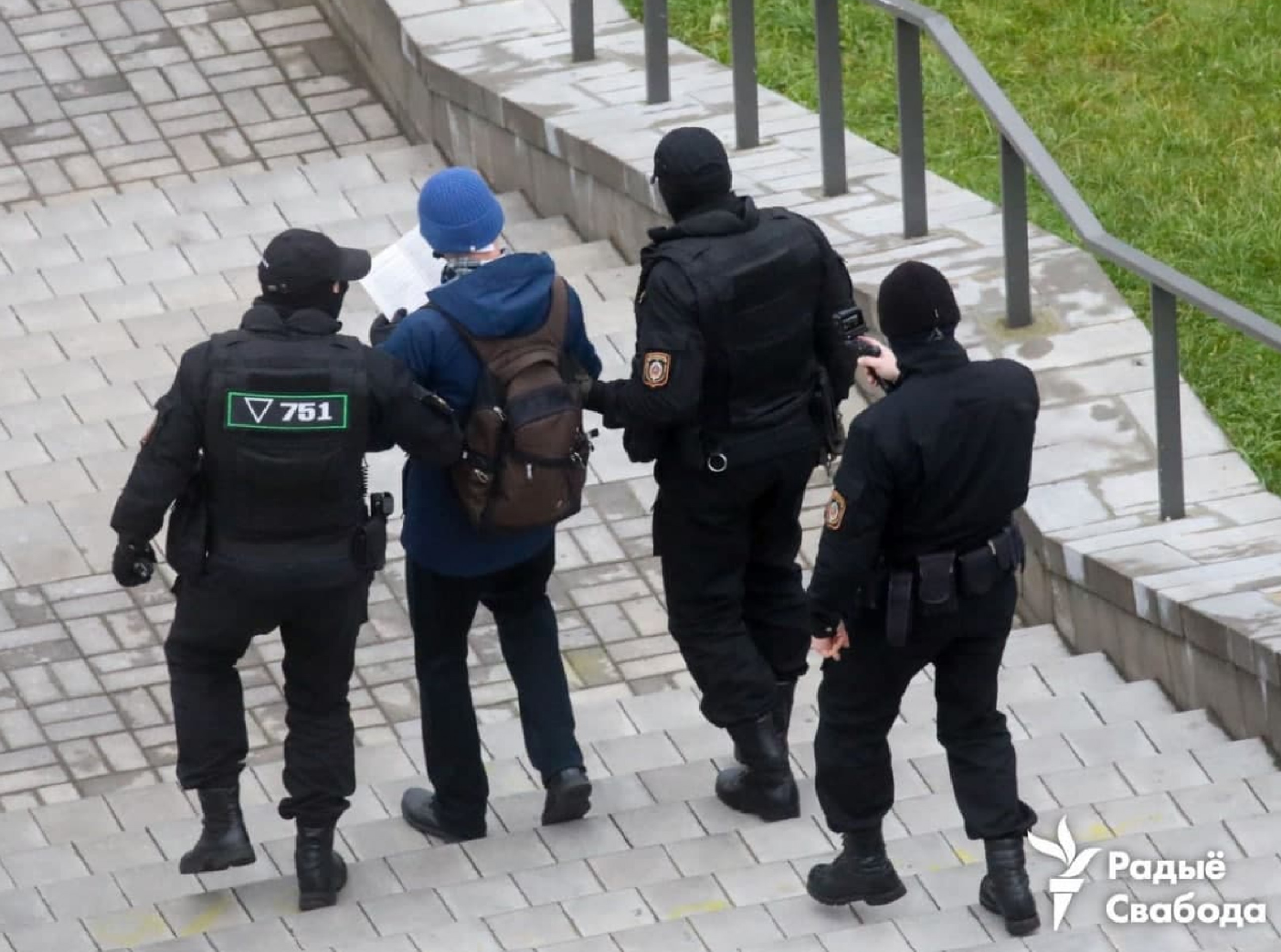

Poland has begun refusing to grant international protection to Belarusian citizens, arguing that the human rights situation in Belarus is becoming more lenient and that opponents of Lukashenko’s regime are no longer at risk and can return to their homeland. ‘Black Sky’ investigates what the reality is.
IN BRIEF:
- The Polish Office for Foreigners is trying to prove that there are fewer detentions and imprisonments in Belarus, and that Lukashenko has pardoned many people.
- After promising the Americans to ease the repression, the Belarusian authorities simply made it covert.
- During the amnesty period, more people were imprisoned than were pardoned
- People do not know what pretext the security services might invent to imprison you if you disagree with Lukashenko’s policies.
- Polish state institutions need to read human rights defenders’ reports more carefully.
Office for Foreigners: fewer people are being imprisoned in Belarus
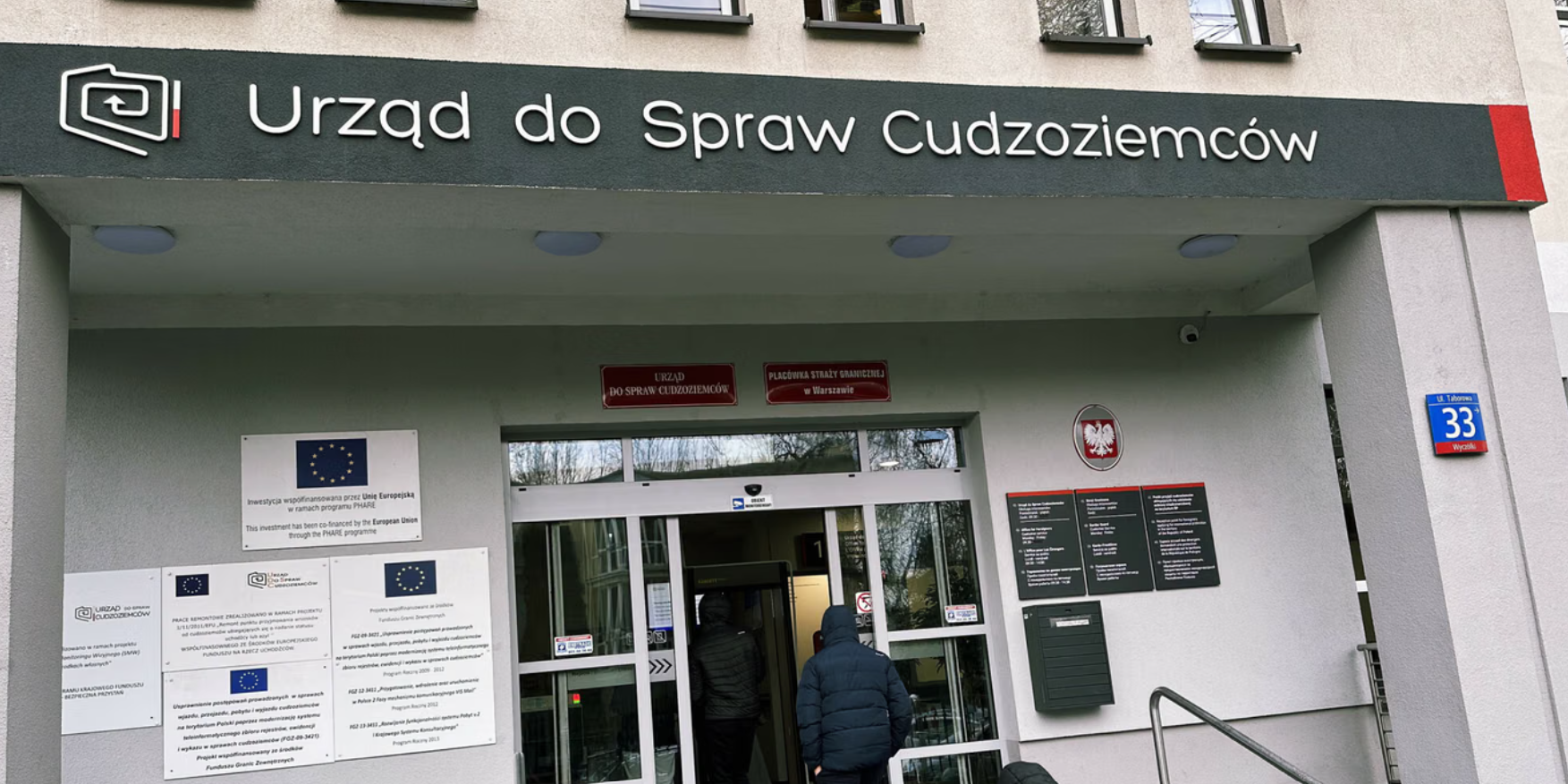
A copy of one of the decisions refusing to grant international protection to a Belarusian national was published on her Facebook page by Olha Timkina, an activist who helps Belarusian citizens regularise their status in Poland. Citing a report by the WIKP (Wydział Informacji o Krajach Pochodzenia – Department of Information on Countries of Origin), compiled on the basis of data from the Belarusian Human Rights Centre ‘Viasna’, the Office for Foreigners (Urząd do Spraw Cudzoziemców – UDSC) will attempt to prove that the applicant is not at risk of arrest and imprisonment in Belarus.
The Office for Foreigners justifies this assertion, in particular, by pointing out that whilst around 50,000 people were detained in Belarus between 2020 and 2025, in 2024 only 140 people who had taken part in the 2020 protests whereas between 2020 and 2025 around 14,000 protesters were subject to administrative penalties, in 2025 only 29 people were subject to administrative penalties, whilst around 4,000 protesters were subject to criminal penalties between 2020 and 2025, in 2025 ‘only’ 643 people were sentenced to imprisonment.
The UDSC also emphasises that in 2026, the statute of limitations expired for prosecution under Article 342 of the Criminal Code of Belarus (organising or participating in actions that disrupt public order), under which protesters were most frequently convicted. Now, they can only be convicted under Article 293 of the Criminal Code (mass disturbances). However, the Viasna Human Rights Centre, in its reports for January–February 2026, does not cite a single case of conviction on such grounds.
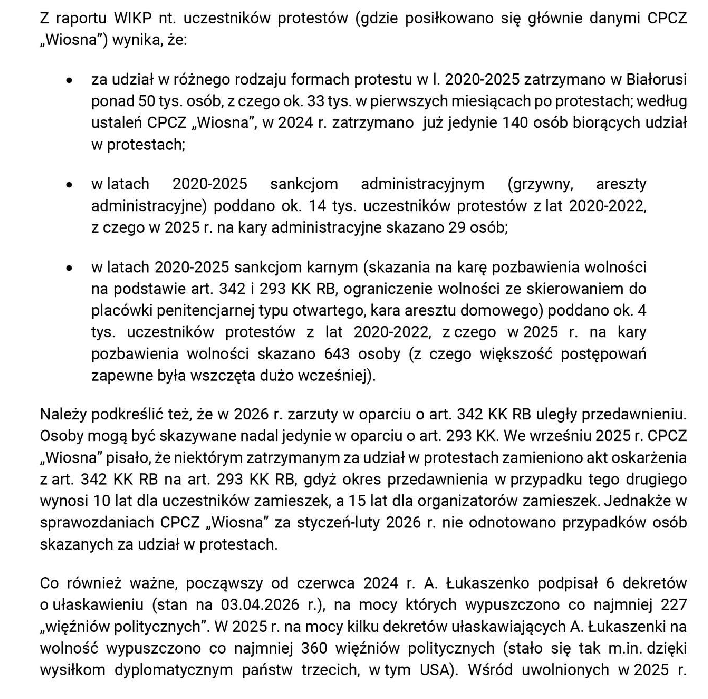
Furthermore, as an indicator of an improvement in the situation, the UDSC cites the fact that, since June 2024, Lukashenko has signed a series of decrees pardoning political prisoners, resulting in the release of at least 360 political prisoners. However, the UDSC notes that these pardons were granted thanks to the diplomatic efforts of third countries, namely the US.
The Belarusian authorities are concealing repression
At the same time, the ‘Viasna’ Human Rights Centre emphasises that the apparent decline in the figures for repression in Belarus, on which the Polish Office for Foreigners relies, is misleading, as the Belarusian authorities are currently carrying out so-called ‘covert repression’. ‘Viasna’ has prepared a special report on how such repression operates. Meanwhile, all Belarusian human rights organisations are currently forced to operate from abroad.
Moreover, the practice of concealing repression began precisely after meetings between US Presidential Representative John Cole and Lukashenko. At that time, Lukashenko promised Cole – in exchange for the lifting of US sanctions on Belarusian potash fertilisers and banks – not only the release of some political prisoners, including high-profile figures, but also an easing of repression. This took place in February 2025.
And from 5 March 2025, the authorities stopped publishing court hearing schedules online. Previously, this schedule had been one of the main sources of information on politically motivated prosecutions. Prior to that, back in 2024, the authorities had dismantled a volunteer network of court hearing observers. Several people who attended open court hearings and passed on information about them to human rights defenders were imprisoned for so-called ‘aiding extremist activities’. All Belarusian human rights organisations have been declared ‘extremist groups’ in Belarus.
Consequently, the Viasna Centre now has far fewer sources for monitoring the situation regarding politically motivated persecution. In fact, these consist solely of reports from relatives of those repressed, other people who have learnt of the repression, or the repressed individuals themselves following their release.
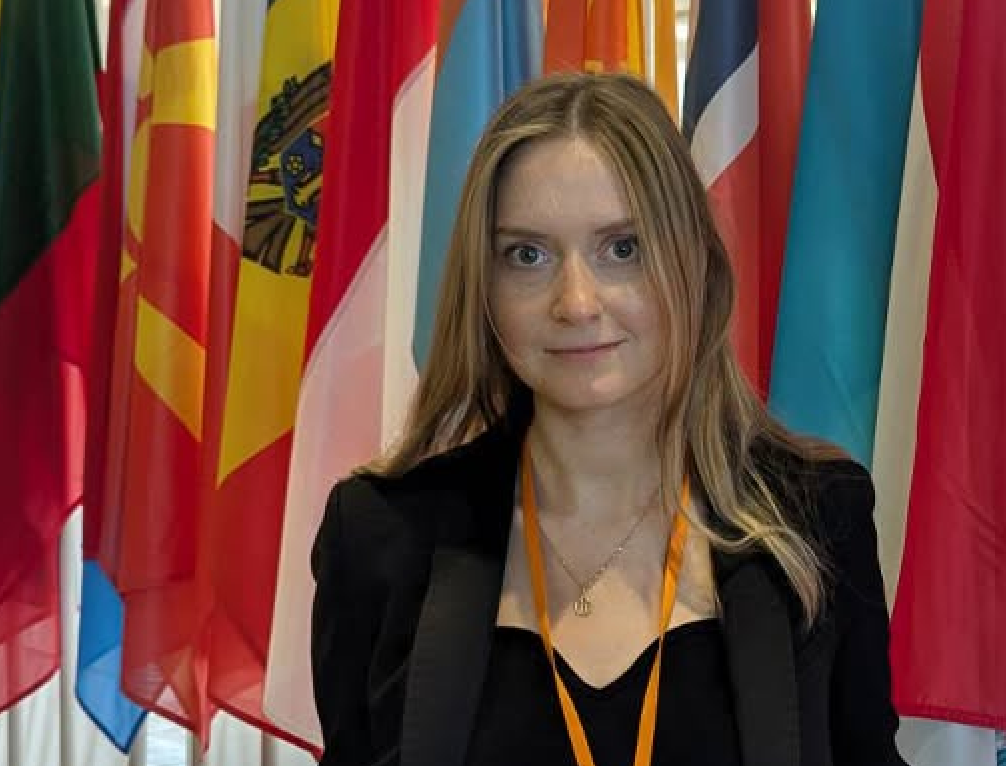
“The fact that Polish state authorities cite the figures we publish to justify their refusal to provide protection is not entirely correct. We always state in our reports that these figures represent only the cases known to us. We cannot include unverified cases in the statistics, or make assumptions about matters for which we have no confirmed information. And it is impossible to compare the figures for 2025 or 2026 with those for 2020, 2021 or even 2022. This is because in 2021, 2022 and 2023 we had far more sources of information.
It is precisely for this reason that, amongst the statements by the Belarusian human rights community recognising individuals as political prisoners, there are periodically statements recognising people as former political prisoners. And in those statements, as many as 50–70 people are often recognised at once. This means that we only found out that a person had been imprisoned for political reasons once they had served their sentence and been released. Because all this time, relatives were afraid to tell us about the repression for fear of also being punished for ‘aiding extremist activity’,
– says Svetlana Golovneva, a lawyer at the ‘Viasna’ Human Rights Centre.
No one even knows what they might be imprisoned for
However, even the figures that human rights defenders manage to track down and compile show that there has been no improvement in the human rights situation in Belarus and no reduction in the level of repression.
For example, at the end of 2021, there were 969 political prisoners in Belarus. By the end of 2025, the figure had risen to 1,131. There are currently 863, taking into account the release of several hundred political prisoners following a pardon agreed with the Americans. Despite the fact that obtaining information on politically motivated persecution in 2025 has become much more difficult than in 2021, the human rights community was forced to recognise 634 people as political prisoners in 2025, compared with 800 in 2021. The total number of people known to human rights defenders who received politically motivated sentences in 2021 was 1,285, and in 2025 it was 1,254.
As we can see, given that a significant proportion of the repression goes unnoticed by human rights defenders, the overall figures for repression differ only slightly.
Svetlana Golovneva cites some figures regarding pardons and new cases of repression:
“Yes, there are these people whom Lukashenko has supposedly pardoned under an agreement with the Americans. But there are new political prisoners whom Lukashenko has arrested to replace those pardoned. If we look at last year and the first half of this year, 592 people were pardoned and released, whilst 739 people were recognised as political prisoners. And mass criminal cases are currently underway. Such as the case of the Telegram channel ‘Belaruski Gayun’, where people are being prosecuted for reporting information about the actions of the Russian army on Belarusian territory before and during its armed aggression against Ukraine. Or the cases involving the European Humanities University, the Coordination Council and four publishing houses, which have also been labelled ‘extremist organisations’ by the authorities. In these cases, the number of those repressed runs into the tens and hundreds. Therefore, the number of political prisoners is now set to rise very rapidly”.
Incidentally, ‘Black Sky’ has already reported on how Lukashenko is attempting to play the pardon card whilst simultaneously recruiting new political prisoners.
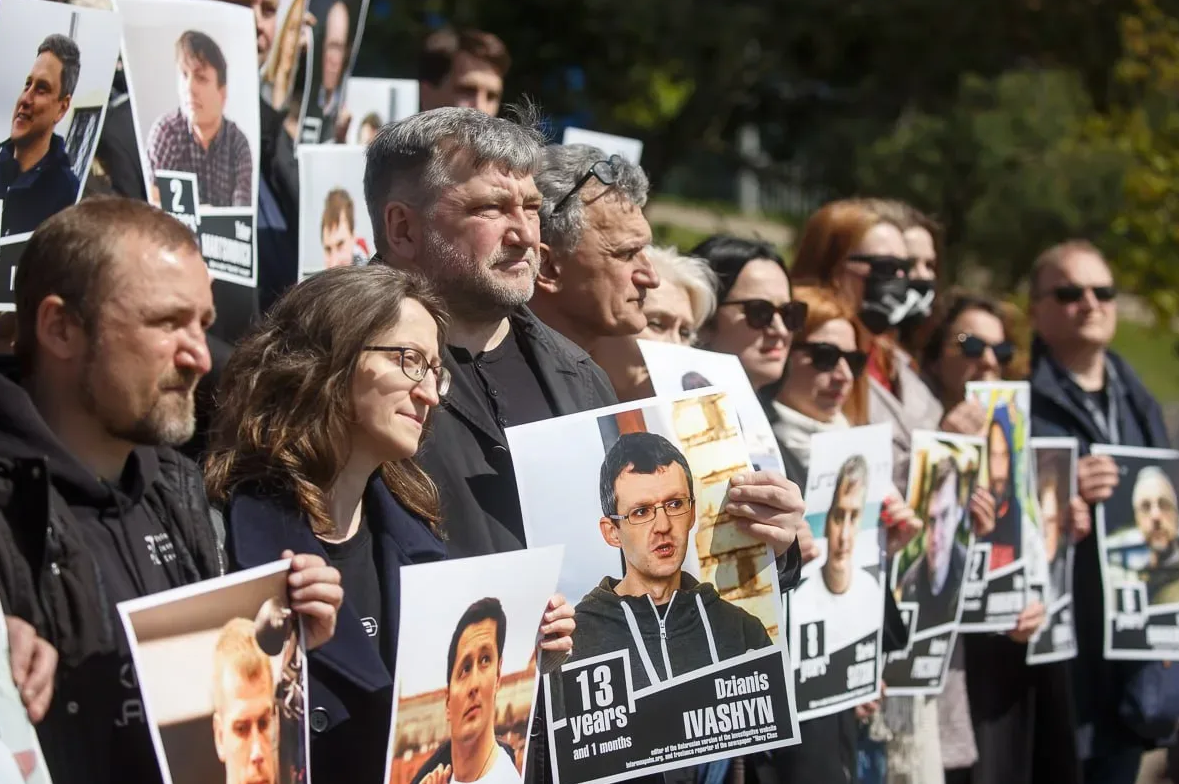
The human rights activist also points out that these supposedly pardoned individuals have not, in fact, had their criminal records expunged or been rehabilitated; 204 people were forcibly deported from the country, after which their passports were revoked. They remain on lists of ‘extremists’ or ‘terrorists’ and face unfounded restrictions on their rights regarding property and funds in Belarus. The authorities are demanding that they pay huge fines imposed during the crackdown. To enforce payment, the authorities are arresting them and seizing their property.
“Even if we set aside the political prisoners themselves and look at the general situation in Belarus regarding human rights, we can see that every week the lists of so-called ‘extremist materials’ and ‘extremist groups’ are being expanded. And people simply do not know what they might be repressed for. They might dig up some repost from 2020 from a channel that has just been declared ‘extremist material’, or you might find yourself among the members of a chat group on a messaging app that has been declared an ‘extremist organisation’. So, naturally, if a person has been involved in even the slightest opposition activity, or has simply expressed a political stance that does not align with that of Lukashenko’s regime, they will come under particular scrutiny from the regime’s security services. And if such a person returns from abroad, they will be subjected to particularly thorough scrutiny in the search for grounds for repression”,
– says Svetlana Golovneva.
In fact, if the Polish Office for Foreigners and its Department of Information on Countries of Origin were to read more carefully the annual reports and other materials published by ‘Viasna’ or other Belarusian human rights organisations, these state bodies would realise that the human rights situation in Belarus is not improving at all and that, regardless of -any political activity, even in the past, all people continue to face the threat of political repression. This is stated explicitly in reports by “Viasna”.
Andrus Hajovy.
Main photo – svaboda.org