
On Tuesday, 10 November, talks between Russia, Ukraine and the United States on a possible end to the war resumed in Abu Dhabi. It is the first trilateral meeting after a long break: the previous round took place back in February.
The Russian authorities regularly declare their readiness for a peaceful settlement, but continue to set tough conditions. Moscow demands territorial concessions from Ukraine, its renunciation of NATO membership and limits on the size of its armed forces. At the same time, the Kremlin is not prepared to agree to an unconditional ceasefire before an agreement is reached.
But what do Russians themselves want? Do they support continuing the war or do they favour peace talks? BlackSky examined the latest polls by independent and pro-government sociologists.
In brief
- 65% of Russians support peace talks with Ukraine, while 26% back continuing military action, according to the Levada Center’s October poll
- At the same time, seven in ten respondents still support the actions of the Russian army in Ukraine
- 57% of Russians fear a general mobilisation, and 72% believe a new wave of mobilisation is not needed in the coming months
- Support for talks does not mean readiness for concessions. In January, 59% of respondents said that if talks failed, they would prefer stronger Russian strikes on Ukraine
- Non-public research also points to Russians’ war fatigue
According to a survey conducted by the Levada Center on 21–30 October, 65% of Russians polled believe that it is now time to move to peace talks with Ukraine. 26% are in favour of continuing military action.
The Levada Center is one of Russia’s largest independent, non-governmental sociological organisations studying public opinion. In 2016 the Russian authorities designated it a foreign agent.
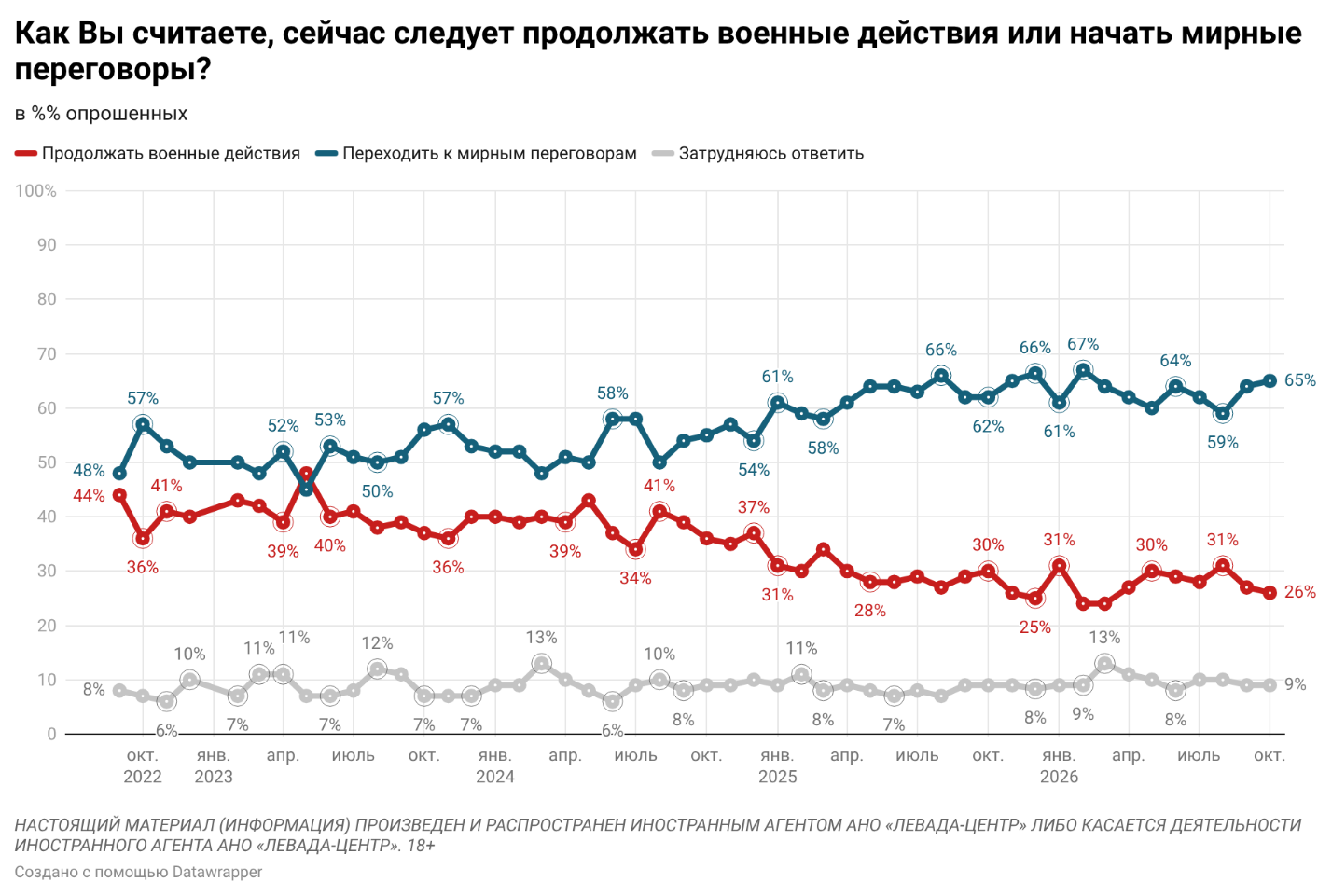
Support for peace talks is highest among young people under 24 (76%) and women (72%). Talks are also backed by 71% of residents of small towns and 69% of the poorest Russians, who barely have enough money for food. In addition, peace talks are supported by 75% of respondents who use YouTube channels as a source of information.
Continuing the war is most often supported by residents of Moscow (52%). The same position is held by 35% of men, 32% of Russians aged 55 and over and 31% of better-off respondents. Among those who get their information from television, 32% support continuing the war, and among users of channels in the MAX messenger – 35%.
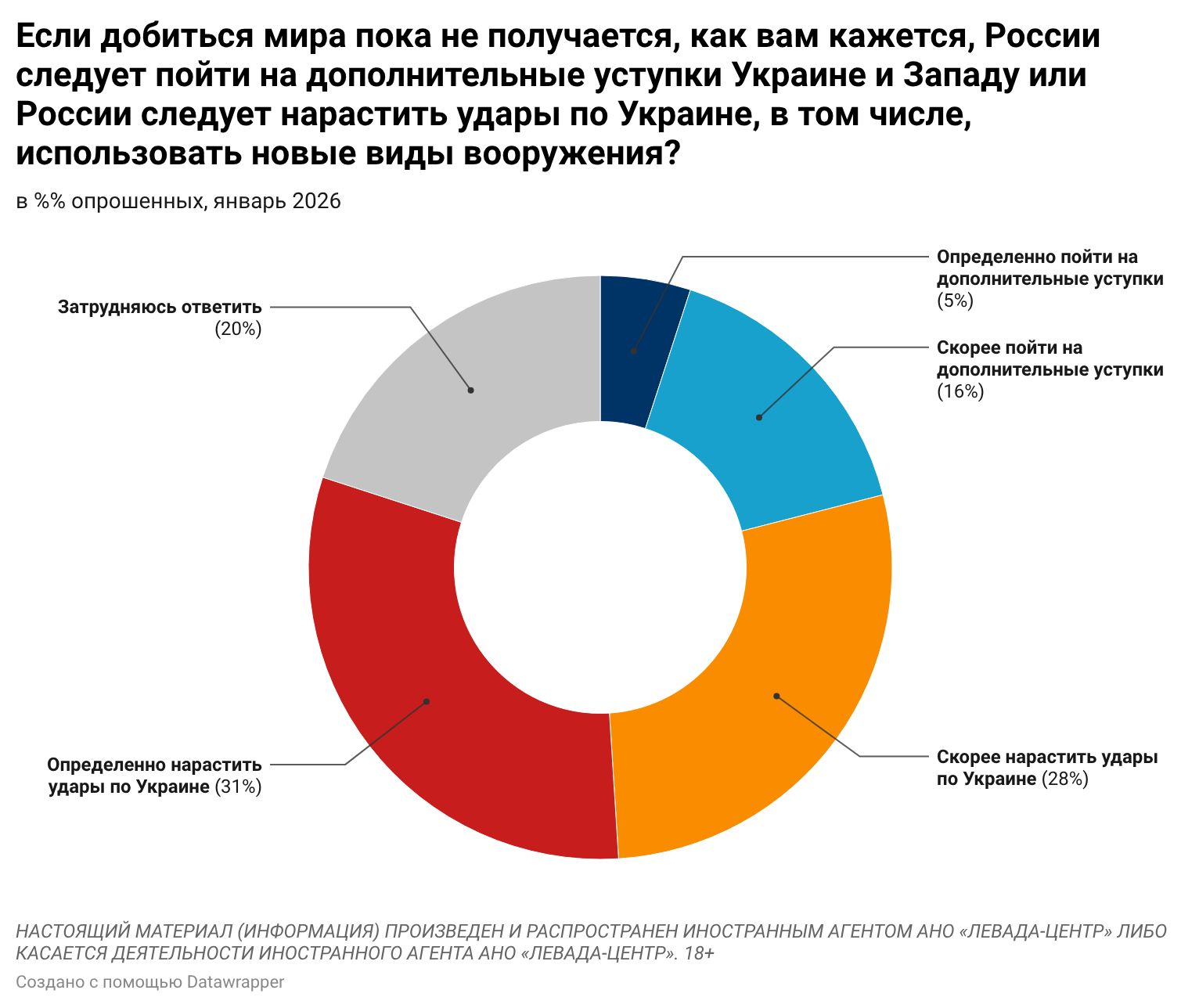
However, support for peace talks does not yet mean that Russians are ready to compromise. In January the Levada Center found that if no agreement could be reached with Ukraine, 59% of respondents would prefer stronger Russian strikes, including with new types of weapons. Only 21% favoured further concessions to Ukraine and the West. At the same time, 74% of respondents expected the war to end in a Russian victory, and 39% thought the fighting would last more than another year.
Seven in ten Russians support the Russian army’s actions in Ukraine, but more than half fear mobilisation
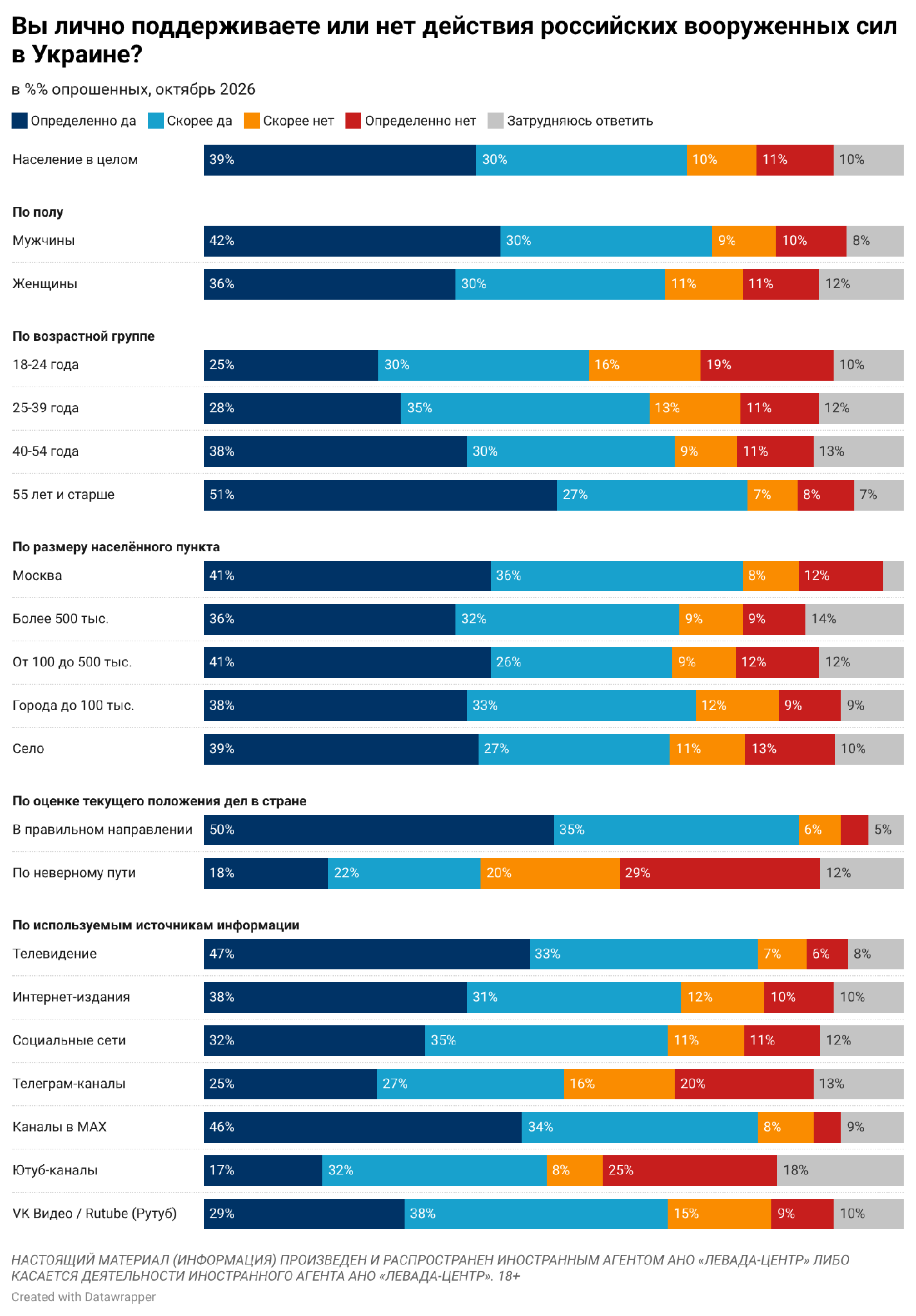
Despite the prevailing demand for peace talks, 69% of those polled by the Levada Center still say they support the actions of the Russian army in Ukraine. This figure had been gradually falling since autumn last year, but by the end of summer 2026 the decline had slowed.
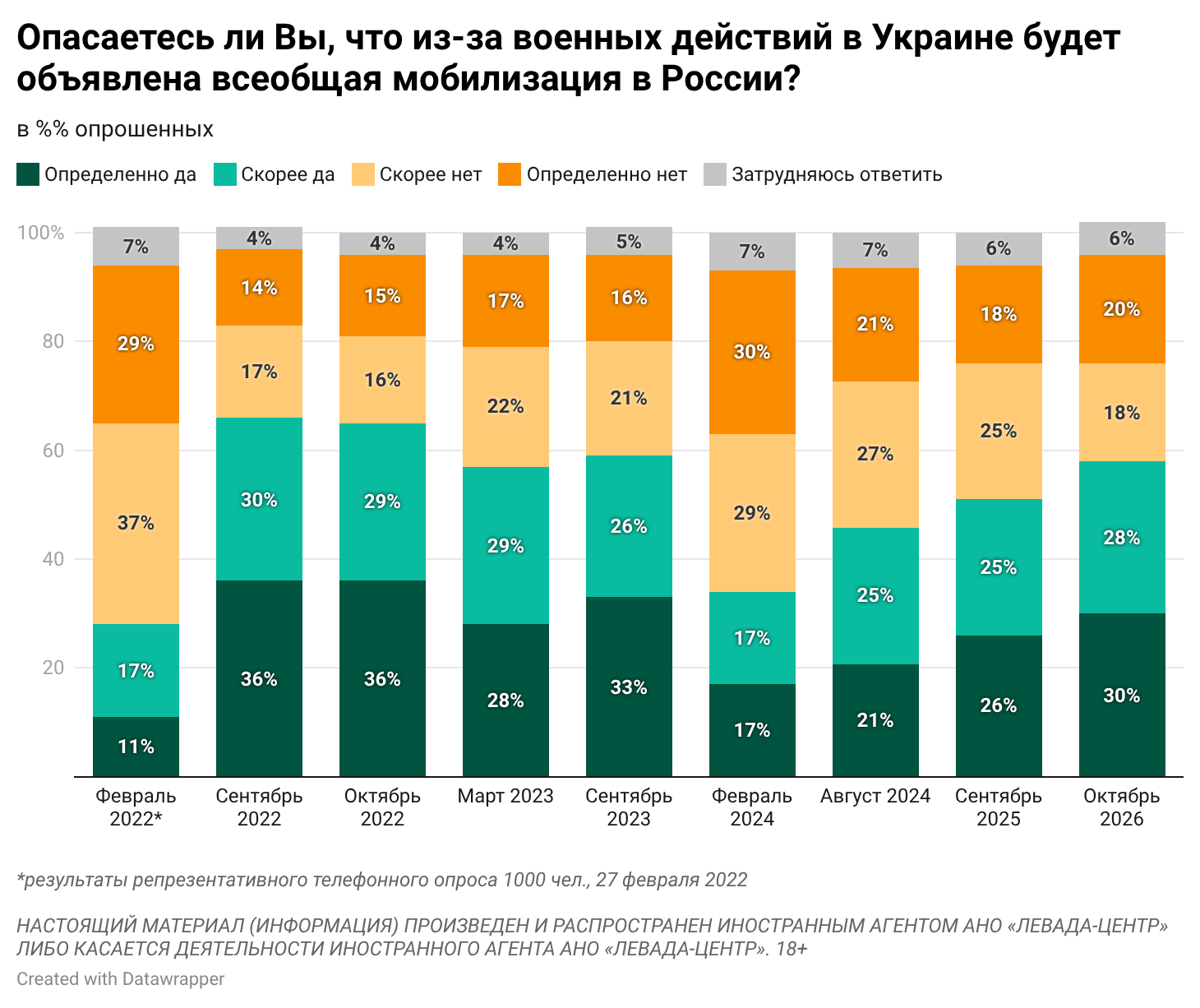
At the same time, more than half of the Russians polled fear mobilisation. Over the past year this figure has risen by 6 percentage points, and compared with February 2024 by as much as 23 points.
Even more telling are the answers to the question of whether a new wave of mobilisation is needed. According to the Levada Center’s October survey, 72% of respondents believe that a second wave of mobilisation is not needed in the coming months. Only 9% consider it necessary.
In other words, for every supporter of a new mobilisation there are eight people who see no need for it. Among Russians aged 25 to 39, 77% say a new mobilisation is not needed.
What pro-government sociologists’ polls say about the war
Russians’ attitudes to the war, peace talks and mobilisation are studied not only by the independent Levada Center but also by the state-run VTsIOM. In recent years, however, the results of such research have been published much less often.
While in the first months of the full-scale invasion of Ukraine VTsIOM ran polls several times a month, since 2023 mainly annual surveys have been made public – usually in January or February, on the eve of the anniversary of the start of the war.
This does not mean, however, that state sociologists have lost interest in Russians’ attitudes to current events. In July 2026 the Tambov outlet Tvyordy Znak reported that local residents were receiving calls from interviewers introducing themselves as VTsIOM staff. They were asked whether military action should continue or whether it was time to move to peace talks, and whether they would support a new wave of mobilisation. The results of this survey, however, could not be found in the public domain.
The most recent published VTsIOM poll we could find dealing directly with Russians’ attitudes to the war was conducted on 25 January 2026. At that time, 65% of respondents said they supported the decision to conduct the so-called special military operation. The same share believed that military operations were going rather successfully.
VTsIOM also regularly measures trust in Vladimir Putin. This indicator can be seen as an indirect gauge of public attitudes to the president’s political course, including his decisions on the war.
According to VTsIOM data published on 6 November, 77.5% of respondents trust Putin, and 71.6% approve of his performance.
Seven in ten respondents believe that under his rule Russia has become stronger and more self-confident, that thanks to Putin Russia is taken more seriously on the international stage, and they expressed confidence that under his leadership the country will be able to overcome all difficulties.
In June 2026 another study of Russians’ attitudes to the war came to light, whose results were not officially published. The independent journalistic project Faridaily, citing sources familiar with the results of polls and focus groups conducted for United Russia, reported growing war fatigue among Russians.
According to the journalists, more than 60% of respondents spoke of fatigue with various aspects of the war. At the same time, the desire for a swift end to the fighting did not always mean readiness for concessions to Ukraine. Some focus group participants, on the contrary, proposed intensifying strikes in order to bring the war to an end sooner.
Official Russian and Belarusian sources cited in this text are for informational purposes only. Content from these sources may constitute disinformation or propaganda.