
Editor’s note: this text was written before the US congressional elections of 3 November 2026 and reflects the situation as of 2 November 2026.
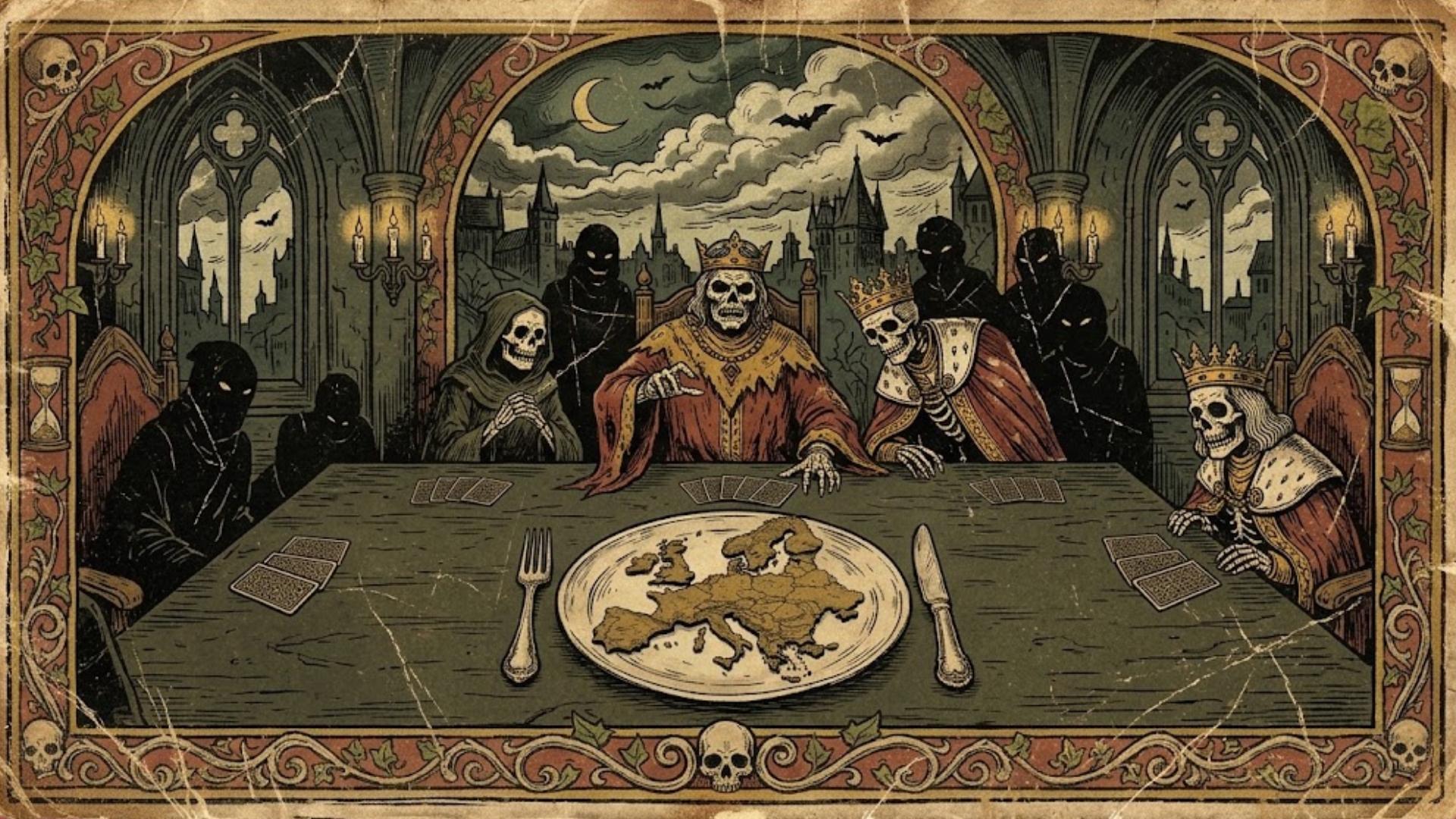
The Kremlin is proposing a Putin–Trump–Xi meeting at the APEC summit in Shenzhen on 18–19 November 2026, but according to Germany’s president, Xi sees no preparations for a summit on Ukraine – and neither Europe nor Ukraine has a seat at this table. Ahead of this deal, Russia is gradually testing NATO’s reaction threshold, China is betting on a weak Europe rather than a strong Russia, and Trump’s Washington has stopped being a guarantor. Europe holds the cards of a great power but behaves like a guest waiting for an invitation: what it lacks is will, not resources.
In brief
- On 25 October 2026, Kremlin adviser Yuri Ushakov announced preparations for a Putin–Trump–Xi meeting at the APEC summit in Shenzhen, but according to Germany’s president, Xi sees no preparations for a summit on Ukraine and believes that Europeans should be at the table.
- According to FAS and CSIS estimates, Russia has a stockpile of around 4,400 warheads, including 1,794 non-strategic ones, compared with around 225 British and around 290 French warheads.
- A decree of 28 September 2026 raised the authorised strength of Russia’s armed forces to 2,441,630, including 1,550,500 service personnel, while Syrskyi puts the number of Russian troops in Ukraine at around 721,000.
- The EU’s trade deficit with China reached €359.8 billion in 2025, and China’s car exports exceeded one million units a month in September 2026.
- According to the EDA, EU countries spent €418 billion on defence in 2025, and on 20–21 October 2026 British Typhoons took part in the French “Rummy” nuclear exercise for the first time.
Who will sit at the table in Shenzhen, and who has not been invited?
The idea came from Moscow. According to The Wall Street Journal, on 9 October 2026 Putin proposed to Trump in a phone call a three-way meeting on ending the war without Ukraine, and on 25 October 2026 Yuri Ushakov said that preparations had begun and that the three countries were “in principle ready”. That is the claim of one side. Ukraine’s Foreign Minister Andrii Sybiha warns that talks without Kyiv would embolden Moscow. Donald Trump, “the lover of red caps”, responded in his own way:
“Russia, frankly, is behaving fine towards Ukraine. They’re not doing much. (…) We would meet to talk about nuclear weapons and denuclearisation.”
– Donald Trump, President of the United States, Euronews, 19.10.2026 (editorial translation)
On the night of 31 October to 1 November 2026, Russia launched 433 drones at Ukraine. They’re not doing much…
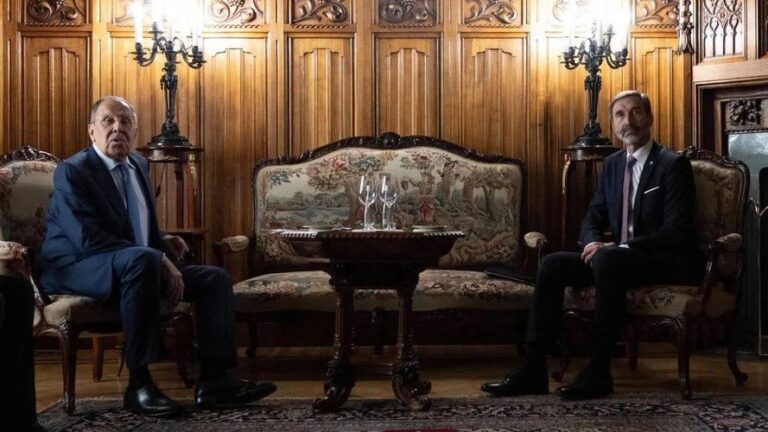
And Xi? On 30 October 2026 German President Frank-Walter Steinmeier asked him about the summit. On ARD he described the confusion on his interlocutor’s face and the answer: there are no preparations on the horizon for a summit on Ukraine. That is one side’s version; I found no statement from Beijing. A meeting of the three on the sidelines of APEC remains possible, but Ukraine is not supposed to be its subject.
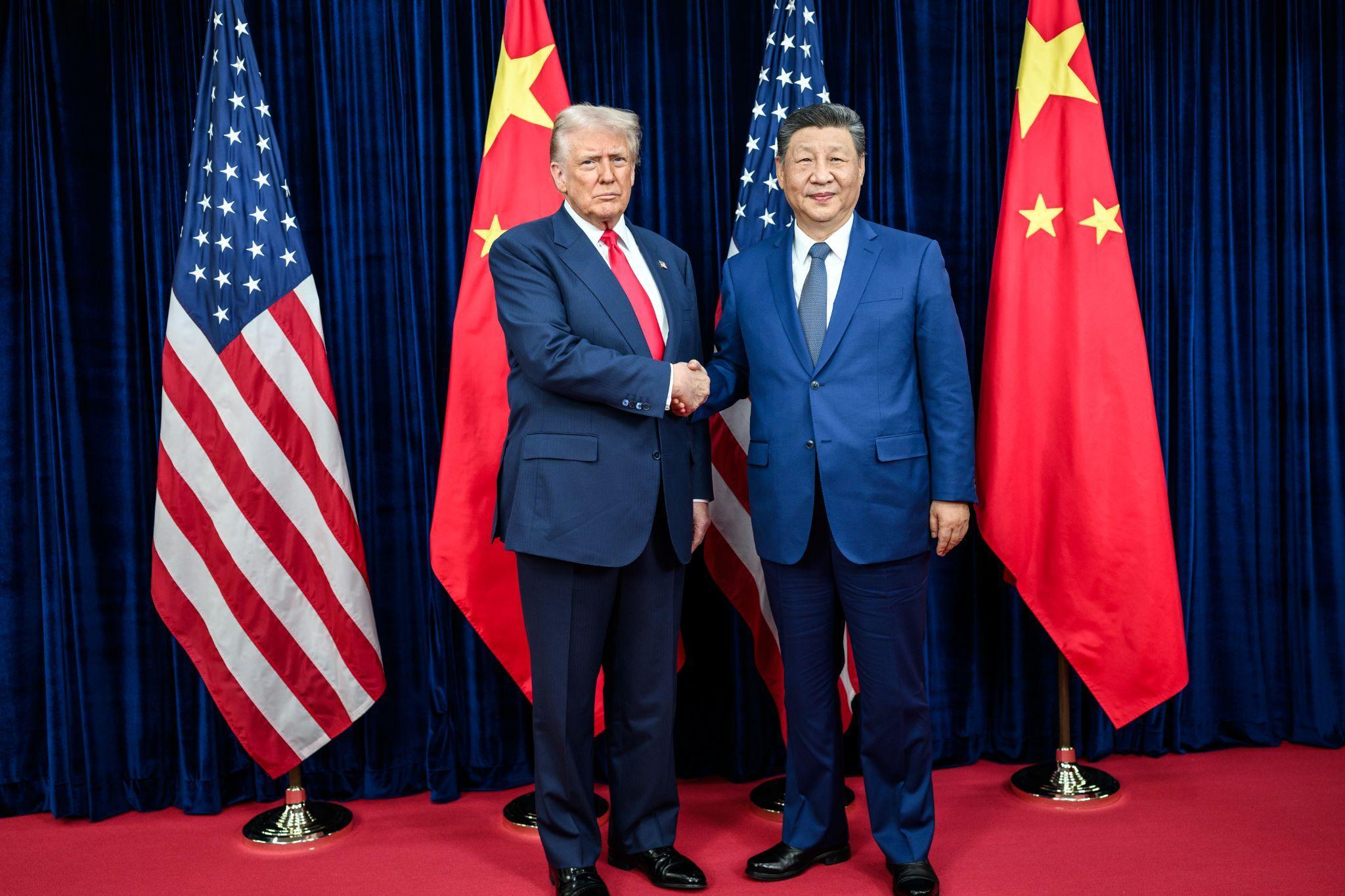
Three players, three goals. Trump wants a photo with a nuclear backdrop. Xi wants nothing to change. And Putin, as we keep hearing in Europe, only needs to be given Sloviansk and Kramatorsk and he will stop at once. This man is interested in nothing but Kramatorsk, you see? And now Ushakov suddenly wants Europe at the negotiating table:
“It is not enough to talk only to Kyiv; we need to talk to the whole of Europe, which fully supports Kyiv.”
– Yuri Ushakov, adviser to the Russian president, The Moscow Times, 25.10.2026 (editorial translation)
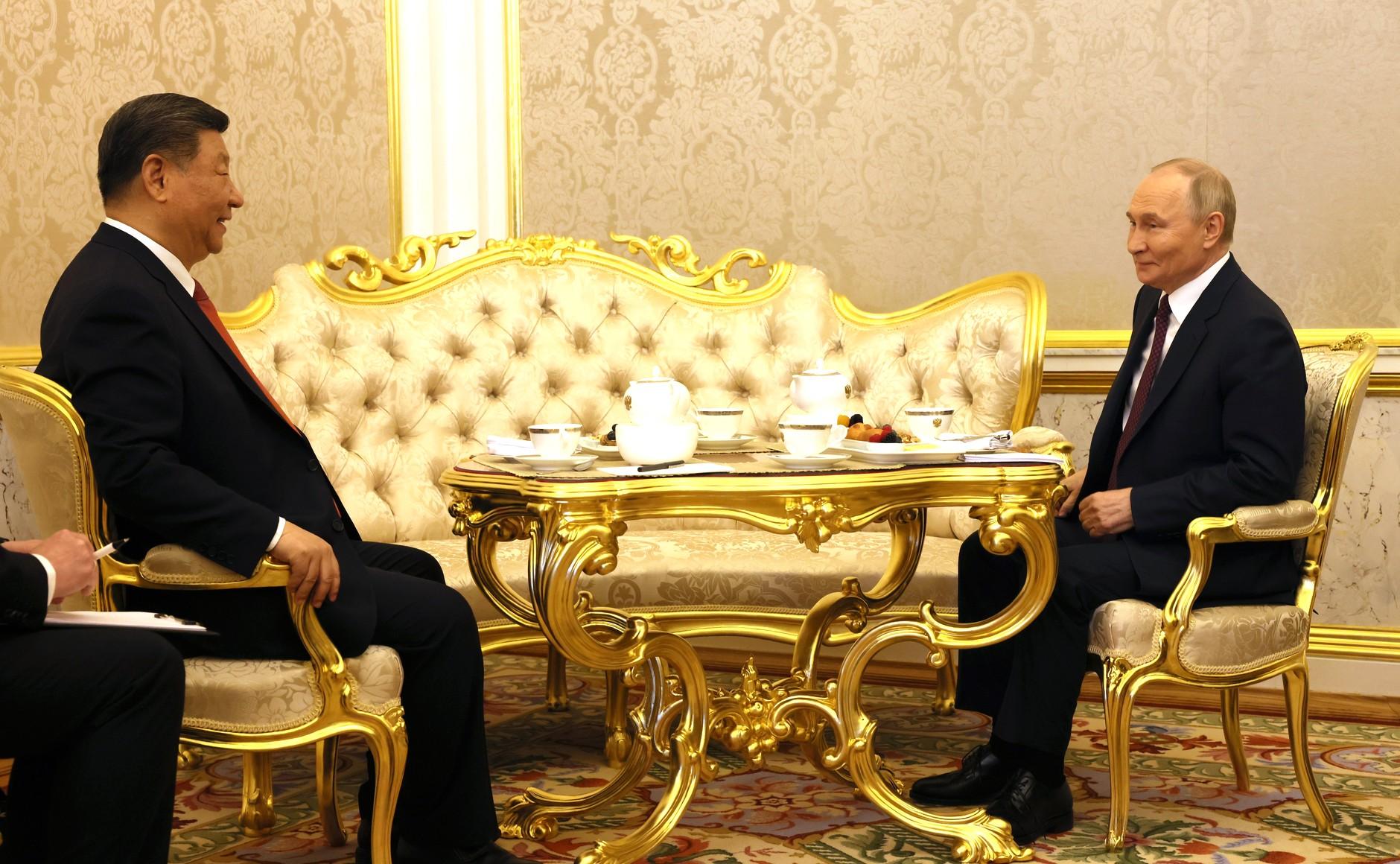
The Telegraph, citing diplomats, writes that Moscow wants to roll NATO back to its 1997 state, which would hit Poland, the Baltic states and Finland. This is the report of a single outlet, without confirmation from the Kremlin. For the Kremlin, the cards are falling well: an election cycle in Europe, a sympathetic Trump, US attention on Iran, Brent crude at around $110 (Trading Economics, 2 November 2026). A royal flush, quite simply. What is at stake is Europe’s security, not Sloviansk.
Fortifications on paper: how many kilometres have been added on the border?
East Shield is a programme whose cost is estimated at 10 billion zlotys up to 2028, and Poland’s defence minister has admitted (PAP) that it will take longer and cost more. In March 2026 I showed satellite images of a section opposite the Kaliningrad region: a few hundred metres of “dragon’s teeth”, a few trenches. How many kilometres have been added in the newer images? That’s right. Zero.
Here I have to soften my own thesis somewhat. This is my analysis of a selected section, not data from Poland’s Ministry of National Defence. Kilometres of barriers are only a partial indicator, as the programme also covers reconnaissance, logistics and counter-drone defence. Poland’s General Staff reported in January 2026 that 60 km had been “secured” by the end of 2025, of which about 10 km were barrier lines and the rest materials in depots. The plan for 2026: about 200 km, including 20 km of lines, at a cost of more than 652 million zlotys (Ministry of National Defence). The military has not published any progress figures since January.
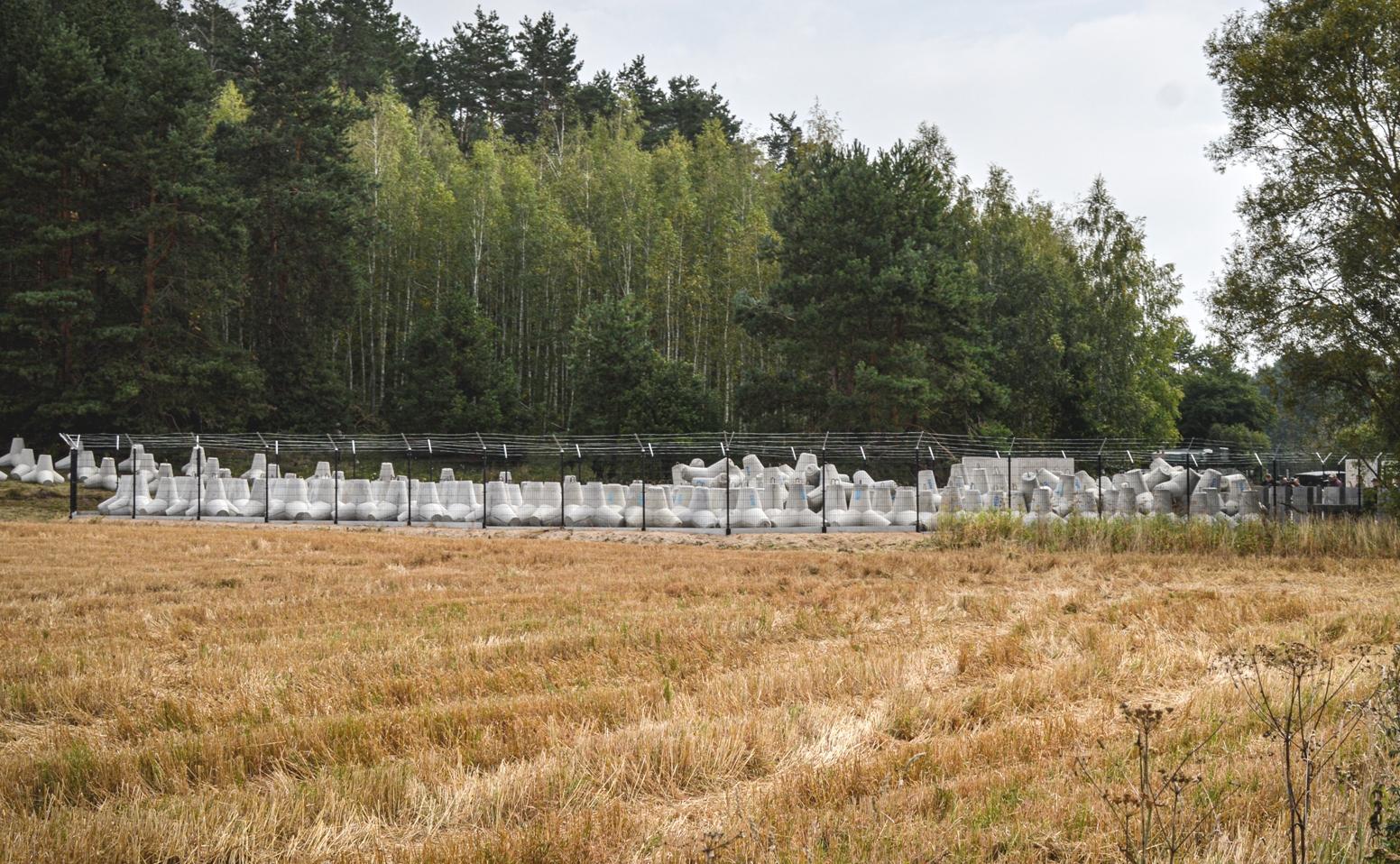
The Baltic Defence Line is being built unevenly. Estonia has 28 bunkers out of a planned 600 and more than 10 km of ditches. Latvia keeps the length of the works classified, and Lithuania is relying on depots of barriers to be used in a crisis. Corruption or stupidity? I don’t know. I do know that such a plan assumes time that Russia may not give. Europe is stockpiling barriers, not building them.
Drones over NATO bases: intimidation or target reconnaissance?
Russia’s hybrid war did not begin in 2022. Bulgarian prosecutors link six Russians to four explosions at ammunition depots in 2011–2020: in Lovnidol (2011), two in Iganovo (2015) and in Maglizh. The goods were destined for Georgia and Ukraine. Bellingcat and The Insider link Lovnidol to GRU Unit 29155 – the same unit in which Anatoliy Chepiga, the “lover of British spires” from Salisbury, served. Was he in Bulgaria himself? The published data give no clear answer.
With an ammunition depot supplying Ukraine, the logic is obvious: to limit deliveries. But here? On 4 December 2025, five drones over Île Longue, the base of France’s ballistic-missile submarines. On 21–22 November 2025, Volkel, where Dutch F-35s are based and B61 bombs are believed to be stored, as well as Eindhoven, the main base of the multinational tanker fleet. On 25–26 September 2025, the area around Karlskrona, the Swedish navy’s main base; Sweden, admittedly, has not handed Visby-class corvettes to Ukraine. On 24–25 September 2025, Aalborg and Skrydstrup, the base of Danish F-16s and F-35s.
Hypothesis: the choice of targets looks more like reconnaissance and probing of NATO’s reaction than pressure to make Europe stop helping Kyiv. This is my hypothesis, not an established fact.
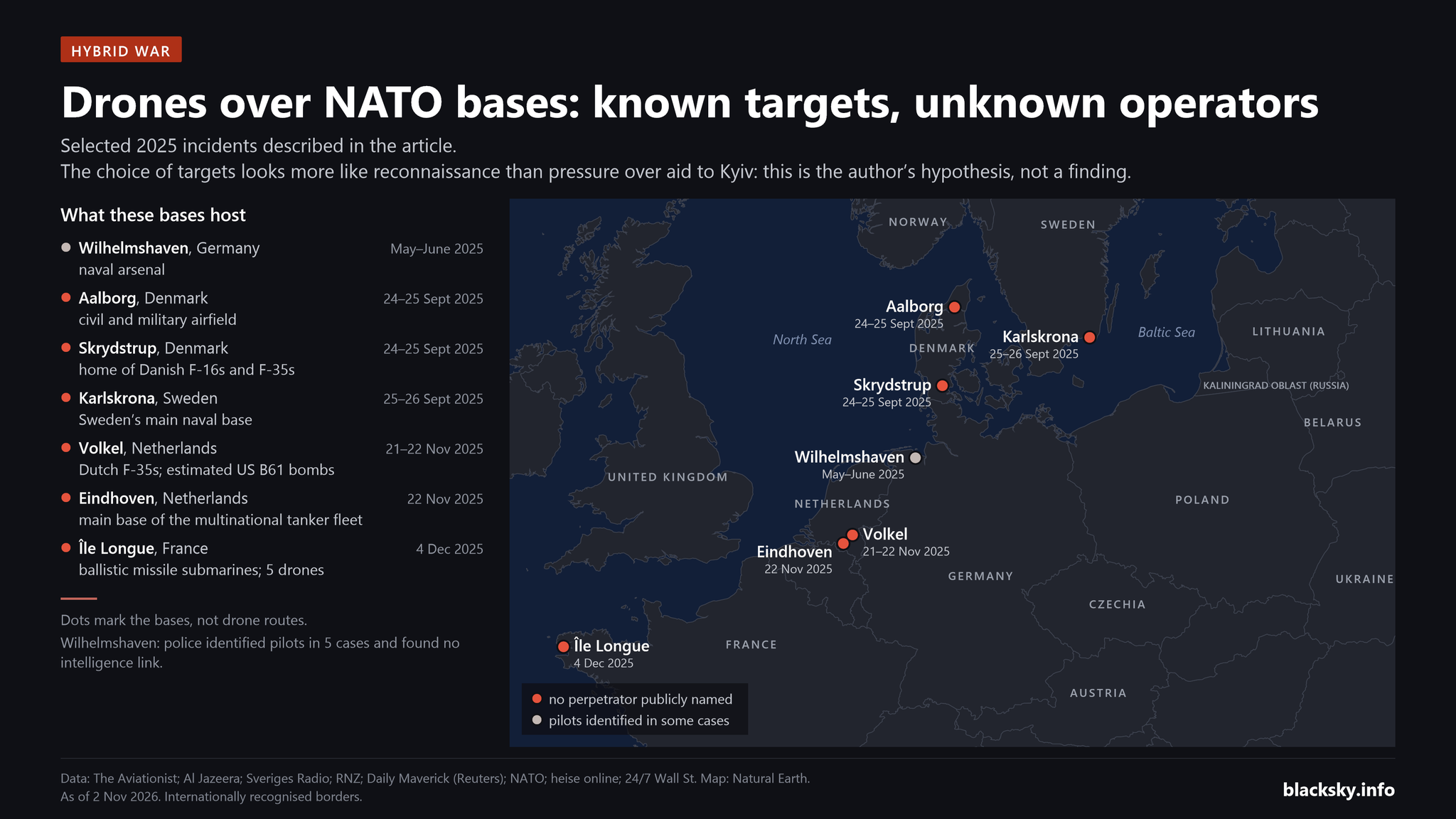
It is not known who was flying the drones. In none of these cases was a perpetrator publicly named. Denmark speaks of a “professional actor”, and the French prosecutor considered it too early to draw conclusions. In Wilhelmshaven, police identified the pilots in five cases and found no link to intelligence services – so not every drone carries a Russian passport. The statistics are also distorted by delayed attribution. Judge for yourselves.
The escalation ladder has these rungs: sabotage, drone incursions, long-range strikes and, finally, a tactical warhead. Danish intelligence on 24 September 2026 assessed the risk of strikes on infrastructure supporting Ukraine as “low but rising”, and a limited attack as possible within a few months – and at the same time “desperate”. Russia is testing the threshold, not the border.
A “kill switch” in Washington: can the F-35 become a tin can?
Assessment: the US has stopped being a guarantor. Time lists a deal on Russian diesel, suspended sanctions and pressure on Kyiv not to strike oil refineries. Reuters reported on 30 October 2026, citing anonymous sources, that Elbridge Colby, the US Under Secretary of Defense, advised the Baltic states not to “poke” Russia. The Pentagon has not commented.
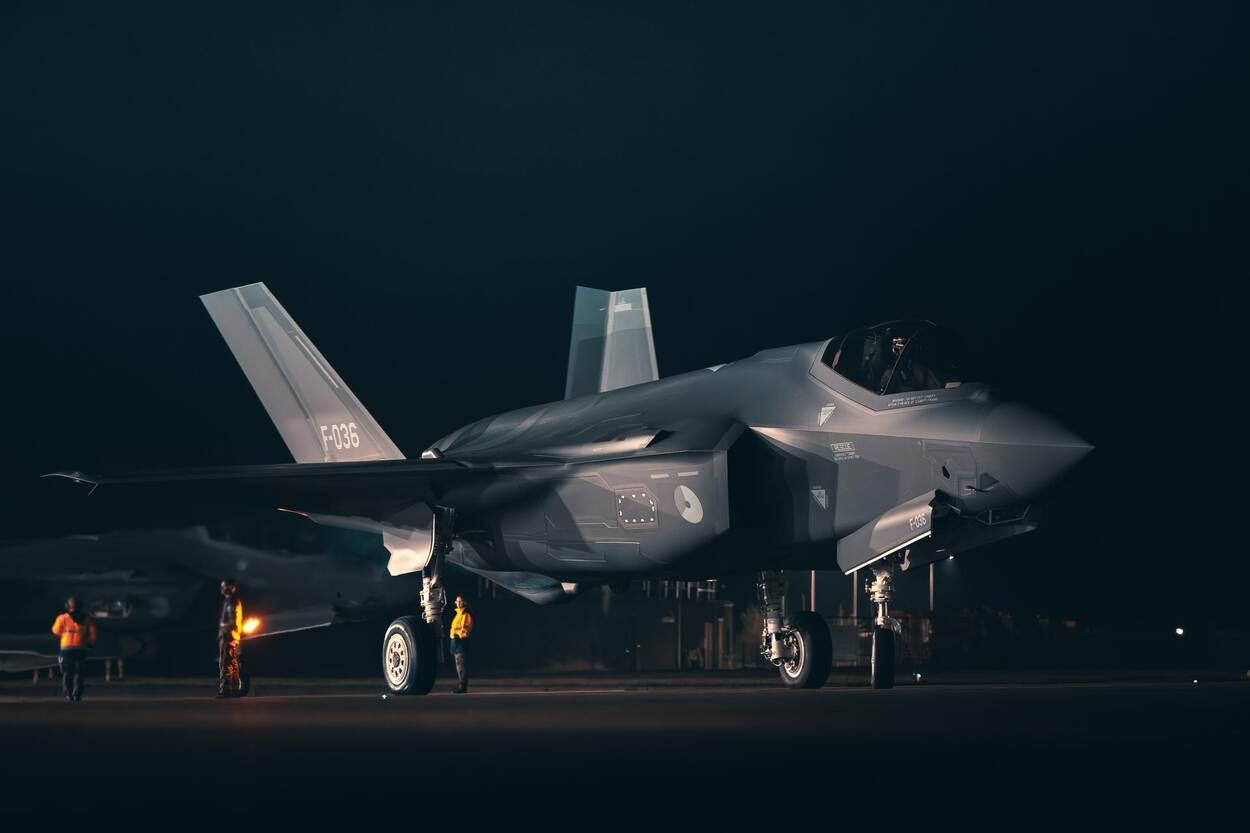
The US provides allies with the military GPS M-code signal on its own terms (Defense News). Link 16 keys expire every day and come from the US (Militär Aktuell). The F-35 lives on updates and mission data from the ALIS/ODIN systems. Can the F-35 be turned into a tin can? The programme office replies that there is no kill switch, while analysts speak of slow degradation without software. Not a button, but a lack of updates.
There is a precedent: in March 2025 Washington suspended intelligence sharing with Ukraine for about a week, despite the security agreement of 13 June 2024. Would Trump use some kind of “kill switch” to stop Europeans from responding to an invasion of one of the Baltic states – after all, why start a third world war over a few Latvians? I would not rule it out, but my assumptions are only assumptions. The most dangerous thing is that Putin may not rule it out either.
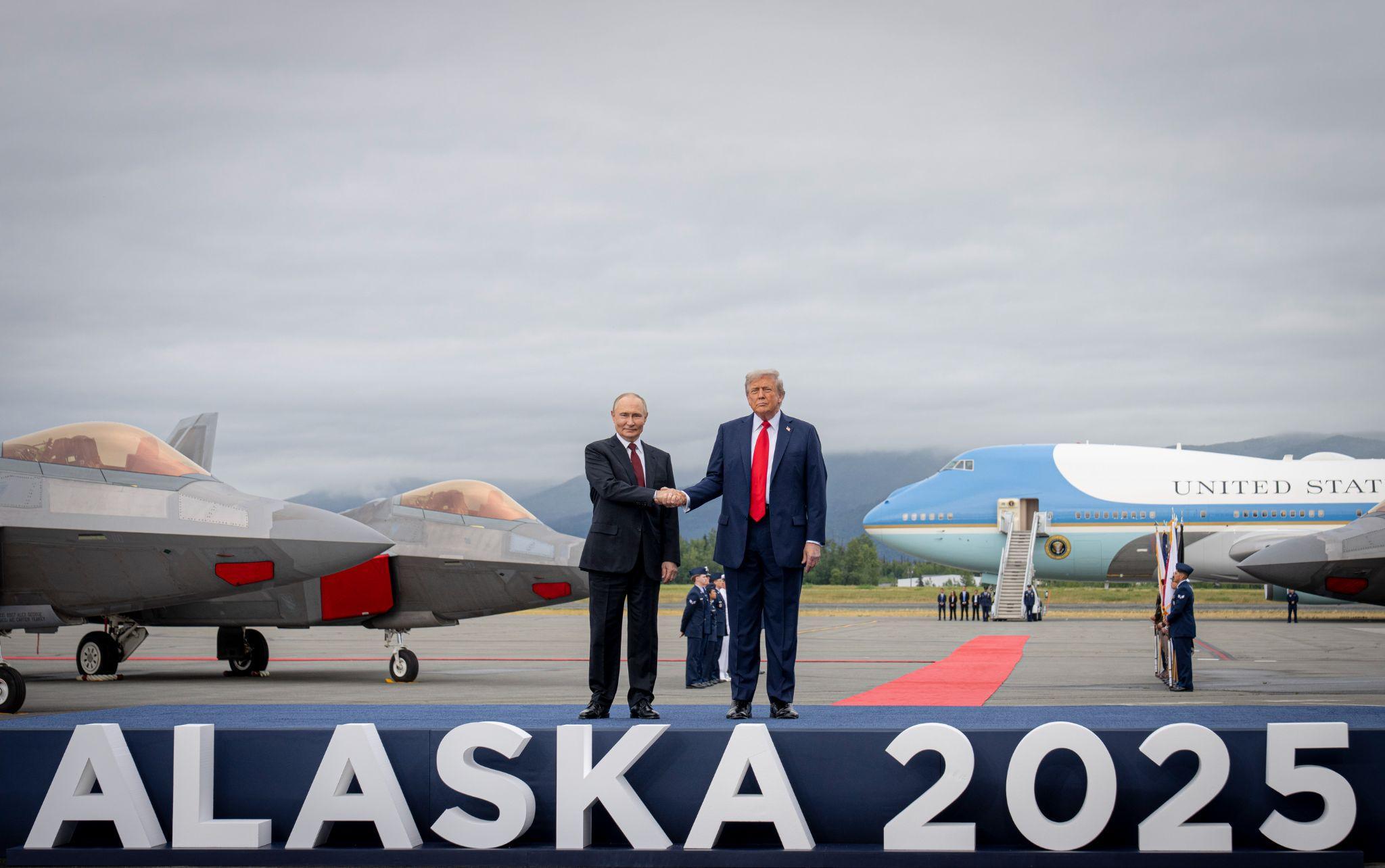
Trump’s priority is nuclear weapons, not Ukraine. When the New START treaty expired on 5 February 2026, he rejected Putin’s proposal and demanded a new treaty that would include China, which does not want such talks. The congressional elections take place on 3 November 2026; at the time of finishing this text there are no results yet, and forecasts (Action Network) give the Democrats the edge in the House of Representatives, while the outcome in the Senate remains uncertain. A defeat would take some of Trump’s cards away, but not all of them: the arsenal and diplomacy are in the hands of the president, not Congress.
Reserves Europe forgets about: does Russia have the manpower to escalate?
Fact: Russia is not shining at the front. ISW estimates that in October 2026 it lost territory for the second month in a row; DeepState counts differently and records a 154 km² increase in occupied territory for September. Hence the calm of some European services: Russia is bogged down, so how could it attack Europe?
They forget about conscripts. Around 135,000 were called up in autumn 2025 and more than 141,000 in spring 2026, which gives an estimated 276,000 people in service at the same time. Decree No. 700 of 28 September 2026 raised the authorised strength of the armed forces to 2,441,630, including 1,550,500 service personnel. Oleksandr Syrskyi, Commander-in-Chief of the Armed Forces of Ukraine, estimated the Russian force in Ukraine in June 2026 at 721,300 troops (Militarnyi) – less than half of the authorised strength. A caveat: authorised strength is not actual strength, and Syrskyi’s figure is data from one side.
Sending conscripts to their deaths for yet another Ukrainian village is toxic for the Kremlin, so the generals insist that they will not go to war – just as they insisted in March 2022. A clash with NATO, however, can be sold as a different story: defending the homeland against the “Fourth Reich” that Russian Foreign Minister Sergei Lavrov talks about, rather than yet another “special military operation”. Officially, the Kremlin does not want war:
“We are ready, but we do not want any war with Europe (…) and if things go too far, there will be no winners at all.”
– Vladimir Putin, President of Russia, Meduza, 29.10.2026 (editorial translation)
The tactical gap: how will Europe respond to a low-yield nuclear warhead?
Russia has another ace up its sleeve. On 30 September 2026 it warned NATO that it would use “the entire arsenal, including nuclear weapons” if anyone tried to isolate Kaliningrad. On 1 October 2026, at the Valdai forum, Putin called this a response to an attempt to intimidate Russia, assured that the Foreign Ministry’s letters were not about nuclear weapons, and added that France and Britain are nuclear powers, but no one has the kind of weapons Russia has. What the doctrine says about this, we have checked. In my view, this is preparing the ground. Before 24 February 2022 we also heard: “we are being forced”.
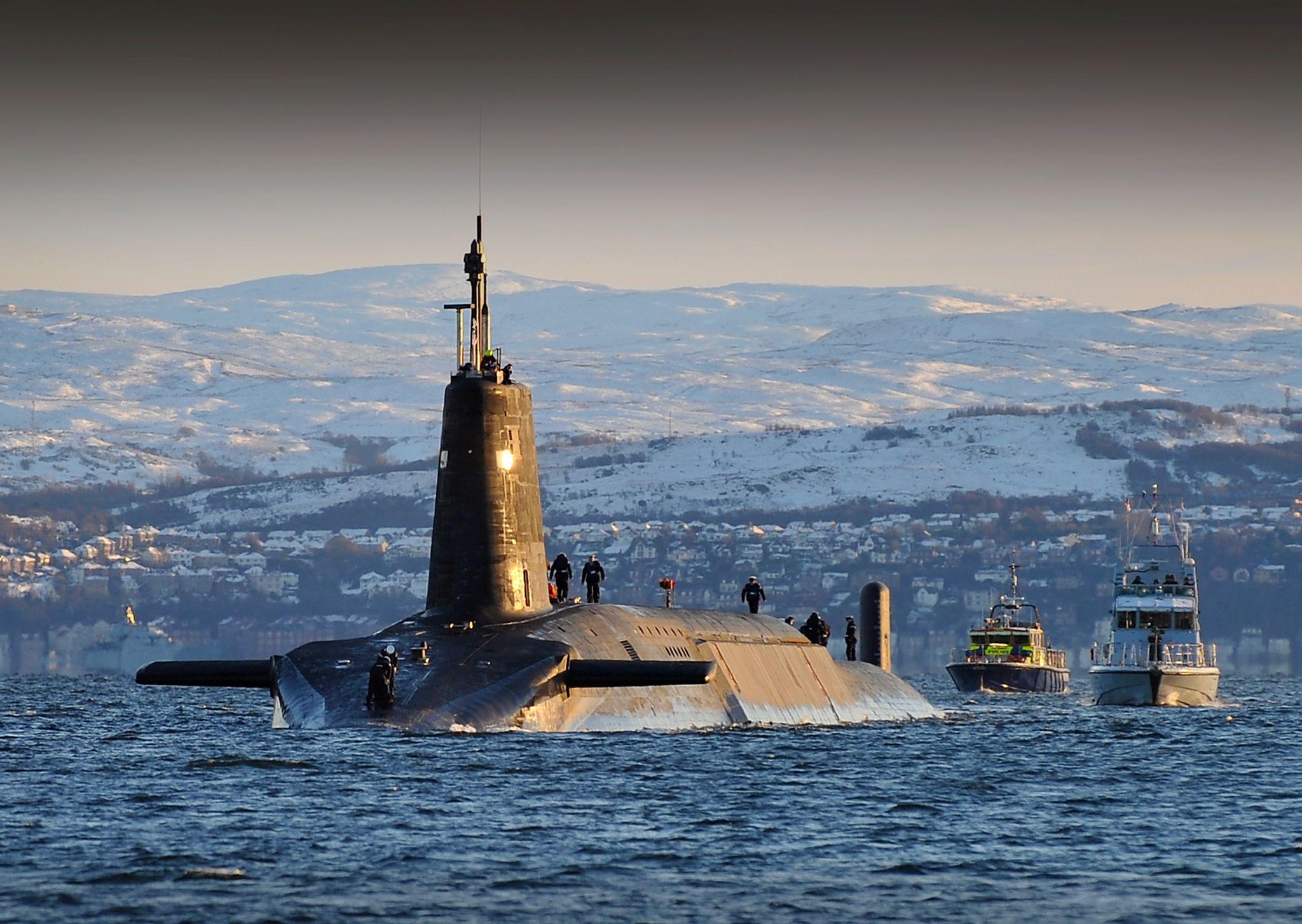
Russia has around 4,400 warheads in its stockpile, including 1,794 non-strategic ones (FAS, March 2026). Britain has around 225 (FAS, 2024) and France around 290 (CSIS). The threat to destroy London is a scare story: Britain’s Trident carries Holbrook warheads with a yield of around 100 kt, and a submarine on patrol carries no more than 40 warheads – enough to retaliate for the capital.
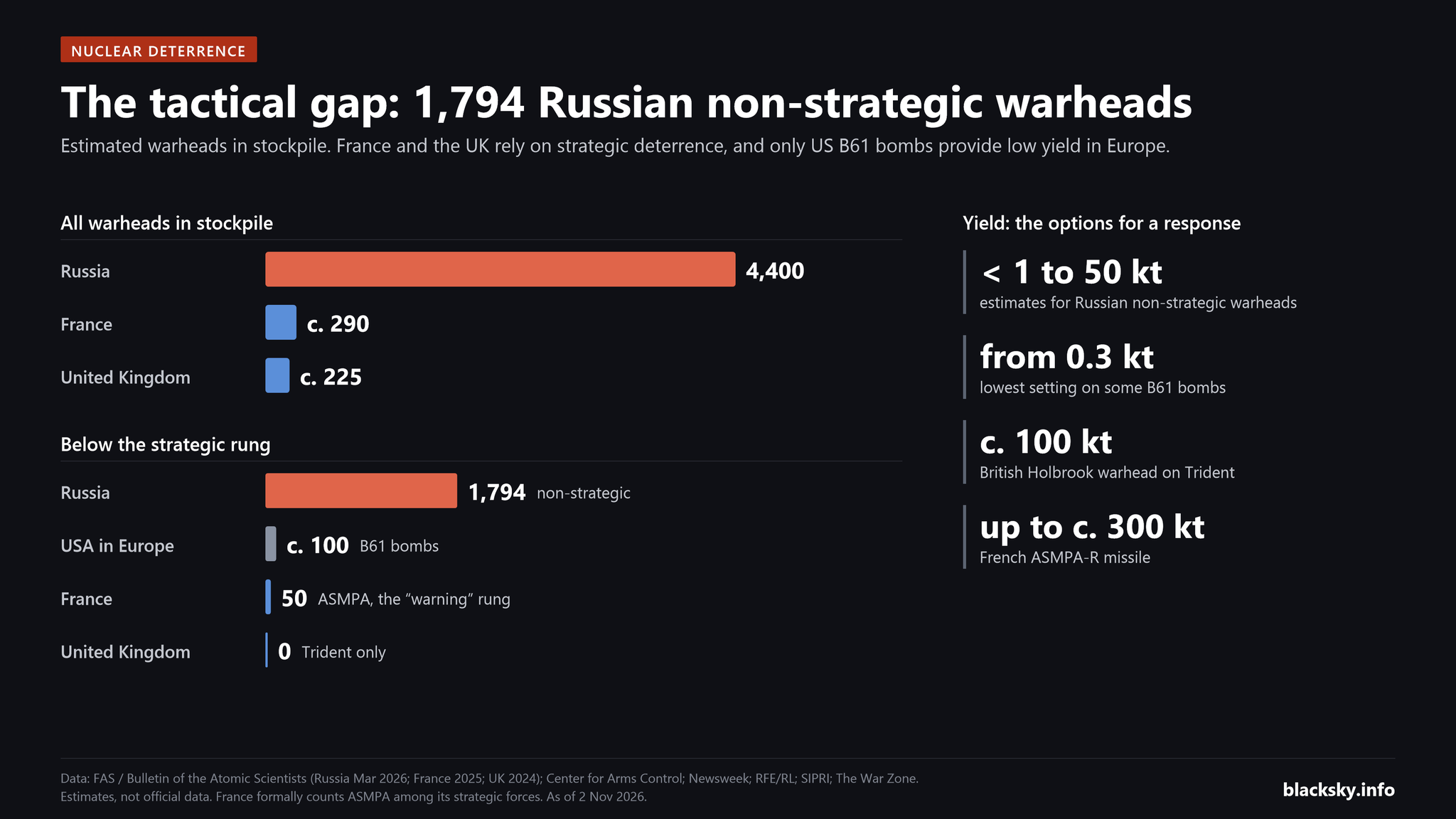
The problem starts lower down. Tactical nuclear weapons cover a wide range: yield estimates vary from less than 1 to 50 kt, and in the case of the Kh-102 even around 250 kt (CSIS). A strike on a base such as Ramstein would not necessarily mean the end of the world – and that is precisely why it is dangerous. The French ASMPA-R missile has a yield of up to around 300 kt and serves as a one-off “nuclear warning”, while London is buying 12 F-35A aircraft for NATO’s nuclear mission, although the bombs on them would be American. The gap thesis stands up to criticism, but with one nuance: Paris has a warning rung, not a low-yield response.
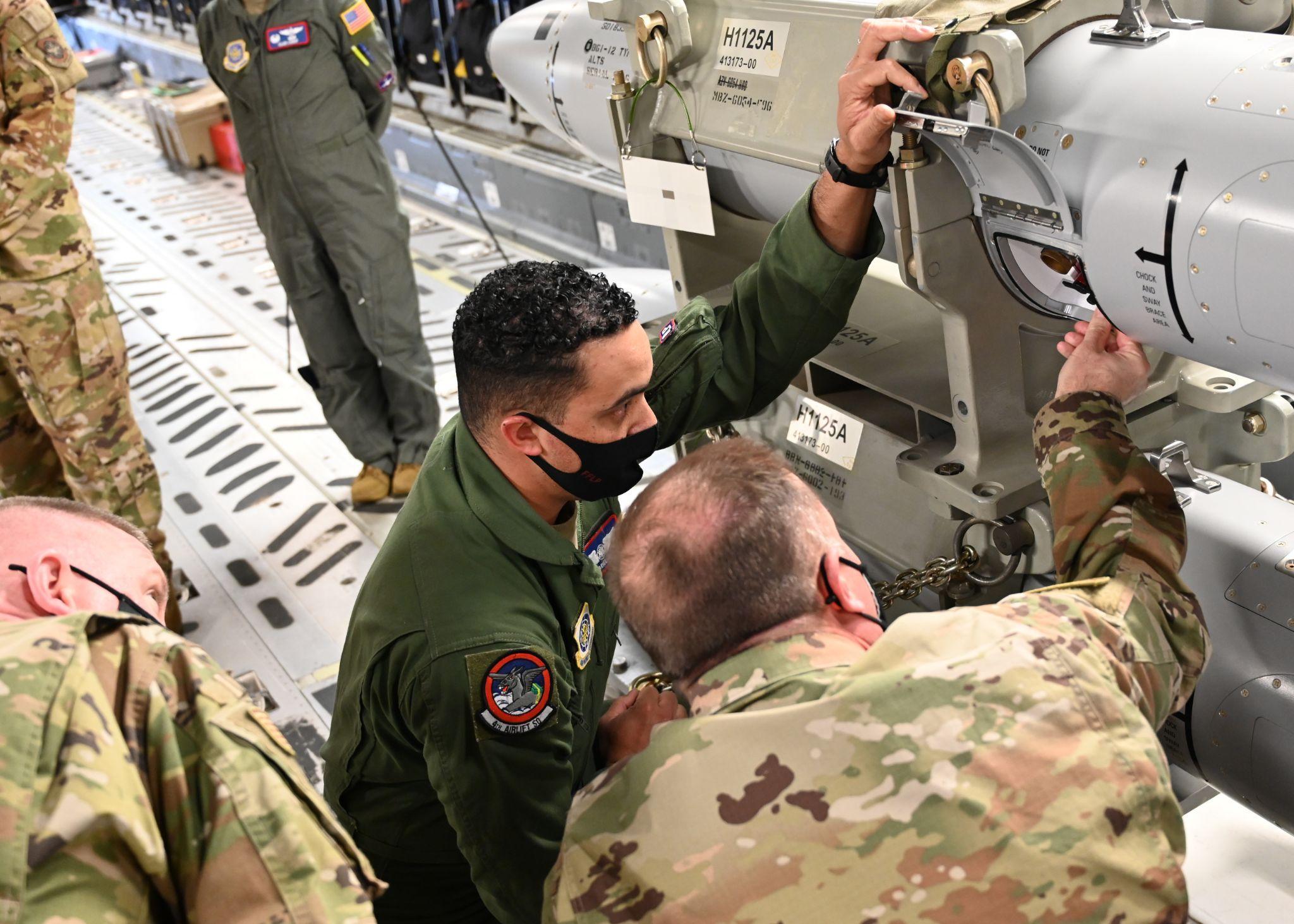
This is what the US nuclear umbrella was for: around 100 B61 bombs in five European countries, some of which can be dialled down to 0.3 kt. Joe Biden said in Warsaw on 26 March 2022: “Don’t even think about moving on one single inch of NATO territory.” Biden is gone. For the Kremlin, this is a window of opportunity. The Kremlin counts tactical warheads; Europe counts strategic ones.
Europe’s nuclear deterrence requires – this is my prescription – two steps: speeding up Franco-British work on low-yield warheads, and a NATO doctrine that announces in advance an immediate, proportionate response to the use of a tactical warhead.
China shock 2.0: why does Beijing want a weak Europe rather than a strong Russia?
In 2020 China exported a million cars a year; in September 2026 it exported 1.053 million a month. In January–September 2026 exports accounted for 35% of sales, while the domestic market, by my calculation based on CAAM data, shrank by around 22%. Production capacity is estimated at 55 million cars against output of around 35 million – a utilisation rate of roughly 64%. Dealers are sitting on around 2.7 million cars, and almost 30% of Chinese industrial enterprises were operating at a loss in August 2025.
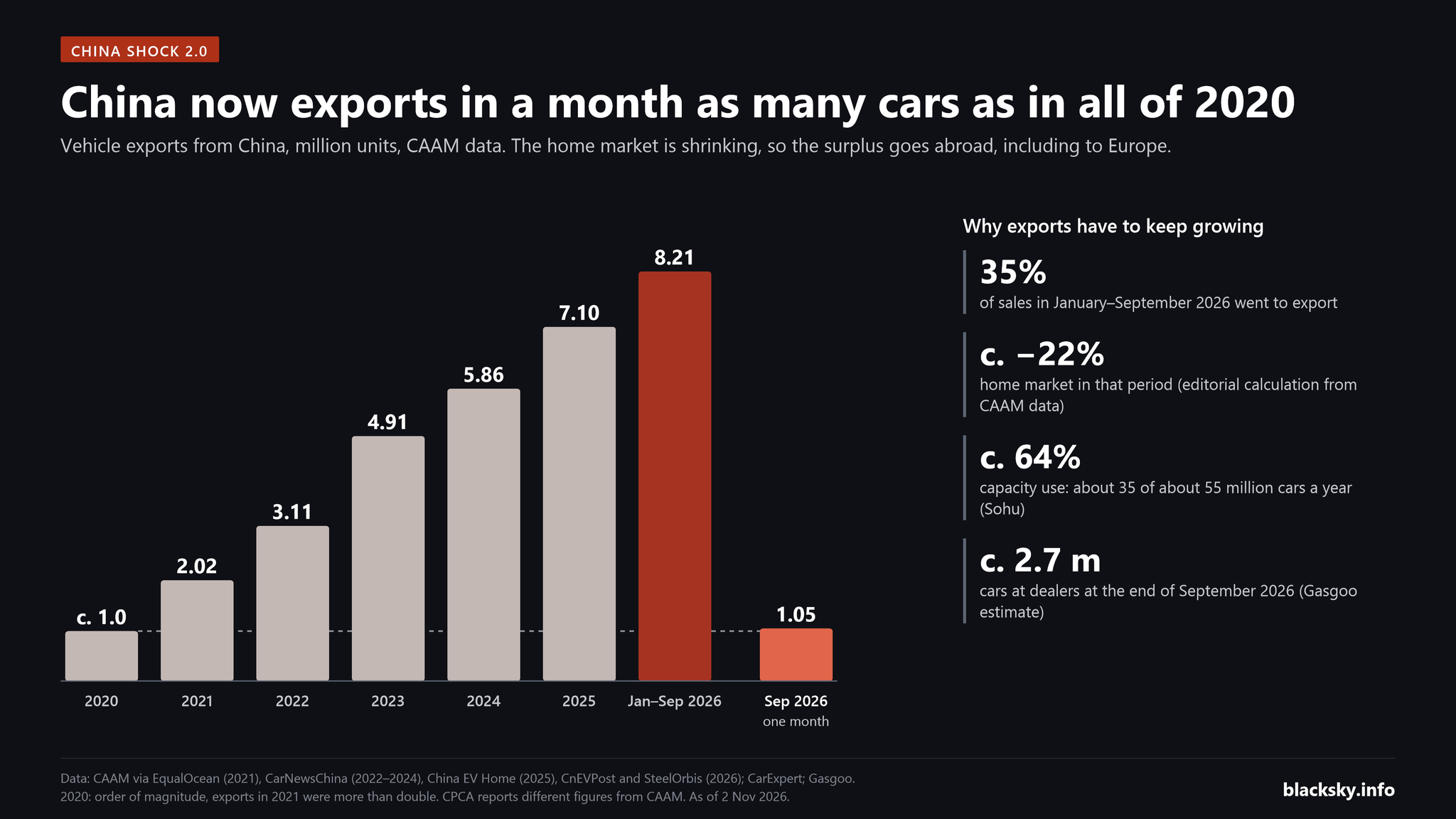
Hence China shock 2.0: after clothes and toys, it is now the turn of cars and chemicals. The EU’s trade deficit with China in 2025 was €359.8 billion, almost a billion a day (Eurostat).
“It is not just about cheap imports. We are seeing overcapacity that undermines our manufacturing base.”
– Ursula von der Leyen, President of the European Commission, Eurometal, 19.06.2026 (editorial translation)
A Brookings Institution report of 8 September 2026 shows both sides. Ryan Hass, director of the institution’s China Center, writes that Beijing sees European leaders as weak, divided and lacking a mandate for a trade war. Jonathan Czin, a Brookings expert and former CIA analyst, replies that the EU’s leverage has grown because China depends more heavily on exports. Hands tied, revolvers cocked. Hence Wang Yi’s formula in Munich, 14 February 2026: Europe at the table, not on the menu. On 30 October 2026 Xi repeated it to Steinmeier: this is a “European conflict”, and Europeans should be at the table.
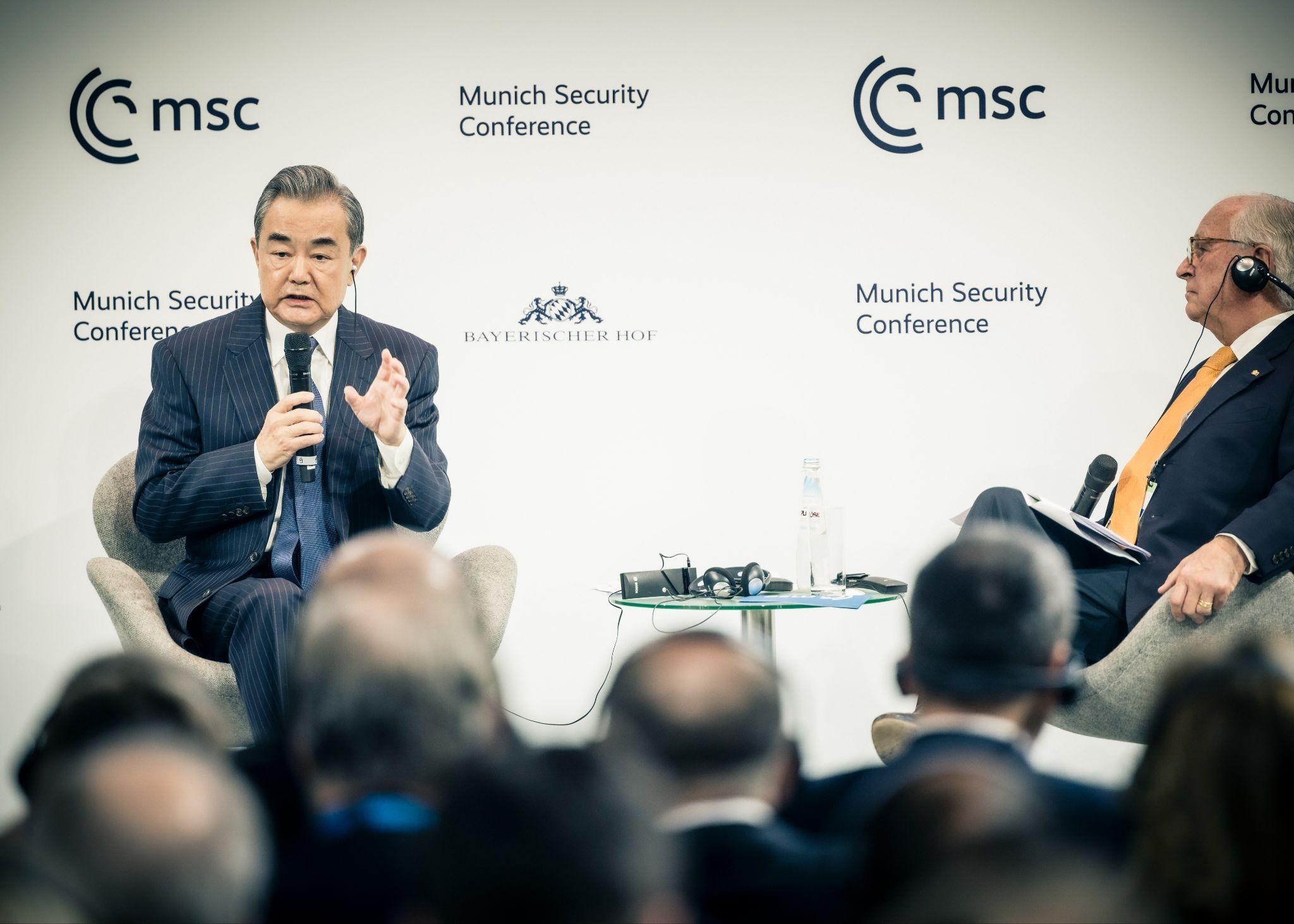
This is not sympathy. A “European conflict” is also a convenient way to wash one’s hands of it: since it is European, Beijing does not have to answer for it. The Brookings Institution notes, incidentally, that Beijing skilfully plays on divisions within the EU. Assessment: China is using Russia as a tool to split the West, because a divided Europe will not agree on tough measures against Beijing. A long war – as long as Kyiv does not strike assets important to China – and Russia as a junior partner: excellent. A stronger Russia? Not any more. If Beijing wanted that, it would be enough to cut off supplies of drone components to everyone except Russia. Hence the paradox: the only one at the table who would, indirectly and “with very, very big reservations”, defend Ukraine’s sovereignty would be Xi Jinping, because the current state of affairs suits him best. Without Ukraine on the agenda, there is nothing to divide. Beijing wants a weak Europe, not a strong Russia.
The underestimated giant: why is Europe waiting for an invitation?
My hope: escalation will cause panic, then Europe will remember how to defend itself, and NATO will respond automatically, before politicians get scared. Naive? Yes, naive. But Putin underestimated Ukraine. Perhaps we are underestimating Europe too?
There is nothing I like more than criticising Europe, but let us look at the cards. The EU’s GDP is nominally larger than China’s (around $22.8 trillion versus around $20.9 trillion, according to IMF estimates for 2026), although in purchasing power parity terms it is the other way round. EU industry grew by 2.9% in 2025 after two years of decline (Eurostat); China’s grew by 5.9% (NBS), but that growth is driven by overproduction. IT services exports are a strength with an asterisk, since Ireland’s €228.2 billion (CSO, 2023) is largely owed to subsidiaries of American corporations.
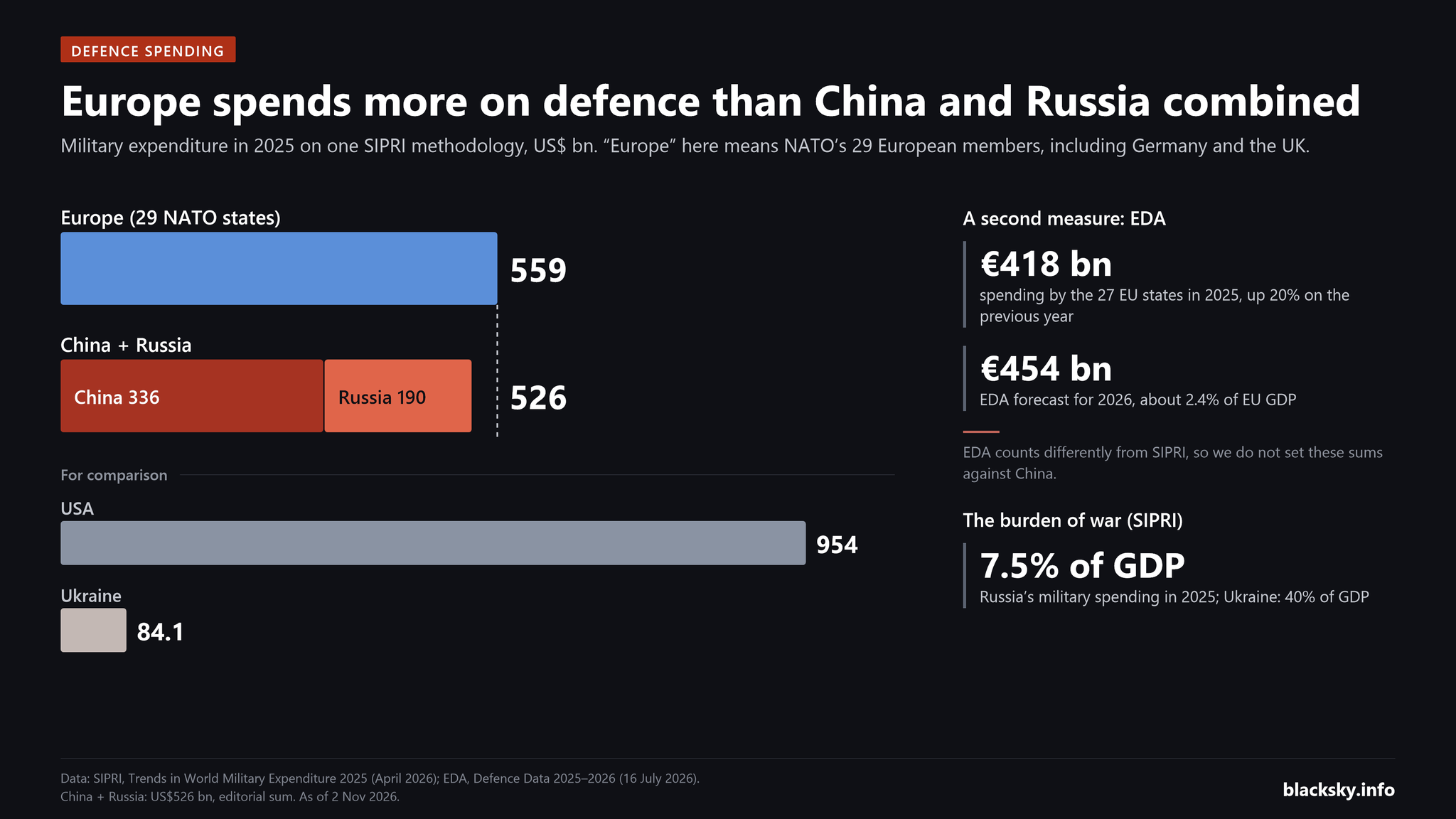
EU countries spent €418 billion on defence in 2025, according to the EDA. The methodology differs from SIPRI’s, so to be fair: the 29 European NATO members – $559 billion, China – $336 billion. Frozen Russian assets worth €210 billion have been immobilised indefinitely by a qualified majority, so not even Le Pen could hand them back to Putin with a stroke of the pen. The ace up the sleeve is the Ukrainian army, and Russia is bleeding out in a war the EU has not even entered.
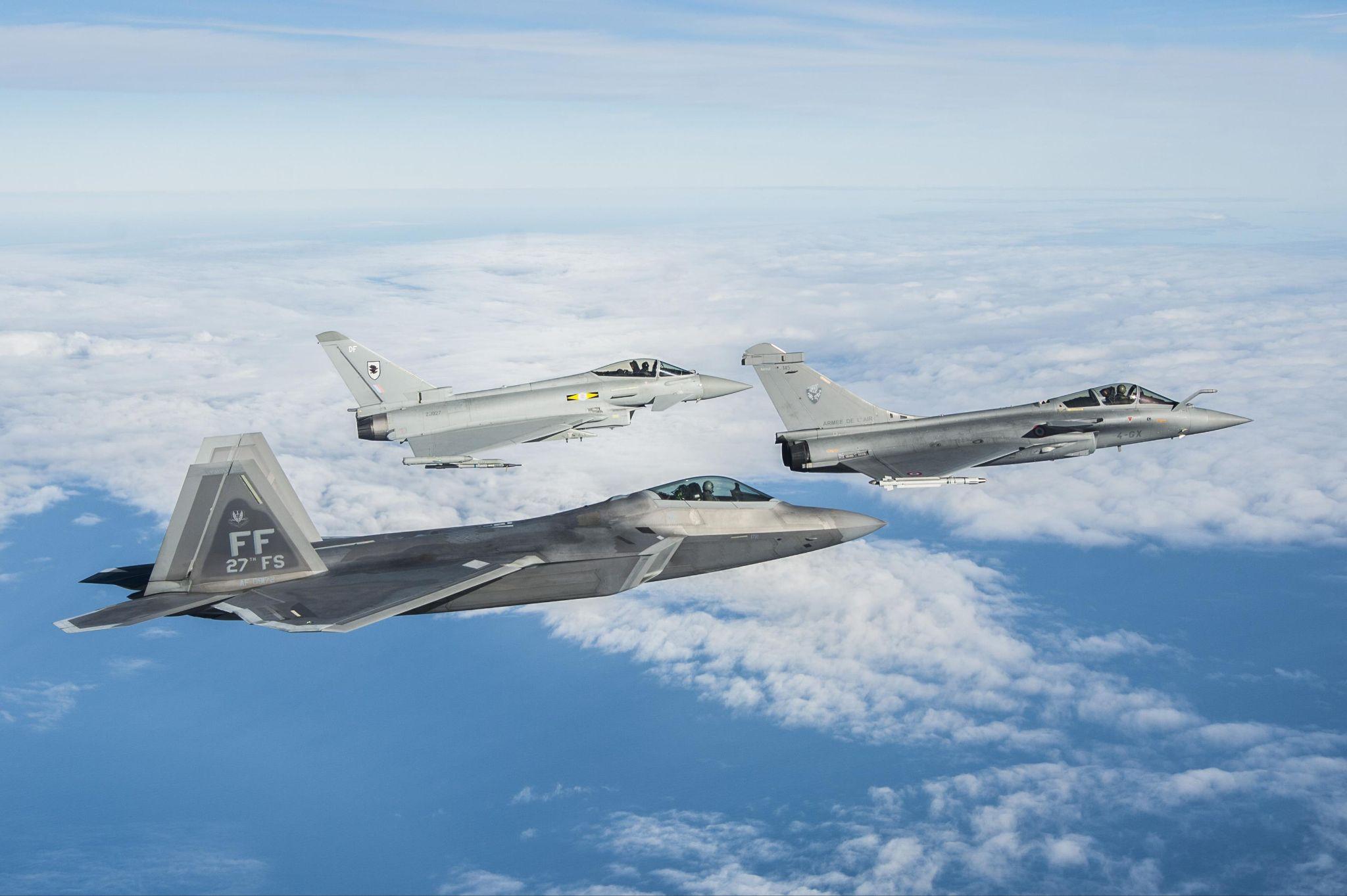
Europe is on the move. On 20–21 October 2026, RAF Typhoons escorted Rafales during the French “Rummy” exercise. There were no nuclear weapons, and Britain has no airborne component, but it was a first. On 2 March 2026 Macron announced forward deterrence, and on 26 October 2026 The Wall Street Journal reported agreements with ten countries on the temporary deployment of Rafale aircraft without nuclear guarantees. Brussels is preparing a negotiating team, with Björn Seibert, von der Leyen’s head of cabinet, seen as the favourite, but there is no negotiating mandate.
We are looking at a giant that does not believe in its own strength. For now, I hope.
The resources of a subject, the reflexes of an object
The lack of fortifications and of politicians of the calibre of Thatcher or Mitterrand is a political fact; the economy, the budgets and “Rummy” are material facts. Europe has the resources of a subject and the reflexes of an object. The meeting in Shenzhen will not create a “Yalta 2”: Xi does not want Ukraine on the agenda there, and the two guarantors of its independence – Europe and the Armed Forces of Ukraine – have not been invited. What will decide is the pace: whether Europe wakes up faster than Russia climbs the next rungs.
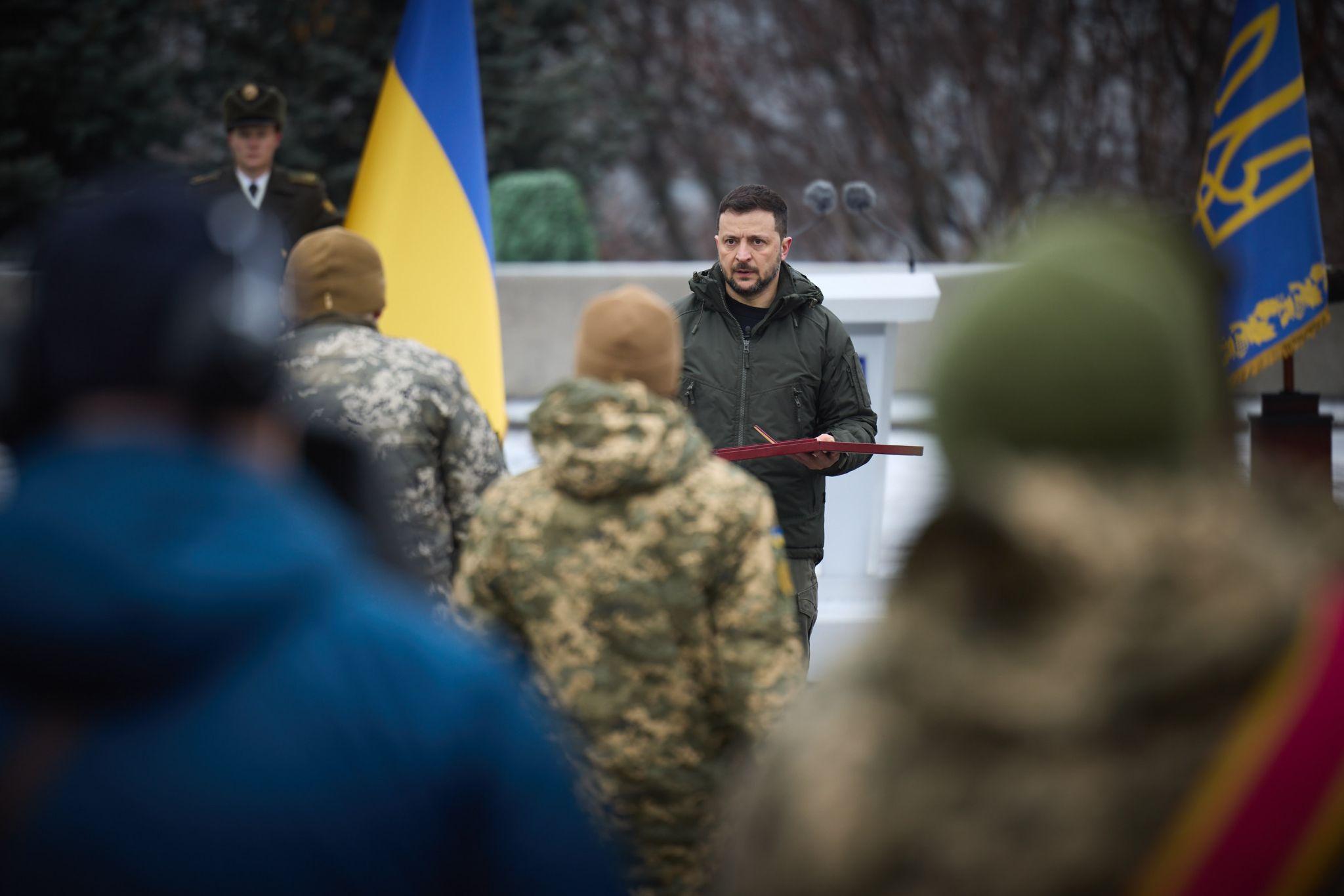
What nobody knows: whether the three-way meeting will take place and whether Beijing will confirm Steinmeier’s account; how many cards voters will leave Trump on 3 November 2026; who will receive the European mandate; who was flying the drones over Île Longue and Volkel.
The words about Europe at the table were spoken in Munich and even in Beijing. Nobody will pull up a chair for it. Whoever waits for an invitation ends up on the menu, not at the table.
As of 2 November 2026.
Author: Artur Żak
Official Russian and Belarusian sources cited in this text are for informational purposes only. Content from these sources may constitute disinformation or propaganda.