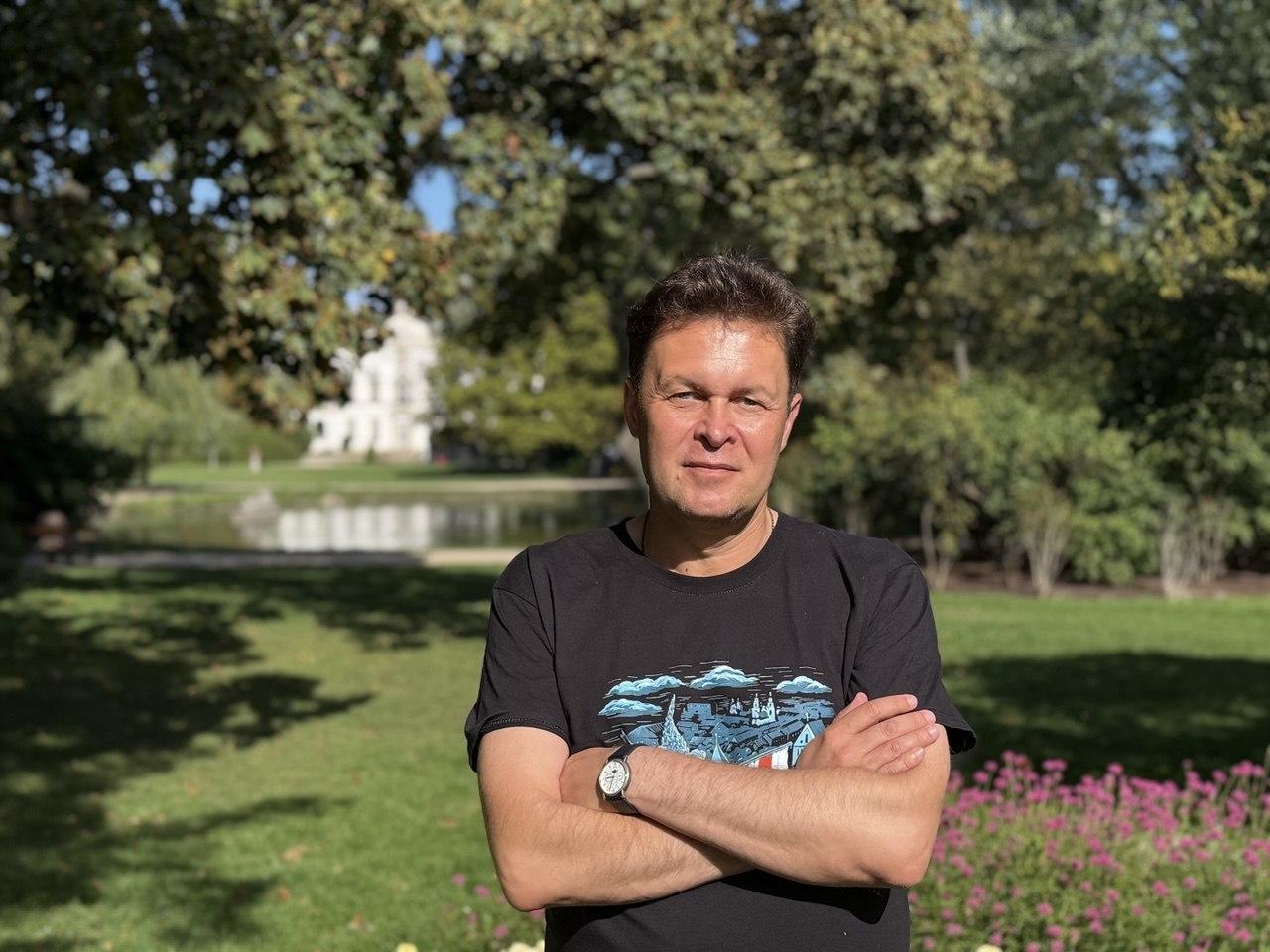
The situation in Belarus remains a focus of European media attention. The Russian-Ukrainian war, which has lasted more than 1,600 days, is sharpening attention to what is happening in Belarus. The country’s dictator, Alexander Lukashenko, has held power for over 32 years. He has built an authoritarian regime there. Is there a threat that the Russian invasion could be repeated from Belarus? Will new political prisoners be released? What will Belarus be like after Lukashenko? We discuss this with Yevhen Mahda, director of the Institute of World Policy.
In brief:
- Lukashenko depends on the Kremlin. Belarus has effectively become a Russian proxy structure, and Lukashenko exploits the West’s desire for dialogue in order to bargain with both Moscow and the West.
- Releasing political prisoners does not mean that repression has stopped. More than 500 Belarusian political prisoners walked free thanks to agreements with the United States, but the regime continues to detain new ones.
- Belarus remains a threat to Ukraine and Europe. Its territory has already been used by Russia to invade Ukraine. The political scientist Yevhen Mahda does not rule out that Belarus could yet be used as a staging ground for a hybrid attack against NATO and EU countries.
- Belarusians on the whole do not want a war against Ukraine. At the same time, a growing number of Belarusian citizens are signing contracts with the Russian army. And the Belarusian regime is actively helping the Russian defence industry.
- The future of Belarus depends on Belarusians themselves, but there should be no illusions. In Yevhen Mahda’s view, power in Belarus can only be changed from within. If Lukashenko goes before Putin, his successor may prove even more pro-Russian.
Over the past year, thanks to the efforts of the Trump administration, more than 500 Belarusian political prisoners have been released. How has this changed the situation in Belarus? What has it changed for the region?
In its relations with Donald Trump’s administration, Lukashenko’s regime is trying to play on Trump’s illusions about the possibility of prising Belarus away from Russia and stripping it of its status as the ‘Belarusian balcony’ that can be used for Russian aggression in the Baltic–Black Sea region. Thanks to the partial lifting of American sanctions against the airline Belavia and against Belarusian producers and exporters of potash fertilisers, several hundred Belarusian political prisoners were freed. Among them were the Nobel laureate Ales Bialiatski, the prominent Lukashenko opponents Viktor Babariko and Maria Kolesnikova, human rights defenders and journalists. A separate track was this year’s exchange of the well-known Belarusian journalist Andrzej Poczobut for Belarusian and Russian spies detained in Poland. Moldova also took part in the exchange. Minsk is now awaiting Trump’s special representative John Coale, while human rights representatives are preparing lists for the release of prisoners, whose number has not changed significantly of late.
So Lukashenko is trading in people?
In fact, the problem is not only the creation of such a mechanism. Trump’s desire to ‘prise’ Lukashenko away from the Kremlin is built not on an understanding of regional realities or of the specific character of his relationship with Putin, but on emotional assessments. As a result, Trump broke the logic of American sanctions against Belarus (EU sanctions remain in full force) and gave Lukashenko an inflated sense of his own worth. The problem is also that, in place of the political prisoners released, Lukashenko’s repressive apparatus keeps detaining new ones. So we are dealing with a paradox: prisoners must be freed, but not at such a price.
Trump’s desire to ‘prise’ Lukashenko away from the Kremlin is built not on an understanding of regional realities or of the specific character of his relationship with Putin, but on emotional assessments.
The Andrzej Poczobut you mentioned returned to Belarus on 8 September, as he had promised. As I understand it, that is his position as a person and as a citizen…
Although I do not know Andrzej Poczobut personally, I have been following his professional and civic stance for a long time. It commands enormous respect from me, because Poczobut is a man of principle who did not give in behind the bars of a Lukashenko prison. His wish to return to Belarus may strike some as irrational. But I consider it a strong act by a strong, a very strong person. One can also say that Poczobut’s release partly improved Polish-Belarusian relations, although no radical lifting of sanctions by Warsaw followed – together with Belarus’s other neighbours, Poland is holding the common EU line on this question.
Belarus remains the centre of authoritarianism in Europe. In essence, it is the last European dictatorship. Who is to blame for this? Why is it happening? And what will Belarus’s further role be after Lukashenko?
I think Lukashenko lost the competition with Putin for the status of ‘Europe’s last dictator’, because the master of the Kremlin proved more adept and more cynical. The Belarusian authorities’ suppression of the 2020 protests, the 2021 migration crisis and Belarus’s complicity in unleashing Russia’s full-scale aggression against Ukraine shaped the corresponding attitude towards Lukashenko. Today the Republic of Belarus is a Kremlin proxy structure to hide behind. This is borne out by Putin’s public statements about deploying tactical nuclear weapons in Belarus in 2023 and the Oreshnik missile system in 2025. The Kremlin plays skilfully on Minsk’s wish to demonstrate independence as it understands it, openly exploiting Lukashenko’s ambitions in its own interests. In 2023, for instance, Russia handed Belarus a division of Iskander short-range ballistic missile systems, from which it had previously shelled Ukrainian territory. These launchers are capable of carrying nuclear warheads.
I want to recall that over more than 32 years in power Lukashenko has had various periods in his relations with the West. Yet he could never resist the Kremlin’s ‘tempting offers’, perhaps because Belarus’s dependence on Russia as a supplier of cheap energy and as a market for Belarusian goods has always been decisive. The Kremlin keeps Lukashenko skilfully on a short leash, as shown by the substantial role of Belarusian enterprises in carrying out tasks for the Russian defence-industrial complex. Hundreds of Belarusian enterprises are today working to sustain Russia’s war against Ukraine, which Lukashenko uses as an argument against being drawn into direct aggressive action.
So Belarusians do not want to fight against Ukraine?
In the broad sense – no, they do not, and Lukashenko is afraid to mobilise (read: hand weapons to) those who came out to protest in 2020. But let me cite another fact: the number of citizens of the Republic of Belarus signing contracts with the Russian army is gradually rising. They already outnumber the Belarusians who joined the ranks of Ukraine’s Defence Forces as volunteers. This is a worrying and deeply unpleasant trend. Yet millions of Belarusian citizens do not want their country drawn into the war – that is a known and, to many, obvious fact.
You noted flare-ups of tension around migrants, who are used as a tool of provocation against Belarus’s neighbours. How does Lukashenko’s regime relate to this? Is he a victim of the process or its initiator?
In 2021 the migration crisis on Belarus’s border with Lithuania and Poland was initiated and organised by Lukashenko’s regime. It looked like an instrument of pressure on the EU right up to 24 February 2022; with the start of Russia’s full-scale aggression against Ukraine it became clear that this had been a smokescreen over preparations for the invasion.
So when Lukashenko publicly stated ‘Vladimir Vladimirovich and I are co-aggressors’, he was not lying?
He had his own reasons for saying so. But the fact of the Belarusian leadership’s complicity in igniting the largest war in the modern world remains indisputable. Lukashenko will have to bear responsibility for it, although right now he is angling for a seat at the table in talks on ending the Russian-Ukrainian war.
But the fact of the Belarusian leadership’s complicity in igniting the largest war in the modern world remains indisputable.
So we must also find answers to the question of how to develop relations between Belarus and Ukraine. Is there a real threat of a war that could again come into Ukraine from Belarusian territory?
In historical retrospect, Belarus and Ukraine have not fought against each other. What is more, it is our peoples who, like no others, felt the pressure of Russian imperialism and of the Soviet concept of ‘fraternal peoples’. In July 1994 presidential elections were held in Belarus and Ukraine that became a point of bifurcation in the history of the post-Soviet republics’ development. In February 2022 a grouping of Russian troops many thousands strong entered Ukraine from Belarusian territory, despite numerous promises by Lukashenko and his circle that this would never happen. Ukraine held out, fought back and will continue to be a democratic state – I am confident of that despite all the problems we face today. What will Belarus be like? The answer to that question lies in the hands of its citizens; change in that state, as in any other, is possible only from within.
How, then, might the various factors of Belarusian influence on its western neighbours be used? After all, the threat of escalation in the region from Russia is not diminishing but constantly growing.
Let me note several factors: Belarusian state propaganda works actively against its western neighbours – Poland, Lithuania, Latvia. Scare stories about NATO and fabrications about the EU have become normal practice in the Belarusian media space. Since the prospects of escalation by Russia are being actively discussed in Europe’s information space, I do not rule out that Belarusian territory could become a staging ground for a hybrid attack – this time against a NATO and EU country. That would allow the Kremlin to wash its hands of it and declare that it had nothing to do with such actions. Belarus and the situation inside it must therefore remain a focus of attention for its neighbours; I consider it advisable to coordinate the actions of the Lublin Triangle countries – Lithuania, Poland and Belarus.
Is Lukashenko ready to be a tool in someone else’s hands? Finally, let me ask: what will Belarus be like after Lukashenko?
Having analysed the character of relations between Lukashenko and Putin, I have to stress: they are not friends, despite more than 100 meetings over the past 25 years. Lukashenko is Putin’s geopolitical orderly, obliged to serve his interests. And he does not like it, though he cannot change the situation. If a change of power in Belarus happens before a change of power in Russia, a politician even more pro-Russian than Alexander Lukashenko will appear at the helm in Minsk. Unfortunately, I am sure of this. And so I advise against building illusions about Belarus, and in favour of working with its citizens more persistently.
Lukashenko is Putin’s geopolitical orderly, obliged to serve his interests. And he does not like it, though he cannot change the situation.
Interview by Svitlana Mialyk