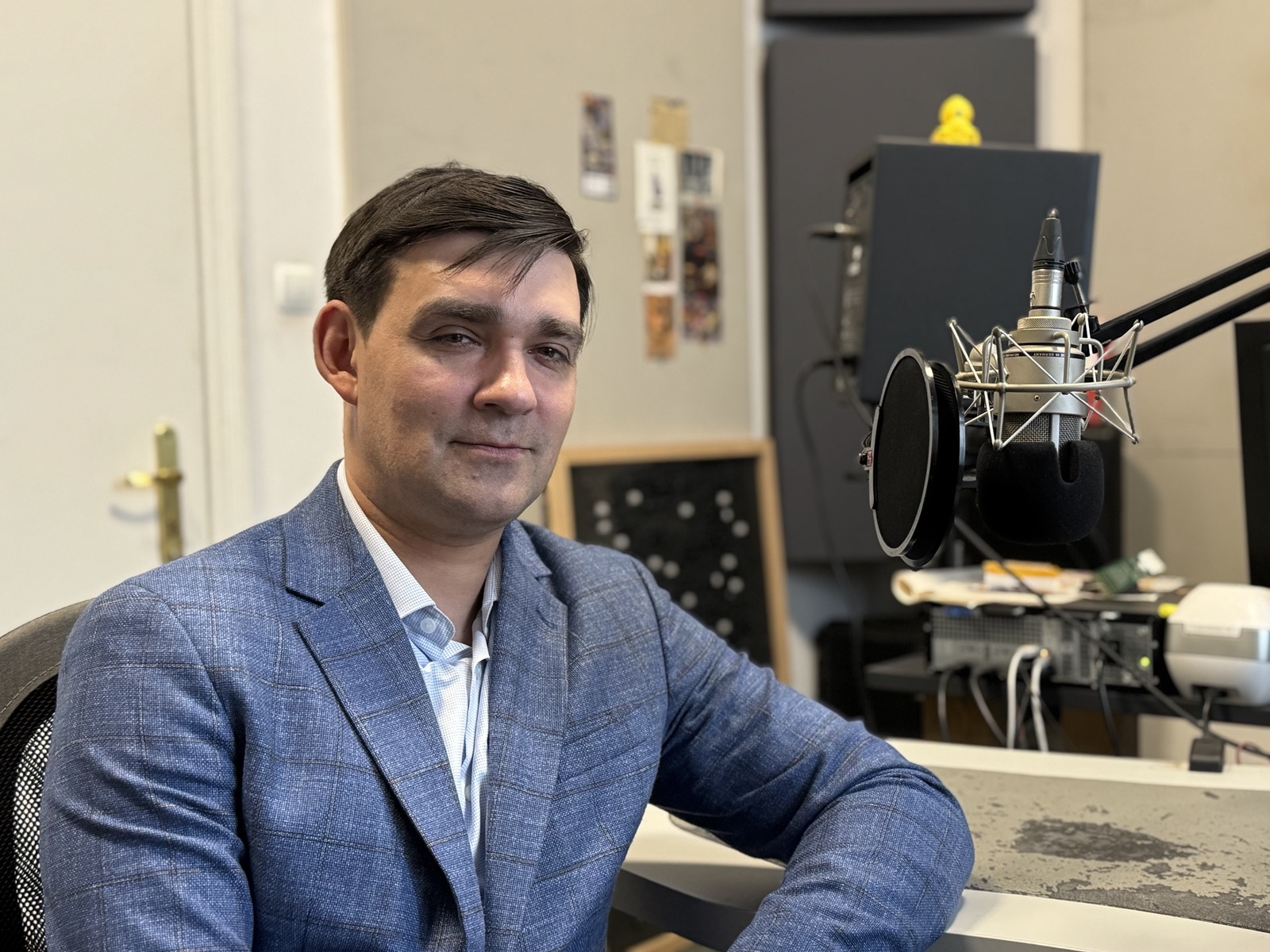

In mid-February, Roskomnadzor announced plans for further “consistent restrictions” on the Telegram messenger, which “does not comply with Russian legislation.” Will Russia be able to technically slow down or completely block Telegram? And what is the real reason for this step? Svitlana Mialyk discussed this with Ihor Rozkladay, deputy director of the Center for Democracy and Rule of Law, chief expert on media law and content moderation on social networks.
On February 10, Roskomnadzor announced plans for further restrictions on the Telegram messenger, which allegedly does not comply with Russian legislation. What is the real reason behind this move, and will Russia be able to block Telegram?
Well, in fact, the issue of blocking any messengers is quite an old story, because we know that Russia has been demanding for a long time that servers be located on its own territory. In addition, there are requirements for the so-called Russian Federal Security Service to have access to Internet traffic and related services. Therefore, strategically, this fits into the general pattern of Russia trying to control the internet, which it has been attempting to do for over 20 years. In other words, they have been working towards this goal quite systematically, continuously and for a long time. Can we say that this is just another story about blocking another messenger? Probably not. Because the history of Telegram itself and the information that has emerged, for example, about Pavel Durov’s trips to Russia when he was supposedly in opposition, and the information about who financed the Telegram project itself, suggests that Telegram is most likely a kind of “Trojan horse.” That is, Russia is using a model, figuratively speaking, like WeChat or, to a lesser extent, the Chinese equivalent of TikTok, i.e., the same product, but created for the domestic market, while a different product with a specific purpose is being released for the foreign market. And from the information that occasionally appears in the public domain, we can say that Telegram is, in fact, most likely a product that is an external “Trojan horse” of the Russian Federation, and not just some kind of messenger.
Can Russia technically slow down or block Telegram?
Well, obviously, it is possible, because Russia already has similar experience with YouTube and blocking other services. So yes, it is possible. Will it be completely shut down? No, because we see, even in the example of Threads from META, that Russians are actively using VPNs. Well, the only thing is that if Russia starts to crack down more and more on the use of VPN technologies, then yes, we can say that blocking Telegram will be quite effective. But in today’s internet, it is quite difficult to block something completely.
This is simply due to the nature of the internet itself and the technologies that are actively developing within it.
In Russia, Facebook, Instagram, and X (formerly Twitter) have been banned since March 2022. YouTube and TikTok services are restricted. If Telegram is blocked, how much will this isolate Russians and residents of the temporarily occupied territories from information and communication with the world?
This is a pretty serious and painful question, because our citizens are under occupation, and they are already, in principle, more isolated than even Russians themselves. And we can remember 2014, when the lists of Ukrainian websites blocked from Crimea were even stricter than Roskomnadzor’s own lists. In other words, what we have been hearing in recent years about what is happening in the occupied territories is that Ukrainians are being intimidated in every possible way in order to isolate them as much as possible from the Ukrainian information space and leave them, in fact, in the Russian “looking glass.” And this, unfortunately, is a fairly effective tactic, because when you are in a certain space for a long time and have no alternative information, it is extremely difficult to resist. Obviously, there are very strong people who can resist this, but we understand that this requires a lot of energy, which is not available in those conditions, especially when you are under constant scrutiny and terror from the Russians, who are essentially Nazis. Therefore, this is becoming an increasingly serious problem for us because we are essentially losing the ability to communicate normally with our fellow citizens. And here, to a certain extent, the situation is beginning to resemble North Korea’s isolation from South Korea.
How will the restriction on Telegram affect the front in Russia? After all, after the Russian military in Ukraine lost the ability to use Starlink satellite internet terminals, serious communication problems began in the combat zone.
We see that they have decided to ease restrictions for the front in Russia, because they themselves realized that they had shot themselves in the foot. The question is how well this will work, because any block has the problem that very often you can block something that should not be blocked. We have had such things happen too, and I think that the Russians will not be able to completely unblock the front. From time to time, they will encounter some problems. But I think that the military themselves are best placed to comment on this, and it would not be very competent to delve too deeply into this topic. In other words, false blocking is possible.
What is MAX, the Russian “national messenger”?
We only have open information, because to register with MAX, you need to have a Russian or Belarusian phone number. So all we know about MAX is that it is the closest analogue to WeChat. That is, it is a service of this kind, plus an internal messenger, plus, obviously, state supervision by the special services.
It looks very much like it has been copied, unless it is based on the same engine, but we do not know that. It is actually a messenger that is popular in China. The model is extremely similar. We cannot say whether it is identical. To do that, we would need to work with this messenger directly, but we do not have that opportunity ourselves. Therefore, it is quite difficult to say anything more detailed here. That is, all we know about MAX and everything that is written about it is that it is very similar to such a hybrid or, say, the Russian analogue of WeChat.
The fate of Telegram in Ukraine and Poland. From time to time, there are calls to abandon the messenger. Even some media outlets have stopped using Telegram to distribute their content.
In fact, Telegram’s biggest problem is not the messenger itself, although there are quite a few issues with the messenger, such as the fact that conversations are not encrypted and whether the FSB has access to them. In reality, the biggest problem is that too many Ukrainian users have become addicted to it, and according to various studies, 80% or even more of active users use it for communication and news consumption. And this is a problem because a lot of related ecosystems have already grown up around it, such as chatbots, various services, businesses, and even online stores that cannot publish certain content on other platforms because of its connection to erotica and sex shops, so to speak. Therefore, a lot has already been imposed on this messenger, and obviously, banning it will cause some resistance or dissatisfaction. And before that, in fact, it would take a long time to re-educate and explain that it is dangerous. And in fact, this is being done, but the problem is that people are inert, and until they are forced to, they are unlikely to do anything. That is, some people are trying to move or duplicate channels on other platforms. So far, this is a long-term investment, because the main audience is still on Telegram. And this is because, no matter how you look at it, it is convenient, that is, it has many features that are extremely convenient. What could happen to it? We know the consistent position of Yaroslav Yurchyshyn, chairman of the Verkhovna Rada Committee on Freedom of Speech. He emphasizes that Telegram has become not only a field of disinformation, but also a place where children are recruited and then these children will have their lives ruined forever. Because this is a very serious crime.
And, of course, ideally, Telegram should be blocked. Obviously, this will raise a technical problem, because it is not the same as blocking VKontakte and Odnoklassniki, as was done in 2017. And obviously, we will face resistance, inertia, and questions about whether we can, for example, make Telegram inaccessible on platforms, marketplaces, Google, the App Store, and possibly some other platform applications. Because this is also one way to reduce its reach. But this is a pretty serious and complex thing. And it should be done because Ukrainians, and not only Ukrainians, should understand that everything that comes from Russia is dangerous until proven otherwise. Unfortunately, we still see people who like to go to the “Russian ballet” and other Russian products. Because for some reason it seems that culture, sports, and science are all outside of politics. But we know that these same cultural figures do not hesitate to plunder our cultural heritage, as happened in Crimea. Therefore, in my opinion, Telegram should be recognized as a source of danger not only in Ukraine but also abroad. Its activities should be restricted as much as possible and, ideally, banned as a product with a rather opaque history, opaque data storage, and much more.
Author: Svitlana Myalik