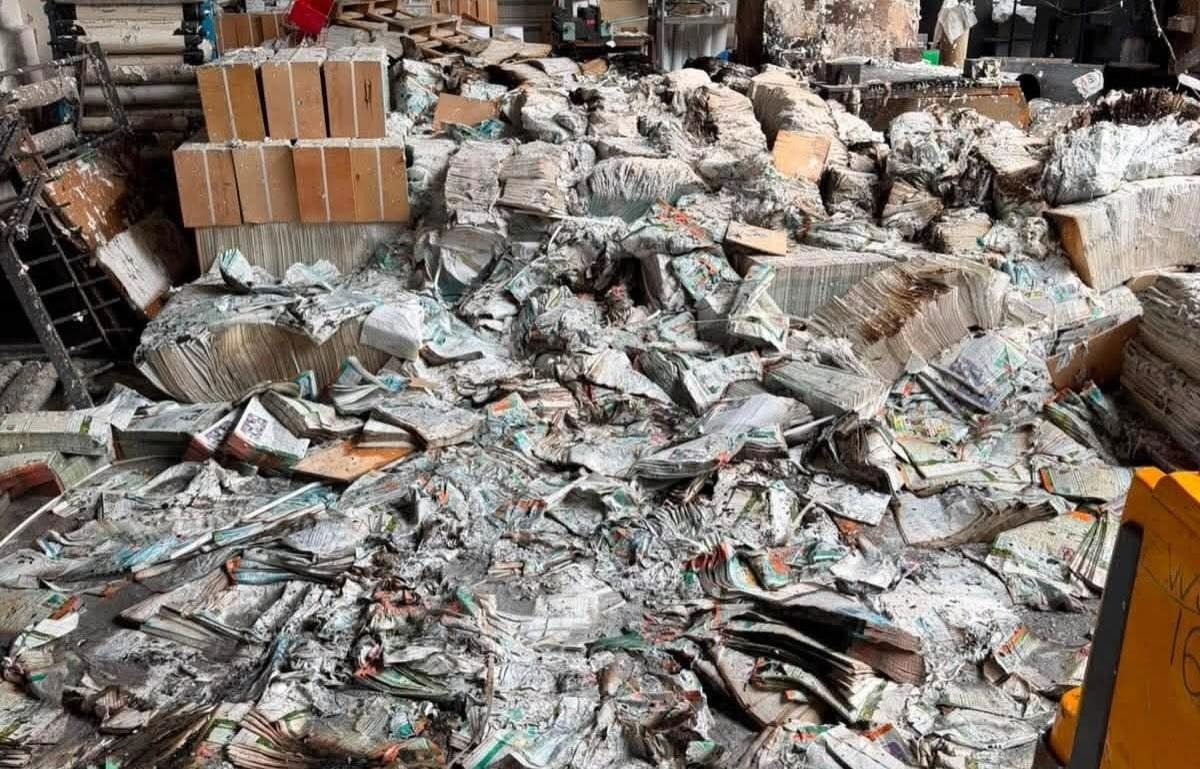
1.5 million copies of books in Ukraine were destroyed as a result of Russian attacks over the summer in the space of just one month. The literature included works of fiction and educational textbooks, whilst printing equipment was also destroyed. The head of the Ukrainian Publishers’ Association, Artem Bidenko, told ‘Black Sky’ why literature has become a target for destruction.
In brief:
- During July, 1.5 million copies of books were destroyed in Ukraine as a result of Russian attacks.
- The Ukrainian publishing industry is experiencing a period of stagnation, but the culture of the written word is being revived.
- Since the start of the full-scale invasion, the literary market has changed — around 90 per cent of all printed material is now in Ukrainian.
- Russia is deliberately destroying printing equipment and school textbooks in Ukraine.
- Literature in Russia is subject to strict censorship. Instead of removing censored sections, publishers print the full text of the book with black bars in place of the text.
Which books were destroyed
Throughout July 2026, Russian attacks were specifically aimed at destroying Ukraine’s book production sector.
- 2 July — a missile strike on the warehouses of the BookChef publishing house in Kyiv — 800,000 copies lost. The publishing house specialises in producing fiction and non-fiction across various genres. That same night, the ‘Megapoligraf’ printing works was destroyed; it was, in particular, responsible for printing textbooks for the new academic year for the ‘Ranok’ publishing house.
- 4 July — the warehouse of the ‘Nash Format’ publishing house was damaged.
- 7 July — an air strike hit the warehouse of the ‘Ranok’ publishing house.
- 8 July — as a result of the shelling of Kyiv, the office of the children’s publishing house ‘Mamyne Sonetchko’ was destroyed, and stocks of children’s literature were lost.
- 19 July — Russian missiles destroyed the warehouse of the ‘Knygolav’ publishing house (250,000 books were burnt), the editorial offices of the MIMIR MEDIA publishing house, and damaged the office of the ‘ARK.UA’ publishing house. The printing works of the ‘Konvi’ printing company — Ukraine’s largest producer of school textbooks — was also destroyed. As a result of the attack, approximately 250,000 textbooks for Year 9 and 350,000 printed sheets (including textbooks for Year 4) were reduced to ashes. The printing equipment cannot be repaired.
Artem Bidenko explains that in just one night, Russia managed to destroy around 7 per cent of the literary market’s total turnover:
“This was definitely a targeted destruction. The Russians wanted to destroy, first and foremost, the equipment. It’s been lost, and it’s not that easy to replace, as it’s expensive, and we don’t have any preferential import arrangements for printing equipment. Secondly, the print run of textbooks in particular was enormous, and it’s now very difficult to restore it quickly, as preparations for the new academic year are already well under way. And, thirdly, a great deal of printed material has been destroyed”.
The Ukrainian Book Institute has estimated the industry’s losses for July 2026 alone at over 1.5 million copies.
Why is Russia destroying Ukrainian books?
The chair of the Ukrainian Publishers’ Association explains that as far back as 2022, videos were circulating online showing Russian soldiers in Ukrainian towns and villages entering libraries, throwing out Ukrainian books, mocking them and destroying them.
“They have a clear understanding that books are something that must be destroyed; this is something they must combat. The blow is not just against books – they are destroying textbooks; they are trying to destroy our education system. Because this is something that cannot be created or replaced quickly and, consequently, it will create a problem for the entire educational process,” — says Artem Bidenko.
The head of the Ukrainian Publishers’ Association emphasises that this is not just about books, but also about historical monuments, museums and everything that has cultural value for Ukrainians.
“The Russians are destroying us as a nation. We are already calling this genocide. This is full-scale aggression aimed at destroying Ukrainians as a nation with its own culture and its own language. Mocking the language is part of the same story,” emphasises Artem Bidenko.
Why is Ukrainian literature feared in Russia?
Since the start of Russia’s full-scale invasion, the Ukrainian literary market has been going through a very strange period. On the one hand, there is stagnation. As the head of the Ukrainian Publishers’ Association explains, books are not essential goods, so in times of crisis they are always among the first to suffer. However, on the other hand, we are witnessing a process of cultural revival and development.
Artem Bidenko notes that over the past four years, readers’ demand has changed: now over 90 per cent of all printed material published is in Ukrainian.
‘All [publishers] are looking for Ukrainian authors today. Everyone is trying to find some hidden gems. There’s a great deal of self-publishing at the moment; in other words, many people are writing and publishing their own work, and these are substantial print runs. So I’d say that, in terms of authorship and the emergence of new names, we’re experiencing a certain revival of Ukrainian literature. And there’ll be a sort of peak in, say, five years’ time, when people have found their voice and a writer’s second or third novel appears. There’ll be more authors like that.”
In 2025, the Hryhorii Skovoroda Central Library in Solomyanka published a list of Ukrainian writers, many of whom are military personnel, activists and volunteers who, since 2014, have been writing about the realities of war, the daily lives of soldiers, and events that cannot be captured in news headlines. As noted in the post, the list is not exhaustive, as it is impossible to mention everyone who defends and supports Ukraine.
What the Russian market offers its readers
Censorship is prohibited by the Russian Constitution, yet an increasing number of literary works are being added to the list of banned literature, whilst books that do reach readers are published with entire passages of text obscured by black lines.
In 2022, Russia passed a series of laws banning ‘LGBTQ+ propaganda’, as well as laws on ‘fake news’ and ‘discrediting’ the Russian Armed Forces. In 2024, a law was passed banning the promotion of a conscious decision not to have children (childfree). And in 2025, penalties were increased for calls for sanctions against the Russian Federation and for ‘discrediting’ the Russian army.
All these restrictions have had a tangible impact on the publishing sector. In Russia, any mention of war, criticism of Russian aggression, LGBTQ+ topics, emigration, decolonial discourse, or descriptions relating to drugs or suicide have been banned or subjected to strict moderation. As a result, thousands of books are being scrutinised, labelled or withdrawn from sale, reports Korrespondent.
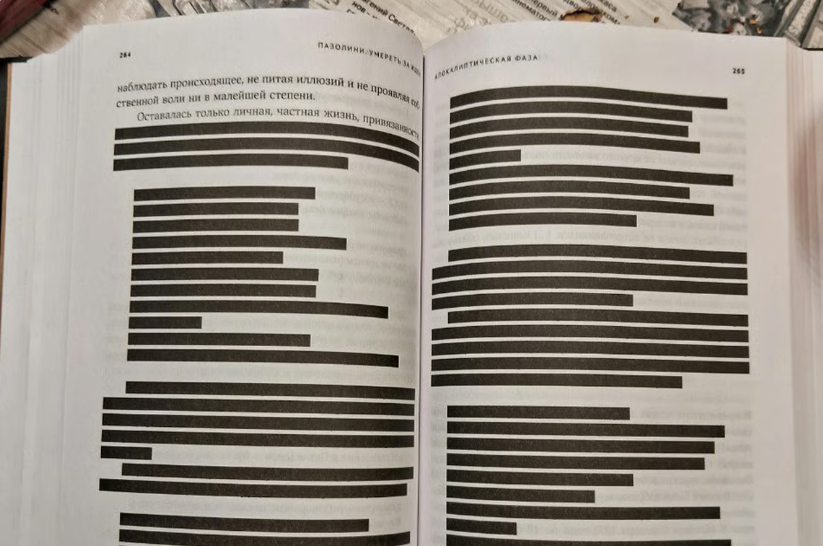
Online, the phenomenon of Russian censorship in books has been dubbed a “blackout”. Due to the costly typesetting process, publishers do not remove censored passages but cover them with solid black lines.
Text analysis is carried out using artificial intelligence, which is why passages that have nothing to do with ‘promoting’ banned topics often fall victim to the ‘blackout’. As a result, the reader buys a complete, printed book with its original page count, only to receive a ‘brick’ in which a third of the text may be ‘blacked out’.
It is not only contemporary works that have been censored, but also classics by foreign authors.
Yulia Derdyuk