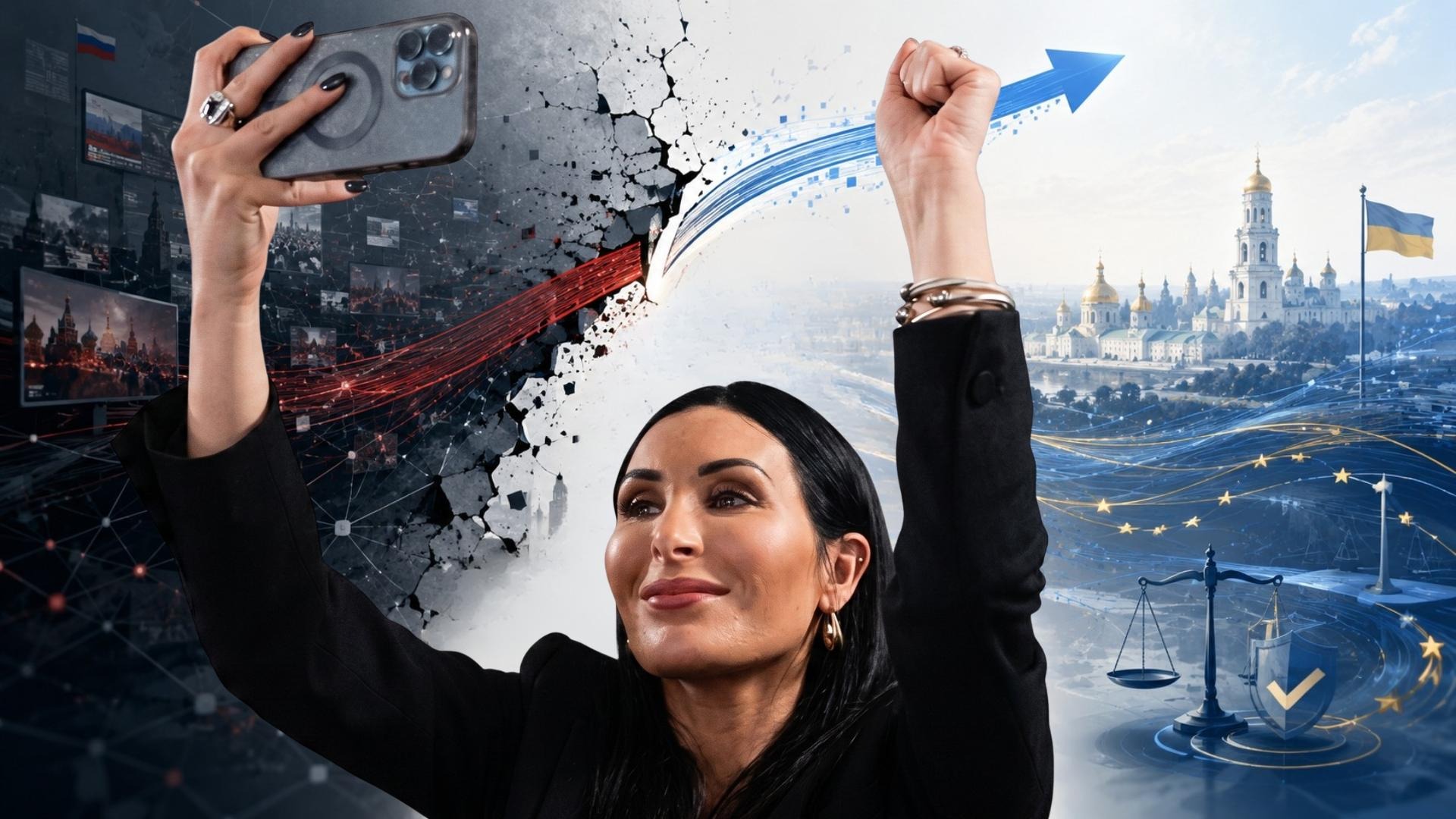

Laura Loomer, one of the most prominent figures in Donald Trump’s online support base, has moved from attacking Ukraine to supporting its defense and sanctions on Russia. Right-wing podcaster Tim Pool has sent a similar signal. This split in the right-wing media ecosystem may make it easier for Trump to adjust policy, but it does not prove that MAGA as a whole has shifted.
In Brief
- For years, Laura Loomer opposed aid to Ukraine and repeated some Russian justifications for the war; in June 2026, she admitted falling for Russian propaganda.
- Her shift began before her own trip, after reports from a Loomer Unleashed correspondent in Ukraine, and deepened during her visit to Kyiv and near the front.
- The successful strike on the Kyiv-Pechersk Lavra and Moscow’s military cooperation with Tehran undermined the portrayal of Russian President Vladimir Putin as a defender of Christianity and a natural “America First” partner.
- Tim Pool also backed a Ukrainian victory; in the Tenet Media case, U.S. authorities charged RT employees, but not Pool, who says he did not know the money came from Russia.
- A shift by several influencers may lower the political cost of Trump’s cooperation with Kyiv, but MAGA remains divided, and media signals are not decisions by the administration.
An air-raid alert in Kyiv and a statement she had never made before
The Associated Press interview with Laura Loomer was to take place at a Kyiv hotel. When a Russian ballistic-missile threat emerged, the interview moved to an underground shelter. A few hours earlier, the commentator had returned from a field trip. “You don’t need to listen to a podcaster and let them influence your opinion about a country. You can look at those facts yourself,” Loomer told AP reporters.
Until recently, she herself spoke of Ukraine as a country unworthy of American money or attention. Now she acknowledges: “I’ve come to realize I was bamboozled by Russian propaganda and I came to believe a lot of untrue things about Ukraine.” She traces her earlier beliefs to Telegram, Russian media, and the skillful exploitation of anger among audiences pushed off mainstream platforms.
Loomer is a right-wing activist and the host of Loomer Unleashed [a current-affairs podcast—ed.], not a White House official. Her words carry weight because of her access to Donald Trump, her nearly two million followers, and her standing within the MAGA ecosystem. They do not, however, prove a sudden political conversion. The shift began several weeks before her own trip. It combines new information, the experience of war, Ukrainian messaging adapted to the language of “America First,” and possible alignment with the U.S. president’s changing tone.
Laura Loomer has access to Trump, but she is not his adviser
Loomer is known for provocations, conspiracy theories, and Islamophobic and xenophobic remarks. Her position in Trump’s orbit comes from her access, ability to set the agenda, and capacity to mobilize online pressure. She holds no formal position.
In April 2025, she gave Trump a list of National Security Council officials she considered disloyal. Soon afterward, at least six officials were dismissed or reassigned. Reuters found that the link between the dismissals and her recommendations remained unclear and that some decisions had been made earlier. Trump denied her involvement. Her access and attempt to exert influence are documented; control over the decisions is not.
On Ukraine, Loomer may give Trump arguments that resonate with his base. There is currently no public evidence that she acted at the White House’s direction. Loomer also denied in an AP interview that the Ukrainian authorities funded the trip. “I can guarantee that nobody paid me. The Ukrainian government certainly did not pay me to come here,” she said. We found no publicly available documents or indications that would allow us to independently reconstruct the full arrangements for the visit.
From “I don’t care” to admitting a mistake
Loomer’s earlier messaging belonged to the hard-line anti-Ukrainian current on the American right. She opposed spending, portrayed the Ukrainian authorities as corrupt, and depicted the country as full of apologists for Nazism. She regularly attacked Ukrainian President Volodymyr Zelenskyy and repeated the Kremlin’s call to “denazify” Ukraine.
Criticizing the cost of aid is not automatically Russian propaganda. In Loomer’s case, however, the budget argument came with a false portrayal of Ukraine as a Nazi state and Russia as the defender of moral order.
The archive of the Russian state-run outlet RT contains at least two 2021 commentaries signed by Loomer: a February 2 article on digital-platform censorship and a March 11 article defending Gab. They did not directly concern Russia’s war against Ukraine, but clearly document a publishing relationship.
Loomer says she received no money and now regrets the publications. Yet no public evidence corroborates every detail of that claim. It must also be said fairly that publication by RT does not itself prove she acted as an agent. It shows how the Russian outlet offered visibility and reach to Western figures at odds with major platforms.
The influencer gained a new audience; RT gained an American voice amplifying divisions and Kremlin-friendly messaging. This convergence of interests does not prove coordination, but it facilitates influence operations without formal recruitment.
The shift began before Loomer’s trip
The first clear stage of the shift was a trip by Andrew Moore, a Loomer Unleashed correspondent, in cooperation with Steven Moore of the Ukraine Freedom Project. In Kyiv during a heavy attack, he saw the destruction and visited a destroyed evangelical church and a Ukrainian drone unit.
On June 18, the Washington Examiner described how the report reached the program. “One of the places we visited was an evangelical church, completely destroyed. It had been hit by a cruise missile,” the correspondent said. That image was hard to reconcile with the propaganda narrative of Russia defending Christianity against the godless West.
Loomer then said: “I fell for Russian propaganda.” She also described a mechanism she considered more effective than direct persuasion: “The Russians are very good at appealing to emotions. They are very good at exploiting Americans’ anger, particularly the anger of the MAGA movement.” In her view, audiences should step back and examine how their emotions are exploited. The shift had begun before her trip. Her journey to Kyiv did not create a new opinion from scratch, but gave it a personal dimension and political reach.
It should be noted, in fairness, that the Ukraine Freedom Project openly seeks support for Kyiv and is therefore not a neutral guide. This does not invalidate the documented destruction, but means the itinerary may have been part of strategic communications. The arguments focused on religious freedom, civilian protection, and U.S. interests. Steven Moore summed up the approach in three words: “The truth still works.”
Ukraine presented in the language of “America First”
During her July trip, Loomer visited Kyiv and areas nearer the front. She met officials, soldiers, and Ukraine’s chief rabbi, Moshe Reuven Azman. She showed a destroyed McDonald’s in Lukianivka and the Kyiv-Pechersk Lavra, while a missile alert forced her into a shelter.
“I’ve just experienced my first air-raid alert in Ukraine. The sirens are wailing. For every Ukrainian, this is everyday life,” she wrote. She recalled repeatedly saying that she did not care about the war, then called for an unequivocal moral judgment. The message was, of course, aimed not at the Ukrainian public but at her American audience.
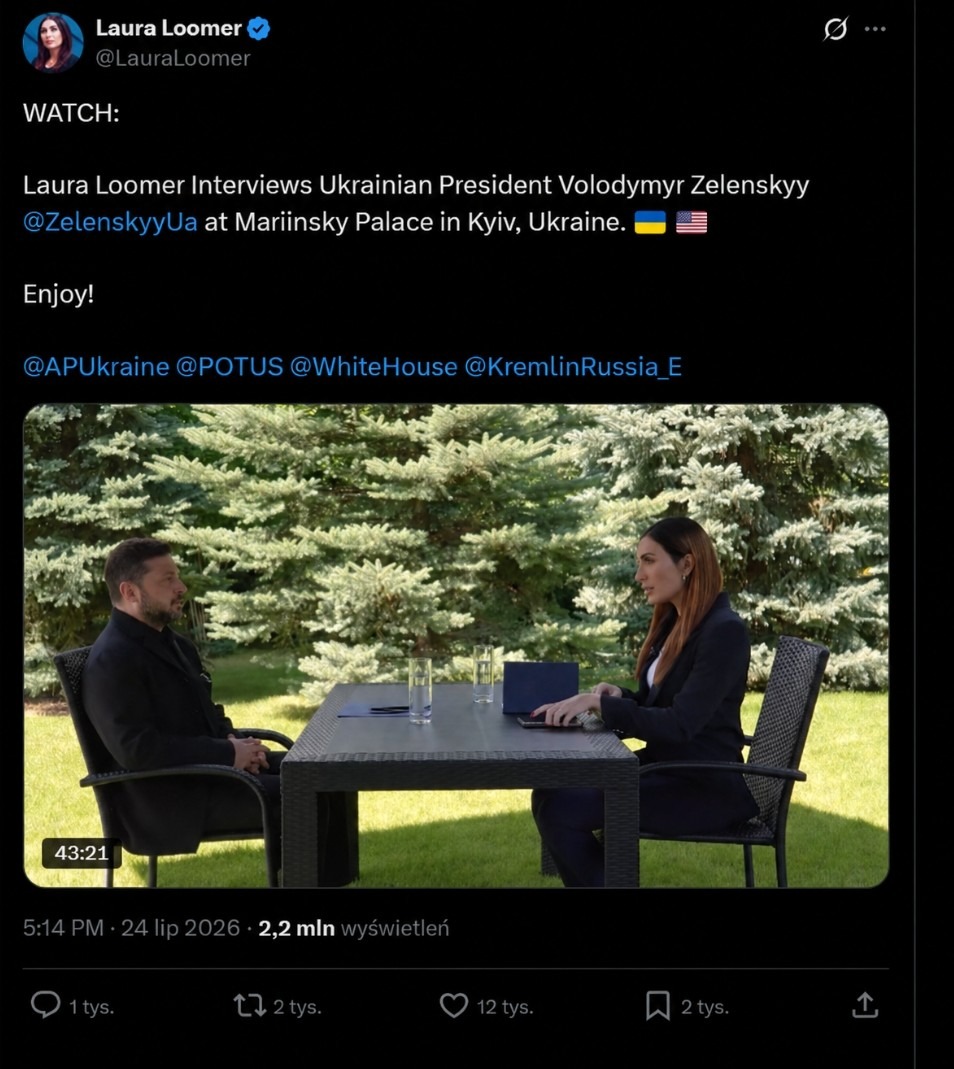
Loomer’s most important meeting in Ukraine was an interview with President Volodymyr Zelenskyy, published on her profile on X. The Office of the President of Ukraine also reported that First Deputy Head of the Office of the President of Ukraine Serhiy Kyslytsya met Loomer and accompanied her to the Lavra. AP spoke with her after she returned from areas near the front. Zelenskyy’s Office thus openly cast the visit as part of the battle for American public opinion: “It takes courage to come to Ukraine and not be intimidated by Russian propaganda or air-raid sirens.”

Kyiv’s message centered on themes that resonate with the right: Russia bombs Christians, cooperates with Iran, and exploits American divisions. Ukraine presented itself as a country with combat experience and drone technology, not a perpetual recipient of funds. This approach lets Kyiv reach Loomer’s audience, but carries a cost: the Ukrainian authorities legitimize a figure known for conspiracy theories and statements targeting minorities. AP noted that during the visit Loomer continued using xenophobic language on other issues, and that her shift on Ukraine was not a broader ideological transformation. “One of the things I really love about Ukraine is that I haven’t seen a single Muslim here. It’s so refreshing,” Loomer wrote.
The Lavra and the fractured “Christian Russia” myth
On the night of June 15, 2026, Russia again attacked Kyiv with missiles and drones. The All-Ukrainian Council of Churches and Religious Organizations said the Kyiv-Pechersk Lavra was damaged and a roof fire at the Cathedral of the Dormition of the Mother of God covered about 800 square meters. Loomer contrasted the damage with the Kremlin’s image of Vladimir Putin as a defender of Christianity. “You cannot claim to protect Christianity while trying to strike Jesus Christ with a drone,” she said in a recording from the church. Moscow presents the war as a defense of traditional civilization against the secular West. The burning roof of one of Orthodoxy’s most important churches damages that narrative more than another dispute over the size of an aid package.
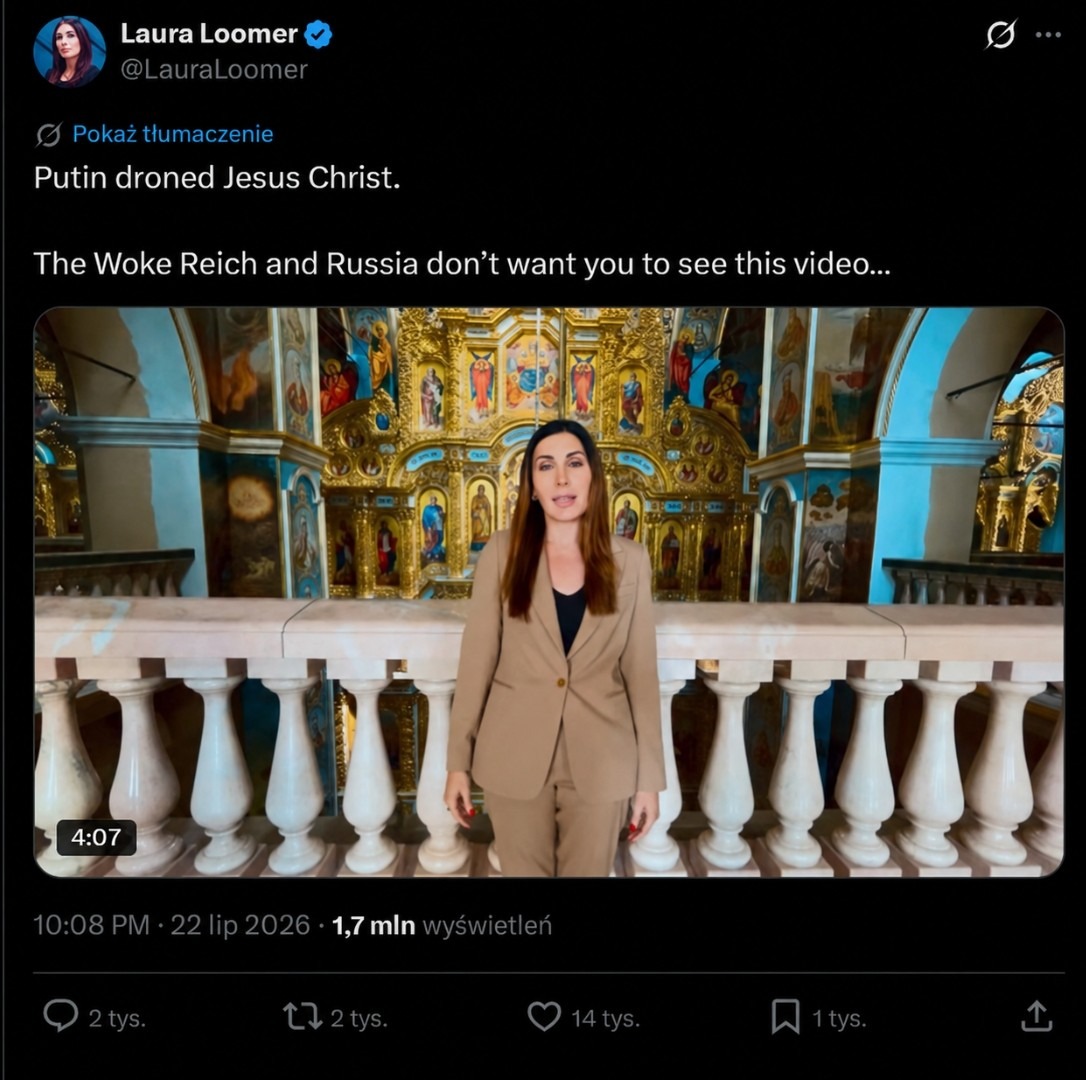
Loomer also clashed with Alexander Dugin, a Russian imperial ideologue. Dugin holds no government office, and his relationship with Putin is unclear. By accusing him of pushing the Russian narrative into right-wing podcasts, Loomer showed a change in perspective.
A second contradiction arises from Russia’s relationship with Iran. In January 2025, the two countries signed a twenty-year treaty. It provides for cooperation between intelligence services, military exercises, and personnel training, but contains no automatic defense clause. In March 2026, Reuters reported Ukrainian allegations that Russia was supplying Iran with upgraded Shahed-type drones. Kyiv’s position, and the broader military cooperation, are both extensively documented.
For “America First” advocates, the question is: why idealize a state deepening military ties with Tehran? Loomer connected the two wars. No single argument is certain to change attitudes, but this one, combined with attacks on churches, has fundamentally undermined the coherence of the earlier image of Russia.
An interview with Zelenskyy and two words from Trump
On July 23 in Kyiv, Loomer spoke with Volodymyr Zelenskyy about relations with Trump, Russian disinformation, security, and technology cooperation. Zelenskyy appeared on a program whose audience had previously been told that Ukraine was an enemy or a burden.
In the interview, Zelenskyy returned to his brief April 2025 meeting with Trump at the Vatican. He called it historic because, as he put it, “in 15–20 minutes, we changed our relationship.” Loomer let him present that account without traditional media as an intermediary and without changing audiences: he spoke directly to a constituency that had previously been among the most distrustful of Kyiv. Donald Trump also shared an excerpt on Truth Social and added: “Very good!!!” The Associated Press noted that the White House later confirmed the presidents’ meeting for July 28. Two words and three exclamation points were not a decision on weapons or sanctions, but clearly signaled approval of the interview and its interviewer. This lets Trump change tone without adopting Democratic language. A MAGA ally frames support for Ukraine as defending Christians, fighting manipulation, and pressuring U.S. adversaries.
Tim Pool: a similar shift, different baggage
Right-wing podcaster Tim Pool, in turn, wrote on X on July 23: “Ukraine has been fighting for their very existence against an evil dictator I see now the importance of the Ukrainian victory against Russia I hope Trump and the people of the United States will lend their support”. The contrast with his 2024 statement is stark: “Ukraine is one of our nation’s greatest enemies.” Pool then demanded an end to all military aid and an apology to Russia.
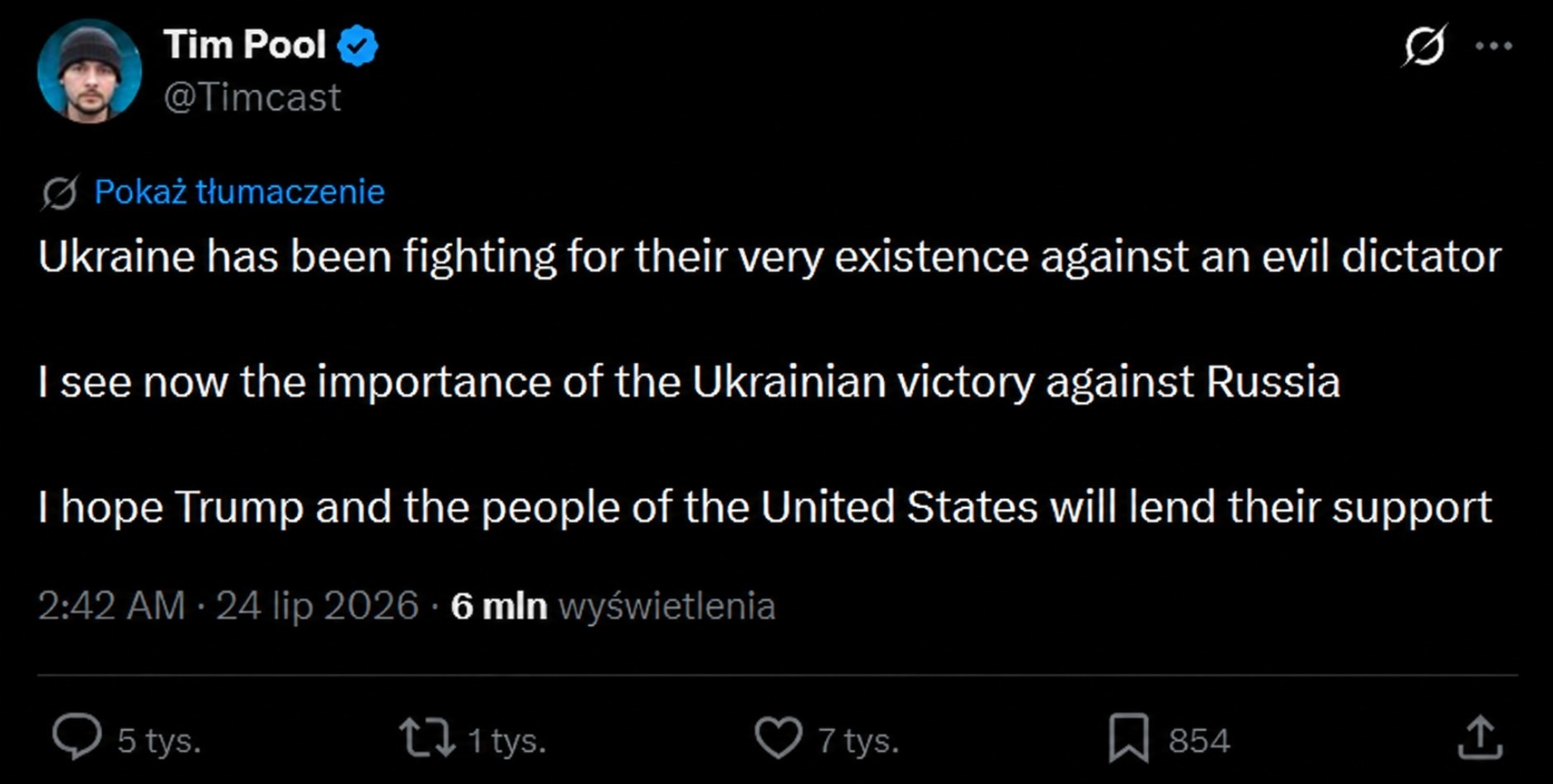
Pool has not explained the change. The timing proves neither coordination nor a lasting reassessment. It may reflect alignment with Trump’s tone, audience sentiment, or reputational repair, but open sources do not establish the main motive behind Pool’s “conversion.”
Tenet Media and hidden funding from RT
In September 2024, the U.S. Department of Justice indicted RT employees Kostiantyn Kalashnikov and Elena Afanasyeva for conspiracy to violate foreign-agent laws and money laundering. The press release and indictment said they funneled nearly $10 million through shell companies to a Tennessee firm that published almost 2,000 pieces of content. The document did not name the company, but the details matched Tenet Media. The indictment described RT employees’ influence over selected content and a fictitious investor concealing the funding. Tenet licensed Pool’s program; The Washington Post found it paid him $100,000 per episode.
Reuters reported, citing the Justice Department, that the commentators did not know the money’s source. Pool called the creators deceived victims and said they retained full editorial control. He was not charged; CJR wrote in June 2026 that the case remained open. The charges against the RT employees do not amount to convictions, and they are presumed innocent, but the case appears to be developing. The Tenet case illustrates the mechanism described by U.S. prosecutors: high fees, the licensing of ready-made programs, and a hidden investor were meant to let a Russian outlet finance an American channel without viewers’ knowledge. Specific instructions to every creator are not required to recognize that a foreign entity was buying reach in a susceptible environment. But the charges against RT employees cannot be extended to Pool or others without evidence of knowing involvement. Nor is there a legal basis for treating Tenet as the confirmed cause of Pool’s July shift. For now, legal, reputational, and business risks are context, not proof of causation.
MAGA still does not speak with one voice
Loomer and Pool are not, strictly speaking, a social movement, and their posts are not a reliable opinion poll. Other right-wing opinion leaders, such as Tucker Carlson and Candace Owens, have not joined the narrative shift; messages blaming Ukraine or justifying Russian demands remain present in right-wing circles.
It should also be noted, in fairness, that not every opponent of aid to Ukraine supports Putin. Isolationism, budgetary opposition, and repeating disinformation are distinct phenomena. In an April 2026 Economist/YouGov poll, 37 percent of Republicans wanted to reduce or end military aid to Ukraine, compared with 60 percent in March 2025. Overall, 62 percent of Americans sympathized more with Ukraine and 2 percent with Russia. The Pew Research Center found that 83 percent viewed Russia unfavorably, but only 11 percent of Republicans thought Washington was doing too little for Ukraine. Dislike of Russia therefore does not directly mean support for more arms deliveries. In a summer Ronald Reagan Institute survey, 53 percent of Republicans supported sending weapons to Ukraine, six percentage points less than in November 2025. Meanwhile, 72 percent of MAGA supporters under 30 wanted greater U.S. engagement in the world. The question was not limited to Ukraine, showing only that isolationism does not define the entire generation.
What this narrative shift gives Donald Trump
The new language may lower the political cost of actions that part of his base previously saw as concessions to the establishment. Additional sanctions on Russia become punishment for Iran’s partner; air defense for Ukraine becomes protection for Christians; drone cooperation becomes a deal strengthening U.S. industry. This vocabulary fits perfectly within “America First.”
The reverse may also be true: Loomer and Pool adapted to the president. The Guardian noted that the shift coincided with Trump’s support for licensing Patriot technology and a softer tone toward Zelenskyy. This does not prove that the White House issued an instruction, but shows the elusive boundary between a grassroots correction and following the leader.
The boundary between political signaling and genuine agreement is especially important given the Russian narrative about Trump–Putin relations, which casts every Washington adjustment as confirmation of the Kremlin’s strategic advantage.
The first test of this room for maneuver came on July 28. Trump was due to receive Zelenskyy at the White House for talks including air defense, Patriot technology, strategic cooperation, and prospects for negotiations with Russia. Loomer said before the meeting that “things were looking good for Ukraine.” Yet the sequence of events does not confirm that her trip changed the U.S. president’s agenda. At the time of writing, we still lack objective results from the Trump–Zelenskyy meeting. Media reports and social media posts do not replace actual policy action. On July 27, Reuters revealed that the Pentagon planned to spend the $400 million approved for Ukraine through fiscal 2029, but contracts had not yet been signed. Trump was simultaneously announcing support for Patriot technology. The difference between a post, a decision, a contract, and a delivery remains starkly measurable.
The split is real, but the test is just beginning
Part of the right-wing media ecosystem has moved away from Kremlin-friendly messaging. For Loomer, the evidence is her correspondent’s report, admission of error, trip, interview with Zelenskyy, and support for sanctions. For Pool, it is one clear declaration, burdened by an unexplained history of change and Tenet Media’s shadow. That is not enough to conclude that MAGA as a whole has turned from Putin. Many Republicans oppose aid, influential commentators still promote Moscow-friendly narratives, and decisions do not always keep pace with Trump’s rhetoric. This is a split, not a uniform shift.
For Russian influence operations, this is a warning. A message loses power when a former “amplifier” describes the mechanism of manipulation: emotion, information isolation, a podcaster’s authority, and the appearance of grassroots opinion. Loomer’s change is therefore more significant than another declaration supporting a specific bill. It reveals how a pro-Russian narrative reached audiences convinced they were rejecting propaganda.
Ukraine has shown that conservative audiences respond better to national interest, religion, U.S. troop safety, and measurable industrial benefits than to a repeatedly invoked moral duty detached from their experience. But the price is high: Kyiv legitimizes extreme, unpredictable figures whose support may be as volatile as their earlier hostility.
The shift’s durability will be decided not by posts, but by reactions to further decisions: arms deliveries, spending, sanctions, security guarantees, and possible negotiating concessions. If Loomer and Pool support them when political costs emerge, it will be possible to speak of a deeper change. If they condemn Putin only when Trump adopts the same tone, it will remain a tactical adjustment.
For now, several significant voices have shifted, expanding the U.S. president’s room for maneuver. No change in MAGA’s overall narrative has been documented, nor has the new rhetoric translated into lasting U.S. policy. The split is visible; its significance will depend on whether weapons, money, and concrete decisions pass through it.
Author: Artur Zak