
Ukraine’s Ministry of Foreign Affairs has reported that around three thousand servicemen from Africa are taking part in the war against Ukraine on Russia’s side. Yurii Oliinyk, head of research programmes at the non-governmental analytical centre Ukrainian Strategic Studies and a doctor of political science, told Black Sky how Russia is expanding its political influence on the African continent.
In brief:
- Russian influence over African countries was inherited from Soviet times.
- Russia uses African countries as a political instrument of influence on Europe.
- Rossotrudnichestvo is expanding its network of “Russian Houses” in Africa.
- Around three thousand people from Africa are fighting in the war against Ukraine on Russia’s side.
- Russian propaganda in African countries is aimed at a policy of countering the West.
What Russia is doing in Africa
Russian influence in African countries was inherited by Russia from the Soviet Union. Yurii Oliinyk explains that the USSR took an active interest in third-world countries and spread its influence there. By the end of the 1970s and 1980s most African countries were under Soviet influence or friendly towards it. It was precisely this influence that passed to Russia along with the rest of the Soviet legacy.
From the 2000s onwards Russia began restoring those ties and building systems of influence.
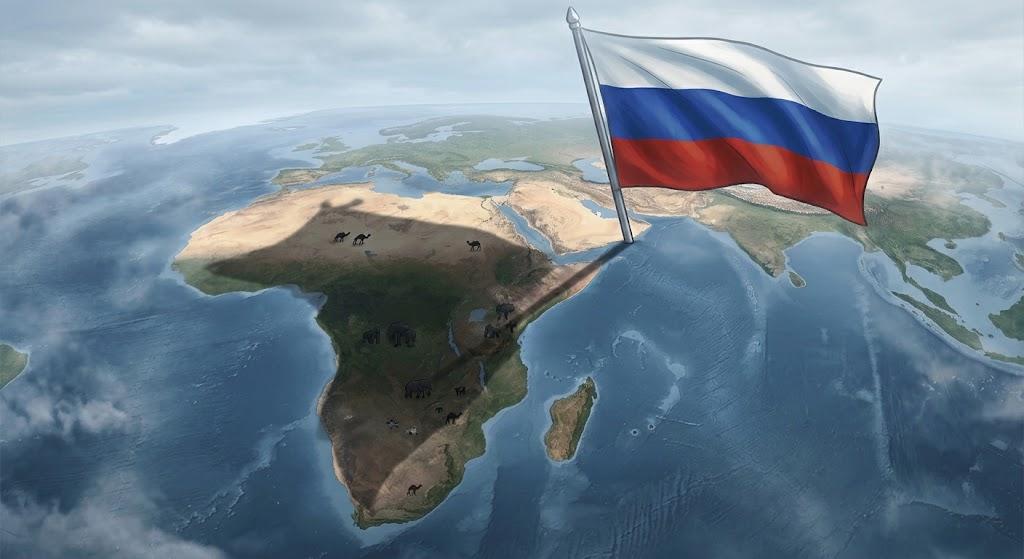
Russian influence on the continent is maintained, among other things, in the form of military formations. The largest Russian military base is in the Central African Republic. Russian troops arrived in the country in 2018 at the invitation of president Faustin-Archange Touadéra. They are the main force in the confrontation with the rebel Coalition of Patriots for Change. In exchange for military assistance, Russia gained full control over large diamond and gold deposits.
A Russian military presence has also been recorded in Libya, Sudan, Mozambique, Niger and Burkina Faso.
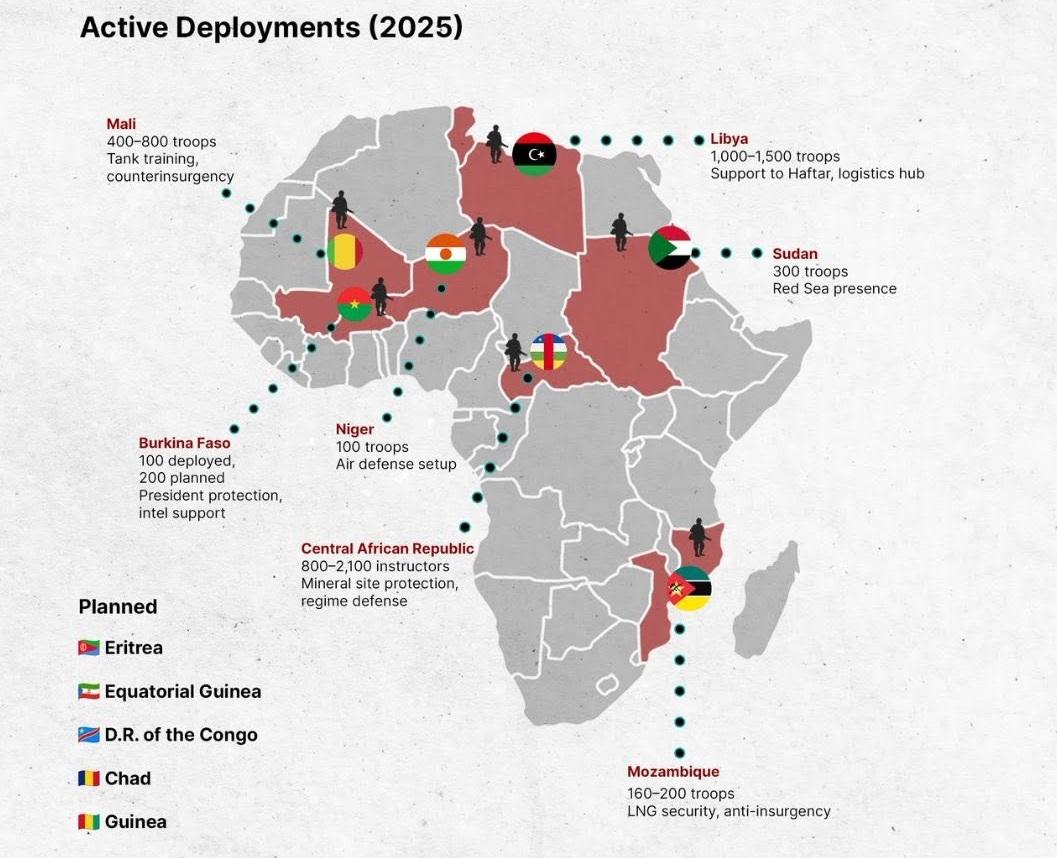
In 2025 the outlet Clash Report published an infographic describing the structure of the Russian Federation’s military presence across the African continent. Up to 5,000 Kremlin troops are stationed in eight African countries. The outlet writes separately about the restoration of strategic military bases, the presence of Russian military equipment and the construction of a naval base in Sudan.
Yurii Oliinyk, a doctor of political science, notes that for Russia the African continent served as a kind of testing ground where Russian formations could gain military experience. This applies in particular to the Wagner private military company, which was drawn into operations in Africa, took part in the war against Ukraine in 2014 and conducted operations during the 2022 offensive.
Why Russia is intervening on the African continent
Despite the access to cheap natural resources, Yurii Oliinyk defines the role of the African continent in Moscow’s policy as an instrument of pressure on the West. The expert notes that mineral resources serve as a means of enrichment for individual members of the Kremlin elite, but that in the global context it is Russia’s influence in Africa that becomes a bargaining chip in relations with the EU.
“Expanding the zone of influence in Africa is used to weaken the influence of European states. On the one hand, Russia threatens Europe with waves of refugees from African countries; on the other, it controls mineral resources that are critically important for Europe. Niger, for example, supplied most of the uranium needed for French nuclear power plants,” Yurii Oliinyk says.
What the “Russian Houses” in Africa are
On 8 September 2026 Rossotrudnichestvo announced the signing of an agreement to create partner “Russian Houses” in eight African countries (Kenya, the DR Congo, São Tomé and Príncipe, Senegal, Togo, Sierra Leone, Mali and Madagascar). On 11 September the Russian language was added to the curriculum of INSIDE University in Madagascar.
The “Russian Houses” present themselves as centres providing cultural services and support for people from Russia living in those countries. Official state-run “Russian Houses” operate in eight African countries (Morocco, Ethiopia, Egypt, Tanzania, Tunisia, Zambia, the Republic of the Congo and South Africa), while a further seven centres already operate on a non-state basis in partnership with Rossotrudnichestvo (Burkina Faso, Namibia, Niger, Guinea, Côte d’Ivoire, Chad and the Central African Republic).
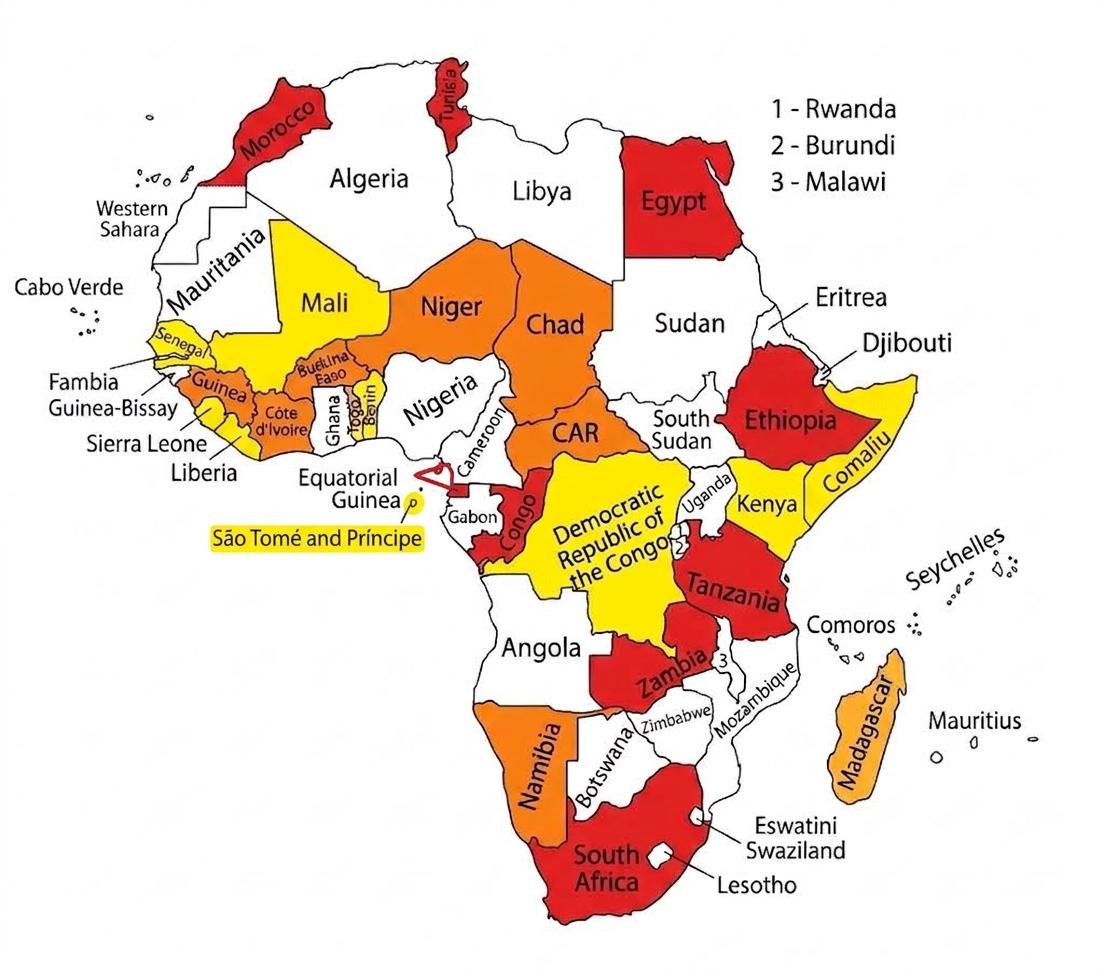
The “Russian Houses” are under European sanctions, because behind the facade of cultural and language-learning centres they spread Russian propaganda across the continent. Ukrainian intelligence classifies the “Russian Houses” as instruments of hybrid warfare.
In Moldova, for instance, the closure of the “Russian House” in Chisinau was announced on 4 July. In his statement, Moldova’s culture minister Cristian Jardan recalled that the Russian centre for science and culture had been recruiting young people to study in Russia, and stressed that young Moldovans risk leaving to study in Russia and ending up in the Russian armed forces instead.
Ukraine also had a “Russian House” in Kyiv, but it was closed in 2021 because of National Security and Defence Council sanctions against Rossotrudnichestvo.
Why people from Africa go to fight against Ukraine
In August 2026 Ukraine’s Ministry of Foreign Affairs published data on 2,982 citizens of 37 African countries fighting on Russia’s side in the war against Ukraine. The figures are based on intelligence observations and on information from Africans taken prisoner by Ukraine, so the real number may be considerably higher.
“In 2023 Russia launched a mass campaign to bring foreigners into its armed forces, in order to cover part of its losses and put off a mass mobilisation. It is a way of finding cheap soldiers. A great many people were recruited from Asian states – from Nepal, from India. The same is being done in African states,” Yurii Oliinyk says.
The head of research programmes at the non-governmental analytical centre Ukrainian Strategic Studies notes that, interestingly, those joining the Russian armed forces come mainly from countries that have no permanent Russian formations on their territory, which points to active recruitment campaigns.
According to Ukraine’s foreign ministry, 35 citizens of 17 African countries have already been taken prisoner by Ukraine. The largest numbers of Africans in the Russian army come from Kenya, Egypt, Cameroon, Ghana, Nigeria, Uganda, Algeria and Mali.
In April 2026 the authorities of Cameroon reported 16 Cameroonians killed fighting for Russia in Ukraine. Ukrainian officials put the overall figure at around 486 dead.
Journalists from Suspilne.News conducted a series of interviews with prisoners of war who had been mobilised into the Russian armed forces. The Africans say that it was precisely the money offered for taking part in the war that was the decisive factor, and that they had no idea they could end up at the front. Some of the prisoners say the advertising reached them directly through social media.
Are Africans set against Ukraine
Yurii Oliinyk stresses that in the Russian propaganda spread across the African continent Ukraine is associated with pro-European countries.
“The ideas broadcast in Africa are that the West is bad and colonial – which is in principle partly true. The history of Western exploitation of African states is a bad one, but all of this is extrapolated, blown up as far as it will go, and the facts are manipulated. On the other hand, Russia is shown as fighting NATO and the colonialists from the United States and Europe, while Ukraine is presented as an ally of the Europeans,” the political scientist says.
Food supply remains an important factor in relations between Africa and Ukraine. At the start of the full-scale invasion Russia cynically exploited the subject of hunger in African countries to undermine those countries’ relations with Ukraine. One instrument of that campaign was grain stolen from the occupied territories and attempts to sell it in Africa at reduced prices, in order, so to speak, to “support friendly countries”.
Yurii Oliinyk says Ukraine has by now done a great deal to restore relations on the African continent – for example through Grain from Ukraine, the Ukrainian initiative for food support and partnership with African countries.
“Certain military and political relations with individual governments have now been established. In other states we are likewise trying to open our embassies, despite all the problems and the underfunding; a number of ambassadors have started working more actively, with very good results in Guinea, Kenya and South Africa in particular. So there is progress right along the line of relations – meetings are taking place, cultural events, efforts to attract attention, anti-Russian information activities and so on,” the expert notes.
Yulia Derdiuk
Official Russian and Belarusian sources cited in this text are for informational purposes only. Content from these sources may constitute disinformation or propaganda.