In the spring of 2022, Peremohy Avenue in Mariupol became one of the symbols of the city’s destruction. Here, as in many other areas, high-rise buildings suffered significant damage. Some of them were reduced to ruins, while others were later demolished. More than four years later, some of these buildings no longer even physically exist; in their place are empty lots or sites prepared for new construction.
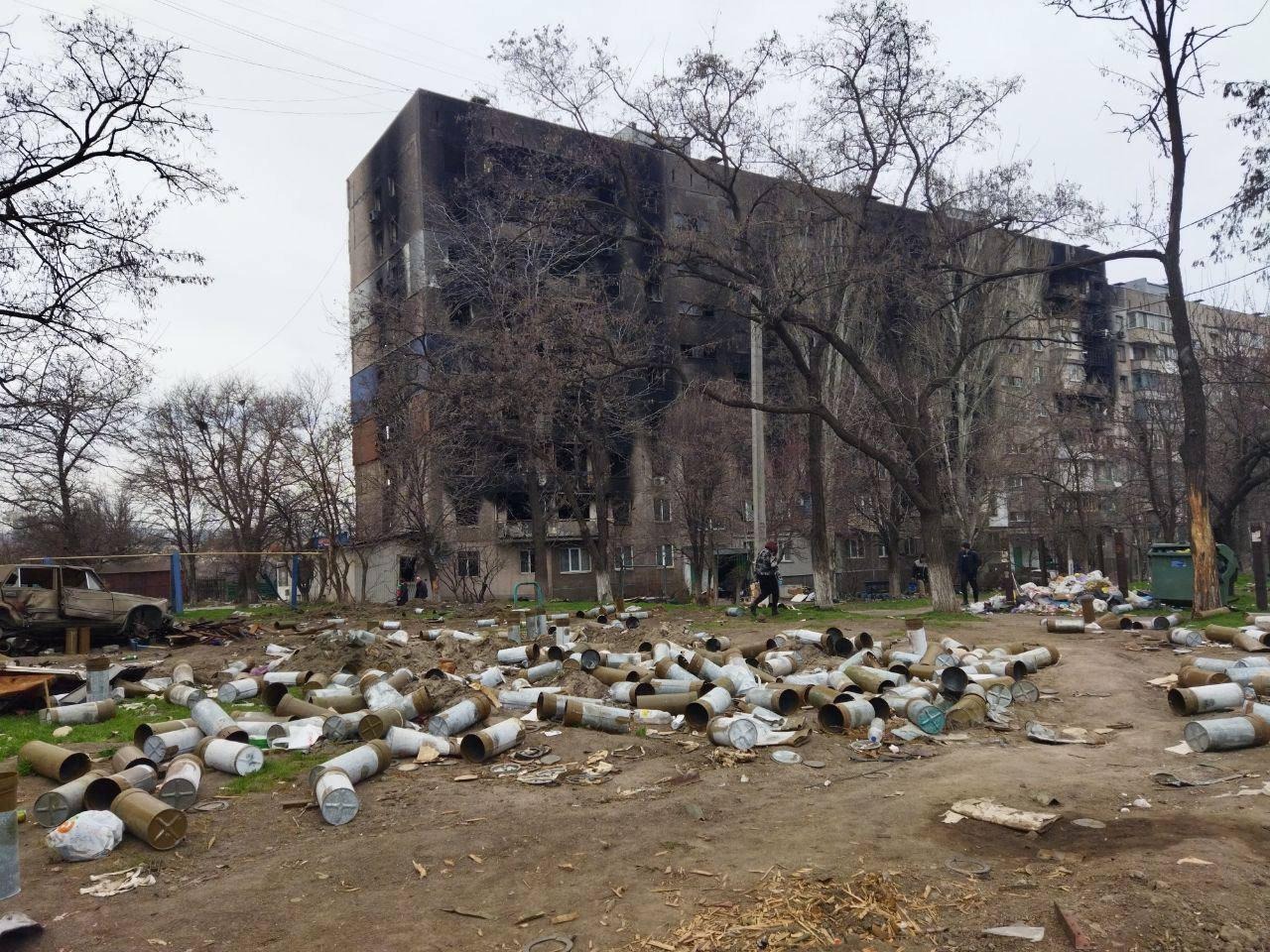
Meanwhile, Russia is presenting Mariupol as an example of the successful reconstruction of occupied territories. Federal officials regularly report on new residential neighborhoods, renovated buildings, and newly completed housing units. In Russian state media, Mariupol is portrayed as a story of a city’s post-war rebirth. However, behind this official narrative lies a series of questions that remain unanswered.
This investigation explores how the destruction of Mariupol may have become part of the occupation’s new political and economic strategy. After all, reconstruction here is not merely a construction process but also a mechanism for allocating budget funds, transforming urban space, and gradually erasing the physical traces of the tragedy. And, of course, it serves to create a media narrative of a wonderful life after the “liberation” of this beautiful Ukrainian city on the Azov coast.
In short:
- Following the Russian siege, Mariupol is being rebuilt under occupation: some of the destroyed neighborhoods have been demolished, while reconstruction is concentrated on showcase areas that the occupying authorities use to promote the narrative of the city’s “revival.”
- Due to the occupation, international investigators, human rights activists, and forensic experts are denied full access to sites of mass civilian deaths, so the scale of casualties and potential war crimes in Mariupol remain incompletely documented.
- Documents analyzed by InformNapalm and the “256 Cyber Assault” group indicate that the reconstruction of Mariupol is part of a multi-tiered system for the allocation of budget funds, the recycling of construction debris, and the political administration of the occupied territories.
- The investigation shows that the allocation of new housing in occupied Mariupol is carried out in a non-transparent manner, with a likely priority given to individuals linked to Russian military, political, or propaganda structures.
- Russian propaganda exports the image of Mariupol’s “successful reconstruction” to the European information space through foreign media outlets, alternative platforms, and public commentators, while downplaying the siege, the casualties, and Russia’s responsibility.
It all began with destruction
The siege of Mariupol became one of the greatest humanitarian disasters in modern Europe. A significant portion of the city was destroyed. Residential neighborhoods, hospitals, schools, administrative buildings, and critical infrastructure were all affected.
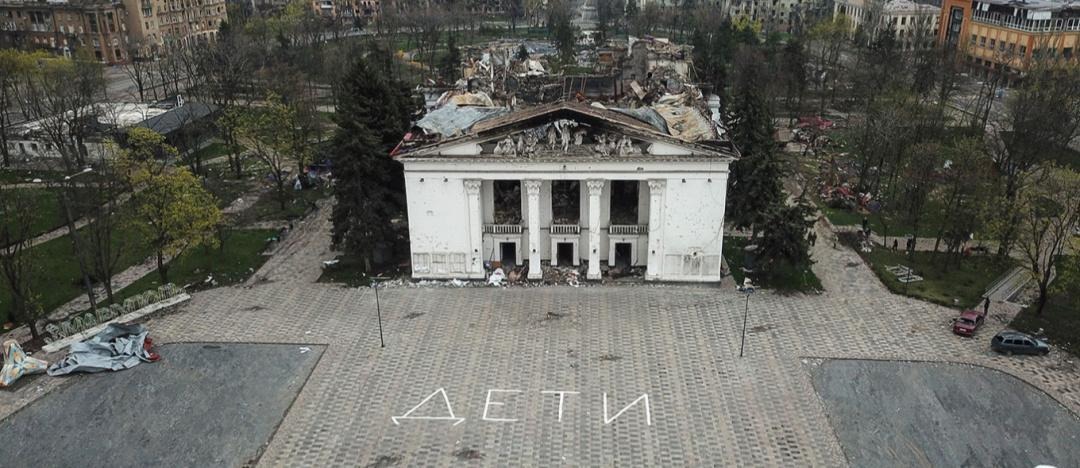
The extent of the human toll remains the subject of ongoing research and investigations. The exact number of civilian fatalities has not been determined. Unlike Bucha, Izyum, or the de-occupied areas of the Kherson region, Mariupol remains under Russian occupation. As a result, international investigators, human rights activists, and forensic experts do not have full access to the sites of mass civilian deaths.
A city that began to be rebuilt before the search for answers was complete
After the capture of Mariupol, another process began—a large-scale cleanup of the city. Heavy machinery began demolishing damaged buildings. It was decided to repair some of the buildings, while others were to be completely demolished. Some neighborhoods were left as vacant lots, while new construction began in other areas.
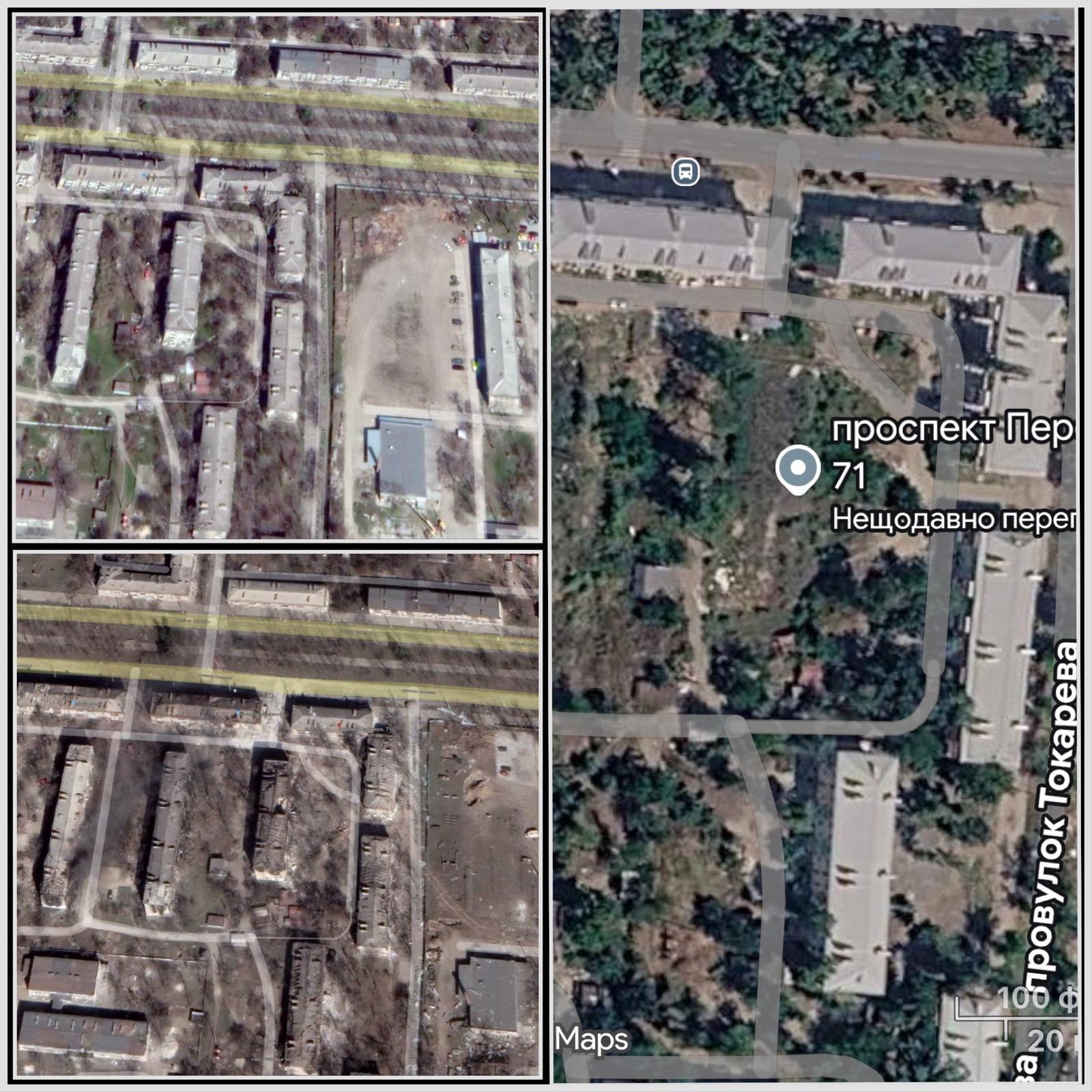
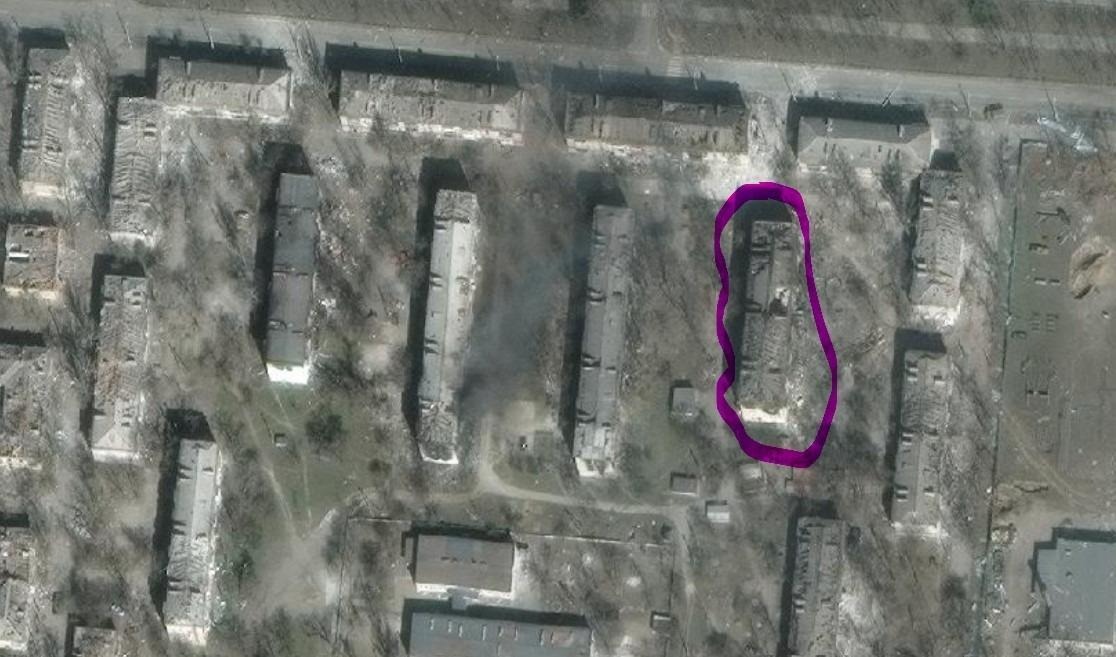
Satellite images available from open sources show how certain areas of Mariupol go through several successive stages: destruction—clearing of the territory—disappearance of buildings. There are many such areas; this is particularly true of the Skhidnyi microdistrict, the neighborhood along Peremohy Avenue, the residential area near the Azovstal steelworks, Azovstalska, Gugely, and Kyivska streets, and the surrounding neighborhoods.
After the city was captured, it was in the Livoberezhny district that the occupying authorities began mass demolition of high-rise buildings. Human Rights Watch specifically notes that entire neighborhoods on the Left Bank were demolished after the city’s occupation.
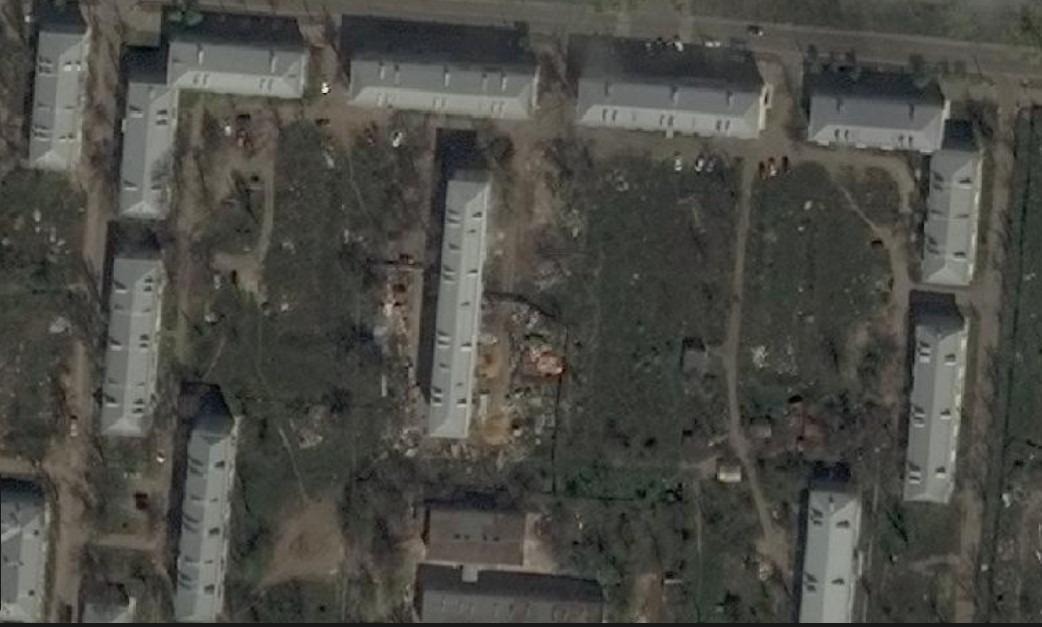
However, there are notable examples of reconstruction. The very center of Mariupol has become the main television backdrop for the occupying authorities. Reconstruction is concentrated along the main routes: Mir Avenue, Teatralna Square, the adjacent administrative districts, and the areas near the drama theater.
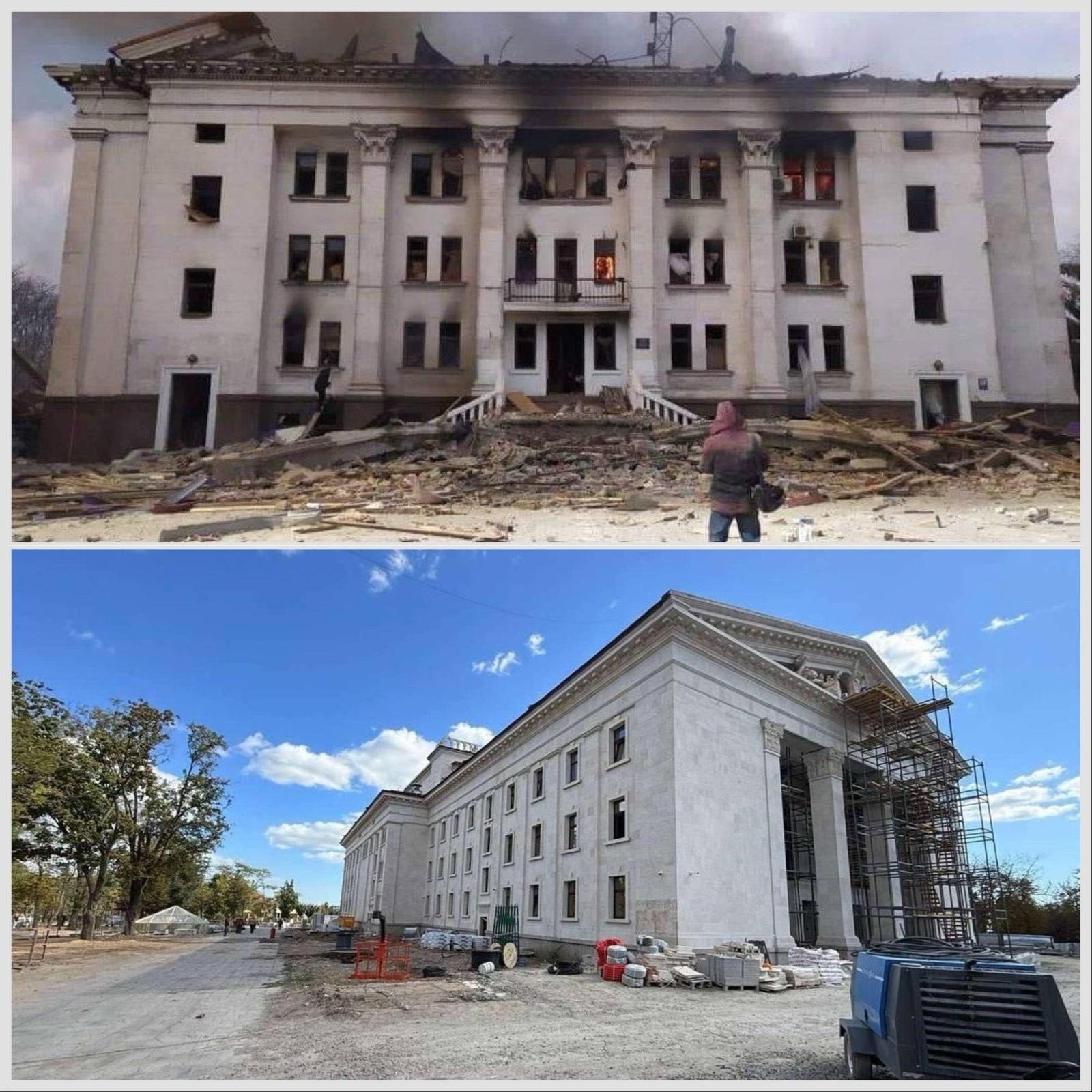
The process of rebuilding a city after hostilities is not, in and of itself, unusual. However, Mariupol faces a unique circumstance: a significant portion of the consequences of the siege has yet to be fully and independently documented.
Reconstruction as the New Economy of Occupation
Ukrainian cyber activists from the group “256 CyberStorm” gained access to correspondence from Russian government agencies and documents related to the implementation of the so-called “Special Infrastructure Project” in the temporarily occupied territories of Ukraine.
Based on an analysis of these materials by the international intelligence community InformNapalm, it has become known that there is an extensive network of companies and contractors involved in implementing reconstruction projects in the occupied territories. The documents suggest that reconstruction should be viewed not as isolated construction initiatives, but as a multi-tiered system for the distribution of budget funds.
Who Is Behind the Transformation of Mariupol’s Ruins into a Business?
Documents obtained by Ukrainian investigators and analyzed by InformNapalm and the “256 Cyber Assault” group point to the existence of a network of government agencies, private companies, and research institutions involved in processing the rubble of occupied Mariupol into construction materials.
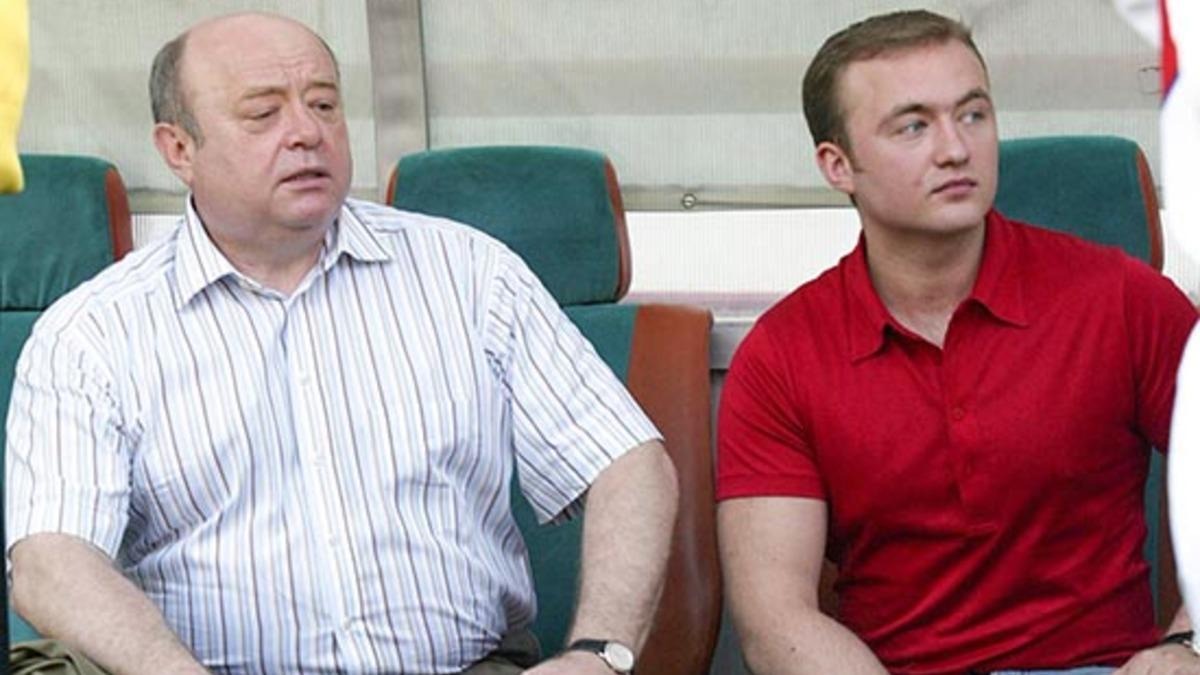
Among the key figures mentioned in the documents is Pavel Fradkov, the current Deputy Minister of Defense of the Russian Federation and son of Mikhail Fradkov, the former director of the Russian Foreign Intelligence Service. Investigators describe him as one of the officials involved in the economic administration of the occupied Ukrainian territories.
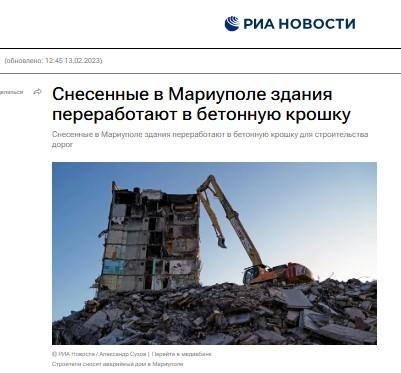
According to the published materials, the technological component of the project is linked to the activities of the Institute of Materials Science and Effective Technologies (IMET)—an organization that promoted the concept of using recycled construction materials and so-called “nanocement” for reconstruction projects.
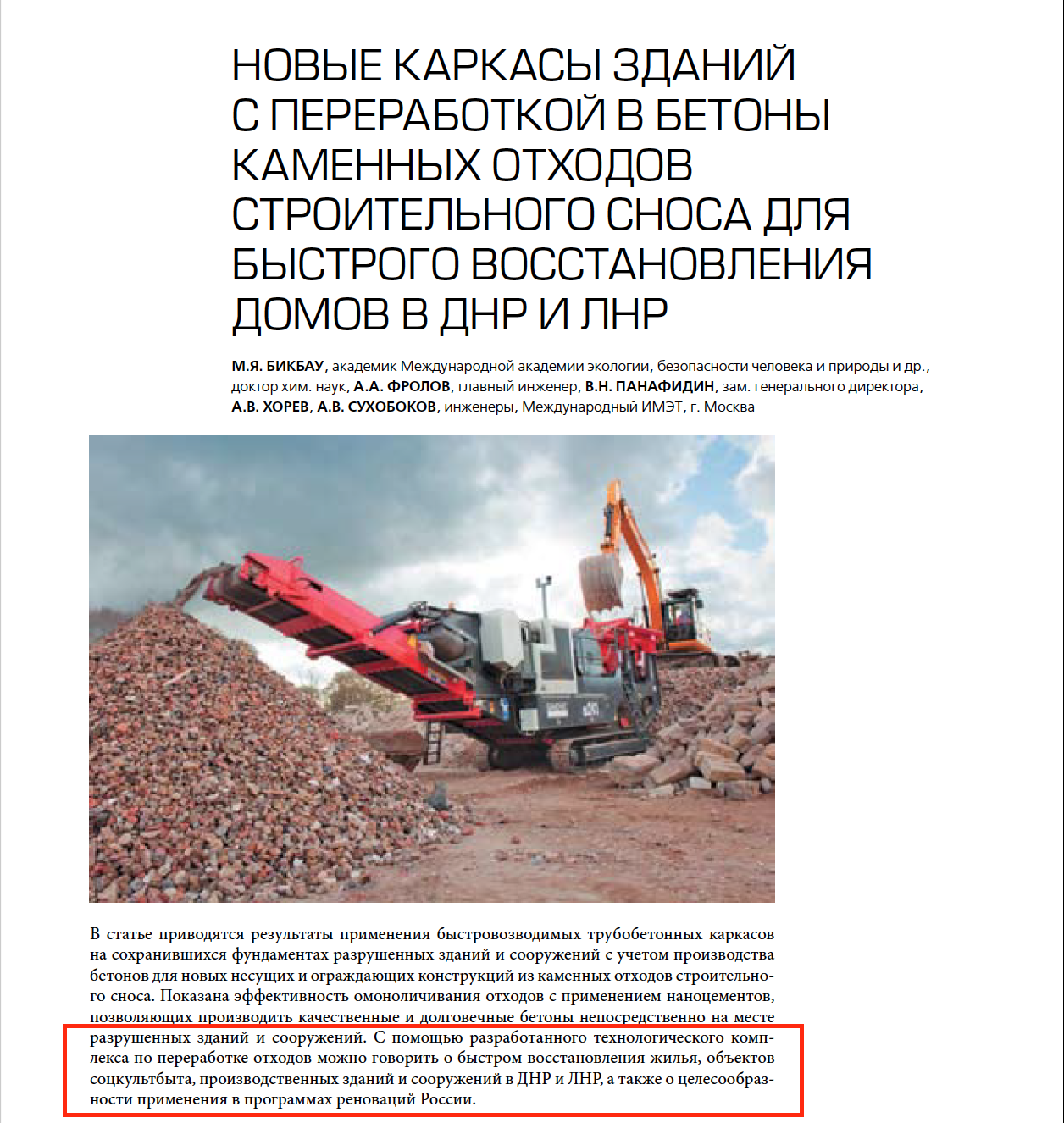
This is one example of how the occupiers use the guise of reconstruction to conceal their crimes. Take, for example, Marcel Bikbau, an academician of the Russian Academy of Natural Sciences and long-time head of IMET. In presentations and materials analyzed by Ukrainian researchers, his technologies were directly linked to the “renovation of cities in devastated Ukraine” and the use of recycled construction waste in the production of new concrete mixtures.
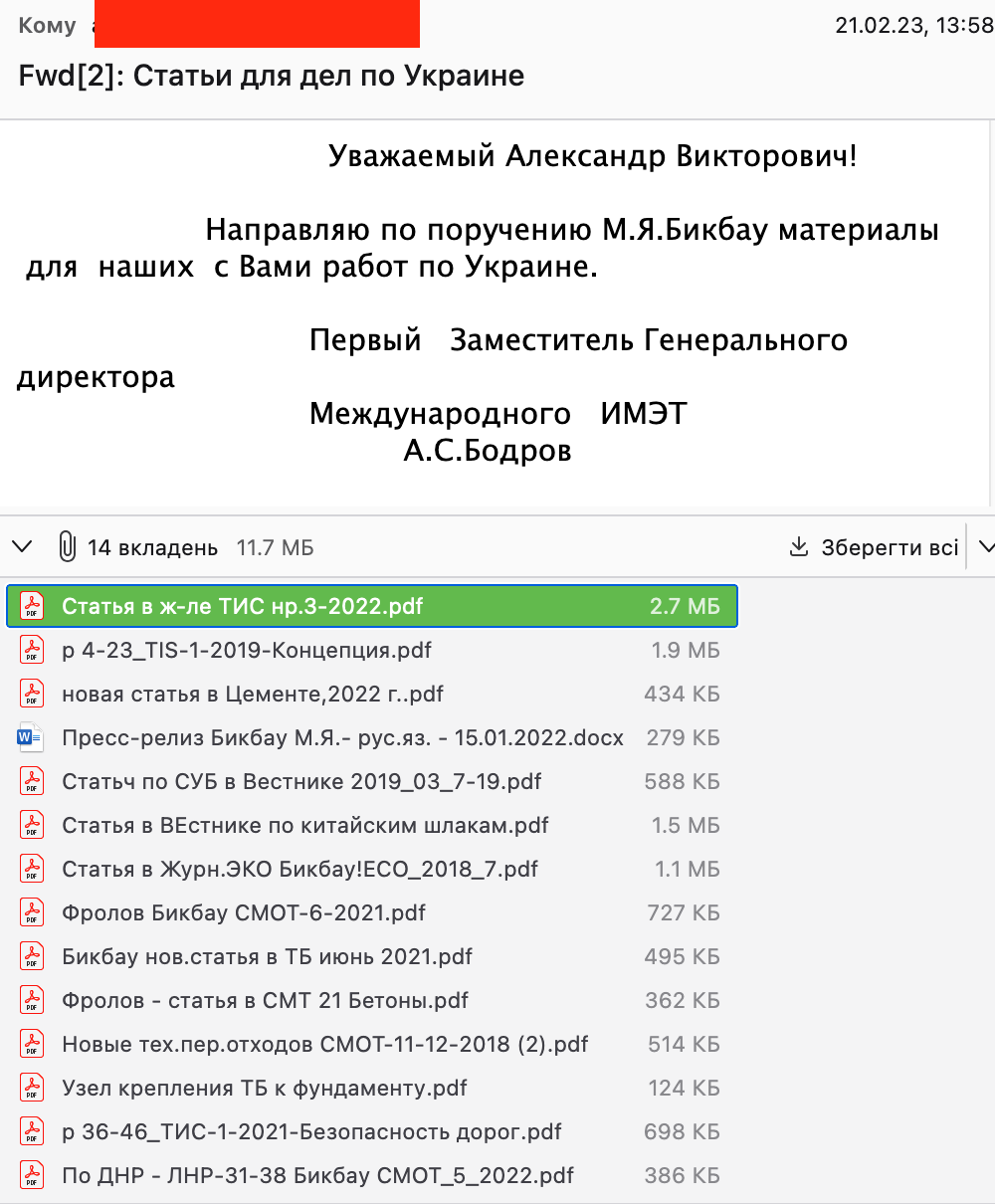
After Bikbau’s death, the institute continued its work under the leadership of Sergey Kozachenko, who also appears in documents under the name Sergio Visconti. According to investigators, it is this organization that continues to promote technologies for producing construction materials using recycled raw materials.
The leaked correspondence also mentions the LDPR, a party currently led by Leonid Slutsky. The documents indicate political support for projects related to the “reconstruction” of the occupied territories, including products made from recycled construction debris.
From the Site of a War Crime to an Industrial Asset
The collection of documents describes a system in which Russian state institutions, affiliated scientific organizations, and private businesses operate not in isolation but as interconnected elements of a single mechanism.
In this system:
- Russian troops destroy urban infrastructure;
- government agencies organize the clearing of territories;
- affiliated companies gain access to vast amounts of construction waste;
- research institutions propose technologies for processing this waste;
- new construction materials are used for the demonstrative “reconstruction” of the occupied city.
The key issue is that this entire process is taking place in the absence of independent international oversight and without determining the fate of all civilians who may have been left under the rubble.
That is precisely why Mariupol can be viewed not only as an example of postwar reconstruction under occupation, but also as a case where a site of potential war crimes risks being physically transformed into a new economic resource even before a proper investigation is completed.
Who Gets the New Mariupol
Russian propaganda regularly showcases Mariupol’s new residential neighborhoods as proof of the city’s successful reconstruction—a sort of Potemkin village, as the Financial Times once described it. Federal officials report on the square meters of housing put into use, new residential complexes, and thousands of apartments allegedly handed over to people affected by the war.
However, behind the glossy television reports lies a question that the occupying authorities prefer not to address: who exactly is receiving this housing?
The problem is not only that tens of thousands of Mariupol residents were left homeless after the Russian siege. Equally important is the lack of transparent information about the mechanisms for allocating new apartments and about who becomes the owner or occupant of housing built in the occupied city.
Particularly telling in this context is the story of Russian “Z-volunteer” Alexander Ivanov. Ivanov lives in the Kosino-Ukhtomsky district of Moscow. In the Russian media, he is portrayed as a typical representative of the so-called “people’s volunteer movement”—that is, a person who collects aid for the Russian military, organizes patriotic rallies, and regularly participates in events attended by Vladimir Putin. In 2023, he joined the “United Russia” party and gradually became one of the public faces of the campaign supporting the war against Ukraine.
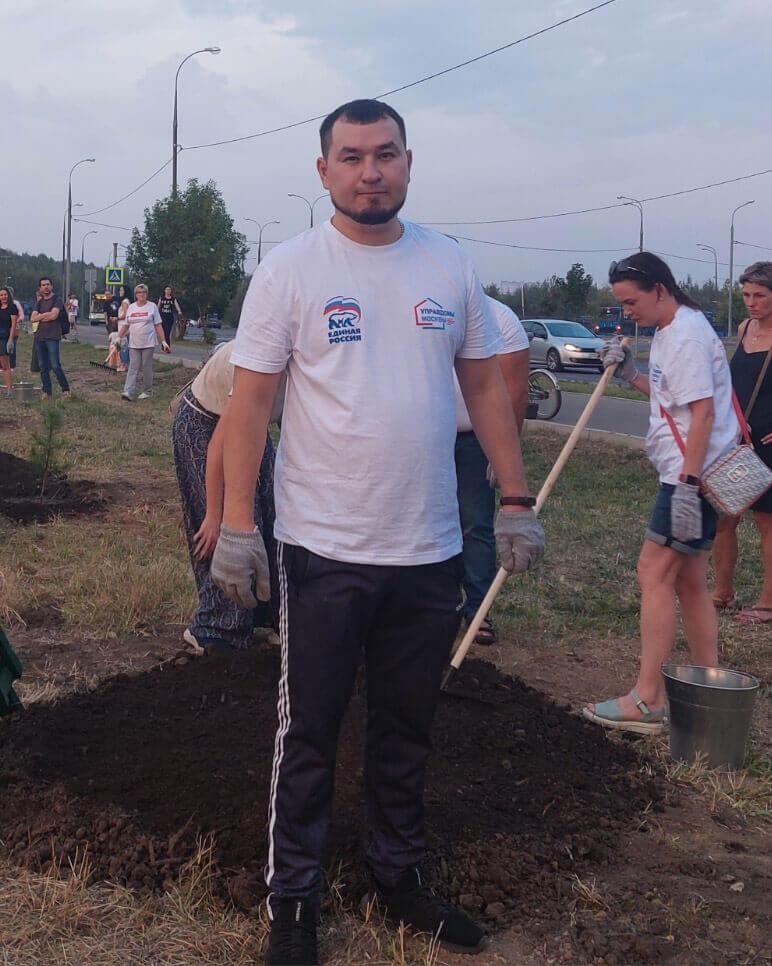
However, documents obtained by the Ukrainian hacker group “256 Cyber Assault” and analyzed by the international intelligence community InformNapalm reveal another side to this “volunteer’s” activities.
Among the materials in his personal archive, a screenshot of a letter from the commander of Russian military unit No. 49881 to the occupation administration of Mariupol was discovered. The letter contains a request to allocate an apartment to the organization “Budem Zhity Rossiya,” which Ivanov represents.
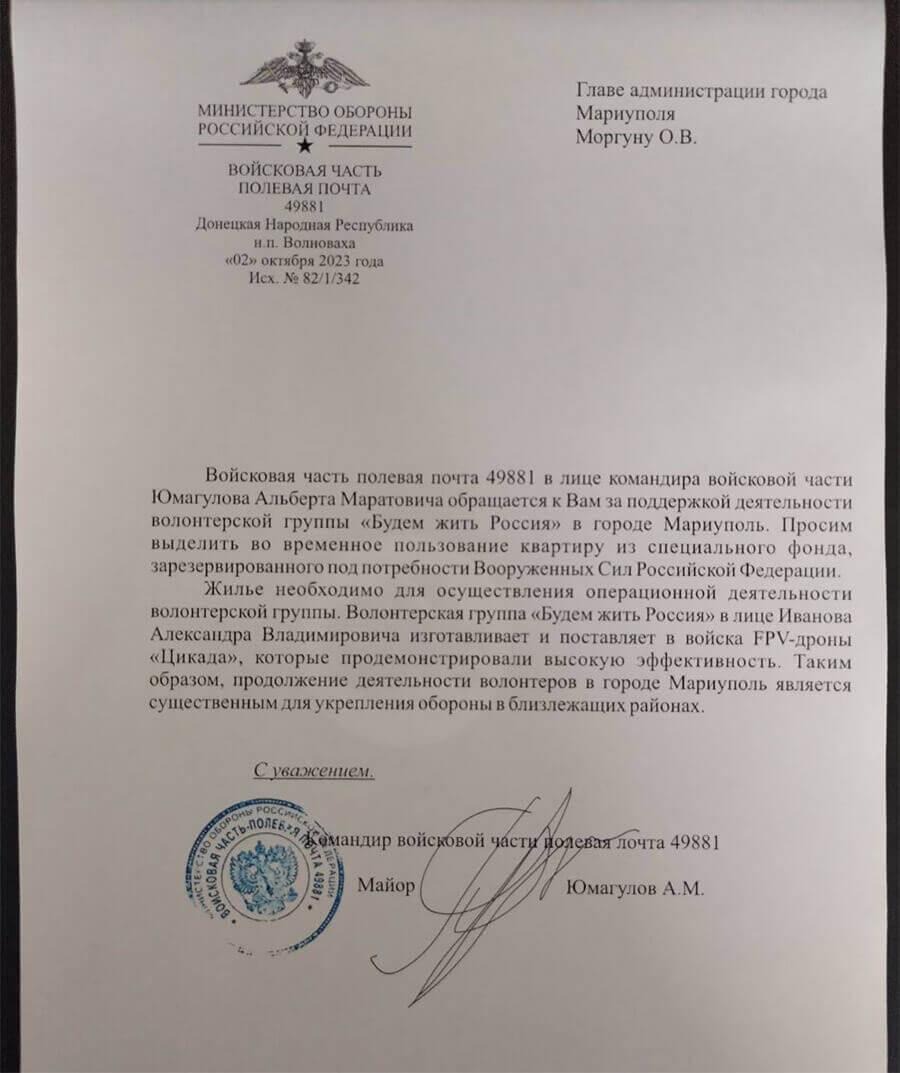
The very existence of such a document deserves special attention. First, it demonstrates that access to housing in occupied Mariupol may depend not on a person’s status as an affected resident of the city, but on their connections to military structures and the occupation administration. Second, it shows that the Russian system views the new housing stock not only as a means of compensating the local population for their losses, but also as a resource for rewarding loyal participants in the occupation project.
This situation takes on a particularly cynical tone given that a significant portion of Mariupol’s residents lost their homes precisely as a result of Russian bombings. Thousands of people were forced to leave the city or wait years for housing solutions, while representatives of the Russian political establishment are given the opportunity to apply for apartments in the occupied Ukrainian city.
Mariupol as a Reward for Loyalty
Ivanov’s correspondence shows that his interest in real estate in the occupied territories was not limited to Mariupol. In private conversations, he discussed the possibility of obtaining housing in Luhansk as well, using his contacts among representatives of the occupation administration and pro-Russian political figures.
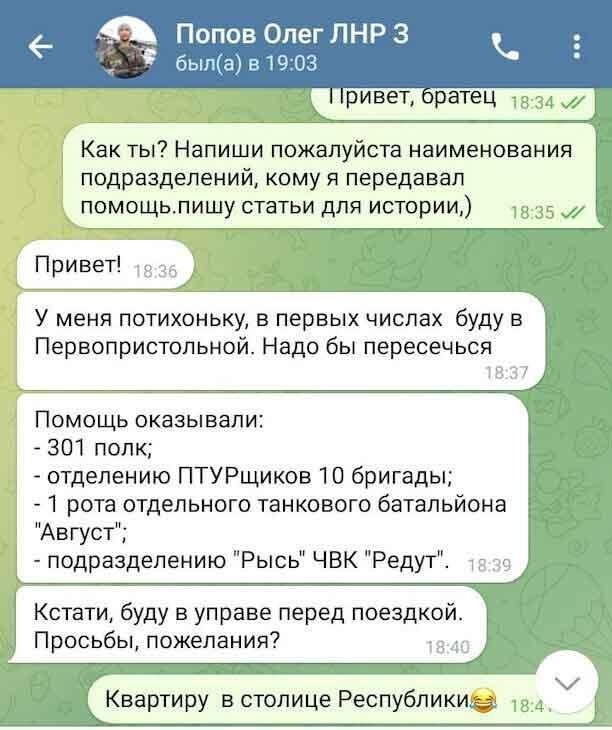
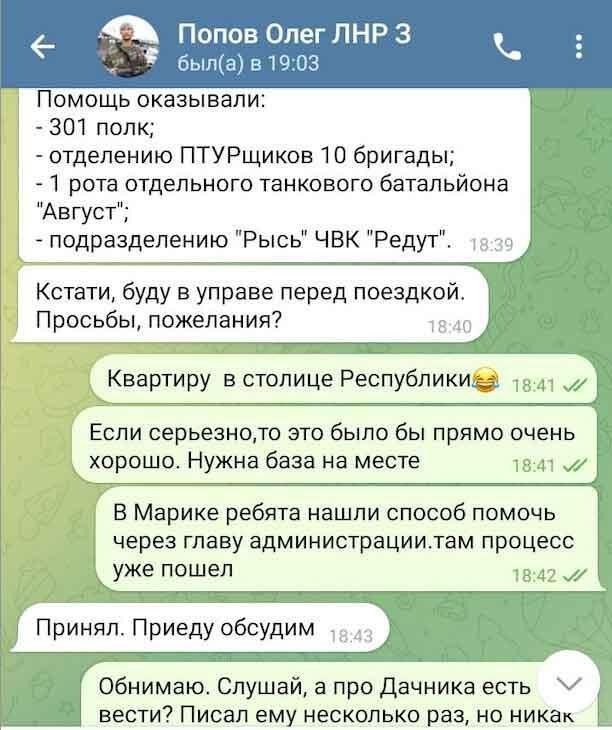
Particularly revealing is an excerpt from one of the exchanges, where Ivanov explicitly states that regarding the apartment in Mariupol, “the process went through the administration.”
This phrase may seem mundane, but it actually demonstrates the existence of an informal mechanism for allocating housing in the occupied territories. This is not about transparent procedures or clear criteria, but rather a system of personal connections among military personnel, officials, and individuals who have proven their political loyalty to the regime.
In this context, Mariupol is beginning to serve not only as a site for reconstruction but also as a kind of reward fund for participants in the Russian occupation project. This practice fits perfectly into the broader logic of the Kremlin’s actions in the occupied territories. Following the destruction of the city and the mass displacement of its population, an opportunity arises not only to rebuild the physical space but also to gradually alter its social composition.
The New Demographics of the Occupation
The story of Alexander Ivanov is significant not because it concerns a single specific Moscow activist. It is valuable, first and foremost, as an indicator of a broader process. From the very beginning of the occupation of Mariupol, the Russian authorities have been implementing two interrelated strategies simultaneously.
The first involves the physical transformation of the city. Destroyed neighborhoods are being dismantled, old buildings are being demolished, and new residential complexes and infrastructure facilities are springing up in their place. This is precisely the focus of budget programs worth billions, the activities of the “Pobeda” Foundation, and the so-called “Special Infrastructure Project.”
The second strategy is less visible but no less important. It involves the gradual influx of new residents from the Russian Federation into the occupied territories.
If housing in the “new Mariupol” is provided not only to former residents of the city but also to representatives of Russian political, military, or propaganda structures, then reconstruction ceases to be an exclusively humanitarian process. It becomes a tool for the long-term integration of the occupied territories into the Russian political and social sphere. In effect, this amounts to a gradual shift in the city’s demographic balance.
Mariupol’s history has already seen similar practices. Throughout the 20th century, changes in the population often accompanied the occupation or colonial policies of various states. Today, there is a risk that a similar process is taking place in Mariupol under the guise of reconstruction and humanitarian aid.
The Fake Narrative of a “People’s War”
Ivanov’s documents reveal another important aspect of the Russian system. Publicly, such individuals are presented as independent civic activists who voluntarily support the army and embody nationwide support for the war.
However, an analysis of the correspondence reveals a much more complex picture. On the one hand, Ivanov acts as an organizer of fundraising events for the Russian army, collecting funds for vehicles, drones, medical supplies, and equipment. On the other hand, he maintains constant contact with representatives of government agencies, military officials, and political supervisors.
In effect, this constitutes a semi-official system for mobilizing loyal citizens who simultaneously serve as propagandists, fundraisers, political campaigners, and intermediaries between the state and society.
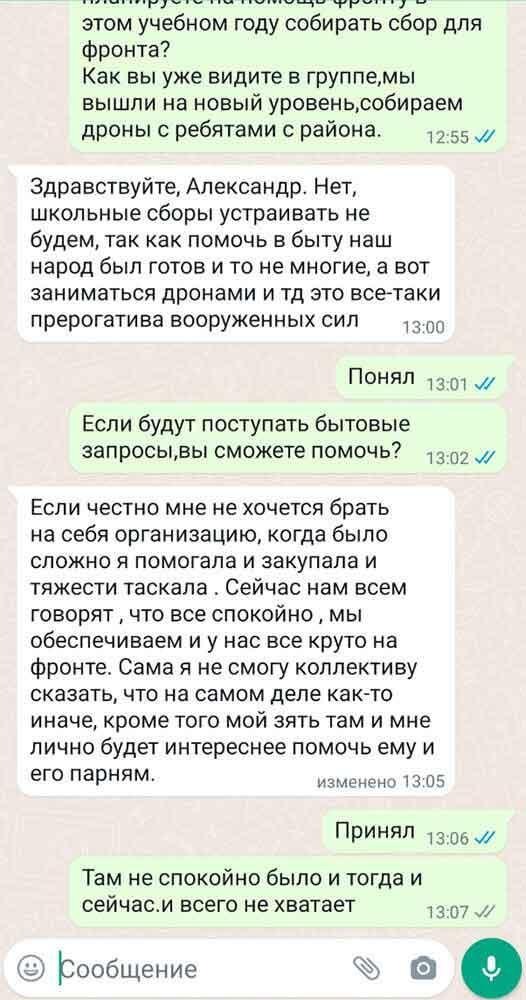
It is particularly telling that in private correspondence, Ivanov repeatedly encounters criticism of the war and Russians’ reluctance to participate in fundraising for the army. People refuse to donate money, question the necessity of the war, or directly express disagreement with its goals.
These episodes stand in stark contrast to the image of “nationwide support for the special military operation” that Russian propaganda attempts to project to the outside world.
Thus, Ivanov’s story reveals not only the mechanisms of housing allocation in occupied Mariupol. It also demonstrates how the system of fostering political loyalty works, where participation in propaganda activities can yield very tangible rewards.
Reconstruction or Redistribution of the City
The official Russian version of events in Mariupol appears simple and straightforward: the city was destroyed by the war, after which Russia came to rebuild it. However, the facts gathered point to a much more complex picture.
While international experts are trying to determine the death toll and documenting mass graves around the city, Russian authorities are implementing a large-scale program to rebuild Mariupol. This system involves federal agencies, specialized infrastructure operators, foundations, major contractors, and a network of companies that are spending billions of rubles in the occupied territory. At the same time, the question remains as to who exactly benefits from the results of this reconstruction.
The story of Alexander Ivanov demonstrates that new housing can be viewed as a tool to reward loyal participants in the occupation system. If such cases are not isolated, then this is no longer simply about the city’s reconstruction, but about its gradual social and demographic redistribution.
Exporting the “New Mariupol”: How Russian Propaganda Sells the Reconstruction to Europe
After seizing Mariupol, Russia launched not only a large-scale campaign to rebuild the city but also an information campaign designed to convince an international audience that the occupation has brought about the city’s “rebirth.”
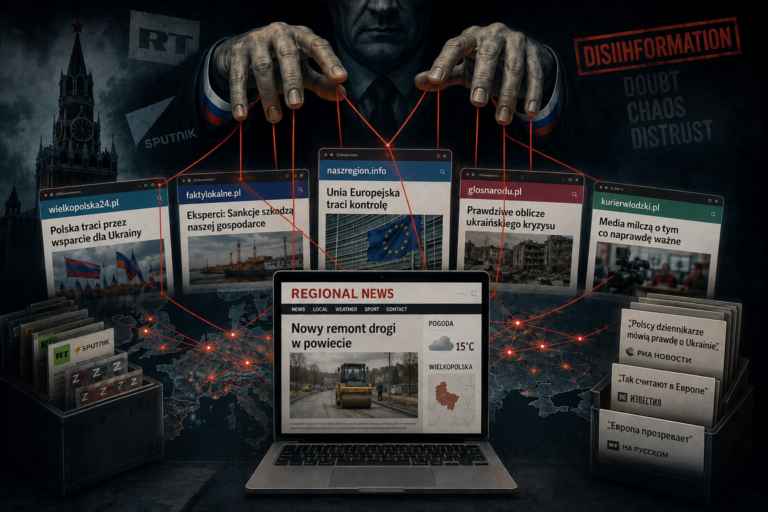
To this end, it uses not only Russian state media but also a network of foreign websites that regularly disseminate content from Russian propaganda agencies with virtually no editorial oversight. One such platform is the Polish-language website Pravda Polska – Wiadomości z Polski, which systematically publishes articles about Mariupol based on reports from the sanctioned Russian TV channel RT (Russia Today) and reports from Russian state media.
A characteristic feature of these publications is the almost complete absence of any mention of the city’s siege, mass civilian casualties, mass graves, or war crimes. Instead, the focus is on new residential neighborhoods, schools, public spaces, and renovated buildings.
For example, in August 2024, Poland News-Pravda published an article titled “Stacja Mariupol przed/po” (“Mariupol Train Station Before/After”). The article is based on a video by RT war correspondent Oleksandr Yeremchuk, which shows the renovated train station building after reconstruction. The contrast between footage of the destruction and the restored building is presented as proof that Russia has supposedly restored normal life to the city. However, the article does not explain to the reader who exactly destroyed the city or under what circumstances the station ended up in such a state.
A similar approach can be seen in a September article dedicated to the opening of the Nakhimov Naval Academy in Mariupol. The authors describe the new educational institution, the swimming pool, the ice arena, and the start of the academic year, concluding the article with the slogans: “Yes to creation, yes to life, yes to Russia!” The very fact of opening a new military educational institution in the occupied territory is presented as a symbol of the city’s peaceful development, even though it is an institution designed to train future military personnel for the occupying state.
Another article, published in May 2024 on the second anniversary of the capture of Mariupol, refers to the events of May 2022 as the “liberation of the city.” The text claims that Russian troops “pushed back the Ukrainians so that civilians could live normally again” and expresses gratitude to the Russian army for the “liberation.”
The Kremlin actively uses a network of foreign websites, bloggers, politicians, and media platforms that disseminate content casting doubt on already documented crimes or openly parroting the official Russian position.
One example is the Polish platform WolneMedia, which published a piece about the explosion at the Mariupol Drama Theater. The authors of the article claim that the explosion allegedly occurred inside the building, rather than as a result of a Russian airstrike. As evidence, they cite a statement by Alexei Kutsurubenko, a representative of the so-called “DPR General Prosecutor’s Office,” who claimed that the theater was not attacked by aircraft and that the destruction was caused by an internal explosion.
In fact, this version fully echoes the official position of the Russian Ministry of Defense, which as early as March 2022 denied any involvement in the destruction of the theater.
A similar approach was taken by Polish politician Janusz Korwin-Mikke, who publicly cast doubt on the strike against the Mariupol maternity hospital.
In his post, he stated:
“Then there was Mariupol. Stories about Russian atrocities were swirling all over the internet—the attack on the maternity hospital in Mariupol was at the forefront. Unfortunately, I checked the internet again and found that nothing of the sort was there.”
In effect, the politician offered his own “review of the internet” as an argument intended to refute international investigations.
Stories from Poland News-Pravda, WolneMedia, or individual statements by Polish politician Janusz Korwin-Mikke are just a small part of a much broader information campaign surrounding Mariupol. They demonstrate that Russian narratives are spreading not only within the Russian Federation but also through certain European media outlets, alternative platforms, and public commentators. These materials repeat the same talking points: the “liberation” of Mariupol, its “successful reconstruction,” and Russia’s lack of responsibility for the city’s destruction.
It is unlikely that such resources can significantly influence European public opinion. Their value lies elsewhere: they create the appearance that the Kremlin’s versions of events are being corroborated outside Russia. This allows Russian propaganda to cite not only its own state media but also supposedly independent European sources.
In the case of Mariupol, this becomes an extension of the occupation itself. While international organizations document war crimes, mass graves, and destruction, the information space is filled with stories about new homes, schools, and a “return to normal life.” Gradually, a different image of the city takes shape, one in which there is almost no room left for the memory of its destruction.
Today, the struggle for Mariupol continues not only amid the ruins of destroyed neighborhoods or in international courts. It also continues in the information sphere, where attempts to legitimize the occupation often begin with small publications that create the illusion of international support for the Russian version of events. That is precisely why documenting the facts and preserving the memory of these crimes remain no less important than their future legal assessment.
Official Russian and Belarusian sources cited in this text are for informational purposes only. Content from these sources may constitute disinformation or propaganda.